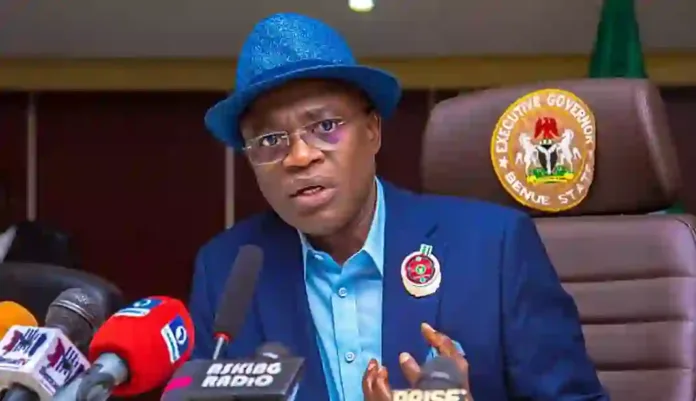
Honourable Kingsley Chinda, until recently, the Minority Leader in the House of Representatives, has emerged as the sole candidate of the All Progressives Congress, APC, Governorship Primary which holds on Thursday (Today) in Rivers State.
He was, until a couple of weeks ago, of the Peoples Democratic Party, PDD, like his boss and political godfather, Minister for the Federal Capital Territory, Nyesom Wike. But he was given a waiver by the APC when he defected to be successfully screened
Rivers state Governor, Siminalayi Fubara and Tonye Cole had announced their last minute withdrawal from the governorship primary election of the All Progressives Congress (APC).
The last minute withdrawal by the incumbent Governor and one other aspirant is seen by political observers as height of frustration being experienced by supporters of Fubara since the commencement of the APC primary election.
From the House of Representatives to the state Assembly primaries, loyalists of Fubara were being disqualified by the APC screening panel from participating in the processes, thus paving the way for supporters of the minister of the Federal Capital Territory (FCT), Nyesom Wike.
Fubara stated in his notice of withdrawal that “After deep reflection and extensive consultations with my family, friends, and associates, I have taken the difficult but necessary decision to withdraw from the APC gubernatorial primaries.
“I do so with a full heart and with a firm commitment to support whoever emerges as the candidate of our great party.
“Leadership is ultimately about sacrifice. There comes a time when personal ambition must yield to the greater good of the people.
“Rivers State is bigger than any individual, and at this critical moment, the peace, stability, and unity of our dear state must take precedence over every personal interest.
“To my supporters who stood firmly with me throughout this journey who gave their time, resources, prayers, and unwavering hope, I offer my deepest gratitude.
“I understand the disappointment, the anger, and the pain many of you may feel. Much has indeed been invested and much sacrificed along the way.
“But please know that your loyalty and trust were never in vain. My silence over this period was deliberate and strategic, guided always by the higher interest of our state and our people.
“As our elders say, not everything a hunter sees in the forest is spoken of in the marketplace. Some truths are best borne quietly, not out of fear, but out of wisdom and restraint for the sake of peace and a greater purpose.
“It is enough to say that I have faced immense pressures and difficult choices, but my love for Rivers State remains greater than anything else.
“I sincerely thank our great party, the All Progressives Congress, for the platform and support extended to me throughout this process. I also express my profound appreciation to His Excellency, President Bola Ahmed Tinubu, GCFR, for his support and encouragement.
“The APC remains our collective home, and I urge all party faithful and supporters to remain steadfast and committed as we continue to build a stronger and more united future together.
“Let it be clearly understood that I stepped aside from participating in the upcoming River’s state Gubernatorial election not out of weakness, fear, or surrender, but out of conviction and sacrifice so that Rivers State may move forward in peace and unity and I remain committed to serving the good people of Rivers state till the end of my term.”
Tonye Cole said he took the decision “in the overriding interest of party unity, peace, and collective progress, to respect the supremacy of the party and withdraw from the forthcoming primaries.
“As a committed democrat and a firm believer in the supremacy of strong institutions as the foundation for sustainable development, I have consistently advocated for dialogue, reconciliation, and unity among the various stakeholders and factions within the Rivers State chapter of our great party, the APC.
“In recent days, the national leadership of our party convened a critical stakeholders’ meeting during which far-reaching discussions were held on the future of the Rivers APC and the imperative of presenting a united front ahead of the primaries and the 2027 general elections.
“Following that meeting, and after extensive consultations with members of my political team, associates, supporters, and other key stakeholders, I have taken the decision, in the overriding interest of party unity, peace, and collective progress, to respect the supremacy of the party and withdraw from the forthcoming primaries.
“Accordingly, I wish to formally announce my withdrawal from the race and pledge my full support and cooperation to whoever emerges as the party’s candidate at the conclusion of the primaries.”
” _Ribadu is the mastermind behind my inquiries and the criticism directed at my commissioners. He aims to be president in 2031 and is intent on removing anyone he perceives as a hurdle to his ambitions” —_ Nasir El-Rufai (Arise TV, February 2025)
Could the unusual appointment of a Homeland Security Adviser be linked to the upcoming 2027 general election? Is the apprehension surrounding what Nuhu Ribadu and Nasir El-Rufai might accomplish in electoral politics behind the introduction of this local security position? Why are Ribadu and El Rufai consistently significant players, whether positively or negatively, in every electoral cycle in Nigeria? Have they found in Tinubu a formidable obstacle? Insights into these inquiries may be unearthed through our political discussions this week, as we examine the roles of these two influential individuals in our political landscape.
In football, “over-dribbling” refers to the practice of holding onto the ball for too long, repeatedly manoeuvring past a defender without making a timely pass. While this may captivate the audience, it often disrupts the team’s rhythm, limits available options, and can lead to a tackle or loss of possession. In political terms, over-dribbling equates to excessive strategising, constant manoeuvring, and indulging in endless political machinations rather than pursuing decisive actions or forming stable alliances. When discussing over-dribbling in politics in Nigeria, we can’t overlook Mallam Nasir El-Rufai and Nuhu Ribadu—two prominent figures whose intellectual ingenuity is widely recognised.
My first encounter with El-Rufai occurred in 2006 as we approached the presidential election when the late Umaru Yar’Adua was set to run in 2007, and El-Rufai was heading the media strategy for that campaign. His tireless efforts to secure Yar’Adua’s election led to his departure from the government, as the modest and reserved Yar’Adua found it difficult to accept El-Rufai’s evident overwhelming brilliance, which was apparent to all under Olusegun Obasanjo.
As for Ribadu, my initial contact occurred during the Human Rights Violation and Investigation Commission, also known as the Oputa Panel, which was established in 1999 by the Obasanjo administration to address various unresolved injustices of the time. I was a reporter covering the panel’s hearings, and Ribadu was acting as a legal representative for the Nigerian Police. He attracted significant attention not purely as a police officer but as a vocal advocate for Northern interests, often overshadowing his role as legal counsel.
Justice Chukwudifu Oputa, the panel’s chairman, alongside Rev. Fr. Matthew Kukah (now the Bishop of Sokoto), repeatedly instructed Ribadu to maintain some neutrality given his position. His fervent defence of Northern issues was overt and provocative. In time, both Ribadu and El-Rufai became integral figures in the Obasanjo administration, forming part of a close-knit “Economic Team” aimed at modernising Nigeria’s governmental framework. Their alliance hinged on a shared reputation for integrity and steadfastness.
During this era, their focus was aimed outward, targeting the old political establishment they sought to replace. The connection between El-Rufai and Ribadu exemplifies the dynamic nature of Nigerian power politics. Both men became recognised as “technocratic superstars” during the Obasanjo administration—one as the reform-minded leader of the Federal Capital Territory and the other as the determined face of the Economic and Financial Crimes Commission (EFCC). Their individual pathways and collaborations offer valuable lessons regarding the intricate nature of political manoeuvring within the corridors of power.
What followed is well-documented, but it’s important to note that the duo was so influential in the Obasanjo government that they played a significant role in deciding who would be Yar’Adua’s vice president in 2007. When Yar’Adua ultimately distanced himself from them and his successor, Goodluck Jonathan, showed little enthusiasm for their continued involvement, they entered a period of political obscurity. Ribadu aligned himself with Bola Tinubu, who welcomed him and offered him the presidential ticket for his party, the Action Congress of Nigeria (ACN), in 2011, while El-Rufai partnered with the esteemed former Head of State, Gen. Muhammadu Buhari, to provide the much-needed intellectual foundation for his political platform.
Recognising El-Rufai’s potential, an energised Buhari appointed him as the National Secretary of the Congress for Progressive Change (CPC), leading El-Rufai to strive to surpass Buhari’s previous regular 12 million electoral achievements. This collaboration culminated in the Tinubu/Buhari alliance that successfully unseated the sitting President, Goodluck Jonathan, paving the way for Buhari’s victory in 2015.
Ike Abonyi
Ambition eventually created a rift between El-Rufai and Ribadu, as anticipated; one ascended to the governorship of Kaduna State while the other faced defeat in his pursuit of the Adamawa governorship. As the 2023 elections approached, El-Rufai was strategising for a vice-presidential position with any Southern candidate except Tinubu, whom he publicly dismissed, while Ribadu maintained his loyalty to Tinubu despite widespread scepticism regarding his prospects. Yet, the outgoing President Buhari’s ambivalence kept both men in uncertainty.
Out of frustration, El-Rufai was compelled to set aside his initial objections and align with Tinubu, whose candidacy had recently gained traction due to Buhari’s indecision. By effectively collaborating with Ribadu, they were able to deliver Tinubu an impressive 8 million votes, a result that emerged late at night amid considerable surprise.
In the aftermath, Ribadu was rewarded for his loyalty, while El-Rufai faced consequences for his earlier disloyalty. While acknowledging El-Rufai’s contribution to his victory in 2023, Tinubu was also mindful of El-Rufai’s previous reservations about him, interpreting them as sincere.
This sequence of events further widened the gap between these two politically shrewd figures. El-Rufai faced disgrace during ministerial confirmation processes, while Ribadu received the appointment as National Security Adviser.
Given their pivotal roles in previous elections, both men possess invaluable insights into electoral strategies that are not readily apparent. Excluding either figure from future electoral considerations could prove detrimental.
El-Rufai’s attempt to demonstrate his influence by claiming access to the intelligence chief’s contacts has since led to his detainment, but this has not quelled the tensions he has kindled.
Tinubu, aware of the need to consolidate power—encompassing state governors, key opposition figures, the National Assembly, and the judiciary—approaches the prospect of the 2027 election with trepidation. His growing discord with Northern factions has rendered every Northern figure, particularly among the Hausa Fulani, suspect.
It is no longer feasible to depend solely on Ribadu, especially with the volatile El-Rufai now positioned outside the inner circle and visibly upset. The logical shift now lies in seeking a dependable alternative among local figures. Even if Ribadu opts for loyalty, his capability in election matters remains questionable and must be bolstered.
The current challenges faced by El-Rufai and Ribadu serve as a cautionary tale on the risks of over-dribbling, which leaves them vulnerable to counterattacks, as we now witness.
The longer a politician remains entrenched in the “ball” of political intrigue, the more exposed they become. Every unnecessary manoeuvre provides opportunities for adversaries to counter and strategise against them.
In high-risk political landscapes, over-dribbling often results in public conflicts or significant legal challenges. When a politician tries to control too many aspects of power simultaneously, they furnish their opponents with the tools needed to dismantle their position—often leveraging state mechanisms or investigative bodies to do so.”.
A political independent who chooses not to collaborate may end up distancing themselves from their supporters and political protégés, a situation currently affecting El Rufai and Ribadu’s political followers as the 2027 elections approach. At first, the public admires a political maverick like El Rufai—someone capable of outmanoeuvring the establishment and overcoming bureaucratic hurdles. However, when their elaborate strategies fail to produce tangible results or encounter a formidable opponent like Tinubu, the initial cheers may shift to discontent. The consequences of the impulsive actions taken by these two prominent political figures highlight that in politics, the most successful politicians are not necessarily those displaying intricate manoeuvring, but rather those who know when to make straightforward, impactful decisions. Just as in football, the scoreboard doesn’t measure the number of successful dribbles, but rather how many goals are scored. By now, these two have realised that the cost of political manoeuvring has led to the loss of a significant friendship for the sake of political survival. While Ribadu effectively utilises the state’s official resources, El-Rufai is pushing the boundaries of political resistance, turning their private disagreements into a public discourse on the use of state authority. The ongoing story of El-Rufai and Ribadu serves as a poignant reminder that in high-stakes politics, today’s ally can become tomorrow’s warning, and a reformist’s greatest opponent can ofte n be the system they once helped establish. God help us as we navigate all the intrigues in our political landscape.
Abonyi is an accompanying Journalist, Columnist and Media Consultant
The Chairman of First HoldCo, Femi Otedola, at once gladdened the hearts of not a few Nigerians, and took others by surprise when he disclosed that he would invest a whopping sum of $100 million.
Approximately, that sum is the equivalent of N137.2bn in Nigeria’s currency.
The family-loving Otedola announced this on Wednesday, May 20, when he led top executives of First HoldCo to Dangote refinery.
To invest in Dangote Refinery, Otedola said he sold his multi billion Naira power plant, Geregu, to raise the money. He, also, jocularly said he deserved to purchase that share having visited and toured the Refinery for 25 times.
The planned investment is part of the private placement worth $2 billion which Dangote refinery is targeting from private investors ahead of the initial public offering (IPO). There is no date yet.
Making the announcement, Otedola said: “From a personal note, I’ve appealed to him (Aliko Dangote). I’ve been here with him 25 times, so my compensation is he’s going to allocate to me shares worth $100 million in the private placement.
“That’s one of the reasons why I sold my stake in Geregu plant to come and invest my proceeds in the IPO of Dangote refinery.”
On October 22, 2025, Dangote disclosed he could sell up to 10 percent stake in the listing. That percentage by Bloomberg’s estimation is valued at $5 billion.
The IPO is billed to be a cross-border listing and would attract investments from domestic and international investors.
Dangote had earlier said that “the IPO is designed to democratise wealth creation and give Africans direct access to participate in the continent’s industrial transformation.”
Bloomberg had also noted that Dangote is aiming for a valuation of up to $50 billion for the refinery.
Before his announcement of the $100 billion investment in Dangote Refinery, money man Otedola had splashed another whopping £53 million to acquire a London luxury property.
Ned Nwoko, a Barrister-at-Law, who represents Delta North Senatorial District in the National Assembly, has alleged that former Governor, Dr. Ifeanyi Okowa, did not allow him to freely perform as a Senator. At the time Okowa was in PDP, and so was Nwoko.
Nwoko was the first to defect to the APC before Okowa and Governor Sheriff Oborevwori joined. Their defection to APC increased Nwoko’s problems, he said. He had no free hand.
In his monumental loss to Okowa for his reelection to the Senate Primaries, Woko also alleged that
aspirants for the All Progressives Congress (APC) senatorial primary in Delta State were
denied the opportunity to freely participate in the exercise.
According to him, the whole process was influenced by the state government to favour selected aspirants.
A report by Arise News quoted Nwoko as saying that the process was designed in a way that weakened internal party democracy and created advantages for preferred candidates during the exercise.
He maintained that the conduct of the primaries did not reflect a level playing field for all participants involved in the senatorial contest.
The lawmaker described the exercise as one that raised questions regarding fairness and openness within the party’s internal electoral procedures.
He noted that the process generated dissatisfaction among some participants who expected a more transparent method of selecting candidates for the senatorial race.
Nwoko maintained that the exercise lacked the transparency required for credible internal party elections, and this, in his view, affected the confidence of participants in the outcome.
He emphasized that internal democracy within political parties should be protected to ensure fairness and inclusion.
Nwoko also explained the circumstances that led to his departure from the Peoples Democratic Party (PDP), stating that his decision was influenced by limitations he experienced while serving as a senator under the party.
He claimed that he was unable to operate freely due to interference in political and legislative activities, which affected his ability to effectively carry out his responsibilities.
He added that the interference extended to decision-making processes and constituency-related projects, which he said were often influenced by the state leadership.
The senator maintained that such restrictions created an environment where independent representation was difficult, prompting his eventual political realignment.
He stressed that elected representatives should be allowed to function without undue interference from party or state structures.
The lawmaker reiterated that the situation in both the PDP and the recent APC primaries reflected broader concerns about internal party control and political influence in Delta State.
He maintained that these issues continue to affect democratic processes within party structures and the selection of candidates for elective positions.
“I was in PDP. I got elected as a PDP Senator. But I realized that my people there—the Governor, Okowa himself—you know, didn’t allow me to operate freely.”
The Central Bank of Nigeria, CBN has promised that inflation will return to existing level in the country as soon as possible, blaming external factors for the rising cost of commodities and goods in the country.
CBN governor, Olayemi Cardoso made this known on Wednesday at the Monetary Policy Committee, MPC, meeting held in Abuja, the nation’s capital after the Committee’s decision to retain the Interest rate at 26.5 percent. The committee is the authority that regulates the benchmark interests rates in the country, and it’s made up of 11 members including the CBN governor who chairs it.
Cardoso while speaking to journalist after the meeting yesterday said all the members agreed on the decision to retain the old interest rate, set by the bank last month.
The development comes amid the rising cost of commodities in the country. The last time the interest rate was set, the inflation rate, according to the National Bureau of Statistics, NBS was 15.06, it has now moved up slightly to 15.38 amid fear that it can possibly move upward due to the war in the Middle east which has caused global rate inflation to spiral.
Due to the war, energy cost has ballooned globally, a situation that has had serious impact on other economic sectors, according to experts.
But Cardoso said the current situation is a temporary one that will fizzle out, insisting that the macro-economic policies in the country will reset the trend.
According to Cardoso, the MPC also agreed to retain other benchmarks including the Cash Reserve ratio, CRR for commercial banks at 45 percent.
He stressed that the impact of the global economic shock caused by the Middle east war has had insignificant impacts on the nation’s economy compared to pressures facing other economies.
“However, indications are that the impact of the crisis on the Nigerian economy has been minimal due to the benefits of prior policy reforms,” Cardoso stated, saying the CBN monetary policy has ensured that the impact on the Nigerian economy has been “mitigated.”
“These include exchange rate stability, improvements in external reserve buffers, strengthened monetary policy transmission, well-capitalised banking system, and ongoing fiscal consolidation, which have significantly bolstered the economy’s ability to absorb external shocks.
“As a result, the pass-through of global commodity and energy price shocks to domestic inflation has been significantly mitigated and would have been more pronounced in the absence of these reforms,” the CBN governor said.
“The MPC was therefore convinced that the essential conditions for price stability remain firmly in place.”
The Chief of the Naval Staff, Vice Admiral Idi Abbas has reaffirmed the importance of sustained inter-agency collaboration in strengthening Nigeria’s maritime security architecture. The Naval Chief stated this at the graduation ceremony for personnel trained under the Nigerian Maritime Administration and Safety Agency’s Deep Blue Project.
Represented by the Flag Officer Commanding, Western Naval Command, Rear Admiral Abdullahi Mustapha, Vice Admiral Abbas described the Deep Blue Project as a model for effective inter-agency cooperation in tackling maritime crimes and sustaining security within Nigeria’s waters and the Gulf of Guinea.
According to him, “The Deep Blue Project remains a classic example of effective inter-agency collaboration. Modern national security demands sustained cooperation, professionalism, vigilance, and continuous capacity development among all maritime stakeholders”.
He commended the graduands for their professionalism and operational efficiency during the capability demonstration, noting that the training marks a renewed commitment to safeguarding Nigeria’s maritime domain.
“The performance displayed by the participants during the capability demonstration was surgically executed, reflecting the quality of training and operational preparedness required to secure our maritime domain,” the Naval Chief stated.
The Chief of Naval Staff, also lauded the Director General of NIMASA, Dr. Dayo Mobereola, for the sustained investment in maritime security capacity development, while reaffirming the Nigerian Navy’s commitment to supporting initiatives aimed at improving maritime safety, security, and national stability.
Also speaking at the event, the Director General of NIMASA, Dr. Dayo Mobereola, stated that the Agency remains committed to strengthening maritime security through strategic partnerships, continuous capacity development, and sustained investment in the Deep Blue Project.
Mobereola emphasised that the 177 graduands comprised of 33 Special Mission Vessel Officers, 14 Special Mission Vessel Engineers, 107 Fast Intervention Boat Operators, Technicians and Boarding Team personnel, as well as 23 Helicopter Team members who underwent specialised training in helicopter operations, tactical boat manoeuvres, medical evacuation, unmanned aerial systems, communications, and combat medic procedures.
“These specialised trainings are designed to improve operational efficiency, intelligence coordination, and rapid response capabilities within Nigeria’s maritime domain and the Gulf of Guinea,” Mobereola said.
He noted that Nigeria has maintained zero piracy incidents for four consecutive years through the instrumentality of the Deep Blue Project, leading to reduced war-risk insurance premiums and improved global maritime confidence.
“For four consecutive years, Nigeria has maintained zero piracy incidents in its waters. This achievement has not only restored global confidence in our maritime domain, but was also a significantly contributor to Nigeria’s election into the Category C of the International Maritime Organization,” he stated.
The NIMASA DG expressed appreciation to the Honourable Minister of Marine and Blue Economy, His Excellency Adegboyega Oyetola, CON “whose sustained support and dedication to the growth of the maritime industry and advancement of the blue economy agenda continue to inspire the Agency’s operations and strategic direction”.
He also commended the Nigerian Armed Forces, Homeland Security International (HLSI), the Department of State Services (DSS), the Nigerian Police Force, and other stakeholders for sustaining the successes recorded under the Deep Blue ProjecHe reaffirmed NIMASA’s commitment to deepening collaboration with relevant security agencies and maritime stakeholders to sustain the gains of the Deep Blue Project and ensure safer waterways capable of supporting Nigeria’s maritime and blue economy aspirations.
President Bola Ahmed Tinubu has promised to embark on political reform of the country during his second term in office, saying what preoccupies his administration at the moment is how to secure the country and make the economy strong.
The president, who is currently serving his first term in office has indicated his interest to run in next year’s presidential election amid Nigerians’ demand for immediate total political overhaul in the country.
But the president while speaking in Lagos, on Wednesday, at the National Democratic Coalition, NADECO, book lunch and presentation of awards to the activists and their partners organised by the National Secretary of the organisation, Ayo Opadokun disclosed that his focus at the moment is to ensure economic prosperity for Nigerians, and to also ensure that they are safe.
Tinubu who was represented at the occasion by Chief Olusegun Osoba, a former governor of Ogun state, accused some people of deliberately trying to bring down the government by fueling insecurity across the country, because they felt offended by some hard decisions of the Tinubu’s government, including fuel subsidy removal.
He said Tinubu is tacking the challenges facing the country head-on, and would ensure that the issue of political reform is taken care of in his second term in office.
He said:”The president asked me to tell you that he will implement political policies in his second term. He is focusing on the economy and security issues now.
“There is a deliberate attempt by people to disturb the peace of the country by those who feel offended by his policies on fuel subsidy and round tripping.”
The president, who was represented by former Ogun State Governor Olusegun Osoba, said unpatriotic elements who are opposed to his laudable policies and programmes are behind the security challenges.
Tinubu lauds NADECO for its heroic struggles over the years, particularly during the struggle to enshrine democracy in the country, noting that it would have been impossible for him to become president if not for the struggle of men and women in NDACO.
Governor Seyi Makinde of Oyo state, has signed an Executive Order to regulate the activities of vigilante and other local associated security associations in the state.
The state helmsman said the action followed the prevailing security challenges facing the state at the moment.
Makinde spoke on Wednesday during a press briefing in his Kolapo Ishola GRA home in Ibadan, the state’s capital.
His remark also came days after suspected kidnappers abducted pupils and students of Baptist Nursery and Primary School in Yawota, Community Grammar School, and L.A Primary School in Esin Ele, Oriire LGA, Ogbomoso.
Security agencies are still combing bushes and forests in the area in search of the abducted students and teachers.
Some local hunters have also been despatched to assist police and other security forces in the rescue efforts.
Signing the Executive Order No 1 of 2026 titled, “Executive Order on the Regulation of Associations, Groups and Organisations Offering Security and Allied Services in Oyo State”, the governor said all security efforts must be coordinated in the facing of the challenging facing the state, saying no one should take law into his hands in trying to protect the state.
He explained that the Order will ensure that all efforts to protect lives and property must be done withing the law and not outside of it, as the state alone cannot provide security, adding that all efforts by the state government is to ensure protection and safety for all.
“Security is not the responsibility of the government alone. It is a collective duty, and we will appreciate the many citizens, associations, and groups who continue to support lawful efforts to keep our communities safe,” the governor said.
“However, at a time when insecurity has become more sophisticated, coordination, accountability, and proper regulation has become necessary.
“This executive order is therefore designed to ensure that all groups involved in security-related activities operate within a clear legal and operational framework that support peace, order, and rule of law.”
All Progressives Congress, APC National Chairman of the All Progressives Congress, Professor Nentawe Yilwatda, has defended the decision by his party to adopt the consensus arrangement in picking aspirants for the 2027 elections. The APC boss however said no aspirant has been forced to submit him or herself to the consensus arrangement, saying this is line with the Electoral Act which provides that in a situation where an aspirant fails to accept the arrangement the aspirants must go through direct primary.
The APC Chairman made this remark on Wednesday after a meeting with President Bola Ahmed Tinubu in Aso Rock, Presidential Villa, Abuja, the nation’s capital.
His comment however comes on the heels of protests across the country by some members of the party that they have been stopped from contesting as a result of the consensus deal adopted by the party.
As a result, some of the aspirants have withdrawn from the race citing intimidation by the leadership of the party. For instance, a former Governor of Ogun state, Gbenga Daniel claimed that he was forced to withdraw from the contest for the Ogun East APC primary so that the incumbent Governor Dapo Abiodun could emerged as the party’s candidate.
Also, a Nollywood star-turned politician, Desmond Eliot, a member of the Lagos State House of Assembly had complained of intimidation during the APC primary for the Surulere 1 Constituency on Thursday, forcing him to withdraw from the race.
The situation is almost the same across the country
Reacting, Professor Yilwatda said the party’s primaries across the country have been successful so far, despite the disenchantment expressed by some aspirants.
“Where a consensus doesn’t work, you go for direct primary and that’s what people are doing across the states,” he said, adding that the primaries have turned out well from his “assessment.”
“There is no state where people said they wanted direct primary and they were handed consensus. We gave out consensus forms and you must sign the form before you step down. You must agree as aspirants before consensus takes place.
“My assessment is very simple. You can see how competitive our party has turned out to be. Just simple demand and supply: you have few positions and you have thousands of people who have come out to vie for these positions across the country, the most competitive ever in the history of Nigeria. I want to thank our members for the support they have given. It is usual for people to complain but it is near perfect”.
Governor of Rivers State, Siminalayi Fubara has finally dropped out of the contest to retain the State’s Governorship seat in 2027.
He has withdrawn from the Governorship Primary of the All Progressives Congress, APC, scheduled for Thursday, May 21, 2026.
In a statement which he personally signed on Wednesday, dated May 20, Governor Fubara said his action was not because he is a coward. He also dismissed the idea of his being weak. He said he withdrew from the race out of conviction and because he wanted to make sacrifice for peace and progress in the State.
“Let it be clearly understood that I stepped aside from participating in the upcoming Rivers State Gubernatorial election not out of weakness, fear or surrender, but out of conviction and sacrifice so that Rivers State may move forward in peace and unity…”
He promised to support whichever candidate emerges as the candidate of the APC.
Following is the full text of Governor Fubara’s letter of withdrawal from the race which he addressed to his “dear” Rivers people.”
“*MY DECISION TO WITHDRAW FROM THE RIVERS STATE GUBERNATORIAL PRIMARIES*
“Fellow Rivers People,
“After deep reflection and extensive consultations with my family, friends, and associates, I have taken the difficult but necessary decision to withdraw from the APC gubernatorial primaries. I do so with a full heart and with a firm commitment to support whoever emerges as the candidate of our great party.
“Leadership is ultimately about sacrifice. There comes a time when personal ambition must yield to the greater good of the people. Rivers State is bigger than any individual, and at this critical moment, the peace, stability, and unity of our dear state must take precedence over every personal interest.
“To my supporters who stood firmly with me throughout this journey who gave their time, resources, prayers, and unwavering hope, I offer my deepest gratitude. I understand the disappointment, the anger, and the pain many of you may feel. Much has indeed been invested and much sacrificed along the way. But please know that your loyalty and trust were never in vain. My silence over this period was deliberate and strategic, guided always by the higher interest of our state and our people.
“As our elders say, not everything a hunter sees in the forest is spoken of in the marketplace. Some truths are best borne quietly, not out of fear, but out of wisdom and restraint for the sake of peace and a greater purpose. It is enough to say that I have faced immense pressures and difficult choices, but my love for Rivers State remains greater than anything else.
“I sincerely thank our great party, the All Progressives Congress, for the platform and support extended to me throughout this process. I also express my profound appreciation to His Excellency, President Bola Ahmed Tinubu, GCFR, for his support and encouragement.
“The APC remains our collective home, and I urge all party faithful and supporters to remain steadfast and committed as we continue to build a stronger and more united future together.
“Let it be clearly understood that I stepped aside from participating in the upcoming River’s state Gubernatorial election not out of weakness, fear, or surrender, but out of conviction and sacrifice so that Rivers State may move forward in peace and unity and I remain committed to serving the good people of Rivers state till the end of my term.
Thank you, and may God bless Rivers State.
“Sir Siminalayi Fubara, GSSRS
Governor, Rivers State
May 20, 2026.”
Since 2023 when he was sworn into office, Fubara has been a governor only in name. His undoing stemmed from the very grave political crisis which engulfed Rivers State three months after he was sworn into office. The political crisis, a product of the bitter falling apart with his political godfather, Nyesom Wike, his predecessor and Minister of the Federal Capital Territory brought the State to its knees and made a ridicule of democracy.