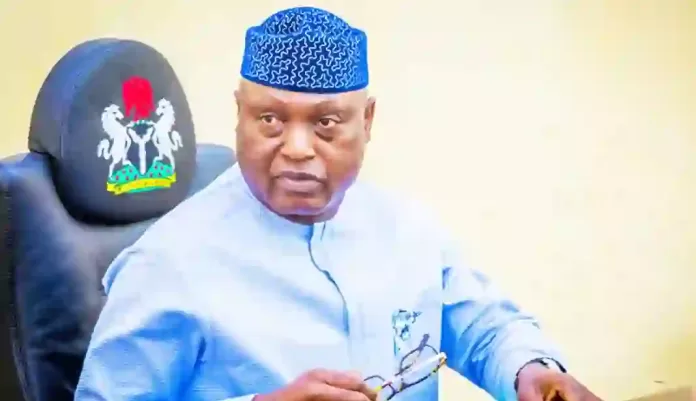
Edo State Governor, Monday Okpebholo, has declared that even if his own son is found involved in cultism, he will be dealt with according to the law. No one would be above the law under his administration, he added.
The governor issued the warning on Monday while addressing former cultists who renounced their involvement in the dangerous practice.
He commended them for turning away from cultism and encouraged others still involved to follow their example.
“You have chosen the right path. You have chosen to save your life. You have also chosen to remove tears from your family’s eyes,” Okpebholo said, describing their decision as a step towards building a safer society.
Emphasising his commitment to fighting criminality without fear or favour, the governor emphasized that protecting the lives of Edo residents was his primary responsibility.
“My duty is very clear. The oath I took is to protect Edo’s life. And this I must carry out to the letter on behalf of Edo people. Even if that person is my child, I won’t know at that moment,” he declared.
He urged those who had renounced cultism to persuade their former associates to abandon the practice, warning that those apprehended would face the consequences.
“The remaining ones that have not changed, that still think they have the power, please tell them if they are caught, no mercy,” he warned.
Okpebholo also disclosed that he has the support of President Bola Tinubu in his drive to make Edo State crime-free.
“I will let you know today that I have the blessing of Mr President to make Edo crime-free.”
As part of efforts to encourage more cultists to turn away from the practice, the governor directed those who had renounced cultism to submit their names and phone numbers for a follow-up engagement, where potential support for their future would be discussed.
Recalling the state’s security challenges, Okpebholo revealed that about 300 people had reportedly been killed within three to four months before he assumed office.
He added that five people died within five days after he took office, underscoring the urgency of tackling insecurity.
Calling for unity among residents, the governor declared that cultism had no place in the state.
“There is no colour in Edo. So, if there is no colour in Edo, we are all brothers.”
Speaking also, the Commissioner for Public Safety and Security, Festus Ebea, lauded those who had renounced their membership of cult groups for taking such a bold step, noting that their decision had helped reduce cult-related activities in the state.
He urged them to see themselves as agents of change.
Ebea also appealed to the governor to extend his dragnet to drug dealers in the state, pointing out that without the intake of hard drugs, cultists and other criminals would not have the courage to engage in criminal activities.
Speaking at the event, Isaac Owobu, one of the former cultists who renounced their membership in Edo Central Senatorial District, described cultism as being worse than HIV.
He expressed gratitude to the state governor for giving them a second chance to turn their lives around and make amends for their past mistakes.
Owobu disclosed that some individuals who had abandoned their education out of fear of reprisal attacks had now returned to school and were pursuing their master’s degrees in Ekpoma.
Meanwhile, the Edo State Commissioner of Police, CP Patrick Daaor, appealed to those still undecided about renouncing their membership of cult groups to take advantage of the opportunity provided by the governor rather than continue their involvement in the practice.
He stressed that the governor valued the youths of the state and was determined to prevent them from destroying their future through cultism.
As the 2026 Legal Year of the Supreme Court of Nigeria begins, the Chief Justice of Nigeria (CJN), Justice Kudirat Kekere-Ekun, has cautioned Judges against political associations or conduct that could cast doubt on their impartiality as the country prepares for the 2027 general elections.
Kekere-Ekun gave the warning on Monday in Abuja during the opening of the 2026 Legal Year of the Supreme Court of Nigeria.
She urged judicial officers to remain neutral when handling election-related disputes and avoid any actions that could suggest favouritism towards a political party or candidate.
The CJN noted that electoral disputes often attract intense political pressure because of their implications for candidates, political parties and the country.
She stressed that judges must remain calm, uphold the law and adhere strictly to their constitutional responsibilities.
“Judicial officers must remain conscious that every word they speak and every action they take during an electoral period will be subjected to scrutiny.”
Kekere-Ekun also urged lawyers to uphold professional standards when handling political and electoral cases, warning against forum shopping and the filing of similar cases before different courts in search of favourable outcomes.
According to her, such practices could result in conflicting court orders, undermine the judicial process and weaken public confidence in the justice system.
She called on legal practitioners to disclose related cases pending before other courts and respect their jurisdiction.
The CJN further warned that the increasing volume of election-related litigation could delay other cases awaiting determination, stressing that all litigants deserved timely access to justice regardless of the political significance of their cases.
On judicial appointments, Kekere-Ekun called for the protection of the processes managed by the National Judicial Council (NJC) and the Federal Judicial Service Commission (FJSC).
She said appointments must remain transparent and credible to sustain public confidence in the judiciary.
She explained that recent appointment processes had included structured assessments, professional and peer feedback, background checks and opportunities for public comments on shortlisted candidates.
However, she cautioned against turning the process into a platform for public condemnation or settling personal and professional disputes.
The Chief Justice also criticised the use of social media to threaten, harass or ridicule members of the legal profession.
She urged lawyers and other stakeholders to channel complaints about judgments or professional misconduct through established procedures rather than resorting to online attacks.
“The administration of justice cannot be left to anger, intimidation or trial by social media.”
Kekere-Ekun maintained that judges must be able to perform their duties without fear of retaliation, while lawyers should be free to present legitimate arguments without intimidation, adding that court officials also deserved protection from harassment.
Meanwhile, the CJN expressed satisfaction with the Supreme Court’s workload and output during the 2025/2026 Legal Year, while acknowledging the need for further improvements in the administration of justice.
She disclosed that the court handled 2,456 matters and delivered 411 judgments during the period, compared with 2,280 matters and 369 judgments and rulings in the preceding Legal Year.
The matters handled included civil and criminal motions, Sharia-related matters and appeals, including political appeals.
Kekere-Ekun said the figures reflected the court’s level of activity, but did not fully capture the challenges posed by delays and the growing number of pending cases.
She said the court has introduced case-management measures to improve efficiency and address outstanding matters.
Between March 23 and December 17, 2026, the E-Diary Office scheduled 1,385 matters for regular court sittings, comprising 1,021 motions and 364 appeals. Of these, 733 were older cases prioritised for hearing.
She added that the court disposed of 178 dormant matters in Chambers and identified 125 cases that had already been concluded, removing them from the active caseload.
The CJN said the measures were part of ongoing efforts to reduce delays, improve case management and ensure that pending matters receive timely attention as the judiciary prepares for another election cycle.
Coming few hours after the resignation resignation of Segun Ogunwuyi as his Chief of Staff, Oyo State governor, ‘Seyi Makinde, has appointed Bashorun Akinwale Akinwole (Wolekanle) as his new Chief of Staff.
He also approved the appointment of Mrs. Aderonke Adedayo as Director-General of the Due Process Office.
The appointments were announced in letters signed by the Secretary to the State Government, Prof Musibau Babatunde.
Bashorun Akinwole, a grassroots politician, previously served as Chairman of the Oyo State Local Government Service Commission.
This followed resignations of some key aides of the governor .
Ogunwuyi, in his resignation letter dated October 12, 2026, said the resignation takes effect from the date on his letter.
“I respectfully write to resign my appointment as Chief of Staff to the Governor of Oyo State, with effect from today, 12th October, 2026.
“Serving the Government and the good people of Oyo State has been a great honour. It has been deeply fulfilling to be part of the exceptional team that has worked relentlessly to deliver the remarkable achievements of this administration.
“I remain immensely proud of what we have collectively accomplished in advancing the growth, development and prosperity of our dear State.
“As I take this decision, I do so with profound gratitude for the opportunity to serve, with confidence in the continued progress of Oyo State.
“Please accept, Your Excellency, the assurances of my highest esteem and unwavering loyalty to Oyo State and the Federal Republic of Nigeria,’ the letter read.
Ogunwuyi, who is a former House of Assembly and House of Representatives lawmaker, is one of the numerous aides of Governor Makinde who have dumped him in the last two months.
Preparatory to his inauguration for a second term on October 16, Ekiti State Governor, Biodun Oyebanji has dissolved the state cabinet.
The governor however, retains Yinka Oyebode, as Chief Press Secretary, Adeniyi Adebayo, Chief of Staff and secretary to state government, Prof Adubiaro.
A statement on Monday explained that the development marks a significant administrative decision by the governor as his administration prepares for a new phase of governance ahead of his second term inauguration scheduled for October 16, 2026.
The dissolution is expected to pave the way for the reconstitution of the State Executive Council, with attention focused on the composition of the next cabinet and the governor’s priorities for his second term.
The retained officials are expected to provide continuity in the coordination of government activities and communication of the administration’s policies and programmes.
Oyebanji, who won the June 20, 2026 governorship election, is expected to begin his second term with renewed expectations from residents concerning infrastructure, education, healthcare, agriculture, electricity and economic opportunities.
The composition of the new cabinet is likely to attract considerable public interest as stakeholders await further announcements from the government.
The governor had earlier sacked other political office holders leaving tbe commissioners.
Oyebanji, while shedding light on the new state cabinet, said he would personally appoint those that worked for his victory in June 20 governorship election, unlike the outgone members that were recommended to him for appointments during the first term.
The new leadership of the ruling All Progressives Congress APC from ward to state level is also expected to be inaugurated immediately after the inauguration.
One of the just removed commissioners, from Ekiti north senatorial district and a close ally of the governor is being tipped as new APC chairman in the state.
Following a request by the Federal Government, a Federal High Court, FHC sitting in Abuja has struck out the eight-count criminal charge brought against the alleged fake Director General of the Presidential Foreign Intervention Promotion Council, PFIPC, Adeniyi Adeyemi.
The Judge, Justice Mohammed Garba Umar, terminated Adeyemi’s trial following the request by the Federal Government to that effect.
The accused person is expected to be moved to the High Court of the Federal Capital Territory for a fresh arraignment.
At the proceedings on Monday, the Director of the Public Prosecution of the Federation, DPPF, Rotimi Oyedepo, SAN, moved an application for the termination of the charges.
Oyedepo told the judge that the Attorney General of the Federation, AGF, and Minister of Justice, Lateef Fagbemi, SAN, carried out a review of the case file and the charge filed by the Inspector General of Police and found some loopholes.
He pointed out that the documents allegedly forged by Adeyemi during his operation of the fake agency are those that can be prosecuted by the High Court of the FCT and not the Federal High Court.
The DPPF disclosed that a new charge has been filed at the High Court of the FCT and that Adeyemi would be expeditiously arraigned afresh.
He urged the judge to strike out the charge as required by law.
Following no objections from Ibrahim Angulu, SAN, who stood for Adeyemi, Justice Umar terminated the charge accordingly.
Adeyemi, 38 years old, is being tried alongside two others whose whereabouts were unknown, on charges bordering on conspiracy and forgery.
The Independent National Electoral Commission (INEC) has clarified that names of governorship candidates in six states, are yet to be made public.
It disowned a viral online announcement concerning the six states, describing the publication as fraudulent and urging Nigerians not to share it.
According to reports, the commission issued a public notice through its official X account, clarifying that the announcement, which mentioned Zamfara, Gombe, Delta, Plateau, Yobe and Kano states, did not originate from the electoral body.
INEC also dismissed claims that it had released a special announcement concerning governorship candidates in the affected states, advising members of the public to disregard the circulating publication.
The commission urged Nigerians to verify election-related information through its official communication channels rather than rely on unconfirmed reports and social media posts.
It identified its official website, inecnigeria.org and news portal, inecnews.com as platforms where members of the public can access authentic electoral information.
The commission also directed Nigerians to its verified social media accounts, including INEC Nigeria on Facebook and @inecnigeria on X and Instagram.
The electoral body called on citizens to remain vigilant and confirm the authenticity of election-related announcements before sharing them, warning that misleading information could cause confusion among the public.
INEC reiterated its commitment to providing accurate electoral information and urged Nigerians to rely on its verified platforms for official updates.
The list being on circulation currently named 14 governorship candidates for Zamfara, Kano has 15 representing various political parties and Plateau 17.
Governor Peter Mbah of Enugu State has lost one of his aides, Lucky Chukwu, a Lawyer to death.
Chukwu until his death, was a Special Assistant to the Enugu State Governor.
His sudden death was announced by his brother, Senator Kelvin Chukwu, who represents Enugu East Senatorial District.
In a Press Statement issued on Sunday, October 11, 2026, to anmounce his brother’s death, the Senator’s Head of Media, Amb. Dr. Ogomegbunam Success Nwoye, described the deceased as an astute public servant and politician.
It added that the Chukwu Family has been left devastated and traumatised following the sad incident.
The statement further added that Senator Kelvin Chukwu has suspended all political activities and engagements for one week to mourn his elder brother.
“Senator Chukwu, who is mourning his elder brother, has, therefore, cancelled all his political activities/engagements for a week,” the statement read.
The Lawmaker also called on the people of Enugu East Senatorial District to join his family in mourning the deceased, whom the statement described as an “erudite son of Nkanuland.”
He prayed for the repose of the deceased’s soul.
“May God rest the soul of Chief Lucky Chukwu,” the statement added.
An inquest in the United Kingdom, which examined the circumstances surrounding the deaths of three Nigerian sisters who drowned in the sea off Brighton, southern England, has confirmed a possible suicide.
The sisters, Jane Adetoro, 36, Christina Walters, 32, and Rebecca Walters, 31, lived together in Greenford, west London. They had become increasingly withdrawn following the death of their mother in 2010.
The inquest heard that the sisters visited an area of Birmingham close to where their mother died on May 11 before travelling to Brighton the following day.
According to report, they were later seen on the town’s eastern seafront in the early hours of May 13, when they entered the sea in difficult conditions. None of the sisters could swim.
Their father, Joseph Jacobsen, described the loss of his three daughters as heartbreaking.
Coroner Penelope Schofield said the court could not speculate on the reasons behind the sisters’ actions.
Evidence presented at the inquest showed that a taxi carrying the sisters arrived in Brighton at 10.21pm on May 12. The driver reportedly noticed that they were quiet during the journey.
Closed-circuit television footage later showed the sisters on Brighton’s eastern seafront. They were last seen alive at 2.42am on May 13.
The inquest also heard that police examining Christina’s laptop found 227 references to water and 179 references to suicide. Christina had reportedly experienced anxiety and depression following their mother’s death.
Rebecca’s medical records contained no significant information relevant to the inquest, while Jane was not registered with a doctor.
Toxicology tests found no evidence of drugs or alcohol in the sisters’ systems, and investigators found no evidence of violence.
Jane was brought ashore by the Royal National Lifeboat Institution (RNLI) and pronounced dead. Christina was recovered by an RNLI lifeboat, while Rebecca’s body was later washed ashore. Both were pronounced dead by paramedics.
The inquest examined the circumstances surrounding the deaths and the sisters’ movements in the hours before they entered the water.
From left: Governor Seyi Makinde and Segun Ogunwuyi
By Ayodele Oni
Citing no specific reason, Segun Ogunwuyi has resigned from his position as Chief of Staff to Oyo State Governor Seyi Makinde, effective from October 12, 2026.
Ogunwuyi communicated his decision in a resignation letter dated October 12, in which he expressed appreciation to the governor for the opportunity to serve the state.
In the letter, the former Chief of Staff described his time in office as an honour, noting that he was grateful to have contributed to the achievements of the Makinde administration.
He said he was proud of the collective efforts made to advance the growth, development and prosperity of Oyo State during his time in government.
Ogunwuyi also expressed confidence in the state’s continued progress, despite his decision to leave the position.
“Serving the Government and the good people of Oyo State has been a great honour. It has been deeply fulfilling to be part of the exceptional team that has worked relentlessly to deliver the remarkable achievements of this administration,” he stated.
He further conveyed his appreciation to Governor Makinde and reaffirmed his loyalty to Oyo State and the Federal Republic of Nigeria.
“Please accept, Your Excellency, the assurances of my highest esteem and unwavering loyalty to Oyo State and the Federal Republic of Nigeria,” the letter added.
The circumstances behind Ogunwuyi’s resignation remain unclear, as no specific reason was provided in the letter.
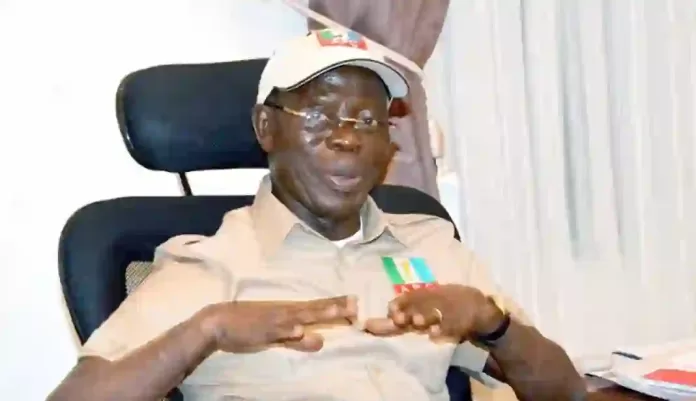
Despite his unprepossessing appearance, Comrade Adams Oshiomhole once cut the figure of a committed and courageous labour leader. His physiognomy seemed forged in the trenches of trade unionism: the intense, darting eyes and perpetual readiness for verbal combat reflected the instincts of a fighter.
During his tenure at the helm of the Nigeria Labour Congress (NLC), the labour movement enjoyed considerable prominence. He injected it with unusual energy, vitality, and a combative spirit, all housed in a small frame that seemed to contain an oversized fighting instinct.
He gave workers a voice that those in authority could hardly ignore. His confrontations with successive governments earned him a reputation as a man who could challenge power without blinking. For a considerable period, Oshiomhole represented the possibility that an ordinary man, armed with courage and conviction, could confront an entrenched establishment.
His popularity as a labour leader paved the way for his eventual emergence as Governor of Edo State. The transition from labour activism to partisan politics was not unusual, but what distinguished Oshiomhole was the expectation that he would transfer the same courage, discipline, and concern for ordinary people into public administration. Many believed that the man who had challenged governments on behalf of workers would, when entrusted with power, demonstrate an uncommon commitment to accountability and public welfare.
Among those with whom Oshiomhole developed a close relationship during his years as governor was Mr Peter Obi, then Governor of Anambra State. Their relationship was marked by mutual respect and an appreciation of certain principles of public administration. Oshiomhole once acknowledged that he stood on Obi’s shoulders to count his achievements. He also credited Obi with inspiring and encouraging him to pursue his stolen electoral mandate through the courts to its logical conclusion. It was a remarkable acknowledgement from a man who would later become one of Obi’s most persistent critics. In this respect, Oshiomhole appears to have found kindred spirits in politicians such as Umahi, Wike, and Soludo, whose criticisms of Obi have also become recurring features of public discourse.
When Oshiomhole was seeking re-election, he invited Peter Obi to campaign for him, citing Obi’s impressive record. I personally accompanied Obi to Benin on several occasions to campaign for Oshiomhole. Those visits were not incidental. They reflected a relationship in which Obi’s reputation as a governor who took public finance and responsible governance seriously was considered an electoral asset. Oshiomhole was sufficiently impressed by Obi’s record to seek his endorsement before the Edo electorate. He publicly described Obi as a governor whose personal life and public conduct he considered worthy of emulation.
It is therefore difficult to reconcile that history with Oshiomhole’s subsequent attacks on Obi, often in language more suited to a personal quarrel than a serious political disagreement. Political relationships can change, and former allies are perfectly entitled to disagree. Democracy requires the freedom to criticise even those one once admired. However, there is a difference between principled disagreement and sustained disparagement that appears to disregard one’s own earlier declarations. When someone who once acknowledged another man’s achievements and actively sought his support later behaves as though that same man has nothing worthwhile to offer, it is reasonable to ask: what has changed—the facts, the principles, or the political calculations?
Valentine Obienyem
A few months ago, Oshiomhole accused Obi of establishing and working with the Bakassi group. The allegation was particularly perplexing because, to the best of my knowledge, the group was not operating in Anambra State before Obi became governor. The chronology therefore raises an obvious question: what evidence supports the allegation? Serious accusations require more than political rhetoric; they require verifiable facts. Without such evidence, the allegation risks becoming an instrument of blackmail rather than a genuine attempt to establish the truth.
More recently, Oshiomhole questioned how Obi could have saved money in dollars when Anambra’s allocations were paid in naira. Yet the currency in which revenue is received does not, by itself, determine the currency in which savings may prudently be held. The relevant questions are whether the transactions were lawful, transparent, properly authorised, and beneficial to the state. Dr Alex Otti, then Managing Director of Diamond Bank, reportedly advised Obi to convert part of Anambra’s savings into dollars to protect their value against the depreciation of the naira. The rationale was straightforward: public savings should be managed in a way that preserves their purchasing power, subject to the risks and safeguards involved.
Curiously, Oshiomhole himself had previously advocated the payment of federal revenues in dollars, arguing from the importance of foreign exchange in the country’s earnings. Why, then, should holding a portion of public savings in foreign currency suddenly become incomprehensible when Obi is involved? The two situations are not identical, but the underlying principle—that foreign currency has a legitimate place in financial management—demands a consistent explanation. Holding dollars is neither automatically prudent nor inherently improper; the circumstances, legality, and purpose of the decision must determine the judgement.
I recall Obi recounting how some governors resisted the advice of Dr Ngozi Okonjo-Iweala on the importance of saving public funds for a rainy day. According to Obi’s account, Oshiomhole protested that it was already raining and that every kobo accruing to the Federation Account should be shared immediately. The remark captures a fundamental disagreement about public finance. Governments must meet present needs, but they must also prepare for future difficulties. Saving is not an argument against building roads, equipping hospitals, improving schools, or paying salaries. It is an argument for ensuring that immediate expenditure does not leave a government financially vulnerable when revenues decline or emergencies arise.
The irony is difficult to overlook: a man who reportedly resisted the argument for preserving public resources now questions the wisdom of another governor’s savings. Intellectual honesty requires consistency, or at least an explanation when one’s present position appears to contradict one’s earlier stance.
There is another dimension to this controversy. As Governor of Edo State from 2008 to 2016, Oshiomhole raised a ₦25 billion bond in the capital market to finance infrastructure, particularly the Benin City stormwater project. Earlier he had borrowed billions. Borrowing is not, in itself, evidence of financial recklessness; its justification depends on the purpose, cost, transparency, and benefits of the expenditure. Nevertheless, a politician who defended borrowing to finance development should appreciate that financial decisions must be evaluated by their rationale and outcomes, not dismissed merely because they involve a particular financial instrument.
The question, therefore, is not whether Oshiomhole borrowed or whether Obi held dollars. It is whether the decisions taken by each administration were lawful, prudent, transparent, and beneficial to the people. Oshiomhole’s own defence of public borrowing makes it particularly important that he apply consistent standards when examining Obi’s financial decisions. If borrowing can be justified by the need to finance development, then holding savings in a foreign currency can also be examined on its merits rather than treated as suspicious simply because the money was originally received in naira.
This brings me to the question in the title: how intelligent is Oshiomhole? Intelligence in public life should be reflected in the ability to understand facts, recognise contradictions, weigh evidence, and distinguish legitimate scrutiny from political insinuation. Oshiomhole’s years in the labour movement demonstrated courage, energy, and political resourcefulness. His subsequent years in public office should also invite scrutiny of the consistency of his arguments and the standards he applies to others. When criticism rests on questionable allegations or fails to engage seriously with the reasoning behind a financial decision, it raises legitimate questions about the quality of the argument.
Nigeria needs politicians who can rise above partisan quarrels to discuss the serious business of governance. Public money must not be spent indiscriminately merely because it is available, just as savings must not be celebrated merely because they exist. Both expenditure and saving must be judged by their legality, prudence, transparency, and benefits to the people. Obi should be scrutinised like every other public official, but the scrutiny must be intelligent and evidence-based.
Ultimately, the controversy is about more than Obi, Oshiomhole, dollars, or naira. It is about consistency, intellectual honesty, and the responsible management of public resources. A politician’s past courage may earn him admiration, but his present arguments must still withstand the test of reason.