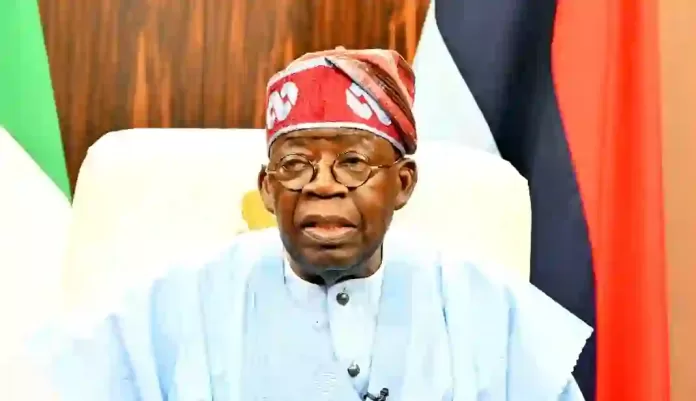


President Bola Tinubu has noted that the victory of Romuald Wadagni in the Presidential election in Benin Republic is a reflection of the People’s trust in his leadership.
Tinubu, in a massage signed by Bayo Onanuga, Special Adviser to the President (Information and Strategy), congratulated the President-elect on his victory at the polls.
Romuald Wadagni, the country’s Minister of Finance, secured an overwhelming majority of the vote in the presidential election held on April 12.
In a letter signed by him, President Tinubu said the victory “reflects the trust the Beninese people have placed in your vision and your distinguished record of service as Minister of Finance.”
President Tinubu also stated that Nigeria and the Republic of Benin “share a long history of friendship, cultural ties, and cooperation,” adding that he looked forward to working with His Excellency Romuald Wadagni to strengthen bilateral relations.
President Bola Tinubu
The full text of the letter :
Your Excellency and Dear Brother,
“On behalf of the Government and the people of the Federal Republic of Nigeria, I extend my warmest congratulations to you on your election as the President of the Republic of Benin following the polls held on April 12, 2026.
“I commend the Government and people of the Benin Republic for conducting a peaceful election and noted that Wadagni’s victory reflects the trust the people have placed in his vision and record of service as the current Minister of Finance.
“This transition marks a significant chapter in your nation’s history. I therefore commend the people of Benin for their resilience and commitment to the democratic process and to maintaining peace during the election cycle.
“Our two nations share a long history of friendship, cultural ties, and cooperation. I therefore look forward to working closely with your administration to strengthen our bilateral relations further, enhance regional security, and promote economic prosperity within the ECOWAS sub-region and the African Union.
“As you prepare to assume the onerous responsibilities of the high office of the Presidency, I wish you great wisdom, fortitude, and success. You can please rest assured of my unstinting support and cooperation in this regard.”
As a mark of support for bereaved family, Edo State Government has approved full educational scholarships for the three children of the late Brigadier General Oseni Omoh Braimah, who died in active service to the nation.
The gesture is seen as a move that underscores growing sub national support for families of fallen military personnel.
Brigadier-General Braimah, who hailed from Edo State, was killed by terrorists in Borno state while leading military personnel to curtail banditry in the northern region.
The approval, granted by Governor Monday Okpebholo, ensures that the beneficiaries will receive uninterrupted funding for their education from their current academic levels through to university.
The beneficiaries include Farida Hussain-Braimah, an 18-year-old 100-level Software Engineering student at Nile University, Abuja; Amir Hussain-Braimah, 16, currently in Senior Secondary School 3 at Olumawu Senior School, Abuja; and Yasmeen Hussain-Braimah, 12, a Junior Secondary School 2 pupil at Olumawu Junior Secondary School, Abuja.
Speaking on the initiative, Okpebholo described the decision as both a moral obligation and a reflection of responsible governance, noting that the late officer’s death represents a significant sacrifice in service to Nigeria.
“Brigadier General Braimah paid the ultimate price in service to this country. It is only right that we stand by the family he left behind and ensure his children have uninterrupted access to education,” the governor said.
He added that the State Government remains committed to supporting the children throughout their academic journey, positioning them for long-term stability and productivity.
Braimah, who was described by the Governor as a symbol of discipline, courage, and patriotism, died during ongoing security operations and was buried with full military honours at the Maimalari Cantonment Cemetery in Maiduguri, Borno State.
The Presidency has accused former Vice President Abubakar Atiku of attempting to undermine the long-standing North-South zoning principle ahead of the next general election.
It warned the former Vice President against pursuing another presidential bid in 2027. Atiku has, however, signified to contest for the last time for the presidency next year on the ticket of African Democratic Congress (ADC).
Atiku Abubakar had reignited the national conversation on power rotation by asserting that the Southern region of Nigeria has spent more years in power than the North since the return to democratic rule in 1999.
Speaking during a recent engagement, Atiku addressed the sensitive issue of zoning and power shift, which has remained a recurring theme in Nigerian politics, especially as the country prepares for the 2027 general elections.
According to Atiku, a careful review of the democratic period shows that Southern leadership has cumulatively held the presidency for a longer duration than the North.
He used this observation to argue that any rigid adherence to zoning must take historical realities into account, rather than being based solely on emotional or regional sentiments.
In a statement released on Thursday, the Special Adviser to the President on Information and Strategy, Bayo Onanuga, argued that Atiku’s stance mirrors his actions during the 2023 election cycle, when he contested as the Peoples Democratic Party (PDP) candidate despite internal expectations that power should shift to the South after the tenure of former President Muhammadu Buhari.
According to him, that decision deepened divisions within the party and contributed to its electoral loss.
Reacting to Atiku’s interview on Arise TV, Onanuga dismissed the former Vice President’s claim that the South has held power longer than the North since 1999, describing the argument as misleading and self-serving.
He noted that the North’s shorter time in office was largely due to the death of former President Umaru Musa Yar’Adua in 2010, which led to the constitutional succession of Goodluck Jonathan.
The presidential aide maintained that this circumstance does not invalidate the zoning arrangement, insisting that the current administration under President Bola Ahmed Tinubu is entitled to complete its tenure as part of the rotational balance.
Onanuga further cautioned Atiku against what he described as a repeat of past political miscalculations, labeling him a “serial contender” and predicting another defeat if he joins the 2027 race.
He urged the former Vice President to abandon any renewed ambition and respect the existing power-sharing framework, stressing that it remains the South’s turn to produce the next President.
Six months after his appointment as the Chairman of the Independent National Electoral Commission (INEC), Professor Joash Amupitan appears determined to beat the record of Professor Maurice Iwu as the most mistrusted electoral administrator yet.
Iwu, a professor of Pharmacognosy (the study of medicinal plants), also had the distinction of managing Nigeria’s worst elections in 2007. On top of that, he gave science a bad name with the dubious claim that he had discovered the cure for Ebola.
The last thing Amupitan wants is to upstage Iwu’s sordid reputation. His comments on social media are stalking him, and he must be wondering if his job is over even before it started.
The long arm of social media
His archived post before his appointment shows partisan leanings during the 2023 election cycle, with content supportive of the ruling All Progressives Congress (APC), and critical of opposition figures.
The account’s activity, coupled with the sudden renaming and restriction after scrutiny intensified, has fuelled suspicion of a hurried clean-up. You’re left to wonder why, if, as he claims, he has nothing to hide.
His numerous travails since becoming INEC chair remind me of a line from Things Fall Apart, one of the greatest novels out of Africa. In it, Chinua Achebe, a master storyteller, embeds an anecdote about suffering in Okonkwo’s troubled life to deepen the impact of the moment: “When trouble knocks at your door, and you tell him to go away because there is no seat for him, he tells you not to worry because he has brought his own stool.”
Amupitan’s self-inflicted troubles already have their own stool and footrest. He’s caught in a mesh, and trying to remove one sticky web only adds to the tangled mess.
Trouble dey sleep
The first gust of the storm blew in October 2025, when the US declared Nigeria a Country of Particular Concern (CPC) over purported genocide against Christians. Almost immediately, Amupitan’s 2020 legal brief entitled “Nigeria’s Silent Slaughter”/“Legal Brief: Genocide in Nigeria – The Implications for the International Community”, in which he argued that attacks by Boko Haram and Fulani herdsmen constituted a genocide against Christians and minority groups in Nigeria, exploded in the public space.
INEC Chairman, Prof. Joash Amupitan.
A broad sweep of individuals and groups felt energised by the obvious religious bias verging on hate and incitement, and called on either President Tinubu to rescind the nomination, or for the National Assembly to decline confirmation, neither of which was heeded.
His 80-page chapter, entitled “Legal Brief: Genocide in Nigeria”, alleged an “Islamisation agenda” describing over 60,000 brutal killings since 2001, linking violence to a Fulani-led jihad dating back to Uthman Dan Fodio in 1804. He cited the 2015 Open Doors Report, which reported the destruction or closure of over 13,000 churches and accused the government of complicity through silence and failure to protect victims. The brief recommended a UN referral to the International Court of Justice or, as a last resort, foreign military intervention.
Fondly remembered
Following his appointment, the brief resurfaced and sparked a backlash, especially for its anti-Muslim slant. Five years down the road, his call to a national assignment blew the lid so fortuitously that it fit into the narrative of American congressmen Ted Cruz and Mike Arnold, alongside other subterranean calculations of the Trump administration, like a well-timed pass.
Amupitan’s brief understated the complexities of the security challenges in Nigeria, quite conveniently sidestepping the reality that the victims of insurgents, bandits and other crimes are indiscriminate, cutting across different religious divides.
There are inferences that this contentious report was targeted at undermining the government of late President Muhammadu Buhari, on whom a section of the population had tagged the label of religious extremism. Not thinking forward, Amupitan couldn’t have fancied that his work would boomerang on Buhari’s successor at the very nick of the author’s call to the national stage.
Not giving up
Despite public reproach, the Senate went on to confirm Amupitan as INEC boss. The ‘Christian genocide’ storm more or less passed overhead and subsided without any serious damage. Always quick to retreat to their for-and-against camps, Nigerians also quietly moved on, waiting for the next controversy.
It came soon again from the Court of Appeal in Abuja. And willy-nilly, INEC was connected to the ruling, having been joined as a party in the case. It was the judgment against the African Democratic Congress (ADC) that invalidated the party’s national executives. INEC acted on the ruling supposedly in good faith, and against the trend in similar circumstances since the Bayelsa governorship election in 2019, when INEC asked the court for judicial interpretation of disputed rulings. The opposition has been baying for blood, accusing the commission of meddling in its internal affairs and demanding Amupitan’s resignation.
While still fending off the onslaught from the ADC, the beleaguered Amupitan is being trailed yet again by a past he is struggling to deny. Trying to erase a digital footprint is akin to wiping a glass screen with a dirty cloth – it just leaves more dirt.
The contents of his digital footprint, traced back to 2006, include information indicating that the Prof is the subject of allegations of partisanship by the opposition. The tweets on his X handle support the claim that President Bola Ahmed Tinubu has not appointed a neutral electoral umpire.
Publicly denying ownership of the Twitter (X) account in his name, with other critical information linkages such as email, phone numbers, and financial records, for a consistent 20-year period, or labelling them as parody or fake accounts, or deleting them, may be smart but not honourable. In the digital age, credibility must be defended not only in the conduct of elections, but also in perceptions of those who conduct them.
A word from Humphrey Nwosu
In his book, Laying the Foundation for Nigeria’s Democracy: My Account of June 12, 1993 Presidential Election and Its Annulment, the Chairman of the National Electoral Commission (NEC), Professor Humphrey Nwosu, said democracy was sustained not just by structures, but by fairness, inclusion and legitimacy.
If Amupitan digs in, as is likely, and his appointor, Tinubu, indulges him, the commission will struggle to retain public trust. INEC may argue that suspicion is not proof and that, in any case, no forensic, platform-level evidence has been found against it.
That is precisely what the National Assembly should do: Initiate a forensic probe. INEC is independent, but not unaccountable.
Work for Akpabio
The numerous calls for his resignation by different groups, including opposition parties and civil society, are nothing but a demand for accountability. Whether he chooses to come clean or to retain the services of whitewash agents to survive to the next day is not up to him.
It might sound like a joke to expect the Senator Godswill Akpabio-led National Assembly to take the matter seriously. Akpabio is an off-colour humour bank, hardly anything more. His failure to institute a forensic probe will only reinforce the perception that Amupitan’s singular job at INEC is to make the ruling party happy.
Ishiekwene is the Editor-In-Chief of LEADERSHIP and author of the book Writing for Media and Monetising It
A prestigious international recognition came the way of Nigeria through Comrade Joe Ajaero, the President of the Nigeria Labour Congress, NLC.
Ajaero was awarded the high profile Svensson Prize on the sidelines of the preparatory meeting for the International Labour Conference in Brussels on Thursday, April 16, 2026.
Highly celebral, Ajaero is not only the President of the Nigeria Labour Congress, but an emblematic figure in the struggle for human rights.
The award was presented to him by Luc Triangle, General Secretary of the International Trade Union Confederation (ITUC).
This prize, which honours an exceptional career, recognises the unwavering commitment of a defender of human rights, labour rights, and individual and collective freedoms in Nigeria and across the African continent.
Despite the dangers, abuses, and intimidation, Comrade Joe Ajaero has remained a man of conviction, action, and vision, whose steadfastness commands respect.
Beyond the recognition of a singular struggle, this distinction honours Nigerian and African trade unionism as a whole.
It also pays tribute to all activists who, wherever fundamental rights are under threat, courageously uphold the ideals of social justice and human dignity.
Ajaero has degrees in multiple disciplines including Law.
Congratulatory messages have greeted the award to Ajaero from across the Nigeria, Africa and the World.
Following the consensus endorsement of Senator Olamilekan Adeola, popular as Yayi, as the All Progressives Congress, APC, Ogun State Governorship Candidate for the 2027 Election, former Deputy Governor of the Central Bank of Nigeria, CBN, Tunde Lemo, has dropped his own ambition and withdrawn from the Governorship race.
Lemo succumbed to the Party’s adoption of Yayi as the APC consensus Candidate, and like Professor Iyabo Obasanjo did, announced his decision to quit in a statement he released in Abeokuta.
The accomplished banker noted that his action followed “deep reflection and wide consultations” with Party leaders and stakeholders across Ogun State.
He described his withdrawal as not a setback, but a strategic move aimed at strengthening party unity and positioning the APC for victory.
His words, “This is not a retreat from service. It is a deliberate, strategic alignment for the greater good”.
He expressed confidence in the judgment of party elders, stating that Adeola has the capacity to leverage on the achievements of Governor Dapo Abiodun and further position the State as a hub for industry and innovation.
He added that the consensus arrangement was intended to promote unity across Ogun’s three senatorial districts and improve the party’s chances in the 2027 general elections.
Lemo, also, called for unity among party members, and urged leaders to prioritise collective success over personal ambition.
“For too long, fragmentation has cost progressives momentum. We must close ranks. Leaders must lead by example, not by insisting on self, but by enabling strength,” he said.
Lemo further directed his supporters across the State’s 20 Local Government Areas to mobilise behind Adeola’s candidacy, and pledged to contribute his expertise in finance, enterprise, and public policy toward the party’s success.
“The contest ahead is not about individuals. It is about Ogun’s future. Let us be on the right side of history—united, focused, and victorious,” he added.
A former national chairman of the All Progressives Congress, (APC) Adams Oshiomhole, has observed that internal crisis within opposition parties are self-inflicted rather than caused by the ruling party.
Oshiomhole made this known during a nationwide media interaction organised by the APC, where he emphasised that it is not the responsibility of the ruling party to intervene in or resolve disputes within opposition groups.
Senator Oshiomole argued that it would be illogical for any political party to establish structures aimed at monitoring or managing the internal affairs of rival parties.
He maintained that each political organisation must take full responsibility for addressing its own challenges, stressing that accountability cannot be outsourced.
Oshiomhole further clarified that while the APC may occasionally offer advice, it cannot assume the role of settling disputes for opposition parties.
He reiterated that such obligations rest squarely on the leadership of the affected parties, adding that expecting otherwise is unrealistic.
He also addressed concerns surrounding funding, rejecting claims that opposition parties are disadvantaged due to limited financial resources compared to the APC.
According to him, access to funding is not exclusive to the ruling party, and financial constraints should not be used as justification for internal disarray.
First City Monument Bank, FCMB, is leveraging culture as an economic driver, using platforms such as the Ibadan Cultural Festival to support small businesses, deepen financial inclusion, and connect local enterprises to broader markets.
As a lead partner in the festival organised by the Central Council of Ibadan Indigenes (CCII), the Bank said cultural gatherings are increasingly evolving into viable commercial ecosystems, bringing together thousands of vendors, creatives, and service providers to drive real economic activity.
Speaking at a press conference in Ibadan, FCMB’s Divisional Head of Corporate Affairs, Diran Olojo, said the Bank’s approach is to enable participation, support business growth, and capture transaction flows within these ecosystems.
“We see culture as a functioning marketplace. Events like this concentrate demand, talent, and enterprise in one place. Our role is to help businesses plug into that, through access to finance, visibility, and the systems that support transactions and growth,” he said.
He noted that the festival stimulates activity across hospitality, retail, transport, and the creative sector, while also attracting diaspora engagement that strengthens remittance flows and local investment.
The Ibadan Cultural Festival, popularly known as Okebadan Festival, attracts residents, indigenes, and visitors, driving a surge in commercial activity across the city.
President-General of the CCII, Ajeniyi Ajewole, said the festival has become both a cultural and economic platform.
“It drives tourism, supports local businesses, and creates an opportunity for Ibadan indigenes in the diaspora to return, reconnect, and contribute to the city’s growth,” he said, adding that FCMB’s involvement reflects growing private sector interest in culture-led development.
Chairman of the Planning Committee, Gbolagade Akere, said the 2026 edition is structured to strengthen Ibadan’s profile as a tourism and investment destination, with activities that combine cultural expression and economic engagement.
FCMB said its involvement reflects a broader strategy to build ecosystems that connect informal and small-scale businesses to finance, markets, and opportunities for scale.
Professor Nentawe Yilwatda, National Chairman of the ruling All Progressives Congress, APC has defended the removal of petrol subsidy, saying it’s a tough decision for President Bola Ahmed but necessary for laying a strong foundation for the nation’s economy.
President Tinubu had, on his ascension to office in 2023, announced the end of the subsidy regime, where government subsidize the petrol consumed in the country by paying marketers an agreed sum.
Following the removal, the price of petrol has gone up from less than N300 per litre to over N1,200.
The APC Chairman spoke on Wednesday during the APC National Media Chat in Abuja, the nation’s capital. He explained that the removal was also necessitated to build the $1 trillion economy promised by the president.
“What has been done is to build an economy that can sustain a one trillion-dollar economy. These are tough decisions, but they are necessary for long-term stability,” Yilwatda said
The APC boss spoke amidst the rising cost of petrol, which economy experts blamed on the US-Israel and Iran in the Middle East, a situation that has raised energy cost globally. The product now sells for between N1,200 and N1,300 per litre across the country.
Since March when the war broke the pump price of a litre of petrol has almost doubled, even as analysts insist that the price is likely to surge if the crisis in the middle east is not quickly resolved.
Not a few Nigerians have lamented the high cost of fuel in the country, and its effects on their livelihood, they urge the federal government to intervene by providing subsidy.
Meanwhile, Senate President Godswill Akpabio said on Tuesday that the price of petrol could have risen to as much as N10,000 per litre if not for the local refineries producing the product.
Akpabio said fuel is now being produced and consumed in the country, unlike in the past when a large part of the country’s fuel was imported, adding that fuel queue has also disappeared from filling stations across the country .
“Since we came on board, we have not had three to five kilometres of vehicles lined up at fuel stations to buy petrol,” he said. “There was a time Nigerians were ready to pay as much as N10,000 per litre, yet the product was not available,” Akpabio said.
Despite high hopes of Nigerians at the formative stage of the ruling, All Progressives Congress, (APC), it has failed to address major challenges confronting the country.
The APC was officially formed on 6th February 2013. It was created through a merger of Nigeria’s three major opposition parties at the time—the Action Congress of Nigeria (ACN), the Congress for Progressive Change (CPC), and the All Nigeria Peoples Party (ANPP)—along with a faction of the All Progressives Grand Alliance (APGA).
The coalition succeeded in wresting power from Goodluck Jonathan with the late Ex President Mohammad Buhari taking over.
Former Vice President, Atiku Abubakar recalled the circumstances surrounding the formation of the APC, saying he was strongly pressured by political leaders to join the party at the time.
He stated that many top political figures visited him and insisted that joining the APC was necessary for the country’s political direction
According to Nigerian Tribune report, he was convinced that the merger would bring positive change to Nigeria.
However, he said the outcome after joining the party did not meet expectations and stated that several key sectors of the country have since faced serious decline.
Atiku pointed to worsening conditions in the economy, security system, education sector, infrastructure, and healthcare services, saying these challenges have created deep concerns for many Nigerians.
He stressed that the current situation in the country requires urgent correction, and that leaders must take responsibility to ensure meaningful reform and restore public confidence.
The former Vice President added that people with experience in governance must now rise to push for real and lasting change, as Nigeria needs a serious effort to fix its major problems and improve the lives of citizens.
Atiku maintained that the goal is not political gain alone, but a national effort to address long-standing issues affecting development and stability in the country.
“I remember when the APC was being formed, the entire political leadership in this country came to my house. They said, If you don’t come into the APC, this is not going to be possible.
“So when APC was formed they literally compelled me to join the APC. Only for us to enter the APC, our economy is gone, our security is gone, our education is gone, our infrastructure is gone. The healthcare is gone,” he said.