

Home Blog Page 4

VP Shettima Clarifies Ilorin Comment: “Non  Support For Tinubu By Northern Govs Was Before APC  Presidential Primary”

0

By Ayodele Oni


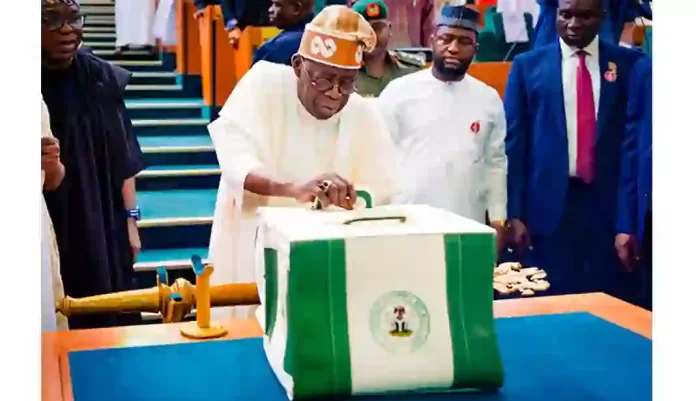
Vice President Kassim Shettima has clarified his remarks concerning the support President Bola Ahmed Tinubu received from northern governors in the build-up to his emergence as the presidential candidate of the All Progressives Congress (APC).


Stanley Nkwocha, Senior Special Assistant to the President on Media & Communications, office of the Vice President, explained that the Vice President’s reference to six northern governors, who believed in and supported President Tinubu was specifically about political consultations and alignments preceding the APC presidential primary in June 2022.


“It was not a comment on the position of northern APC governors, following President Tinubu’s emergence as the party’s candidate, nor was it intended to question their support during the 2023 presidential election.


“Following the presidential primary, APC governors in the North rallied around the party’s candidate and played important roles in the campaign and electoral efforts that culminated in President Tinubu’s victory in the 2023 general election.


“VP Shettima holds the northern governors and other leaders of the APC in high regard and recognises their individual and collective contributions to the success of the party and the emergence of President Tinubu.


“The Vice President regrets any interpretation of his remarks that may have suggested otherwise and hopes this clarification places the comments in their proper context.


“VP Shettima also appreciates the Nigerian media for its longstanding professionalism and constructive engagement with his office and urges continued accuracy and context in the reporting of public remarks as the country approaches another political season.”


Report had quoted Shettima as saying “No fewer than 13 governors from the region refused to support Tinubu, then presidential candidate of the All Progressives Congress, APC, saying inspite of the decision of the governors no to support his presidential bid, Tinubu still went ahead to forgive the after winning the election, noting that the president has displayed that he has a large heart.


The vice president spoke on Wednesday during thee turbaning of Governor AbdulRahman AbdulRazaq as the Sardauna of Ilorin Emirate by the Emir of  Ilorin,  Ibrahim Sulu-Gambari, at his palace in the state capital.

OPINION: What Shall We Do About South Africa?

0
Azu Ishiekwene
Mr Azu Ishiekwene


By Azu Ishiekwene


If South Africa needed any serious signal that the mobs roaming the streets of its cities and townships in search of immigrants were a disgrace, the FIFA World Cup in June 2026, provided a large screen. 

But the country is not looking. Or is looking but cannot see.

In the last three years, according to Xenowatch, about 50 people have been killed in xenophobic-related incidents in South Africa. That’s not counting the displaced and wounded or the hundreds forcibly repatriated, and those whose businesses have been destroyed.

Between June 2026 and now, there have been eight verified deaths linked to xenophobic attacks on Africans. Two of them, Bishop Taiwo Michael Fakunle and James Uchechukwu Nwankwo, were Nigerians. The Ghanaian News Agency reported that two Ghanaians were killed between July and August.

Scapegoating Bafana

What will it take to end this madness, which has set one of Africa’s most promising countries against the rest of the continent?

During the World Cup, Bafana Bafana was the unfortunate target of African fans worldwide who could barely disguise their animosity. The fans wanted Bafana to lose even against less-fancied opponents and would have willed it if they could. A competition that should have united the continent was, in effect, a continuation of war by other means. 

Root of the matter

It’s not exactly a new thing. Xenophobic outbursts began in 1994, the year Nelson Mandela was sworn in as the country’s first black president in its first-ever multi-racial elections and popular suffrage. 

The attacks were then construed as part of the negative offshoots of the prolonged apartheid rule. The expectation followed that, somehow, they would fizzle out, one way or the other. They have not.

After localised incidents in Alexandra Township in 1994, the first significant blowout happened in 2008. And ever since, xenophobia has acquired a life of its own, with sustained cycles of recurrence up till the present. 

It must have been the biggest embarrassment that accompanied Nelson Mandela to his grave – this prolonged moral shock that South Africa can no longer stand other Africans in their neighbourhoods. It’s a continental disgrace for which people like Julius Malema of the Economic Freedom Fighters are repeatedly calling out in vain. 

It’s unbelievable that almost 15 years after his passing, Mandela’s successors have only responded with half-hearted gestures, often appearing helpless while mobs take the law into their own hands.

Local grievances

I understand the practical challenges that sometimes feed the xenophobic demons. In a recent letter shared with me, my friend and one of South Africa’s most outstanding editors, Ferial Haffajee, wrote, with a heavy heart, about how Mayfair, Johannesburg, where she grew up, has changed from a serene neighbourhood into a precinct of chaos with immigrants who bribe city planners, turning every street corner into a commercial jungle. That hurts.

It gets even worse. With an unemployment rate of 33.6 percent, politicians whose job it is to fix the system have mobilised sentiments against immigrants. 

They blame foreigners for “taking the jobs,” putting pressure on healthcare and other services, and contributing to crime. On top of these, Nigerian targets are also accused of drug-running, and the mortal sin of libido levels that put their hosts at a social disadvantage, as if life were a sex Olympiad. It’s not a laughing matter, especially as many of these sentiments were mobilised by politicians during the 2024 elections in South Africa.

Where the truth lies

The truth, however, is far more nuanced than politicians are willing to admit. UN figures estimate that, of the 304 million international migrants worldwide (3.6 percent of the global population), South Africa (pop. 65 million) had about 2.63 million immigrants as of mid-2024. 

The bulk of immigrants there were born in the SADC region, while about 25 per cent are from the rest of Africa. Of this non-SADC immigrant population, only about one percent or 24,718, are Nigerians. And the trope about job hijack needs to be stripped of its false covering.

Black South Africans control the state and constitute most workers and consumers. But white South Africans remain disproportionately influential in private-sector ownership, wealth, and senior corporate management. And this is despite the affirmative black economic empowerment programme that has been in place for 32 years. 

A 2024 employment equity data showed that white employees held 61.1 per cent of top management posts; Africans held 18 per cent; Indians held 11.9 per cent; coloured people held 6.2 per cent; and other foreign nationals held 2.8 per cent.

The household income data is even starker. It shows that the average income of white-headed households was nearly five times that of black-African-headed households in 2022/23.

The large screens at World Cup viewing centres that the lynch mob wouldn’t look at are staring back at them, if only they cared to lift their heads.

Metamorphosis of Ramaphosa

President Cyril Ramaphosa, one of the most documented beneficiaries of the Black Economic Empowerment (BEE) programme, has been disappointing. It would be unfair to accuse him of stoking the deadly xenophobic attacks. 

Yet, it would seem that, knowing what he benefited from BEE through Shanduka Resources, along with prominent figures such as Patrice Motsepe, Tokyo Sexwale and Saki Macozoma, he is comfortable not taking a tough stand, lest the Black oligarchs become the targets of the vigilantes.  

The African Union, the continent’s prefect, is helpless. Nigeria’s President, Bola Ahmed Tinubu, reporting South Africa to the AU to list the matter for discussions in January 2027, means nothing. If the AU has lost its voice or the capacity to stamp its feet, where are the African leaders in the mould of Sekou Toure, Kwame Nkrumah, Leopold Senghor, Murtala Muhammed and several others? 

Nigeria’s former President Olusegun Obasanjo was right when he said in a recent interview that African leaders had not done enough to stop the xenophobic attacks in South Africa. 

Whether it was São Tomé and Príncipe, where Obasanjo rebuked soldiers who toppled the elected government in 2003 or in The Gambia, where the regional ECOWAS faced down President Yahya Jammeh in 2016, whenever the continent’s leaders stood together, the outcomes have been commendable. Nothing demonstrated that lesson as profoundly as the end of apartheid in South Africa, a lesson which Obasanjo had to remind South Africa once again. 

Not a new problem

Tensions arising from migration have been, and will continue to be, a reality of human existence. Even between Nigeria and Ghana, two neighbouring countries and friendly foes, the first major mass deportation of Nigerians happened in 1969, when the military government targeted Nigerians as the cause of the country’s woes. Only for Nigeria to retaliate 14 years later in the infamous “Ghana-must-go,” which affected nearly one million Ghanaians, accused of “taking Nigerian jobs.”

Yet, looking back today, both countries have seen, as Thomas Sowell said in his epic book, Migrations and Cultures, that “migrations are not always permanent resettlements.”

“Even during the era of mass migrations across oceans during the past century and a half,” Sowell wrote, “vast numbers of people have continued to return home. It has been estimated that, between the mid-1830s and the late 1930s, approximately 30 million people left the Indian subcontinent and nearly 24 million returned.”

No condition is permanent

Anti-immigrant scapegoating may seem normal, especially among politicians in the post-Trump era. Still, I share the sentiment expressed on the back of the proverbial mammy wagon that often travelled East of Nigeria in the old days: “No condition is permanent.”

I will recommend this banner to the mobs in KwaZulu-Natal, Gauteng and the Western Cape, some of the deadliest xenophobic crime scenes in recent times. 


Ishiekwene is the Editor-In-Chief of LEADERSHIP and author of the book, Writing for Media and Monetising It.


Consumption Of Toxic Drinks In Ondo: Death Toll Rises To 49, Spreads To Other LGs

0
Ondo State


By Ayodele Oni


Anxiety and fear have gripped residents of southern part of Ondo state as death toll from the suspected consumption of toxic alcoholic drinks and locally produced drink known as ‘Monkey Tail’  continue to rise with 49 confirmed as at Wednesday.


The latest figure represents an increase from the 38 deaths initially recorded in Odigbo Local Government Area of the state, where the incident initially happened.


The state Commissioner for Health, Dr Banji Ajaka, who disclosed this on Wednesday night, said the number of affected persons has now climbed to 170.


He explained that the latest deaths were recorded in Irele Local Government Area of the state, where eight persons have died from suspected poisoning.


Ajaka disclosed that health authorities have deployed response teams to Irele LGA and other affected communities to conduct surveillance, manage cases and trace the source of the suspected toxic substance.


The Commissioner confirmed that government was yet to establish whether the suspected poisoning came from one source or multiple sources.


 “So, all the people that have been affected altogether now is about 170, those that have been admitted and those that have died.


“We are always fast about it wherever and whenever we hear reports of the issue. Our teams are already in Irele as I’m talking to you now.”


Ajaka revealed that the government was working with various agencies including the National Agency for Food and Drug Administration and Control (NAFDAC), National Drug Law Enforcement Agency (NDLEA), Department of State Services (DSS), Nigeria Police, Nigeria Security and Civil Defence Corps (NSCDC) as part of the investigation.


According to him, the outbreak has also been discussed at a national meeting involving state health commissioners and officials of the Nigeria Centre for Disease Control and Prevention (NCDC).


The Commissioner stated that the investigation would continue until the source of the suspected poisonous substance was identified.


Mr Ajaka had previously attributed the deaths to the consumption of locally produced alcoholic and alcoholic-herbal substances.


The latest figures follow an earlier outbreak reported in Odigbo LGA of the state, where 29 deaths had initially been recorded.


The affected communities include New Town, Odole, Okele, Orita Odigbo, Araromi-Obu and Oniparaga.


The state government has subsequently banned the production and sale of locally brewed alcoholic and alcoholic-herbal drinks in Odigbo as a precautionary measure.

Anambra’s Debt Controversy: X Users Roast Soludo, Call Him “Educated Illiterate”

0
Charles Soludo - Governor of Anambra State

By Ayodele Oni


Reactions have trailed move by the Anambra State Government’s decision to release what it described as indebtedness of the state during the regime of former governor Peter Obi, who is now presidential candidate of the Nigeria Democratic Party, ( NDC)


X users have taken to the social media, with some condemning the decision, which they described as politically motivated.


Anambra State Commissioner for Information and Value Reformation, Law Mefor, had revealed that the state government obtained what it described as a certified printout of the account, number 2018779464, from its inception to date.


In a statement issued on Wednesday, Mefor, disclosed that eight external loans linked to projects undertaken during or inherited into Peter Obi’s administration has an outstanding balance of $92.35 million, which the government put at about ₦127.37 billion as of June 30, 2026.


According to him, the loans were connected to projects involving healthcare, education, erosion control, agriculture and community development.


But, Obi, has rejected the allegations, maintaining that he left office without owing salaries, pensions, gratuities or contractors for duly executed and certified projects.


He challenged the government to produce evidence to the contrary, saying he would stop his 2027 presidential campaign if it could establish that he left such debts.


X users put Governor Charles Soludo, under heavy fire on social media after his government released what it claimed were records of loans left behind by former Governor and NDC presidential candidate, Peter Obi.


Government move backfired spectacularly, with X users descending on Soludo, accusing him of bitterness, propaganda and playing politics for a ministerial slot under President Bola Tinubu.


These are some of the reactions: Justice4U8: “If @PeterObi send this people to jail now, they will start crying. Now you’re publicly going crazy because Governor Soludo wants to be minister after Governor. You that his using to publish rubbish. I hope you can definitely defend all this rubbish. You rushed to publish.”


@cisero81: “Soludo you are a Professor for goodness sakes. Could you concentrate on governance and stop this stupidity and bitterness? Was Anambra money missing or stolen under Obi? What is the source of your bitterness and misery exactly?”


@Whiteswizzy: “Soludo is an educated illiterate. He’s fighting Obi because of Tinubu. He has no evidence of his claim.”


@Danhenchi: “Are you guys really this stupid? Or is this a movie script? Why don’t you tell us the exchange rate at the time Peter Obi was governor? Did Peter Obi spend these monies in 2026? Envy can really make people try to defend the indefensible no matter how it makes them look.”


@Karlomege: “Bunch of liars. Initially you said it was 123.77 billion dollars. Now, you are changing it to million dollars. Inconsistency is how criminals are caught. After few hours, you will still come back to say it’s 123 thousand dollars.”


@Movingwinds19: “Obi will stop his campaign and step down. He has been caught.”


@KellyValentyne: “Soludo left the Dubai-Taiwan Anambra he promised Anambra people to meddle in propaganda and blackmail. It is a shame that I once believed he will deliver, this truly shows that education is not wisdom and leadership has nothing to do with Ur educational qualification.

Shetima: 13 Northern Govs Worked Against Tinubu In 2023

0
VP Kashim Shettima
VP Kashim Shettima

President Bola Ahmed Tinubu forgave all the Northern Governors whodid not suport him during the 2023 presidential election,Vice President Kassim Shettiam said.

No fewer than 13 governors from the region refused to support Tinubu, then presidentialcandidate of the All Progressives Congress, APC, Shetima revealed, saying inspite of the decision of the governors no to support his presidentialbid,Tinubu still went ahead to forgive themafter winning the election, noting that the president has displayed that he hasa large heart.

The vice president spoke on Wednesday during thee turbaning of Governor AbdulRahman AbdulRazaq as the Sardauna of Ilorin Emirate by the Emir of  Ilorin,  Ibrahim Sulu-Gambari, at his palace in the state capital.

Tinubu won the 2023 election by securing over 8.6 million votes,to defeat his closet rivaland Notherner, AtikuAbubakar ofthe Peoples Democratic Party,PDP.

Shetima said only six governors from the north supported Tinubu during the election, but that  Tinubu embraced and forgave them after he won, because he’s a good leader.

He, however , did not mention the governors who refused to support Tinubu, but hinted that Abdulrasaq was among the six governors who supported the president during his presidential bid.

Shetima: “You know we have 19 states. Apart from Niger former governor, Abubakar Sani Bello, seated here, and Malam Abdurrahman AbdulRazaq (governor of Kwara State)…

“But to avoid controversy, I will stop naming the names of the other governors. But the governors that were supporting President Tinubu in the North were not more than six who believed in him. But Tinubu refused to be deterred. He was able to cross the road.”

Meanwhile, 18 Nothern governors who are members ofthe president’s party have declared their support for him regarding the 2027 presidential election. Aside Governor Bala Mohammed of Bauchi state, the remaining state governors fromthe region have promsied to workfor him to return tooffice.

Alleged NYSC Cert Forgery: Atiku Ordered To Serve Tinubu Court Papers

0
Bola Tinubu and Atiku Abubakar

The controversy over President Bola Tinubu’s eligibility to contest the 2027 presidential election has taken a fresh turn, with the Federal High Court in Abuja granting former Vice President Atiku Abubakar permission to serve court processes on the President through the All Progressives Congress, APC.

Justice Inyang Ekwo granted the application on Wednesday following an ex parte motion filed by Atiku’s counsel, O.T. Omotayo-Ojo, seeking an order for substituted service.
Atiku, the presidential candidate of the African Democratic Congress, ADC, and his party are challenging the participation of Tinubu and the APC in the 2027 presidential election, alleging that a forged National Youth Service Corps, NYSC, discharge certificate was submitted to the Independent National Electoral Commission, INEC.
The suit, marked FHC/ABJ/CS/1888/2026, listed Tinubu, the APC and INEC as the first, second and third defendants respectively.
The plaintiffs are asking the court to compel INEC to remove Tinubu’s name and that of the APC from the list of candidates and political parties for the 2027 presidential election.
The application for substituted service became necessary, according to Atiku’s counsel, because efforts to personally serve Tinubu with the originating summons and other court processes had been unsuccessful.
Omotayo-Ojo therefore asked the court to permit the documents to be served on the President through the APC.
Justice Ekwo granted the request and ordered the plaintiffs to effect service within seven days, following an undertaking by Omotayo-Ojo, who held the brief of Silas Onu.
The court subsequently adjourned the matter until September 28 for mention.
But while Atiku and the ADC are pressing ahead with the case, Tinubu, the APC and INEC have mounted legal challenges to the suit.
In their joint counter-affidavit filed on September 9, Tinubu and the APC asked the court to dismiss the case, arguing that it was incompetent and that the plaintiffs lacked the legal right to institute the action.
The defendants  also denied submitting any forged certificate to INEC for either the 2023 or 2027 presidential elections.
The defendants, through the APC Director of Legal Services, Sanusi Samaila, further denied submitting Form CF001 to INEC for either election as alleged by the plaintiffs.
They maintained that the NYSC had never denied issuing a discharge certificate to Tinubu at the end of his service.
In a written address filed alongside their preliminary objection, counsel to Tinubu and the APC, Chief Akin Olujinmi, SAN, argued that the allegation of forgery was criminal in nature and must be proved beyond reasonable doubt under Section 135(1) of the Evidence Act.
Olujinmi argued that an allegation that a certificate was forged must be backed by a disclaimer from the institution purported to have issued the document.
He contended that Atiku and the ADC had produced no evidence from the NYSC Directorate disclaiming the issuance of Tinubu’s discharge certificate.
The senior lawyer consequently described the suit as hypothetical and academic and urged the court to dismiss it.
He also challenged the competence of the case on the grounds that it was a pre-election matter, arguing that the plaintiffs lacked the locus standi to challenge Tinubu’s candidacy on the APC platform.
INEC has similarly challenged the suit.
In its preliminary objection filed on September 7 through its counsel, Dr Alex Izinyon, a Senior Advocate of Nigeria, SAN, the electoral commission cited several grounds, including statute-bar, lack of locus standi, absence of a reasonable cause of action and abuse of court process.
INEC also alleged that the plaintiffs failed to comply with the mandatory written deposition requirement under Paragraph 7(1) of the Federal High Court Pre-Election Practice Directions (Amendment) 2026.
The commission further challenged the propriety of Reliefs 2 and 3 in the originating summons and urged the court to dismiss the case.

PDP Factions Unite In Kano, Pick Abacha As Gov Candidate

0
Mohammed Abacha

The Kano state chapter of the  Peoples Democratic Party, PDP, has picked Muhammad Sani Abacha as the party’s 2027 governorship candidate. The PDP governorship hopeful is the son of the late military dictaor, General Sani Abacha, who died in office in 1998.

This is not the first time Abacha is contesting the state governorship election.

According to the PDP, his choiceas the party’s governroship candidate became necessary after Muhammadu Bello Halda, who had earlier won the pimary to represents the party in next year’selection, stepped down.

As a result of the development, the PDP said a fresh primary was conducted where Abacha emrged as its candidate, saying the Independent National Electoral Commission, INEC,  was present at the primary election .

The state PDP Chairman, Dr Bello Gambo Bichi, said all the statkeholders agreed to the candidature of Abacha, including the Taminu Turaki faction, whose candidate has  been picked as runingm ate to in the governrshipelection next year.

Bichi said the decision to bring on board, Yusuf Ado Kibiya, a former factional PDP chairman and former Commissioner for Land and Agriculture, the PDP Deputy Governorship candidate was neccessary to unite the party in the state ahed the election, adding that there’snolonger fations inthe state, as all the stakeholders were now united.

The magazine reports that two groups in the party led by FCT Minister , Nyesom Wike and Turaki,aformer Ministe of Speial Duties, are still in court to determine which one is the authentic leadership.

Bichi,however, stated that the twofactions are united in Kanostate and agreed to sharing the governorship ticket, saying that the decision by the former governorship candidate tostep down for Abacha,was in line with the Electoral Act,which says where a candidate steps down as a  torch bearer, the party can conduct fresh primary to replace him/her.


Bichi: “Last time we did a primary election in which Muhammad Bello Dalha was declared winner, but following consultations among stakeholders in Kano and Abuja, the candidate decided to withdraw.

“The law says that as a result of withdrawal, a replacement primary must be held. That is what brought us here today.”

He added: “After a wide consultation and reconciliation, we agreed to give the deputy governorship slot to the Turaki faction here in Kano. With this, there is no faction in Kano PDP. We have reconciled.”

“Things Have Changed In The North, Tinubu Will Be Beaten Woefully”- Fmr Minister Dalung On 2027 Polls

0
Solomon Dalung and Bola Tinubu

By Ayodele Oni


Two things may likely cause the woeful performance of the All Progressives Congress (APC) and its candidate, President Bola Tinubu in the north during 2027 general elections.


According to a chieftain of the African Democratic Congress, (ADC), Solomon Dalung, the death of former President Mohammadu Buhari and unending trial of Kaduna former governor, Malam Nasir El Rufai, will work against APC and President Tinubu.


 Dalung, a former Minister of Youth and Sports Development, said President Bola Tinubu will be “beaten woefully” in the 2027 presidential election, arguing that the president has lost much of the northern support that helped him win in 2023.


Mr Dalung, who served under former President Muhammadu Buhari, said Mr Tinubu’s 8.7 million votes in the 2023 election were largely boosted by Mr Buhari’s political influence in the North.


He argued that with Mr Buhari death and the North now bearing the brunt of the Tinubu administration’s policies, the president could be left with only about 3.7 million of his 2023 votes.


Mr Dalung made the remarks during an interview on Channels Television’s Politics Today, where he discussed the opposition’s prospects ahead of the 2027 presidential election.


The former minister, pointed out that the election would be largely determined by the performance of the Tinubu administration and the hardship faced by ordinary Nigerians.


He accused the government of recklessness and impunity, saying its handling of the country had turned it into a campaign asset for the opposition.


“This administration in the history of Nigeria has been one of the governments that mismanaged the goodwill of the Nigerian people.


“It is very reckless, it operates on impunity and it doesn’t bother whether what they are doing has any implications on the citizens of the country,” he said.


“By their mismanagement of governance, they are the main campaigners for the opposition party.”


Mr Dalung claimed that Tinubu’s 2023 result should not be viewed as a reliable measure of his support ahead of the next election.


He stated that about 5.5 million of Tinubu’s 8.7 million votes came from the North, largely because of Buhari’s political influence and the Muslim-Muslim ticket adopted by the APC.


According to him, that support has now been withdrawn because northerners have become some of the biggest victims of the administration’s policies.


“So, Tinubu does not even have the 8.7 million votes. So, we would rather have 3.7 million votes,” Mr Dalung said.


He pointed out that the anger against the government has gone beyond partisan politics.


“This anger is not the anger of the political parties, but it is the anger of Nigeria. People who will decide and determine.”


Mr Dalung also cited the 2026 Osun governorship election as evidence that the influence of incumbency and financial mobilisation could no longer guarantee electoral victory.


He claimed that several governors, ministers and senior APC officials campaigned in the state but could not secure victory for the party.


“Almost 20-something governors were in Osun. About 15 or 16 ministers, the national chairman, were there. All the bullion vans that were rolling into Osun could not deliver the APC. And it wasn’t like the opposition in Osun was organised,” he said.


The APC candidate, Bola Oyebamiji, lost the 15 August election to the incumbent governor, Ademola Adeleke. The result has since become part of the political debate over the strength of the ruling party ahead of 2027.


Mr Dalung said the death of Mr Buhari had fundamentally altered the political calculations ahead of 2027.


He also cited the detention of former Kaduna State Governor Nasir El-Rufai as another factor that could affect the ruling party’s support base.


“For those of you who are thinking what has changed between 2023 and 2027, Buhari is dead. There’s a huge difference. He’s no longer around.”


He said that Tinubu has also failed to properly inherit Mr Buhari’s political legacy, referring to the events surrounding the former president’s burial.


“On the day of the burial of Buhari, he handed over the legacies of Buhari to Atiku, because he went and occupied Buhari’s house and prevented Atiku from coming even close. They stopped Atiku about a kilometre away from Buhari’s house.”


Mr Dalung noted that the situation has created an opportunity for opposition politicians to win over voters who previously supported the APC.


The former minister also backed former Vice President Atiku Abubakar and former Rivers State Governor Rotimi Amaechi as the opposition pairing best positioned to manage the country after the 2027 election.


“Abubakar Atiku and Amaechi are the most experienced politicians and competent enough to be trusted with the management of Nigeria in 2027.”


He described Atiku as an experienced politician who understands the Nigerian political system after serving as vice president for eight years.


He also said Mr Amaechi, who has been active in Nigerian politics since 1999, has sufficient experience to help lead the country.


Mr Dalung said Atiku had also developed a 10-point agenda addressing the economy, insecurity, youth unemployment, agriculture and national unity.


Atiku is the presidential candidate of the ADC, while Mr Amaechi is his running mate. The ADC has emerged as a major platform for opposition forces seeking to challenge Mr Tinubu in 2027.


The opposition realignment has, however, remained fluid, with Peter Obi and Rabiu Kwankwaso contesting the 2027 election under the Nigeria Democratic Congress (NDC), while Mr Atiku leads the ADC.

Is Alex Otti Lying?

0
Alex Otti - Governor of Abia State

“An Insider’s Ledger on Peter Obi’s $155 Million Anambra Reserves which Gov. Soludo did not see in Anambra account books.”


By Valentine Obienyem


In public discourse, political rhetoric is cheap, but banking ledgers are stubborn things. When critics dismissed Peter Obi’s claim of leaving behind substantial savings and investments at the end of his tenure as Governor of Anambra State, the debate was decisively settled not by a partisan defender, but by a consummate professional who held the receipts.


In his backpage column titled “The Triumph of Profligacy Over Prudence,” published in THISDAY on Monday, June 8, 2020, Dr. Alex Otti—then the former Group Managing Director and CEO of Diamond Bank, and now Governor of Abia State – provided an authoritative, firsthand testimony that removed the issue from the realm of speculation.


Otti was neither a spectator nor a political surrogate; he was the chief executive of the financial institution that structured the transaction. He recounted how Governor Obi approached his office with a deliberate mandate: to insulate Anambra State’s accumulated fiscal surplus against the perennial ravages of inflation and domestic currency depreciation. Rather than leaving surplus liquidity to languish in rapidly eroding naira accounts, Otti’s bank facilitated the conversion of state funds into $155 million, securing them in high-yielding, foreign-denominated assets.

Valentine Obienyem
Valentine Obienyem

To mitigate counterparty risk and guarantee liquidity, the investment was prudently syndicated across three leading commercial banks: $50 million in Diamond Bank, $50 million in Access Bank, and $55 million in Fidelity Bank. These funds were locked into five-year Tier-2 capital instruments yielding up to 9% per annum, accruing strictly to the credit of Anambra State.


The arithmetic of that foresight was staggering. As Otti demonstrated, the original $155 million portfolio – valued at roughly ₦25 billion when deposited in early 2014 – had appreciated exponentially through currency realignments and compounding dollar coupons. By mid-2020, the present value of that single portfolio had expanded to well over ₦95 billion.


To ask whether Alex Otti was lying is to ignore both the gravity of professional reputation and the immutable nature of banking records. A bank chief executive cannot invent $155 million out of thin air, syndicate it across three competitor institutions, and place it on regulatory records without leaving an indelible paper trail.


Otti’s intervention remains an unassailable piece of primary evidence: Peter Obi did not merely leave money behind; he demonstrated a masterclass in sovereign wealth management that defied Nigeria’s culture of administrative waste.


To listen to him directly, visit: https://www.facebook.com/share/v/1DsEcGWsbC/?mibextid=wwXIfr

Obi Will Not Be Distracted By Political Surrogates – Media Office Tackles Presidency

0
President Bola Tinubu and Peter Obi


By Ayodele Oni


The Peter Obi Media Office has reacted to the presidency’s remark on the disagreement between Anambra state government and former governor Peter Obi on the debt profile of the state.


The Presidency had demanded from the candidate of the Nigeria Democratic Congress, (NDC), Peter Obi, whether he will withdraw from presidential race, now that Anambra state government had released details of indebtedness of his administration in the state.


Reacting to the ongoing dispute between  presidential candidate of the NDC and the state government over the debts and financial liabilities, it added that the Anambra State Government has now responded with claims concerning liabilities allegedly left by the former governor’s administration.


But the Peter Obi Media Office described as laughable and shameless call by President Bola Tinubu’s spokesperson that Peter Obi should defend the document released by the Anambra State government.


The statement was signed by Idris Zekeri Jnr, Spokesman of the media group on Wednesday.


“A president with such a dirty cupboard that he has been unable to clean it even using hired surrogates is pointing at the man with undented records in all ramifications.


“Peter Obi is on the road, meeting Nigerians, listening to their concerns, and asking for their mandate directly.


“He will not be distracted by political surrogates deployed to speak for a president who should be speaking for himself. Our campaign is about the people—not political noise.


“While others hide behind surrogates, Peter Obi will continue to go directly to Nigerians: to hear them, engage them, and present his vision for a better Nigeria.


“The mandate belongs to the people, and it will be sought from the people—not negotiated through proxies. Let the surrogates talk.


“Obi will keep walking, meeting, and listening to Nigerians. Obi will not be dragged into endless exchanges with political proxies.


“His focus is on Nigerians—their hardship, their hopes, their concerns, and the future they want. A New Nigeria is possible and will be OK.”