


Controversy has continued to trail the reported release of kidnapped victims in Igboho, Oorelope council area of Oyo state as the Police Command faulted the purported release.
The controversy began when Igboho issued a two-hour ultimatum to Fulani leaders in the community, demanding the release of a pregnant woman, her children, and a sibling who were reportedly abducted during a midnight raid.
In a viral video, Igboho expressed outrage over allegations that a pregnant woman and a ransom bearer had been killed during negotiations.
“You kidnapped a pregnant woman, and the person who brought the ransom, you killed him and killed the pregnant woman, for what? In Igboho? You people are not even afraid of me in my father’s land?” he boasted.
Igboho also rejected demands for ransom, insisting that Fulani residents should take responsibility for securing the victims’ release.
“We don’t have any ransom to pay. You Fulanis should raise that ransom among yourselves and pay because we don’t have such money to pay,” he declared.
However, Oyo State Police Command debunked widespread reports that kidnapping victims abducted in Igboho, Oorelope Local Government Area, have been released, following a two-hour ultimatum issued by Yoruba Nation activist Sunday Adeyemo, popularly known as Sunday Igboho.
In a statement released on Sunday, the command’s Public Relations Officer, DSP Olayinka Ayanlade, described the claims circulating online as false, unfounded, and misleading.
“The Command wishes to state unequivocally that the claim contained in the circulated video is false, unfounded, and misleading,” Ayanlade stated.
The police confirmed that two victims, identified as Mrs Kuburat Omowumi and her son, who were abducted on June 16, 2026, remain in captivity despite reports suggesting otherwise.
Ayanlade added that efforts are ongoing to secure their release and advised members of the public to verify information before believing it.
The Oorelope Local Government Chairman, Jacob Ogundiran, also refuted claims of the victims’ release, urging the public to disregard unofficial reports.
“The kidnapped victims are yet to regain their freedom. We urge members of the public to disregard any information suggesting otherwise unless it emanates from official and credible sources,” he said.
As of Sunday, uncertainty surrounds the fate of the victims, with the police maintaining that investigations are ongoing and no operational link has been established between Igboho and any rescue operation.
The command cautioned the public against relying on unverified social media reports and urged citizens to await official updates.
Nine-year-old Master Victor Oluwatobi, the son of a pastor who was abducted three weeks ago, has regained his freedom following a coordinated security operation.
The schoolboy was rescued through the joint efforts of security agencies and safely reunited with his family after spending weeks in the custody of his abductors.
Victor was kidnapped on the night of June 5, 2026, when armed men stormed Ugbosi Quarters in Idogun, destroying two buildings in a failed attempt to abduct their landlords, who escaped.
In the chaos that followed, Pastor Oluwatobi managed to evacuate some members of his family, but could not rescue his son, who was reportedly asleep when the attackers struck. The gunmen whisked the boy away into the forest.
Following the abduction, the Ondo State Government deployed a joint security team comprising the Army, Police, Amotekun Corps and local vigilantes, who conducted extensive search operations across the forests in a bid to locate the victim.
The sustained operation eventually led to the boy’s rescue on Sunday morning.
Residents of the community have commended the Ondo State Government and the security agencies for their determination and collaboration, which culminated in the child’s safe return.
Confirming the development, the Ondo State Commissioner for Information and Orientation, Hon. Idowu Ajanaku, praised the security operatives and all those who contributed to the successful rescue, describing the operation as a testament to the effectiveness of coordinated security efforts in the state.
Speaking during a press briefing, on Sunday, the Commissioner for Information and Orientation, Idowu Ajanaku, expressed gratitude to Governor Lucky Aiyedatiwa for his prompt intervention and unwavering commitment throughout the period of the boy’s captivity.
He noted that the government’s swift response brought hope and reassurance to the victim’s family, the people of Idogun, and residents across Ose Local Government Area.
Ajanaku recalled that the unfortunate incident occurred on June 5, 2026, when unknown gunmen invaded Ugbosi Quarters in Idogun at midnight, destroying two buildings in an attempt to abduct the landlords.
While the intended targets escaped, Master Victor Oluwatobi was taken away after being left behind during the chaos.
While appreciating the resilience of the victim’s family during the difficult period, Ajanaku commended all security agencies involved in the rescue operation for their professionalism, dedication, and sacrifice.
He assured residents that the government remains committed to strengthening security across the state and ensuring the safety of lives and property.
He added that the successful rescue has been widely welcomed by residents, who have also expressed appreciation to Governor Aiyedatiwa and the security agencies for their collective efforts.
President Bola Tinubu has urged those that contested Saturday’s governorship election in Ekiti state with Biodun Oyebanji to rally round him in the task of taking Ekiti to the next level of governance.
The Independent National Electoral Commission INEC has declared Oyebanji winner of the run off poll after scoring 319,224 votes, while Oluyede of PDP his closest rival, garnered 40,543 votes and Dare Bejide of ADC secured 12,872 votes
The president congratulated Governor Oyebanji on his resounding victory in Saturday’s Ekiti State gubernatorial election.
The President commended the people of Ekiti State for their peaceful and orderly conduct, and for reposing their trust in Governor Oyebanji.
He also applauded law enforcement agencies for maintaining law and order.
Gov Biodun Oyebanji
He charged the Independent National Electoral Commission, (INEC) to continue to invest in conducting a peaceful, free, fair and credible election as we approach the Osun governorship election in August and the general election next year.
With his overwhelming victory in the election, Oyebanji has emerged as the first governor in the history of Ekiti State to win re-election back-to-back.
President Tinubu noted that Governor Oyebanji’s first term was marked by significant strides in infrastructure, agriculture, youth employment, education, healthcare, and rural development under the BAO agenda.
“The renewed mandate is therefore a clear vote of confidence in continuity, stability, and people-centred governance.”
President Tinubu urged Governor Oyebanji to remain magnanimous in victory and to carry all Ekiti people along as he consolidates on his achievements in the next four years.
The President also commended all those who contested the election with the governor for exercising their democratic rights, saying it is now time to rally round Oyebanji in the task of taking Ekiti to the next level of governance.
The President reaffirmed the Federal Government’s commitment to partnering with the Ekiti State Government to deliver more dividends of democracy and accelerate the Renewed Hope Agenda across Nigeria.
He prayed for God’s wisdom, strength, and good health for Governor Oyebanji as he continues to serve the good people of Ekiti State.
Meanwhile, following his landslide historic gubernatorial triumph in last weekend’s gubernatorial poll, Ekiti State Governor, Biodun Oyebanji, has described his re-election for a second term as a humbling endorsement of his administration by the people.
In his first social media post on X, after posting a vote tally of more than 319,000 votes to emerge winner, he pledged to accelerate development and ensure that governance delivers greater benefits to all residents of the state.
Speaking after the Independent National Electoral Commission (INEC) declared him winner of Saturday’s governorship election, Oyebanji said the outcome reflected the collective desire of Ekiti people for continuity, stability and sustained progress.
According to the governor, the overwhelming support he received across the state sends a clear message about the people’s confidence in his leadership and vision for Ekiti.
“The voice of the people has reverberated from every part of our great state, and the message is clear,” he stated.
Oyebanji noted that winning in all 16 local government areas and securing 85 per cent of the votes cast was a remarkable expression of trust by the electorate.
“I am deeply humbled by the scale of this victory. Securing a clean sweep across all 16 local government areas and 85 per cent of the popular vote is a humbling vote of confidence from Ekiti Kete.
“From our urban centres to our most remote communities, you have spoken with one thunderous voice for continuous development, stability and a future of endless opportunities,” he said.
The governor stressed that the renewed mandate places a greater responsibility on his administration to expand the reach of its programmes and policies to every part of the state.
“This mandate means that our work must touch every household even deeper. There are no winners or losers today; there is only one united Ekiti determined to continue its journey of upward mobility,” he added.
Oyebanji also assured residents that he would continue to govern with humility, fairness, and dedication, while expressing appreciation to the people for their support.
“I pledge to honour this immense trust by continuing to lead with humility, dedication and fairness. Thank you, Ekiti Kete, for making history with us,” the governor wrote in a post on X.
The College of Law, Caleb University is celebrating a big win.
On June 11, 2026, the Faculty made the University proud by winning the 2026 National Disability Rights Moot Court Competition.
The high profile Competition was held at the University of Ilorin and the Faculty of Law, Caleb University, emerged the clear winner.
It was represented by those it called its Student- Advocates – Precious Emmanuel, Toluwanimi and Rachel Shobo. With their brilliant and sure-footed Coach, Mrs Gloria Aigbadon, the Student-Advocates shone like a million stars. Their poise, good communication skills, and understanding of the issues were unmistakable and unmatchable.
In a statement where it celebrated its high profile feat, the Caleb University College of Law said:
“The College of Law, Caleb University, is proud to announce that it has emerged Winner of the 2026 National Disability Rights Moot Court Competition, held today, 11th June 2026, at the Main Auditorium of University of Ilorin, Kwara State.
“This outstanding victory is a testament to the dedication, hard work, legal excellence, and advocacy skills demonstrated by Caleb University Team.
“From rigorous preparation and an unwavering commitment to advancing disability rights and inclusive justice, the team distinguished itself among participants from universities across the country.
“We heartily congratulate our student-advocates (Precious Emmanuel, Toluwanimi and Rachel Shobo), the coach (Mrs. Gloria Aigbadon), and the entire Caleb University community on this prestigious achievement.
“This victory further reinforces Caleb University’s commitment to academic excellence, advocacy, and leadership in legal education.
“As we celebrate this milestone, we give glory to God and thank everyone whose support contributed to this success.
Congratulations, Team Caleb University!”
Caleb University’s College of Law is noted for its string of academic laurels since it began. This stems from its discipline, solid academic foundation, guided by dedicated members of staff and comfortable academic environment.
“…at the vanguard of this opposition is the government of his own home state of Anambra. With a furious energy, the incumbent Governor views Obi as a primary target. In several public remarks, the Governor has not concealed his deep displeasure toward him.”
Aeschylus’s “Seven Against Thebes” has often been described as a drama “chokeful of Ares” – a work saturated with martial tension, capturing the terrifying atmosphere of a city under siege, the panic of its citizens, and the constant clash of armed forces at its gates. It is a story of overwhelming pressure exerted upon a single entity, where survival depends entirely on resisting a coordinated assault from multiple fronts.
In a modern political sense, one can draw a direct parallel to the transformative journey of Mr. Peter Obi in Nigerian politics. His trajectory stands out as a defining narrative of Nigeria’s Fourth Republic, establishing him as the ultimate pioneer of judicial recourse in the nation’s executive history.
Not only was he the earliest governor to successfully reclaim a stolen mandate through the courts, but he also fortified that precedent by overturning an unconstitutional impeachment through judicial intervention. Most significantly, his subsequent pursuit of a constitutional interpretation regarding his tenure culminated in a landmark Supreme Court ruling. By declaring that a governor’s four-year term begins only when they take the oath of office, this single verdict irrevocably altered Nigeria’s political space, introducing the system of staggered gubernatorial elections.
Today, Obi operates within a highly charged, adversarial environment, continuously confronted by entrenched political interests, subjected to sustained hostility, and forced into a perpetual defensive posture. He stands as a titanic, lone figure navigating a crowded field of bitter, sometimes inhuman opposition.
Where does one begin in describing this hostility? It is a source of profound frustration that at the vanguard of this opposition is the government of his own home state of Anambra. With a furious energy, the incumbent Governor views Obi as a primary target. In several public remarks, the Governor has not concealed his deep displeasure toward him. This animosity persists despite the fact that Obi has not, in any sustained or direct manner, engaged him in confrontation. It raises a question often asked in political circles: what might the tone have been in the absence of Obi’s fierce grassroots supporters, who consistently serve as a protective buffer against this harsh political rhetoric? The organic army that stopped the rehearse of the part 11 of his essay.
From there, the siege expands outward to other prominent political actors across the country, each operating within their own selfish interests, strategic alliances, and narrow interpretations of Obi’s relevance.
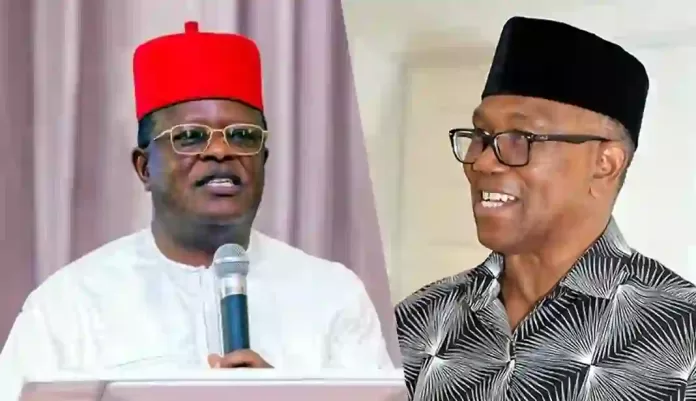
Consider Engineer David Umahi. His outlook, often framed through a strongly Abakiliki lens, is frequently reflected in public remarks that tend to downplay Obi’s national profile. Seizing every opportunity to speak critically, Umahi consistently advances three main propositions: first, that President Bola Tinubu represents the most consequential leadership Nigeria has experienced in recent times; second, that opposition to his administration is fundamentally misguided and politically self-defeating; and third, that Peter Obi’s political influence is overstated and lacks national depth, with an implied suggestion that he himself possesses greater political weight and experience.
I think Umahi represents those typical Igbo men whose senses are blinded by ambition and whose political sanity is perpetually open to question. I recall what he did or received from Obi when Obi was the Vice Presidential candidate to Atiku, and the least support he ought to have offered was managing the campaign in Ebonyi, which he openly sabotaged after… The brief revelation by that woman regarding a contract executed for him shows how soulless he is and how he operates below qualities that could be genuinely considered human. He loves Tinubu more than he loves his father and mother. I heard him call Obi deceitful and speak about stopping a project based on what he heard from social media postings. What does he hope to achieve by amplifying such falsehoods? In fact, he is a clear danger to humanity and civilization.
Adjacent to these institutional struggles stands a relentless auxiliary of the press – a fierce coalition of detractors featuring Bayo Onanuga, Daniel Bwala, Reno Omokri, and Femi Fani-Kayode. Together, they function as a powerful engine of detraction, specializing in the art of public character assassination. With tireless persistence, they exhume old ghost-stories of scandal, amplify hostile narratives, and, when truth fails them as usual, simply manufacture new ones. They are known for concentrating acid in their inks, pouring out vitriol in full measure to burn any character they touch. Yet, despite the sheer weight of this onslaught, Obi’s reputation and personal integrity ultimately overpower their collective assault, leaving the core of his political identity remarkably unblemished. Thanks to “Obidients” who are more than equal to the task of standing up to them.
As if to outdo this quartet, Senator Adams Oshiomhole entered the arena. His morose outlook, gloomy disposition, and controversial travel history (Private jet) often place him at the centre of public debate. Politically, he began like Gabriel but is, in the words of some critics, in danger of ending like Lucifer. I recall when he was Governor of Edo State and seeking re-election; he practically prostrated (“dobale”) before Obi, pleading with him to come and campaign for him, publicly describing Obi as the best governor in Nigeria, whose testimonial would be beyond dispute. On that basis, Obi went to Edo State to campaign for him. Today, however, his tone has changed significantly, as he has made remarks questioning security under Obi’s tenure, despite contemporaneous reports – including assessments attributed to the Inspector General of Police – which ranked Anambra among the safest states in the country at the time.
Separately, there is Daleon Ademolake-Clarke, a lawyer and my classmate who has become a pro-Tinubu social media commentator. He leads a faction that regularly participates in and amplifies what many would consider unfounded narratives against Obi, whether through original posts or reshared content. In his efforts to defend Tinubu, he often engages in this digital contestation with considerable intensity. Most of those within this online classification, however, operate under anonymous or pseudonymous identities, because they consider what they do as “infra dig.”
There is the “City Boys” group – a loose network of individuals with varied perspectives, many of whom appear content with simply being associated with the ruling party, often with little concern for the ideological substance behind it. They are driven largely by the search for visibility, money to grab, belonging, and recognition within the social media space. Among its more prominent figures is Cubana Chief Priest, whom some loosely describe as “money without the man,” a phrase meant to capture the performative nature of influence within that circle. Their primary currency is attention. Together, they form an ecosystem that frequently recycles and amplifies negative propaganda, driven less by coherent conviction and more by the pursuit of engagement, clout, and relevance they lack honourable means of attracting. A significant number of participants in this space are also drawn from the diaspora, further expanding its reach and intensity. Left exasperated by the spectacle of their antics, Obi once remarked, and correctly so: “City boys! Is it only the East that has boys?”
Valentine Obienyem
Finally, we have a group that defies reason, often associated with Kenneth Okonkwo. Their positioning within the political discourse is fluid and, at all times, inconsistent. Some of the individuals in this class, whom I also describe as the dregs of society, include Jones Onwuasoanya, Iyke Orji, Chijoke Sam, Okeke Godwin Iyke, Oraegbunam Pajimo, Machi Pius Igwe, and Chukwuma Okafor. Their interventions often reflect opportunism, prompted by a lack of coherent direction. They are political “ikwurigbas” and “aturusokwunye ewu.”
In all of this, an undeniable pattern stands out: a sustained and coordinated hostility against a single figure, shaped by shifting alliances, political self-preservation, and evolving interests.
One must ask: What is Tinubu so afraid of that he must mass such unprecedented opposition against one man—a spectacle never before witnessed in the history of Nigerian political opposition? The President reminds me of the Roman Emperor Domitian, who was so consumed by the fear of conspiracy that he lined the walls of his porticoes with shining, polished stone, creating mirrors so that he might always see whatever went on behind his back. Tinubu must be the reincarnation of that paranoid sovereign. There is no apparatus he has not engaged to track, monitor, and desperately eyeball Obi’s every movement.
What, then, are Obi’s sins? His “sins,” if they can be called that, are remarkably simple. He has sought, as far as humanly possible, to wrong no man, even in the most trivial of matters. He has cultivated a reputation for personal discipline and moderation, rarely placing personal comfort above public duty. He has consistently preached prudence, accountability, and the careful management of scarce resources, insisting that government should serve the people rather than those who occupy public office. He has also demonstrated a capacity to distinguish between what is politically expedient and what is morally or economically sound, often choosing the latter even when it is unpopular.
Yet, in a political culture where excess is often celebrated, restraint becomes a crime; where patronage is the currency of power, frugality is viewed as a threat; and where politics is treated as a private estate, the insistence on transparency is seen as subversive. It would therefore appear that Obi’s greatest offence is not what he has done, but what he represents. His real “sin” is that, endowed with these qualities and enjoying considerable public appeal, he dares to aspire – within his constitutional rights – to the highest office in the land. In seeking the presidency, he challenges entrenched interests, unsettles comfortable arrangements, and offers an alternative vision of leadership. For many of his opponents, that appears to be an unforgivable transgression.
People love Peter Obi because of his undeniable antecedents. He was the lone governor who consistently advocated for national savings during the Jonathan administration, warning against a culture of consumption without production, and he went on to practise exactly what he preached. The people of Anambra State remain deeply grateful to him because he had the courage to confront – and, through difficult and sometimes painful decisions, substantially cure—m – the cancer of political disorder that once threatened to consume the state. He restored a measure of stability, fiscal discipline, and confidence in public administration, leaving behind a legacy that many still reference today.
Is it his fault that this affection has become contagious? Is it his fault that the admiration once confined to Anambra has, through the osmosis of shared experience and collective aspiration, spread across the nation? People did not wake up one morning and decide to support him out of sentiment. They looked at his record, weighed his words against his actions, and concluded that there was a rare consistency between the two. In a country where promises are abundant and performance often scarce, that consistency has become his greatest political asset.
This is why the relentless attacks on him have largely failed to achieve their intended purpose. The more his critics seek to diminish him, the more they inadvertently remind people of the qualities that first attracted them to him. His appeal is not founded on propaganda, ethnicity, religion, or the machinery of state. It is rooted in a perception that he represents competence, prudence, integrity, and hope. And ideas rooted in hope are notoriously difficult to defeat.
Perhaps that is the central lesson of this modern “Seven Against Thebes”. The story is not really about the seven who stand at the gates; it is about why they are there in the first place. The intensity of the opposition is itself a measure of the significance of the figure they oppose. If Peter Obi continues to command unusual attention from politicians, commentators, influencers, and power brokers alike, it is because they recognise what millions of Nigerians already recognise: that he remains a consequential force in the national conversation. Whether one supports him or opposes him, one cannot ignore him. And in politics, as in life, the surest evidence of relevance is not the number of friends one has, but the number of adversaries one compels to unite against him.
It’s double celebration for the All Progressives Congress APC as its candidate for Ondo South Senatorial District bye-election Prof Adedayo Faduyile, was declared victorious in the Ondo South Senatorial District bye-election held on Saturday, securing a decisive mandate from voters across the district’s six local government areas.
His victory is coming after that of Ekiti state APC Governorship candidate, Biodun Oyebanji.
The Returning Officer for the election, Prof Gbenga Ibileye, officially declared Faduyile the winner at the Independent National Electoral Commission (INEC) collation centre in Okitipupa, Ondo State, after the completion of the collation of results from all participating local government areas.
According to the final results announced by the Returning Officer, the APC candidate polled a total of 68,474 votes, defeating candidates of the Allied Peoples Movement (APM), Action Peoples Party (APP), and the Boot Party.
Faduyile, a former National President of the Nigerian Medical Association (NMA) and currently the Special Adviser on Health Matters to Ondo State Governor, Lucky Aiyedatiwa, ran a campaign focused on quality representation, healthcare development, youth empowerment, and infrastructural advancement across the senatorial district.
His victory is seen as a major boost for the ruling APC in Ondo State, further strengthening the party’s political dominance in the state’s southern senatorial zone.
The bye-election was conducted to fill the vacant Ondo South Senatorial seat in the National Assembly, following appointment of Jimoh Ibrahim as UN Representative by President Bola Tinubu.
The poll witnessed the deployment of security personnel and electoral officials across the district to ensure a peaceful and credible voting process.
Political stakeholders, party agents, election observers, and supporters gathered at the collation centre as the final results were announced, with jubilation erupting among APC supporters following the declared winner.
The People’s Democratic Party PDP, African Democratic Congress ADC and others had boycotted the poll.
Prof Faduyile is expected to represent Ondo South Senatorial District in the Senate, succeeding the former occupant of the seat and carrying the mandate of the electorate to the National Assembly.
For Ekiti State Governor, Biodun Oyebanji, it was not only a clean sweep across the 16 Local Government Areas of the State when the Independent National Electoral Commission, INEC, declared him the winner of the Governorship polls early Sunday morning he made history. He broke the jinx. He became the first Governor in Ekiti State to win back-to-back.
INEC had announced the registration of 988,923 eligible voters to participate in the election.
Of the figure, a total of 720,724 people collected their permanent voters cards.
The results announced by INEC indicates that a little well over 500,000 voters participated in the poll.
The All Progressives Congress, APC, had earlier boasted of polling 500,000 votes for its candidate, Governor Oyebanji.
On Sunday when INEC declared APC’s candidate and incumbent Governor, winner of the governorship election, he polled less than 320,000 votes. He, however secured a swepy victory across all 16 local government areas of the state.
The Returning Officer for the election and Vice-Chancellor of the Federal University of Technology, Akure, Professor Adenike Oladiji, announced the results in the early hours of Sunday, confirming Oyebanji’s dominance over his closest rivals, Dr. Wole Oluyede of the Peoples Democratic Party (PDP) and Dare Bejide of the African Democratic Congress (ADC).
Results collated from the 16 local government areas showed that Oyebanji polled a total of 319,224 votes, while Oluyede garnered 40,543 votes and Bejide secured 12,872 votes.
Oyebanji defeated Oluyede by a margin of 278,681 votes and Bejide by 306,352 votes, underlining the scale of his victory.
The APC candidate recorded victories in all the councils, underscoring his overwhelming statewide acceptance and the strength of the ruling party’s grassroots structure.
LG Results breakdown
In Ijero Local Government Area, Oyebanji polled 25,506 votes to defeat Oluyede, who scored 2,479 votes, and Bejide, who secured 2,026 votes.
At Ikere Local Government Area, the governor garnered 11,116 votes to floor Oluyede’s 9,892 votes, while Bejide trailed with 245 votes. The result represented the PDP’s strongest showing in the election.
In Ado-Ekiti Local Government Area, the state capital, Oyebanji secured 38,026 votes to defeat Bejide, who polled 3,817 votes, and Oluyede, who garnered 1,054 votes.
The APC candidate also dominated in Aiyekire/Gbonyin Local Government Area with 17,133 votes, leaving Oluyede and Bejide behind with 1,563 and 314 votes respectively.
In Efon Local Government Area, Oyebanji polled 8,742 votes, comfortably ahead of Oluyede’s 2,051 votes and Bejide’s 205 votes.
The governor continued his winning streak in Ekiti East, where he secured 26,359 votes to defeat Oluyede, who scored 2,795 votes, while Bejide polled 1,730 votes.
In Ekiti West, Oyebanji obtained 28,258 votes, leaving Oluyede with 3,644 votes and Bejide with 674 votes.
At Emure Local Government Area, the APC candidate garnered 14,325 votes to beat Oluyede’s 851 votes and Bejide’s 732 votes.
A major talking point of the election emerged in Ekiti South-West Local Government Area, the home council of ADC candidate Dare Bejide. Oyebanji recorded a landslide 14,705 votes to defeat Oluyede, who scored 1,800 votes, while Bejide managed 1,076 votes in his own local government.
In Ido-Osi Local Government Area, Oyebanji polled 17,901 votes to overcome Oluyede’s 1,449 votes and Bejide’s 561 votes.
The APC standard-bearer also cruised to victory in Ikole Local Government Area with 26,508 votes, defeating Oluyede, who secured 812 votes, and Bejide, who polled 750 votes.
At Ilejemeje Local Government Area, Oyebanji secured 8,984 votes, while Oluyede and Bejide garnered 1,243 and 579 votes respectively.
Irepodun/Ifelodun Local Government Area equally fell to the APC candidate, who polled 29,278 votes against Oluyede’s 2,119 votes and Bejide’s 511 votes.
In Ise/Orun Local Government Area, Oyebanji recorded 12,908 votes to defeat Oluyede, who polled 1,627 votes, and Bejide, who secured 365 votes.
The governor maintained his dominance in Moba Local Government Area with 20,500 votes, while Oluyede and Bejide garnered 1,572 and 994 votes respectively.
In Oye Local Government Area, Oyebanji rounded off his statewide sweep with 18,975 votes, defeating Oluyede, who polled 2,891 votes, and Bejide, who secured 998 votes.
The public response issued on behalf of former Benue State Governor, Chief Samuel Ortom, following the submission of the report of the Benue State Income and Expenditure Commission of Inquiry, raises familiar arguments that deserve clarification rather than emotional amplification.
At the heart of the matter is a simple question: Should former public office holders be exempted from scrutiny once they leave the office? The answer is clearly no.
It is ironic that those who now condemn the investigation as a political witch-hunt were themselves active participants in similar accountability processes while in government.
During his tenure as Governor, Chief Samuel Ortom constituted the Justice Elizabeth Kpojime Commission of Inquiry to investigate the administration of former Governor, Senator Gabriel Suswam. That commission made its findings and presented its recommendations to Ortom for further action. To date, legal proceedings arising from the probe are ongoing.
Having embraced the principle of probing a predecessor while in office, it is difficult to understand why the same principle has suddenly become objectionable to Ortom when applied to his administration.
The attempt by his media handlers to portray the exercise as a diversionary tactic designed to distract from governance challenges is equally unconvincing. Accountability and governance are not mutually exclusive responsibilities.
Governor Alia is simultaneously pursuing developmental objectives while ensuring that public resources entrusted to previous administrations are also properly accounted for. Transparency and accountability are essential components of good governance, not distractions from it.
The argument that previous panels established by the present administration were challenged in court and subsequently dissolved does not invalidate the legitimacy of investigating past government activities. In a constitutional democracy, disputes over the legality of commissions of inquiry do not automatically extinguish the government’s authority to seek answers regarding the management of public resources. Ultimately, the courts will determine whether the commission was properly constituted and whether its findings meet legal standards.
It is also important to note that merely describing an investigation as a witch-hunt does not make it one. Such allegations are common whenever former public officials face scrutiny. The real test lies elsewhere: Was the evidence properly examined? Were conclusions supported by verifiable facts? These are the questions that should concern the public. Political rhetoric cannot be substituted for due process.
The Ortom camp appears to suggest that any investigation involving a former governor is automatically tainted by political motives. Such a position is neither sustainable nor democratic. If every probe is dismissed simply because politics exists, then no public official would ever be held accountable. Democratic governance requires that those entrusted with public resources remain answerable for their stewardship, regardless of who they are.
Furthermore, the timing of the report should not be misconstrued as an attempt to divert attention from contemporary issues. The commission was established to examine matters within its mandate, and the submission of its report represents the completion of that assignment. Accountability cannot be suspended merely because governance challenges exist. If anything, responsible governance demands both present performance and retrospective scrutiny.
The people of Benue State deserve facts, not political grandstanding. They deserve a transparent examination of how public resources were managed and whether established procedures were followed. If the findings of the commission are not convincing, the law provides adequate avenues for challenge and redress. If they are valid, they should be addressed on their merits rather than dismissed through allegations of persecution.
Accountability is not a witch-hunt. It is a fundamental pillar of democratic governance. Those who once demanded it from others should not object when it is demanded of them.
Benue state income and expenditure commission of inquiry has uncovered N139.8 billion in unaccounted public funds income and expenditure between 2015 and 2023.
This is an established fact and instead of ranting in the media space, Ortom and his team should be honourable enough to refund the money to the coffers of Benue State.
Sir Tersoos Kula is the Chief Press Secretary to the Governor of Benue State
Another dimension to vote buying was experienced on Saturday during the governorship election in Ekiti state.
Investigations revealed that party agents used numbered slips instead of cash for vote buying during the election.
This is just as the Action Group Renewal Organization (AGRO) Nigeria expressed concerns over the credibility and integrity of the governorship election in Ekiti State, alleging widespread irregularities in the issuance of Permanent Voter Cards (PVCs) ahead of the exercise.
There are indications that some voters in the ongoing governorship election in
Ekiti State are selling their votes at the polling units where they are queuing to exercise their franchise.
It was observed across multiple polling units in Emure-Ekiti and Ose-Ekiti Local Government Areas, with incidents consistent with vote-buying at several polling units.
Party agents were seen asking voters to display their marked ballot papers as proof of voting preference.
Rather than distributing cash directly at the polling units, some agents issued numbers to voters after they cast their ballots.
The purpose of the numbers could not be independently verified by this newspaper.
However, the practice was observed repeatedly across some of the polling units visited, with voters receiving numbers after showing their ballot papers to party agents.
Election observers have previously identified the use of coded numbers, tokens and other verification methods as tactics sometimes employed to facilitate vote-buying while avoiding the direct exchange of cash at polling units.
Security personnel and election officials were present at the affected polling units at the time of observation.
Speaking on behalf of the AGRO, on Saturday, the Initiator, Comrade Adeyinka Fadumiye, described as highly suspicious reports indicating that nearly 99 percent of registered voters in Moba Local Government Area had collected their PVCs prior to the election.
Fadumiye, a political scientist with over two decades of experience in election monitoring and observation, argued that such a development is practically impossible in a country where voter apathy has become a recurring feature of the electoral process.
“To suggest that virtually all registered voters in a local government area collected their PVCs defies logic and electoral realities in Nigeria.
“Such a feat would be difficult to achieve even in advanced democracies like the United States. Therefore, serious questions must be asked about how such figures were arrived at,” he said.
The AGRO Nigeria Initiator alleged that some unscrupulous elements within the Independent National Electoral Commission (INEC), working in concert with misguided members of the ruling All Progressives Congress (APC), may have compromised the electoral register and facilitated the issuance of PVCs to unqualified and ineligible individuals.
According to him, if such abnormalities could occur in Moba Local Government Area, it would be difficult to confidently rule out the possibility of similar irregularities in other parts of the state.
“For this situation to arise, it suggests that the voters’ register may have been manipulated to accommodate fictitious names and unauthorized persons.
“This development raises fundamental concerns about the integrity of the electoral process.
“Opposition parties must be seriously concerned about what is happening in Ekiti State. What we are witnessing may be a testing ground for a larger strategy ahead of the 2027 general elections.
“If electoral institutions fail to address these concerns now, similar occurrences may be replicated across the federation,” he warned.
Calling on INEC to restore public confidence in the electoral process, Fadumiye urged the electoral commission to identify and remove compromised officials within its ranks before preparations for the 2027 general elections commence in earnest.
“INEC must redeem itself by purging the commission of bad eggs and ensuring that the integrity of the voters’ register is protected. Any attempt to manipulate or rig the 2027 general elections could have grave consequences for Nigeria’s democracy and national stability,” he concluded.
An Open Letter to Northern Nigerian Political Leaders
By Dr. Zainab Suleiman
An open letter to Northern Nigerian Political Leaders
To: The Governors, Commissioners, Hisbah Boards, Traditional Rulers, and Legislators of Northern Nigeria
Subject: Stop Cloning Poverty: Marry Skills, Not Just Couples
Esteemed Leaders,
I write not to insult, but to confront us with a truth too bitter to keep swallowing.
This year, Kano has approved N1.5bn for 3,000 couples. Katsina is sponsoring 1,000 couples. Zamfara, 100 couples. Mass weddings are paraded as welfare. But sirs, let us ask the hard question: What exactly are we wedding?
1. We are wedding illiteracy to illiteracy
When both partners cannot read a prescription, cannot calculate school fees, and have no trade beyond “survival”, we are not forming families. We are duplicating poverty. A ring does not create income. A certificate of marriage does not create jobs.
2. GDP vs Womb Count
Our GDP grows when we produce goods, services, and ideas. But we celebrate population growth as if it were production. 3,000 new households without land, factories, clinics, or schools is like building 10 floors on sand. The building will fall. It is falling already. You cannot eat GDP. And GDP cannot feed children born into homes with zero economic base.
3. The Street Kid Factory
Marry two people with no income → have 6 kids → cannot feed them → children hit the street. Those street kids don’t disappear. In 15 years they become the statistics for crime, drug abuse, banditry, and terrorism we cry over today.
We are not having babies. We are manufacturing future headlines for NBS and UN reports.
4. Malnutrition is killing our children like chickens
When 8 mouths share 1 meal, the smallest bodies lose first. Stunting, kwashiorkor, measles, diarrhea — these are not “God’s will”. They are math. Calories in < calories needed = death. Our under-5 mortality rate is the verdict on our choices.
5. Broken homes from day one
A wedding does not cure unemployment or trauma. Illiteracy + poverty + desperation = divorce, domestic violence, and children who grow up learning that marriage = suffering, father = absent.
Terrorism does not start with ideology. It starts with hopelessness. Boko Haram, bandits, cults — they do not recruit PhDs. They recruit boys who were “produced” but never raised.
6. This is not religion
Islam demands _nafaqah_ the ability to provide. Christianity says “he who does not provide for his household is worse than an unbeliever”. Our tradition says “know the family you’re joining”.
No religion encourages backwardness. What we are doing is weaponizing religion to dodge responsibility. Piety without planning is negligence with prayers.
7. The women and the future we ignore
Mass wedding + zero family planning education = women’s bodies broken by back-to-back pregnancies. Maternal mortality is the hidden tax we don’t budget for.
When 7 kids share 0 books, public schools collapse into daycare centers. Mental health dies under shame and hunger. And we pretend we will “fix it later”.
The deepest cut for us ,
We are not cursed. We are making choices with consequences. Marrying poverty to poverty and calling it “empowerment” is like pouring petrol on fire and calling it rain.
So what is the plan, leaders?
N1.5bn for dowry, furniture, and N100k “capital”… then silence. No skills training. No literacy classes. No job placement. No follow-up.
The real plan seems to be: “Push the problem 18 years forward and let the next governor handle the street kids.”
Here is what would change everything:
Take half that budget. Before any wedding:
1. Adult literacy + numeracy: 6 months. If you can’t read, you can’t budget.
2. Vocational training: Carpentry, tailoring, solar installation, farming tech, phone repair. Give skills, not just furniture.
3. Family planning + health education: Not to stop births, but to space them so mothers and children survive.
4. Marriage counseling: Teach conflict resolution. A home without peace is a prison.
Marriage should equal: skill + income + literacy + planning. Anything less is a photo-op, not policy.
Sirs, we in Abuja see the result daily: beggars at Area 1, almajiri at traffic lights, mothers selling sachet water with babies on their backs. That is not “the poor”. That is the child of the wedding we cheered 10 years ago.
The North does not lack faith. It lacks foresight. If we want a North that leads Nigeria, we must stop producing children without infrastructure. We must stop treating population as wealth.
Give us leaders who think right even when there is no election. Give these couples more than a ceremony. Give them a future.
The children we fail to feed today will be the men we fail to jail tomorrow. The choice is yours.