Bode George, a former Deputy National Chairman of the Peoples Democratic Party, PDP, says the country is in shamble under the watchful eyes of President Bola Ahmed Tinubu.
According to the PDP chieftain, Nigeria “has been completely in a shambolic situation, it is perpetual despair and despondency,” telling the president that it is not the time to play politics with the problem facing the country at the moment.
George said President Tinubu “has a hell of a job to do” to lift the country out of the current economic decadence left by his predecessor, Muhammadu Buhari.
The administration recently accused the former leader of destroying the economy after spending eight years in office.
The PDP chieftain while speaking on a Channels Television programme, said Buhari left a bad economy that has left many Nigerians in hunger, a situation President Tinubu must now work hard to reverse.
“The state of our nation has been completely in a shambolic situation, it is perpetual despair and despondency. There is hunger in the land and there is anger in the land; the insecurity has gone beyond control,” he stated.
He said further: “So, when you look at all those things; we are all Nigerians and I listened to his (Tinubu) New Year speech and I also listened to what Chief Osoba said, this is not the time to play politics, it is our nation. He (Tinubu) has a hell of a job to do and I have listened to him.
“He has these eight objectives for the year, national defence, internal security, and job creation; the man who left who was my oga did a woeful job, he did not do well at all; they belong to the same party.
“So, we all Nigerians will give him a chance, let us see how he is going to handle it. Bola Tinubu, God will guide him – he is in the hottest seat in the whole of Africa today because for every 10 Africans 6 are Nigerians, brilliant people. So nobody can pull any wool over our eyes, I pray for him, I pray for our country.”
An ardent critic of President Tinubu, Chief George once vowed to leave the country if Tinubu became president.
He has yet to relocate from the country after Tinubu won last year’s presidential election.
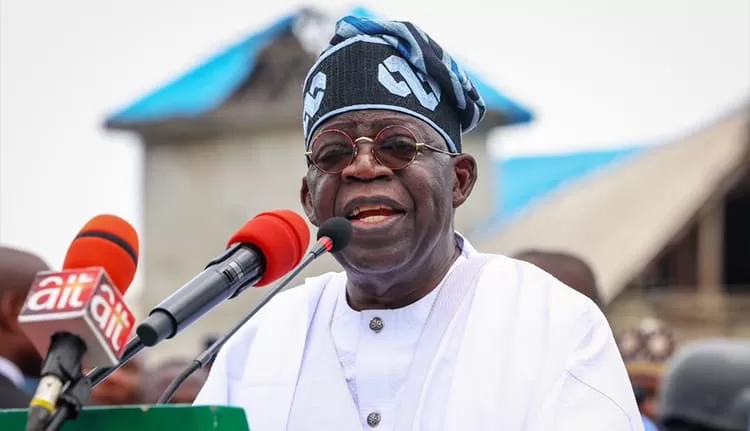
President Bola Tinubu has disclosed that insecurity in the country threatens his administration quest to transform Nigeria to a $1 trillion economy.
In a statement signed by Ajuri Ngelale, the President’s Special Adviser on Media and Publicity, Tinubu said the ‘enemies of progress’ poses a threat to the plan to rejig the country’s economy.
There is an urgent need to put an end to the menace, Tinubu said, adding that he would not accept any excuse from security agencies, saying “failure is not an option under my leadership.”
The president, after coming to office in May this year, promised to raise the bar from the over $400 billion economy left by his predecessors, to the $1 trillion mark.
That projection is now being threatened by the security situation in the country, Tinubu said on Friday, while addressing top security chiefs in the country.
Security experts insist that the problem of insecurity, particularly in the south east and northern parts of the country, for instance, is likely to have ripple effect on the economy.
Last August, President General of Ohanaeze Ndigbo Worldwide, Chief Engr. Emmanuel Iwuanyanwu, claimed that the south east region was losings trillions of naira due to the sit-at-home order by the Indigenous People of Biafra, IPOB, the group blamed for the spate of killing and kidnapping in the region.
Also, in the northern part of the country security agencies are struggling to nip in the bud threats by bandits and terrorists, which according to security experts have put the ‘nation’s food basket’ in peril.
Speaking yesterday during a briefing by the security topnotch, which include Nuhu Ribadu, National Security Adviser, NSA and Service Chiefs yesterday in Aso Rock, Nigeria’s seat of power, President Tinubu ordered them to quash the multi-dimensional security problems to save Nigeria from serious economic problems.
Tinubu said, “we are pursuing a $1 trillion economy in the next few years, and our efforts will be undermined if we do not finally wrap up our progressive onslaught against enemies of progress. Be encouraged. The confidence of our people in your capacity is rising, and they are appreciative of the sacrifices of our men and women.
“The success you are recording is undeniable. Nigerians are seeing it, but the avoidable errors, as witnessed recently in Kaduna, are unacceptable and cannot be repeated. I am pleased that coordination between all agencies has dramatically improved over recent months, but there is no room for celebrations until we can end this; until we can bring our troops back to their own localities, and until we can free up resources for our critical economic expansion programme.
“I do not play with my intelligence reports. I have multiple lines of sight. The Navy and sister branches must step up their game to achieve our aims for the benefit of all Nigerians. All malign actors will be aggressively uprooted from our midst. Those working against the national agenda from within and without will meet justice. Your task is clear. We will sustain our momentum. Failure is not an option under my leadership,” Tinubu stated.
Commences Automation of Government Services Delivery
Governor Ademola Adeleke of Osun state has harmonized, into a single bill, the multiple taxes and levies collected by different Government Ministries, Departments and Agencies across all business sectors, formal and informal.
The Governor’s new initiative was informed by the need to put an end to the incessant challenges of multiple taxation faced by taxpayers in the Osun state.
This Harmonized Bill curates all Levies, which all businesses are expected to pay on an annual basis as a single bill.
The new initiative which was announced by the Governor’s spokesperson, Mallam Olawale Rasheed, explained that the single bill, allows for easy and convenient payments that can be in equal or unequal tranches.
“The harmonized bill certificate will be issued automatically after completion of the payment. Businesses are enjoined to pay their taxes as early as they can as there may be fines or late payment penalty for delayed payments.”
Furthermore, the statement also identified the Official Online Payment Channels in the State as the https://pay.irs.os.gov.ng.
Others are POS Machines in Tax Stations across the state, banks in and outside Osun, ATM Machine across the country and using of any Money Transfer Service for those outside the country by using the Pay with Transfer feature online on http://pay.irs.os.gov.ng.
The State Government has further deployed some Automation Systems for improved government services delivery which include but not limited to the Government Assets and Utility Management System for renting and leasing of government properties and assets, C of O in 45 days programme, Electronic Affidavit system, Electronic State of Origin and Local Government Area of Origin portal, Mobile Tax stations, Seamless online payment systems for taxes among others.
The release then admonished members of the public to always ensure collection of evidence of payment which is in form of Government Automated Revenue Receipt (A.R.R) for all payments made and to visit any OIRS Tax Offices nearest to them for any complain or enquiry.
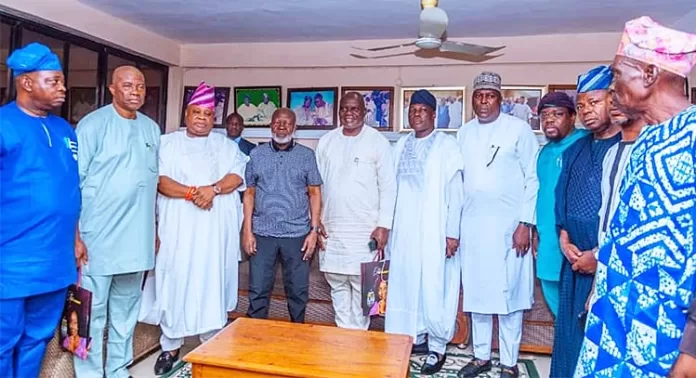
In a dramatic move, top elders of Osun Peoples Democratic Party and members of the party’s Board of Trustees have commended Governor Ademola Adeleke for his concerted delivery of good governance and democratic dividends in the last one year.
Former Deputy National Chairman of the party, Alhaji Shuaib Oyedokun; former National Secretary of the party and former Governor of Osun state, Prince Olagunsoye Oyinlola and the 1999 governorship candidate of the PDP in Osun state and third republic Senator, Dr Oluwole Alabi, all described the Governor’s performance as outstanding, sterling and calling for unconditional rapprochement within the party for a more entrenched hold on the state.
In a series of strategic meetings Tuesday night ahead of an upcoming stakeholders’ meeting , Governor Adeleke was accompanied by his Deputy, Prince Kola Adewusi; Speaker of the House of Assembly, Right Honourable Adewale Egbedun; Deputy Minority Leader, Senator Lere Oyewumi; Secretary to the State Government, Hon Teslim Igbalaye; South West Zonal Vice Chairman nominee, Hon Kamar Ajisafe, State chairman of the party, Hon Sunday Bisi and other critical leaders of government and the party.
Former Governor Oyinlola who affirmed his faith in PDP as an elder of the party said he is proud of Governor Adeleke’s approach to governance as well as his remarkable records of service delivery since assuming office.
“ Mr Governor, we are proud of you. You represent us and the party well. Reports from the streets speak volumes of your good performance”, the prince Okukuland affirmed.
PDP elder, Dr Alabi who will clocks 80 years in March said the Governor has proved naysayers wrong by his spectacular delivery across the sectors in the last 12 months.
“ Let me be frank. I misjudged you. You proved to me and others that you are up to the task, that you know your onions, that you understand the needs of our people and you can deliver democratic dividends.
“ I follow your activities closely. I can confirm that you are performing. Politics apart, you are Mr Performer people are calling you. Your records have rebranded the PDP. Our task is to now close ranks and provide full party backing for your grade A governance”, Senator Alabi posited.
In his frank remarks, the former National Deputy Chairman of the party, Alhaji Oyedokun said Governor Adeleke has discharged his mandate in the best interest of the people, explaining that “ we cannot deny your great performance. On the streets, your positive hands are noticeable.
“ As a long time political actor and as an elder of note locally and nationally, I affirm that you have given the party good records to campaign on. People are thrilled by your person, your brand.
“ You dance to deliver democratic dividends. You praise the Lord as you upgrade infrastructure and take care of workers’ welfare. What we need next is to close our ranks and unite behind your government as a true peoples’ government”, Chief Oyedokun who just lost his wife noted.
Governor Adeleke at the strategic meetings appreciated the party elders for their positive review of his administration ,noting that those kind words coming from the caliber of such leaders further encouraged him to do more.
“I thank our elders for these kind words. Whatever success we have recorded is by God’s grace and peoples’ support. I am encouraged to devote my time to continue to serve the people.
“ I am committed to further open the doors of government and party to all party members. We seek the Governorship and God granted our prayers. So the past is gone, the present and the future are the focus. I value all party members, especially our elders. We will do all that is necessary to ensure an inclusive government committed to public service”, the Governor restated.
“I trust our party chairman, Hon Bisi, will do the needful. To all party men and women, be rest assured that as we raise the profile of the party, we will ensure a new PDP where all members have a sense of belonging for collective success”, the Governor noted.
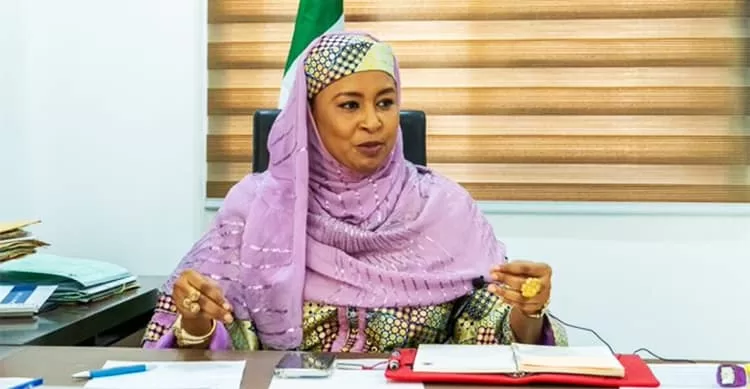
Navigating through banana peels and tempestuous waters was certainly not Dr. Betta Edu’s New Year wish but out of the blues, 2024 began on that volcanic note for the Cross River state-born youthful Minister for Humanitarian Affairs and Poverty Alleviation.
It all started Tuesday, the 2nd of January with the sack by President Bola Ahmed Tinubu for alleged humongous fraud to the tune of N44bn, of Shehu Halima, the Chief Executive Officer of the National Social Programme Investment Agency, NSIPA, an Agency under the Ministry of Humanitarian Affairs and Poverty Alleviation.
No sooner was Mrs Shehu’s sack announced than several online news platforms broke the news of Edu’s alleged complicit in the NSIPAgate.
According to one of the online news publications sighted by The Source, the Minister was alleged to have unilaterally withdrawn N3bn of the NSIPA fund.
President Tinubu: Booted out Halima Shehu
The alleged N3bn heist was followed by a circulating memo of approval by Dr Edu, for the withdrawal of half a billion Naira for disbursement to four states-Cross River, Akwa Ibom, Lagos and Ogun- for the Renewed Hope Grant for Vulnerable Groups.
The payment of the fund into the account of one Mrs Oniyelu Bridget is ostensibly being cited by the Minister’s traducers as evidence of fraud.
However, caught in the vortex of damaging graft allegations, Edu, a former Commissioner of Health in Cross River and the immediate past National Woman Leader of the All Progressives Congress, APC, has laid bare, her five months stewardship in the Ministry as Minister, challenging her accusers to spot a stain if they could.
This magazine was reliably informed that a powerful cabal, jolted by the audacity of the Minister to call the Presidency’s attention to the alleged N44bn NSIPA fraud, was behind the graft allegations against her.
There are, however, whispers that certain disgruntled career politicians in Cross River who were irked by Dr Edu’s surprise emergence as Minister may have also been sponsoring some of the online publications against the Minister.
The aim, it has been alleged, is to force President Bola Tinubu to dispense with her and name one of them as her replacement.
However, multiple Aso Rock sources told the Magazine that the Presidency is aware that the graft allegations against the Minister are phantom as all funds to her Ministry were duly authorized by the President.
Dr Edu’s Special Adviser on Media and Publicity, Rasheed Olanrewaju Zubair, in a series of press releases over the issue, alluded to this.
Describing the online story accusing his principal of fraud as incoherent, disjointed and a calculated attempt to smear her, impeach her integrity and derail the mandate given to her by President Tinubu, Zubair said: “For the records, all the Programmes embarked by the Ministry under the Present Minister, Dr Betta Edu, thus far, including Government Enterprise and Empowerment Programme (GEEP), Grants for Vulnerable Groups (GVG) and others secured the approval of Mr President.
“Therefore, let it be emphatically stated here that at no time did the Minister make unauthorised withdrawals let alone N3 Billion from the NSIPA account or had anything to do with NSIPA funds as alleged by the hack writers.
“The alleged withdrawals only happened in the figment of the imaginations of the merchants of falsehood”
On the half a billion Naira Vulnerable Group Grants allegedly paid into the account of one Oniyelu Beatrice, Zubair clarifies thus: “It is glaring that the same sponsored disgruntled elements who in the past few days have been trying to smear the Honourable Minister, Dr Betta Edu, and stain her integrity because she brought Federal Government’s attention to the ongoing 44.8 Billion fraud in NSIPA are behind this.
“These elements have been trying to link her to a phantom fraud and are behind this latest misadventure.
“However, this latest vile effort of theirs is another infantile blackmail doomed for evisceration.
“For the avoidance of doubt, the said N585,198,500.00 was approved, and it is meant for the implementation of Grants to vulnerable groups in Akwa Ibom, Cross River, Ogun, and Lagos states. We must, however, note that GVG was first launched in the Kogi state where recipients testified.
Halima Shehu: Sacked
“Akwa Ibom and Cross River were launched in December 2023, Kogi already happened in November, and others will be launched in the coming weeks.
“The general public is invited to note that the Renewed Hope Grant for Vulnerable Groups is one of the social intervention schemes of the federal government, which is being implemented by the Ministry of Humanitarian Affairs and Poverty Alleviation.
“Oniyelu Bridget is the Project Accountant for GVG from the Department of Finance and it is Legal in civil service for staff, the Project accountant is to be paid and use the same funds legally and retire with all receipts and evidence after the project or Program is completed.
“The evil motive of the mischief-makers behind the circulation of the memo is well-known and should be ignored”
Meanwhile, a public affairs commentator, Aminu Danbaba has dismissed as “dissipation of energy”, the allegations against the Minister.
Danbaba who said he has been following her trajectory in public office right from her days in the Cross River state government stated: “Having closely followed Dr Edu’s trajectory in public office, it was inconceivable that anyone could accuse her of financial impropriety of any kind because Dr Edu is a stickler for due process and will never circumvent rules to achieve an end, whether such an end is personal or official.
“It is, therefore, obvious that sponsors of the spurious N3bn NSIPA withdrawal allegation against the Minister do not know the Betta Edu persona; otherwise, they would not have dissipated energy concocting the laughable allegation: Betta will NEVER tip her hand into the public treasury”
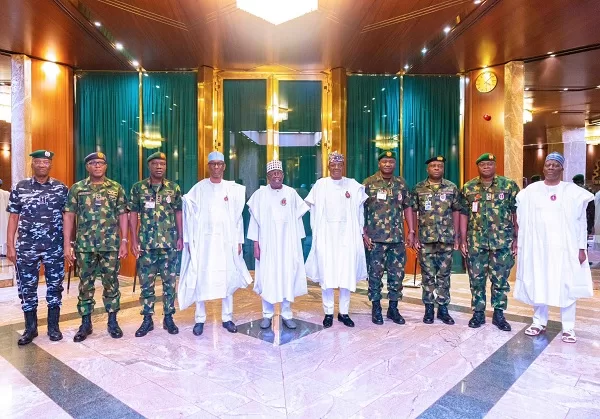
President Bola Tinubu met with Security Chiefs in Abuja on Friday and asked them to ensure that there is conclusive victory against the myriad of security threats in the country.
Addressing the Chiefs and Heads of Intelligence Agencies at a Presidential security briefing at the State House, in Abuja, President Tinubu said while good progress is being made with the elimination of some security threats across multiple theatres, success will ultimately be defined by a final conclusion to the multi-dimensional menace.
A statement by Ajuri Ngalele Presidential Spokesman stated that Tinubu remarked that “We have too many investments that we need to make now in soft and physical infrastructure, in social security, in MSME empowerment, and other growth enablers.
“We are pursuing a $1 trillion economy in the next few years, and our efforts will be undermined if we do not finally wrap up our progressive onslaught against enemies of progress.
“Be encouraged. The confidence of our people in your capacity is rising, and they are appreciative of the sacrifices of our men and women.
“The success you are recording is undeniable. Nigerians are seeing it, but the avoidable errors, as witnessed recently in Kaduna, are unacceptable and cannot be repeated.
“I am pleased that coordination between all agencies has dramatically improved over recent months, but there is no room for celebrations until we can end thisuntil we can bring our troops back to their own localities, and until we can free up resources for our critical economic expansion programme.”
The President emphasized that the armed forces must deliver on his objective to ensure the nation achieves a sustainable production of two million barrels of crude oil per day, including condensates, within the first quarter of 2024.
“I do not play with my intelligence reports. I have multiple lines of sight. The Navy and sister branches must step up their game to achieve our aims for the benefit of all Nigerians.
“All maligned actors will be aggressively uprooted from our midst. Those working against the national agenda from within and without will meet justice. Your task is clear. We will sustain our momentum. Failure is not an option under my leadership.”
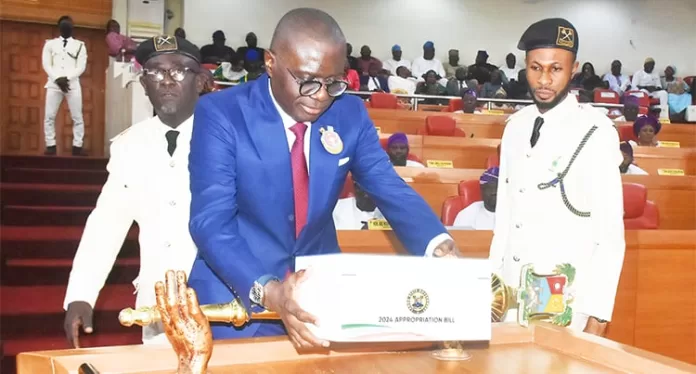
A sigh of relief came the way of Governor Babajide Olusola Sanwo-Olu as the Rt. Hon. Mudashiru Obasa led-Lagos State House of Assembly on Friday, finally, passed a total of N2,267,976,120,869 as the 2024 budget for the State.
The budget made up of 58 percent Capital Expenditure and 42 per cent Recurrent Expenditure was approved following a unanimous voice vote by all the lawmakers present at the sitting.
“A bill for a law to authorise the issuance and appropriation of N952,430,566,998 from the Consolidated Revenue Fund for Recurrent Expenditure and N1,315,545,553,871 from Development Fund for Capital Expenditure thereby totaling a budget size of N2,267,976,120,869 for the year ending 31st December, 2024 be passed into law,” the Speaker had raised on the floor as the budget report was read a third time.
Obasa, thereafter, commended the Lawmakers for their dedication and cooperation at ensuring a quick passage of the Appropriation Bill while directing the Clerk of the House, Barr. Olalekan Onafeko, to forward a copy of the approved budget to Governor Babajide Sanwo-Olu for assent.
Prior to its passage, Hon. Sa’ad Olumoh, chairman of the joint-committee on Budget and Finance, had presented a report containing some recommendations to the House.
Among the recommendations is that the Public Works Corporation, the Water Corporation and the state-owned tertiary institutions be placed on first-line charge to enable them perform optimally.
Governor Sanwo-Olu had on Wednesday, December 13, 2023, presented the 2024 budget proposal of N2.246 trillion to the House of Assembly saying that the state anticipated internally generated revenue of N1.251 trillion and federal government allocations of N596.629 billion.
Recall that Obasa, during the presentation of the budget by the Governor, urged the Government to ensure a functional budget.
“It is highly important for us to apply the right indices towards ensuring a performing and functioning budget that would lift our people out of poverty and reposition the state towards infrastructural growth and renewal.
“Palliatives should move from just giving people garri, rice, beans or even money. We should have a direction that is focused, impactful and deeply backed up by effective policy implementations.
“For instance, in the name of palliative care, let there be provision of drugs at all public hospitals in the state at subsidised rates. At the same time, focus should be on a downward review of treatment costs in these hospitals,” the Speaker said during the budget presentation.
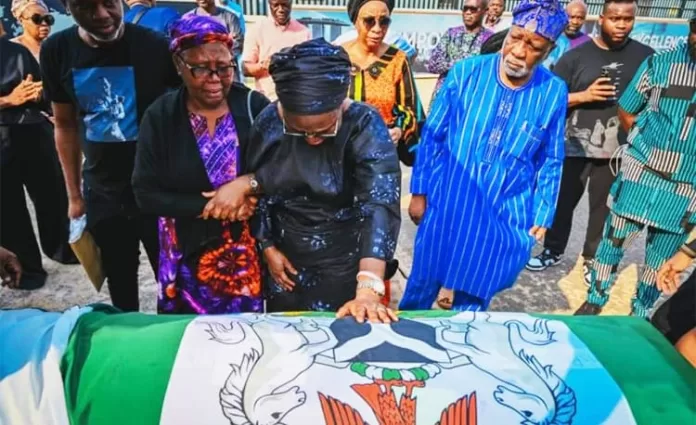
The body of the late former Governor of Ondo State, Oluwarotimi Akeredolu has arrived Nigeria.
The aircraft which conveyed the body arrived about 3:39 p.m, Friday.
The late Governor’s remains were brought into the country from Germany, where he passed away.
The body was received by his wife, Betty Anyanwu-Akeredolu, his children, and siblings led by Prof. Wole Akeredolu, the immediate younger brother.
Lagos State Governor, Mr. Babajide Sanwo-Olu, represented by his Chief of Staff, Tayo Ayinde; Ogun State Governor, Prince Dapo Abiodun, represented by the Secretary to the State Government, Tokunbi Talabi; and representative of Osun State Governor, Senator Demola Adeleke also joined in receiving the body.
Chairman of the All Progressives Congress (APC) in Ondo State, Ade Adetimehin; a member of the House of Representatives, Gboyega Adefarati, and some members of the Ondo State Executive Council, led by the Secretary to the State Government, Princess Oladunni Odu, were also present at the airport to receive the body of the former Governor.
Family members, followers, friends, and associates could not control their emotions when the body of the late Governor was lowered from the plane.
Late Governor Akeredolu passed on in Germany on December 26, 2023.
His remains have been deposited at the morgue until the final burial.
Details of the burial arrangements are expected to be announced by the family at a later date.
The peace initiative in the South East region is getting a boost as the Northern community resident in Abia State, and the Bishops of Methodist Church, have pledged to support Peace In South East Project, (PISE-P) to ensure it achieves its objectives.
PISE-P, brain child of the Deputy Speaker, House of Representatives, Benjamin Okezie Kalu which calls for a non kinetic approach to resolving the security issues in the region was recently unveiled in Bende Local government Area of Abia State.
Speaking during a courtesy call on the Deputy Speaker in Bende on Friday, leader of the northern community, Alhaji Saliru Idris said members will join hand with Kalu to ensure that the project is sufficiently achieved.
He appreciated Kalu for coming to their aid when the Lokpanta cattle market in Umunneochi Local government area of the state got burnt.
“We will rally round to support this movement. Part of the reason why we are here is because, when our brothers in the cattle market had a problem, when you heard about it, you asked me what was the problem.
“Immediately you took action by forming a committee of the House of Representatives who were sent to this place for a fact finding mission.
“The people were overwhelmed with joy and pleaded with me that whenever an opportunity comes for them to thank you physically, they will like it. That’s why when they heard about this, they quickly said let’s come and show you the appreciation.
“That made us to believe that, indeed, we have a brother in the House of Representatives.”
Earlier in his remarks, the Deputy Speaker sued for peace amongst them and their host communities.
“The northerners are very trustworthy, that’s the truth. We are one nation. We are one. We should always find a reason to come together. I have northerners working with me.
“This is the spirit I want to build around Nigeria. Let me tell you, because of my love for one Nigeria, that was why the Emir of Kano, and Emir of Bichi were here for the unveiling of PISE-P.
“It’s the first since 1914, you have the leader of the south west, Ooni of Ife here, Emir of Bichi, Kano, Obi of Onitsha all in one place talking about peace.
“Some donated cows, money and so on. They said they like what we are doing. I want you to like what we are doing as well because you will benefit from it. Let’s have one Nigeria where there’s peace.”
Similarly, Bishops of Methodist Church led by the Arch Bishop of Umuahia Diocese, His Grace, Chibuzor Okpoko said the Church will fully get involved in spreading the message of peace across the south east and indeed, Nigeria in general.
He said: “Let me say this. We thank God that we have an opportunity for our son to be the number six man in the nation. We want to also thank God that from the state government, Governor Otti planned a reception for you.
“It has never happened before. We as Methodist Bishops are also happy that you made the whole country come to Bende Local Government Area. We are happy that there was no security issues.
“The Issue of peace is what we are involved in. No peace, no security. I want to thank you for the peace initiative you just started. We are committed to this. The good thing is that the governors were involved. For me to see the governors make a pledge, it was a perfect synergy.
“I want to say that we will pray for you. We don’t care about the party but the personalities and the people who are ready to impact our people. We have to be pragmatic.
“We have a role to play. The impact of the clergy is not to be doubted at all. We are standing with you on this bold step. We will pray for you and ask God to give you more wisdom”, Okpoko said.
In his remarks earlier, Kalu asked the clergy men to support the peace initiative, stressing it will help integrate the south east into the national political mainstream.
“Talk about it and tell the people why peace is needed. The Muslims are supporting this peace and Christians must also support this peace.
“Let’s use the non kinetic means. We can achieve those things agitating you but not through the barrels of guns. The President of Nigeria loves the South East and he is in support of this initiative.
“I want to tell Mr. President that these were the general that partnered us. I don’t want to do it alone. I have pushed for a platform that will stimulate reintegration.
“I need you to support this initiative, back me up with prayers. It’s a long journey but no matter how long, starting with prayers will reduce it. In the next six months, Peace in South East will be building roads, markets. We will get the results.”
Jolly Nyame, former Taraba State Governor has gone down memory lane on his time at the Kuje Prison Correctional Center, Abuja.
Nyame served time for embezzlement and diversion of public funds.
He disclosed that he learnt a lot which has made him know more about life and what it entails.
He said this during a Thanksgiving service which took place at the Christian Association of Nigeria, CAN Secretariat in Jalingo, Taraba State Capital.
The former Governor vowed to emerge as a more capable leader following his incarceration if given a second chance to preside over the affairs of the state.
He declared that the experience had bestowed invaluable lessons, shaping him into a better potential leader for the people of Taraba State.
Nyame stated, “I learned a lot while in Kuje Prison and in the hospital. If given another opportunity to lead the people of Taraba State, I will do better because of the experience I have gained.”
He stressed the significance of faith and resilience, advising leaders to stand strong in the face of challenges.
Nyame, who served only four years of a 14-year sentence, asserted that his imprisonment was politically motivated.
Amidst personal reflections, he delivered a message of hope and unity for Nigerians, emphasizing the importance of prayer and faith in the nation’s future.
On his personal journey, Nyame urged Nigerians to be prudent in their expenses while calling on the government to prioritize policies that enhance citizens’ lives.