

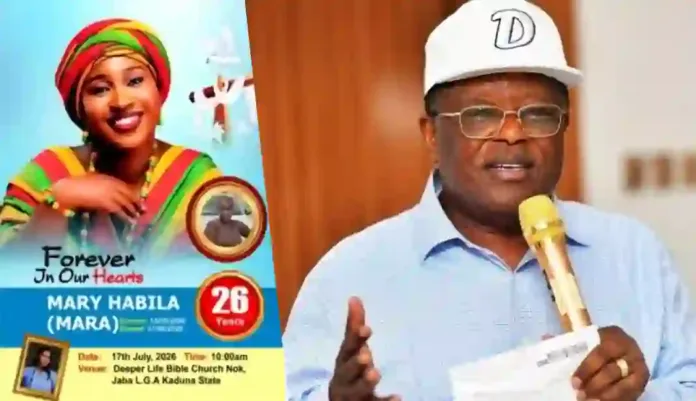
A former Minister of Science and Technology, Uche Nnaji, has been, finally, arrested after several months of uncertainty that trailed his alleged Certificate Forgery Scandal.
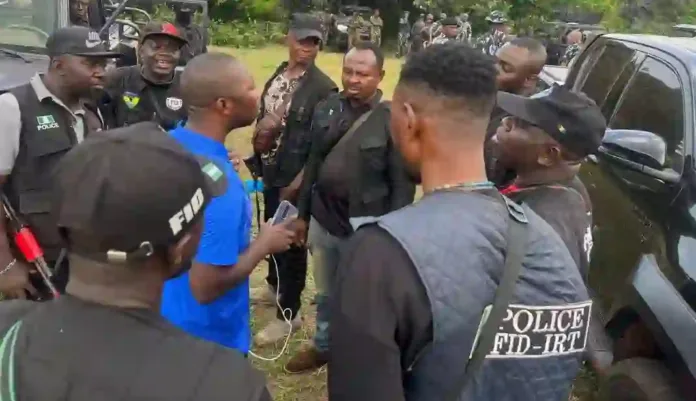
He was arrested Wednesday morning at the Akanu Ibiam International Airport in Enugu while preparing to board a chartered flight to Abuja.
Nnaji was intercepted by security operatives at the airport and taken into custody.
He is expected to be handed over to the Independent Corrupt Practices and Other Related Offences Commission, ICPC, for further questioning.
Recall that Nnaji’s alleged Certificate forgery scandal has been a long-running controversy. He was alleged to have submitted forged academic credentials during his appointment process.
He has been under investigation following allegations that he falsified his educational records, including his University degree and National Youth Service Corps, NYSC, certificate.
This led to his forced resignation as Minister, as the matter gained wider public attention after investigations raised questions over the authenticity of documents submitted by the former minister to key government institutions during his screening and confirmation process.
Civil Society Groups, anti corruption Groups and opposition Parties had petitioned President Bola Ahmed Tinubu over the certificate forgery Scandal rocking his administration, with
findings from earlier investigations disclosing that documents were reportedly submitted to the Nigerian Senate, the Office of the Secretary to the Government of the Federation, and other security agencies as part of official verification procedures.
The anti-corruption agency had intensified efforts to bring Nnaji in for questioning after accusing him of repeatedly ignoring several invitations sent to him regarding the case.
His alleged refusal to honour those invitations reportedly pushed the commission to seek legal backing for stronger action.
Earlier in June 2026, a Federal High Court sitting in Abuja granted the ICPC permission to arrest the former minister as part of ongoing investigations into the alleged certificate forgery.
The Court also approved an application allowing the commission to declare him wanted through newspapers, social media platforms, and other media channels if necessary.
The Commission argued before the court that Nnaji had failed to cooperate with investigators despite repeated invitations for what it described as investigative activities.
The forgery allegations stem from reports suggesting that the former minister presented documents claiming he graduated from the University of Nigeria, Nsukka (UNN) and completed the mandatory NYSC programme.
However, investigations later cast doubt on the authenticity of both certificates.
The scandal deepened following news that Nnaji had reportedly admitted that UNN did not issue him a degree certificate, a revelation that further strengthened public scrutiny around the case.
Despite the allegations, the former minister had maintained his innocence and previously dismissed reports surrounding the matter as a coordinated media attack.
He also challenged the court’s arrest order by filing an appeal at the Court of Appeal in Abuja in an attempt to halt enforcement.
His arrest now signals a significant turning point in the case as investigators move to intensify questioning.
Governor Uba Sani of Kaduna state has stared that President Bola Ahmed Tinubu has done enough for the north to attract it’s votes in 2027.
The Kaduna helmsman said the president has done more for the region than all his predecessor, including the immediate past president, late Muhammadu Buhari, a northerner who died last year.
Governor Sani made the remark while speaking during an interview on ARISE Television on Tuesday, saying President Tinubu will even garner more votes from the north, more than what he got in the 2023 presidential election.
Most of the votes secured by the president to emerged victor in that election were mostly from the region.
Recently, however, there’s a serious debate in the region on whether the incumbent, who’s seeking a return to office should be supported.
Some of the president’s critics in the region have vehemently opposed his return to office next, accusing him of abandoning the region despite receiving massive support from it three years ago.
Sani, a staunch ally of the president however insisted that President Tinubu has done well for the region, saying it’s people will back his reelection.
He dismissed suggestions that northerners are disappointed with President Tinubu, saying he meant well for the region, citing some signature infrastructure of the incumbent in the region, including roads, which he said were abandoned by his predecessors.
“Let me be very frank with you. And when I talk, I talk on the basis of data and statistics. President Bola Ahmed Tinubu today, I can tell you, he has done more than any leader for Northern Nigeria,” the governor said.
According to Sani, “I can tell you categorically, no president has done to the North in terms of development as President Bola Ahmed Tinubu has done in the last three years. And I’m speaking on the basis of data and statistics.
“A lot of people have come here and told you the North will not vote for Asiwaju. That is a figment of their imagination.”
“I can tell you categorically, I’m the Governor of Kaduna State and I can tell you, Asiwaju Bola Ahmed Tinubu will get more votes in 2027 than what he got.”
Continuing, Sani said, “As we are speaking, and you should jot it down, this project will be commissioned, by God’s grace, November this year, because over N600 billion has already been paid to the contractor.
“I’m following the project personally… President Bola Ahmed Tinubu has already paid the contractors over N600 billion from about N750 billion of the project to complete the road by November.
“Only last three weeks, the President has paid part of the N178 billion to construct the road from Kaduna to Birnin Gwari, which was abandoned for over 25 years. And you tell me the people will not be happy?” the governor said.
“Full Speech Delivered By Chief Olabode George At The 80th Rememberance Anniversary Of Herbert Macaulay In Lagos.”
*Protocols*
I consider it a great honour and privilege to have been invited to deliver this epoch memorial lecture in honour of one of the most remarkable figures in the history of our nation, Herbert Samuel Heelas Macaulay.
Whenever the name Herbert Macaulay is mentioned, one description immediately comes to mind: “The Father of Nigerian Nationalism.”
That title was not inherited.
It was earned.
It was earned through courage in the face of intimidation, through conviction in the face of opposition, through sacrifice in the service of a cause greater than self and finally through an unwavering belief that Nigerians deserved dignity, representation, justice, and a meaningful voice in determining their own future.
Your Excellency, Mr. President, I acknowledge your presence with respect and appreciation. Your attendance at a lecture honouring Herbert Macaulay reflects the importance of preserving the memory of those whose sacrifices helped to lay the foundations of our nation.
The issues we discuss today are therefore not merely historical, they concern the continuing journey of Nigeria and the responsibility that rests upon every generation entrusted with her leadership.
Today, we gather not merely to remember a historical figure, we gather to reflect upon the life, character, vision and enduring relevance of a man whose influence continues to shape the Nigerian story.To understand Papa Herbert Macaulay is, in many respects, to understand an important chapter in the making of modern Nigeria. His life reminds us that nations are not built by accident. They are built by men and women who possess the courage to challenge injustice, the vision to imagine a better future, and the determination to pursue that future regardless of personal cost.
Papa Herbert Samuel Heelas Macaulay was born on the 14th of November, 1864, in Lagos. He was born into a family distinguished by scholarship, leadership, faith, and public service.
Chief Bode George
He was the grandson of Bishop Samuel Ajayi Crowther, the first African Anglican Bishop and one of the most extraordinary Africans of the nineteenth century. The influence of Bishop Crowther upon the young Herbert Macaulay cannot be overstated.
The story of Bishop Crowther is itself one of the most inspiring stories in African history.
Captured into slavery as a child, liberated by the British Navy, educated in Sierra Leone, and eventually elevated to the episcopate, he became a symbol of African excellence, resilience, faith, and intellectual achievement.From him, Herbert Macaulay inherited more than a distinguished family name. He inherited a commitment to learning, he inherited discipline, he inherited faith, he inherited a sense of duty.
And perhaps most importantly, he inherited the conviction that privilege carries responsibility.
The values that shaped Herbert Macaulay were therefore not accidental. They were deeply rooted in a family tradition that emphasised education, service, leadership, and responsibility to society.
From an early age, he demonstrated exceptional intelligence and intellectual curiosity. He received his education at CMS Grammar School, Lagos, one of the foremost educational institutions of its time.
At a period when educational opportunities for Africans were severely limited, Herbert Macaulay distinguished himself academically. His talents eventually earned him the opportunity to pursue further studies in England.There he studied engineering, surveying, and related technical disciplines, acquiring professional qualifications that placed him among the most accomplished Africans of his generation. At a time when very few Africans possessed such credentials, Herbert Macaulay stood out as a highly educated professional whose expertise commanded respect.
His education equipped him not only with technical competence but also with a broader understanding of governance, administration, and the structures through which societies function. Upon his return to Lagos, he joined the colonial civil service as a surveyor in the Public Works Department.
His competence quickly became evident.Yet it was during this period that he also encountered firsthand the inequalities embedded within the colonial system. Working within government exposed him to realities that would profoundly shape the course of his life. He observed a society in which decisions affecting Nigerians were frequently made without meaningful Nigerian participation.
He witnessed policies that disadvantaged indigenous communities. He saw traditional rights weakened.He saw land disputes resolved in ways that often favoured colonial interests over local interests.And he came to understand a truth that remains relevant in every age: – that is, Governance without representation inevitably produces injustice. For many people, such observations might have remained private frustrations.
For Herbert Macaulay, they became a call to action.He recognised that education carries responsibility.He understood that privilege imposes duty.He believed that knowledge must be used in the service of justice.
What began as concern gradually evolved into activism.What began as activism eventually matured into leadership.The colonial authorities soon discovered that Herbert Macaulay was not a man who could easily be intimidated.
He questioned decisions he believed were unjust.He challenged policies that disadvantaged Nigerians.He confronted authority when he believed authority was wrong.He spoke boldly when silence would have been safer.And he did so at considerable personal cost.
His growing criticism of colonial policies brought him into repeated conflict with those who exercised power.
He faced harassment.
He faced prosecution.
He faced imprisonment.
He faced sustained efforts to diminish his influence and silence his voice. Yet throughout these struggles he remained remarkably consistent. His commitment was never rooted in personal gain. It was rooted in his conviction that Nigerians deserved dignity, representation, and a meaningful voice in determining their own future.
The more he witnessed injustice, the more convinced he became that meaningful change required organisation, leadership, and collective action.That conviction would ultimately lead him from activism into politics and establish his place in history as the Father of Nigerian Nationalism.
And it is at this point that Herbert Macaulay ceases to be merely an educated professional and emerges as something far greater:
The recognised voice of an awakening people.
The champion of political representation.
*The defender of indigenous rights*
And d. the pioneer of organised democratic politics in Nigeria.
In Part II this lecture stops being a biography and becomes a national story. This section shows how Herbert Macaulay moved from activism to nation-building and why his legacy still matters today.
PART II
THE NATIONALIST, THE POLITICAL PIONEER, AND THE UNFINISHED WORK OF NATION-BUILDINGAs Herbert Macaulay’s influence expanded beyond Lagos, so too did his understanding of the challenges confronting the Nigerian people.He came to realise that meaningful change could not be achieved through criticism alone.Passion was not enough.Public advocacy was not enough.There had to be an organised platform through which the aspirations, concerns, and interests of Nigerians could be articulated, defended, and advanced.
This understanding marked a turning point in his public life.What distinguished Herbert Macaulay from many of his contemporaries was his refusal to accept injustice as inevitable.
He possessed the rare combination of education, courage, vision, and conviction.He was prepared to challenge authority when he believed authority was wrong.He was prepared to speak when silence would have been safer.
And he was prepared to endure personal consequences in defence of principles he believed were essential to justice and national progress. His experiences under colonial administration strengthened rather than weakened his resolve.The more he witnessed exclusion from governance, the more convinced he became that Nigerians deserved a greater role in determining their own future. By the early decades of the twentieth century, Herbert Macaulay had emerged as one of the most influential public figures in Lagos.
Through journalism, public advocacy, civic engagement, and political mobilisation, he became a powerful voice for reform and representation.His influence did not derive from wealth.It did not derive from official position.It derived from the confidence ordinary people placed in his willingness to speak on their behalf.
He became, in many respects, the voice of those whose concerns were often ignored.What began as advocacy on behalf of Lagosians gradually evolved into something much larger.Herbert Macaulay came to understand that the struggle before him extended beyond Lagos.It extended beyond any single ethnic group.It extended beyond any individual ambition.His nationalism was inclusive.
He envisioned a Nigeria in which every citizen would have a stake in the nation’s future.He believed that governance should be accountable to the people.He believed that public institutions should exist to serve the public interest.He believed that nation-building required both rights and responsibilities.Most importantly, he believed that Nigerians possessed the capacity to govern their own affairs.
At a time when many doubted the political capabilities of Africans, Herbert Macaulay demonstrated unwavering confidence in the ability of Nigerians to shape their own destiny.This conviction led to one of the most significant milestones in Nigerian political history.
In 1923, Herbert Macaulay founded the Nigerian National Democratic Party, the NNDP—the first political party in Nigeria.The establishment of the NNDP represented a watershed moment in the political development of our country.For the first time, Nigerians had an organised political platform dedicated to advancing their interests and promoting political participation.
The formation of the NNDP marked the transition from isolated resistance to structured political engagement.It transformed political advocacy into organised political action.The NNDP was more than a political party.It was a declaration of confidence in the political future of Nigerians.It was an affirmation that Nigerians deserved representation.It was an assertion that Nigerians should participate meaningfully in decisions affecting their lives.It was, in many respects, the beginning of organised democratic politics in Nigeria.
Through the NNDP, Herbert Macaulay demonstrated that effective leadership requires more than criticism.It requires organisation.It requires institution-building.It requires the ability to convert ideas into action and aspirations into achievement.This remains one of the enduring lessons of his life.
Great nations are not built merely by identifying problems.They are built by creating institutions capable of solving them.
As the years progressed, Herbert Macaulay’s reputation continued to grow.He became increasingly recognised not merely as a political activist but as the foremost symbol of emerging Nigerian nationalism.
His leadership inspired a generation of Nigerians to believe that change was possible.
He encouraged citizens to see themselves not simply as subjects of colonial administration but as stakeholders in the future of their country.Long before independence became a realistic political objective, Herbert Macaulay was laying the intellectual and political foundations upon which future generations would build.
He planted seeds whose harvest he knew he might never personally enjoy.Yet he continued the work because he understood that true leadership is measured not by immediate reward but by lasting impact.One of the most significant chapters of Herbert Macaulay’s later years was his collaboration with Dr. Nnamdi Azikiwe. Together, they helped transform nationalist aspirations into a truly national movement.
The partnership between Herbert Macaulay and Nnamdi Azikiwe represented a powerful convergence of experience and youthful energy.Macaulay brought wisdom, credibility, and decades of political struggle. Azikiwe brought dynamism, intellectual influence, and a growing national following.
Together, they demonstrated the power of unity of purpose in pursuit of a greater cause.Their collaboration helped strengthen nationalist politics and prepared the ground for the developments that would eventually lead to self-government and independence.
Although Herbert Macaulay did not live to witness the attainment of independence in 1960, his contribution to that achievement remains immeasurable.He passed away in 1946, fourteen years before the realisation of the dream for which he had laboured.
Yet history remembers him because he belonged to that rare category of leaders who devote themselves to causes greater than themselves.He invested in a future that he knew he might never see.He planted seeds whose harvest would belong to future generations.
That, perhaps, is one of the greatest lessons of his life.The generation of Herbert Macaulay understood sacrifice.They understood duty.They understood stewardship.And they understood that nation-building is a responsibility that extends beyond one’s own lifetime.
Ladies and gentlemen,As we reflect upon Herbert Macaulay’s life and legacy, we must now ask ourselves a profoundly important question:
What would the Father of Nigerian Nationalism make of the Nigeria we have become?
Would he recognise the democratic ideals for which he struggled?
Would he be satisfied with the strength of our institutions?
Would he be content with the quality of our leadership?
Would he believe that public office is always exercised in the service of the people?
Would he conclude that the sacrifices of his generation have been fully honoured?
Or would he conclude that some of the battles fought by his generation are still being fought today under different names and in different forms?These are not comfortable questions.But history rarely asks comfortable questions.History asks honest questions.And honest questions demand honest answers.
For while Nigeria has made undeniable progress since independence, there remain challenges that continue to test our national resolve.Indeed, there are moments when one imagines that Herbert Macaulay would view some of our present realities with profound concern.
The Father of Nigerian Nationalism fought for representation, accountability, justice, and the supremacy of the public interest over personal ambition.He fought against exclusion.He fought against arbitrary power.He fought against systems that denied ordinary people a meaningful voice in determining their future.
Were he to observe some of the challenges confronting Nigeria today—the persistence of insecurity, the erosion of public trust, concerns about the strength and independence of institutions, and the frustrations of many citizens—he would undoubtedly remind us that nation-building requires more than political rhetoric.
It requires courage.It requires integrity.It requires institutions strong enough to withstand pressure.And it requires leaders willing to place country above self.Not because Nigeria has failed.But because Nigeria has not yet fully become all that it has the capacity to be.And that unfinished task now belongs to us.
PART III
DEMOCRACY, INSTITUTIONS, NATIONAL SECURITY, AND THE UNFINISHED TASK OF NATION-BUILDING
Ladies and gentlemen,
The unfinished task before our generation is not the struggle against colonial rule. That battle was fought by Herbert Macaulay and those who followed him.The unfinished task before us is the struggle to build a nation worthy of their sacrifices.The challenge before us is to strengthen democratic institutions.To deepen public accountability.To promote justice and fairness.To ensure that leadership remains a sacred trust rather than a personal privilege.To build a society in which every citizen believes that they have a stake in the success of the nation.
For Herbert Macaulay understood something that every generation must remember: The strength of a democracy is not measured by the power of those who govern.It is measured by the strength of the institutions that restrain power.
Across our nation today, many citizens are asking difficult questions.
Questions about accountability.
Questions about transparency.
Questions about the administration of justice.
Questions about whether constitutional principles are always protected with the vigilance they deserve.
Questions about whether institutions established to serve the people remain sufficiently insulated from partisan pressures.
These concerns cannot simply be ignored.For democracy survives on confidence.Confidence in the rule of law.Confidence in the impartiality of institutions.Confidence that justice will neither be delayed nor denied.Confidence that public authority will always remain subject to constitutional restraint.Once citizens begin to lose confidence in institutions, the foundations of democratic governance begin to weaken.
History offers a warning that no serious democracy should ignore the following:
When political competition weakens, democracy weakens.
When institutions cease to be visibly impartial, democracy weakens.
When opposition voices are treated as enemies rather than participants in the democratic process, democracy weakens.
And when citizens begin to believe that political outcomes are predetermined, public confidence suffers.
No patriot should desire a Nigeria in which democratic choice becomes an illusion.No patriot should desire a Nigeria in which institutions are viewed through partisan lenses.No patriot should desire a Nigeria where the concentration of power becomes a substitute for democratic legitimacy.
The lesson of history is clear.Governments come and go.Political parties rise and fall.Presidents come and go.But institutions must endure.For when institutions are weakened, nations suffer.When justice is perceived to be selective, public confidence suffers.When power ceases to recognise restraint, democracy itself comes under pressure.These are not partisan concerns.They are national concerns.And they are concerns that every patriot should take seriously.Your Excellency, Mr. President,History occasionally grants leaders the opportunity not merely to govern but to shape the future direction of a nation.Such moments are rare.They demand courage.They demand vision.And they demand a commitment to strengthening institutions beyond one’s own tenure.
The generation of Herbert Macaulay struggled to secure representation.Subsequent generations struggled to secure independence.Our generation must secure the integrity of democracy, the strength of our institutions, and the confidence of our citizens in the fairness of the Nigerian state.
History will ultimately judge all of us not by the offices we held, but by the institutions we strengthened, the justice we protected, and the legacy we leave behind.
Ladies and gentlemen,As we reflect upon Herbert Macaulay’s vision for Nigeria, we must also reflect honestly upon one of the greatest challenges confronting our nation today: insecurity.
Across various parts of our country, communities have experienced violence, displacement, fear, and uncertainty.Families have mourned loved ones.Businesses have suffered disruption.Farmers have been unable to access their lands.Children have been deprived of the peace and stability necessary for learning and development.
Behind every statistic is a human story.Behind every casualty is a family.Behind every attack is a community whose peace has been disrupted.No nation can achieve its full potential while citizens live in fear.No economy can flourish where communities remain insecure.No democracy can deepen where insecurity undermines public confidence.Security is not merely a military objective.
It is the foundation upon which national development, economic growth, social stability, and democratic progress must rest.
As we discuss patriotism and nation-building, we must never forget those who stand between order and chaos.The men and women of our Armed Forces.The Nigeria Police Force.The intelligence services.The Civil Defence Corps.And all who daily place themselves in harm’s way in service to our nation.Many serve under difficult and dangerous conditions.Many spend long periods away from their families.And some have made the ultimate sacrifice.
A grateful nation must never take such sacrifices for granted.We honour their courage.We honour their service.And we pray that God will continue to protect all who serve this nation with honour.As I conclude this memorial lecture, I return once more to the life of Herbert Samuel Heelas Macaulay.He did not live to see the Nigeria for which he struggled.He did not live to witness independence.He did not live to enjoy the harvest of the seeds he planted.Yet he planted them anyway.That is patriotism.That is sacrifice.That is statesmanship.
The generation of Herbert Macaulay did its duty.The question before us is whether we shall do ours.For every generation is tested.Some generations are tested by war.Some by oppression.
Some by economic hardship.Our generation is being tested by whether we shall defend the institutions of democracy, preserve the rule of law, uphold justice, and place country above self.History teaches us that nations rarely lose their way suddenly.They lose their way when corruption becomes normal.When injustice becomes acceptable.When power becomes more important than principle.When citizens become indifferent to the gradual erosion of the values upon which great nations are built.The real danger facing a nation is not merely corruption.It is the normalisation of corruption.The real danger is not merely injustice.It is the acceptance of injustice.The real danger is not merely the abuse of power.It is the silence of good people in the face of abuse.
My fellow Nigerians,The future of our country will not be determined by those who came before us.Their work is done.The future of Nigeria will be determined by what we choose to defend, what we choose to tolerate, and what we choose to build.
When future generations look back upon our own time, may they say that we strengthened our institutions.May they say that we defended democracy.May they say that we upheld justice.May they say that when truth came under pressure, we stood for truth.May they say that when democracy was tested, we stood for democracy.May they say that when our nation called, we did not fail her.
For the greatest monument to Herbert Macaulay is not one built with stone.The greatest monument to Herbert Macaulay is a Nigeria governed by justice.A Nigeria where institutions are stronger than individuals.A Nigeria where leadership remains accountable.A Nigeria where democracy is protected.A Nigeria where every citizen can once again believe in the promise of our nation.
If we build such a Nigeria, then we will not merely be remembering Herbert Macaulay.We will be continuing his work.We will be honouring his sacrifice.And we will be fulfilling the vision for which he devoted his life.
May God bless all who labour for justice.
May God bless all who defend democracy.
May God bless all who serve this nation with honour.
May God bless our Armed Forces and all our security agencies.
May God bless every patriotic Nigerian.
And may God continue to bless the Federal Republic of Nigeria.
The Delta State House of Assembly has directed the House Clerk to officially notify the Independent National Electoral Commission (INEC) to conduct a bye- election for a vacant seat in the parliament.
The vacancy followed the defection of a member representing Udu State Constituency, Hon. Collins Egbetamah, from the All Progressives Congress (APC) to Nigeria Democratic Congress, (NDC).
The Assembly had declared vacant the seat of the member representing Udu State Constituency, Hon. Collins Egbetamah, following his resignation from the APC, and defection to the NDC.
The House declared the seat vacant in line with Section 109(1)(g) and (2) of the Constitution of the Federal Republic of Nigeria, 1999 (as amended).
The declaration followed the adoption of a motion by the Leader of the House, Hon. Emeka Nwaobi, seconded by the Deputy Speaker, Hon. Arthur Akpowowo, and unanimously approved at plenary presided over by the Speaker, Hon. Emomotimi Guwor.
The Speaker directed the Clerk of the House to communicate the resolution to the Independent National Electoral Commission (INEC).
“Accordingly, this Honourable House is satisfied that the constitutional requirements under Section 109 of the Constitution have been fulfilled.
“Therefore, pursuant to Section 109(1) and (2), I hereby declare the seat of the Honourable Member representing Udu State Constituency vacant with immediate effect,” Guwor stated.
He directed the Clerk to transmit the resolution to INEC and other relevant authorities and requested the commission to take the necessary constitutional steps to conduct a by-election to fill the vacancy in accordance with Section 116(2) of the Constitution.
Presenting the motion titled, “Consideration of the Letter from the Honourable Member Representing Udu State Constituency Pursuant to Section 109 of the Constitution,” Hon. Nwaobi noted that documentary evidence before the House confirmed Egbetamah’s defection from the APC to the NDC while still serving as a member.
He cited Section 109(1)(g), which provides that a member shall vacate his seat if, having been elected on the platform of one political party, he becomes a member of another party before the expiration of his tenure, except as expressly provided by the Constitution.
The Speaker had earlier read Egbetamah’s resignation letter dated June 19, 2026, in which he informed the House that he resigned from the APC on April 30, 2026, to further his political aspirations.
He commended the APC and its stakeholders for their support.
Chairmen of the 18 local government areas in Ondo state have demanded intervention of President Bola Tinubu in the rejection of the list containing names of winners of primary election to the national Assembly by National Working Committee’s (NWC) of the All Progressives Congress (APC).
Speaking under the umbrella of the Association of Local Governments of Nigeria (ALGON), Ondo State chapter, the council chairmen insisted that the names eventually announced by the party’s national leadership did not reflect the outcomes of the primary elections conducted across the state.
Addressing journalists in Akure, the ALGON Chairman and Chairman of Akure South Local Government, Gbenga Fasua, said the appeal was not an act of rebellion against the party leadership, but a plea to preserve the credibility of the APC’s internal democratic process.
According to him, the primary elections held between May 16 and 23, 2026, were conducted by duly constituted electoral committees, monitored by party stakeholders and local government chairmen, and produced winners through what he described as a transparent process.
Fasua stated that the council chairmen were alarmed when candidates different from those declared at the primaries eventually emerged on the list released by the APC National Working Committee.
He stressed that, as chairmen and chief security officers of their respective local government areas, they witnessed the conduct of the primaries and the announcement of the results.
“We are not here to protest. We are making an appeal to the National Working Committee and to Mr. President because we were physically present during the elections. We monitored the process and we know those who emerged from the exercise.”
He added that the chairmen remained loyal members of the APC and would ultimately abide by whatever decision the party reached.
“If the National Working Committee does not agree with our position, we are not making a protest. Whatever decision the party takes is supreme, and we shall abide by it because we are party loyalists.”
The ALGON chairman maintained that their intervention was driven by the need to defend the sanctity of the votes cast by party members and to sustain confidence in the APC’s internal electoral process.
He said the appeal represented the collective position of the 18 local government chairmen and reflected the wishes of party members at the grassroots.
In a letter addressed to President Bola Ahmed Tinubu, the chairmen urged the President to intervene by ensuring that the authentic results submitted by the electoral committees were upheld, insisting that doing so would strengthen internal democracy, restore confidence among party faithful and promote unity within the Ondo APC.
The latest intervention comes days after the APC National Working Committee approved sweeping substitutions of National Assembly candidates in Ondo State following the review of petitions arising from the primaries.
Under the reviewed list, Senator Adeniyi Adegbonmire (SAN) replaced Dr. Taiwo Fasoranti as the APC candidate for Ondo Central Senatorial District, while Senator Olajide Ipinsagba displaced Hon. Gbenga Elegbeleye in Ondo North. The Ondo South Senatorial District ticket remained unchanged with Hon. Isaacs Kekemeke retaining the nomination.
For the House of Representatives, Hon. Donald Ojogo replaced Akingboye Leke in Ilaje/Ese Odo Federal Constituency, while Hon. Festus Akingbaso emerged in place of Hon. Rasaq Obe for Idanre/Ifedore.
The NWC also substituted Hon. Kayode Adejana with Hon. Dr. Oluwatimehin Adelegbe for Owo/Ose Federal Constituency, replaced Hon. Olumuyiwa Daramola with Hon. Okunjimi John Odimayo for Okitipupa/Irele, removed Dr. Abiola Makinde for Hon. Dr. Michael Olajide Akintomide in Ondo East/Ondo West, and replaced Oyerinmade Matthew with Hon. Festus Ayodele Adefiranye for Ile-Oluji/Okeigbo/Odigbo Federal Constituency.
Omoyele Sowore, African Action Congress, AAC, Presidential Candidate, has been granted a N200 million fresh Bail by the Federal High Court in Abuja on Tuesday.
The activist’s failure to appear for trial weeks after revoking his earlier bail led to the fresh N200m Bail condition.
Justice Muhammad Umar, in a ruling, directed Sowore to provide two sureties before the bail could take effect.
One of the sureties must be a traditional ruler from his community, while the second must own landed property within the Federal Capital Territory.
The Judge, also, ordered the defendant to deposit his international passport with the Court Registrar pending the determination of the case.
After granting the application, Justice Umar handed Sowore over to his lawyers and adjourned further proceedings until Monday, July 6, when the defendant is expected to open his defence.
Sowore is being prosecuted by the Department of State Services on allegations bordering on cybercrime, following social media posts in which he allegedly referred to President Bola Tinubu as “a criminal.”
He has denied the allegations and pleaded not guilty.
The Court revoked Sowore’s bail on June 16 and issued a bench warrant for his arrest after he failed to attend proceedings.
Sowore had explained that he was unable to appear because of a prior engagement in Lagos and sought an adjournment, but the prosecution, led by Akinlolu Kehinde (SAN), opposed the request, urging the court to proceed with the trial.
Following the revocation of his bail, Sowore challenged the bench warrant and sought the trial Judge’s recusal.
The application was dismissed, after which he was remanded in the Kuje Correctional Centre pending the hearing of his fresh bail application.
Delivering Tuesday’s ruling, Justice Umar restored the defendant’s bail on fresh terms, requiring him to meet the N200 million bail bond and fulfil the conditions attached before regaining his freedom.
Reacting shortly after the ruling, Sowore described the bail conditions as part of the authorities’ continued efforts against him but insisted they would not deter his movement.
He said, “There is no bus on earth that can stop this revolution. We warned them, but they would not listen. But now, it appears a little bit of common sense is returning to them, and as a result, I was granted bail, requiring a traditional ruler, somebody with property in Abuja, and N200m and my international passport.
They have always been after the passport. So nobody can come after our movement. Nobody can stop the movement. Nobody can stop the idea whose time has come.
“What I want to tell Nigerians is that it is not about my freedom; it is about the liberation of the Nigerian people.”
Management of the Osun state University, Osogbo, has alleged that troops from the Army Depot, Osogbo, invaded students hostels in the state capital on Monday evening, assaulted students, seized over 60 mobile phones and other gadgets, while some female students were stripped naked.
The attack, which was said to have been carried out by soldiers that are part of a batch that had their passing-out parade last Saturday, has triggered outrage on campus and prompted a formal complaint to Army authorities.
According to the university, the soldiers stormed halls of residence and targeted students wearing clothes or caps in Army colours.
Report claimed that male students were reportedly beaten, while several female students said they were stripped naked and forced to dance unclad.
University Public Relations Officer, Ademola Adesoji, told _The PUNCH_ that “some female students said they were stripped by the soldiers. They also said they touched them indecently.”
He added that some male students were also assaulted.
“Over 60 gadgets, including phones, were seized from the students,” Adesoji said. “Over 20 have already been identified as the victims.”
There is also an allegation of rape, but the university said it could not be confirmed as of press time. “We can’t confirm the alleged rape yet,” Adesoji stated. No victim had been identified when the report was filed.
According to Adesoji, two students were hospitalised after the attack, but one was discharged on Tuesday morning.
The Vice Chancellor, Prof. Clement Adebooye, visited the affected hostels on Tuesday and said the incident had been reported to the management of the Army Depot, which is located close to the campus.
“It is sad that the Army Depot, located close to the campus, which we felt would give us security cover, could eventually release men that will subject our students to this kind of harrowing experience,” Adebooye said while addressing affected students.
The university revealed that three of the soldiers involved had been identified and were brought to the campus on Tuesday morning. The VC said he has “taken the matter up with the Army authority.
The United Kingdom, (UK) has announced a major significant change in the country’s approach to asylum support and settlement.
Under the New change, still waiting for parliament’s approval, the UK government attached stringent measure which some asylum seekers will have to meet before consideration of their request for permanent stay.
They will have to repay up to £10,000 in housing and financial support before they can apply for permanent settlement in Britain.
The proposal, which is still subject to approval by Members of Parliament, is part of the government’s broader effort to reduce the country’s annual asylum support bill, currently estimated at £4 billion.
Announcing the reforms on Tuesday via its official X account, the UK Home Office said: “New reforms will see asylum seekers pay towards the cost of their housing and financial support.
“Migrants who can afford to are expected to have to pay around £10,000 to be eligible for settlement.”
Under the proposed policy, repayments will be means-tested, meaning only those who can afford to pay will be required to do so.
The government explained that payments could be made through monthly instalments or deductions from benefits, with safeguards in place to ensure individuals are not left destitute.
It also said migrants who leave the UK would be expected to clear any outstanding repayments if they wish to return.
The Home Office pointed out that the measure is aimed at easing the financial burden on taxpayers, while ensuring that beneficiaries of state support contribute when they become financially capable.
Officials described the proposal as a fair way of recovering part of the cost of asylum accommodation and financial assistance.
Explaining the rationale behind the reform, the UK Interior Minister, Shabana Mahmood, said: “Receiving asylum support is a right, but it is also a responsibility.
“Once people can contribute and repay the generosity of the British people, we expect them to do so.”
Reactions have continued to trail allegation of the allocation of N27.4 billion in this year’s budget to a non-existent establishment.
Presidential candidate of the African Democratic Congress (ADC), Atiku Abubakar, has called on President Bola Tinubu to suspend his Chief of Staff, Femi Gbajabiamila, over allegations of a-N400 million bribery scandal and questions surrounding a N27.4 billion budgetary allocation.
In a statement issued on Tuesday by his Media Office, Atiku urged the President to demonstrate accountability by ensuring that public officials in his administration are held responsible for allegations levelled against them.
The former vice president was reacting to claims made by Prince Adeniyi Adeyemi, Director General of the Presidential Foreign Intervention Promotion Council (PFIPC), against Gbajabiamila.
Atiku Abubkar and Bola Ahmed Tinubu
He pointed out that the Chief of Staff’s reported assertion that the PFIPC does not exist raised further concerns over the controversy.
Atiku questioned how N27.4 billion could be allocated in the national budget to an agency allegedly described as non-existent.
According to him, the explanation attributed to Gbajabiamila had only intensified doubts about the matter and raised questions over the credibility of the 2026 national budget.
“The Chief of Staff’s claim only created more problems for the government,” Atiku stated, arguing that allocating N27.4 billion to an agency allegedly described as non-existent “puts question marks on the credibility of the entire 2026 national budget.”
A Nigeria Democratic Congress, (NDC), Chieftain, Buba Galadima, has expressed the view that the proposed state police, will go the way of the past Native Authority Police.
Galadima made the remark on Tuesday during an interview on the ARISE News Morning Show.
The NDC chieftain cited his experience during the era of the Native Authority Police, alleging that the institution was abused to intimidate and detain political opponents ahead of elections.
“I was adult enough to see what had happened during the Native Authority Police.
“When elections approached, three months to the election, the Native Authority Police would gather all the opposition elements in their territorial jurisdiction and lock them up.
“Some of them, they would just say, ‘Oh, you have abused the Emir,’ or ‘You have abused the chief,’ or ‘You have abused the Judge,’ or that you were wearing shoes when your village head was seated on a chair. Then they would clamp all of them into detention,” he said.
Galadima, maintained that the alleged misuse of the Native Authority Police contributed to the migration of many people from parts of Northern Nigeria.
He further argued that the proposed creation of state police, which prompted a constitutional amendment now by the national Assembly, will not solve Nigeria’s insecurity challenges, and warned that it could instead be used by political office holders to suppress opposition.
Questioning the effectiveness of the proposed state police, Galadima said Nigeria’s security problems would not be resolved merely by creating another policing structure.
“If the Nigerian Police, if the Nigerian Military cannot solve security situations in Nigeria, I wonder how the state police would be able to do that,” he added.
The elder statesman alleged that the push for state police was politically motivated, claiming it could be deployed by elected officials during the 2027 elections.
“All that we know is that the president and the governors are looking for state police before the elections so that they use them as political thugs to attack the opposition, disrupt the election and kill democracy.”
He emphasized that state police could deepen ethnic and religious divisions if recruitment were dominated by particular groups in individual states.
“The state police could be used to even destroy the unity of this country because if there are certain states where only one tribe or only one religion will constitute the state police, people from other parts of the country will have no liberty to live and do their businesses as guaranteed by the Constitution of the Federal Republic of Nigeria.”
He stated that the proposed policing structure would create more challenges than it would solve.“For me, it will create more problems, more division and more suspicion
The National Assembly recently passed the Constitution of the Federal Republic of Nigeria (Alteration) (State Police) Bill, 2026, and has been transmitted to the 36 state Houses of Assembly for consideration.