



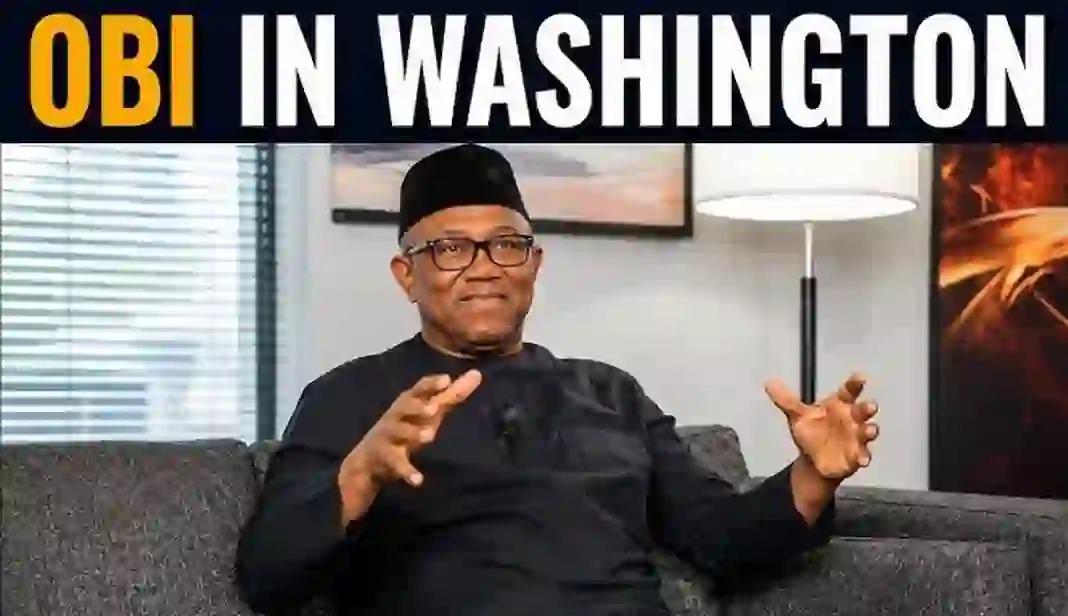

The Presidential Candidate of the National Democratic Congress (NDC), Peter Obi, has stated that if he becomes President, he will listen to every section. Obi made the declaration during an interaction with Nigerians during his recent visit to Washington, USA.

To achieve the aim of unifying the country, Obi said; ‘I will listen to all agitators, harmonise them and make some sacrifices with a view to bringing the country together.’
In stating that he would “listen to all agitators with a view to uniting Nigerians,” he offered a significant shift from the conventional, iron-fist approach to state security and national cohesion. This philosophy positions dialogue, social justice, and inclusion as the primary mechanisms for healing Nigeria’s deep-seated geopolitical fractures. Unfortunately, his position has been misconstrued by some people who singled out Nnamdi Kanu as one of the agitators and ran with it just to attach Obi to their ethnic motives.
For decades, Nigeria has leaned heavily on military and security interventions to suppress regional grievances, whether in the Southeast, the Niger Delta, the Middle Belt or the North. Obi’s proposal, being twisted by opponents, suggests that agitation is often a symptom, not the root cause.
By shifting the strategy from active combat to active listening, Obi plans to treat agitators not just as security threats but as citizens with grievances — many of which stem from economic marginalisation, perceived injustice, and institutional neglect.
True national unity cannot be coerced; it must be built. The core argument for Obi’s dialogue-first model rests on three main pillars: Many regional agitations are driven by poverty, high youth unemployment, and uneven development. Listening allows the government to identify the socio-economic disparities driving the anger.
Agitation frequently flares up when a region feels entirely excluded from the federal power structure. A conversational approach signals that every region has a legitimate seat at the table. And democracy, which our principal plans to practise realistically, will encourage structured dialogue to restore faith in democratic institutions and to demonstrate that the state values civic engagement over intimidation.
“True peace is not merely the absence of tension; it is the presence of justice.”
This timeless principle underpins the concept of engaging aggrieved factions to find a common, workable middle ground for a fractured nation.
Peter Obi’s Media Office, therefore, believes that his stance of listening to agitators is a pragmatic recognition that gun barrel diplomacy has its limits. For a multi-ethnic, multi-religious state like Nigeria, unity cannot be enforced by decree. It must be negotiated through shared prosperity, fairness, and mutual respect. A New Nigeria is Possible.
Discover more from The Source
Subscribe to get the latest posts sent to your email.




, Peter Obi, has stated that if he becomes President, he will listen to)