


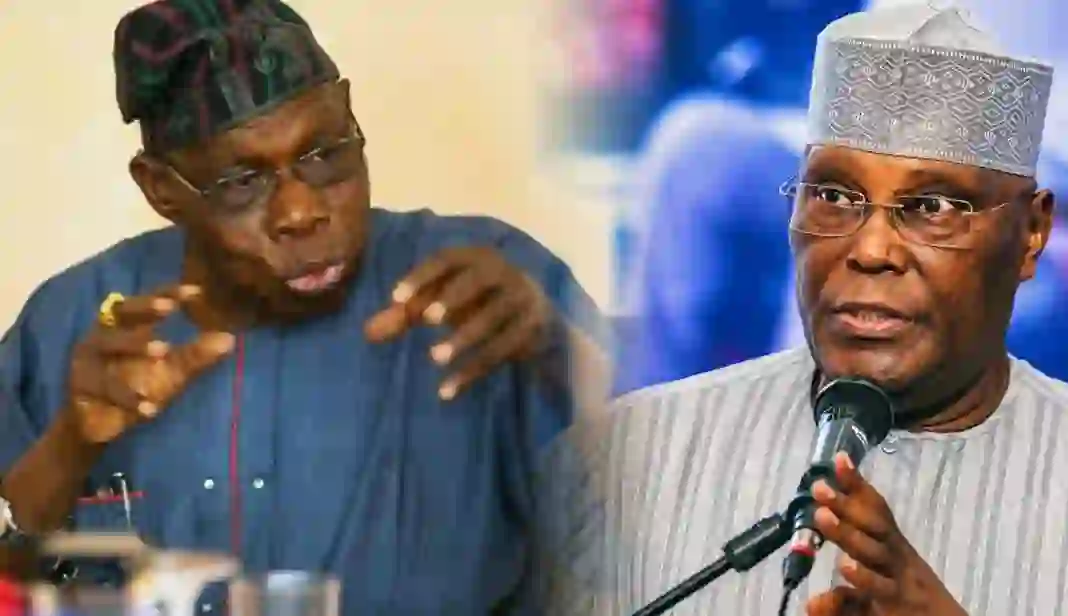

As a Historian, I know how history is often simplified into convenient narratives. Over time, these narratives become accepted truths, not necessarily because they are accurate, but because they are easy to remember and endlessly repeated. One such narrative currently circulating in Nigeria’s political discourse, is the claim that former President Olusegun Obasanjo’s enduring opposition to the presidential aspirations of former Vice President Atiku Abubakar stems principally from Atiku’s role in frustrating the controversial 3rd Term agenda.
2. This narrative has recently gained renewed prominence through commentaries by respected public intellectuals and political actors, including Dr. Reuben Abati, Rt. Hon. Rotimi Amaechi’s Media Team, and numerous commentators across the mainstream and social media. While many of these analyses correctly recount important events surrounding the 3rd Term controversy, they reach a conclusion that, in my considered judgment, is factually inaccurate. They confuse the climax of a political conflict with its origin. Nothing could be further from the truth.
3. I write this article to challenge this false narrative on two grounds.
Advertisement
4. The first is personal experience. Between 1999 and 2007, I served as Special Assistant to the President on States and Local Government Affairs and later on Research and Strategy, posted to the Office of the Vice President within the Aso Rock Presidential Villa. In that capacity, I occupied a unique vantage point from which I saw firsthand many of the events that culminated in one of the most consequential political feuds in Nigeria’s democratic history.
5. I participated in official meetings, prepared memoranda, interacted regularly with the Vice President and occasionally with the President and thus witnessed, firsthand, the gradual deterioration of what had begun as one of the strongest political partnerships in contemporary Nigerian history. Throughout that period, I also offered formal and informal advice aimed at preventing the conflict from escalating. Regrettably, those interventions did not alter the course of events.
6. The second ground is scholarly. As a trained historian, I have always approached political events through the discipline of chronology, causation and evidence. Historians distinguish carefully between immediate causes and underlying causes, between triggers and structural factors and between the culmination of a crisis and its genesis. Political controversies cannot be properly understood by isolating their most dramatic episode while ignoring the sequence of events that produced it.
7. It is precisely this distinction that has been lost in the current public discourse.
8. Anticipating this gap, in 2008, I documented my participations, observations and reflections in a book titled *An Ugly Dusk to a Beautiful Dawn*. The title reflects the extraordinary optimism with which Nigerians welcomed democratic rule in 1999 and the remarkably beautiful relationship that initially existed between President Obasanjo and Vice President Atiku Abubakar. That beautiful beginning, as narrated in the book, unfortunately, deteriorated into one of the ugliest political feuds in Nigeria’s democratic experience.
9. The consequences of that rupture extended far beyond the personal relationship of the two leaders. It profoundly weakened governance, divided the ruling establishment, distorted democratic institutions and produced political consequences that continue to shape Nigeria today. In my assessment, the feud significantly contributed to the broader failure of democratic governance, resulting in the entrenchment of corruption, deepening poverty, widening inequality, growing insecurity and persistent political instability. It is difficult to identify another single political conflict that has imposed such enduring costs on Nigeria’s Fourth Republic.
10. The central questions, therefore, are not merely who opposed whom during the 3rd Term debate, but rather: How did this conflict begin? What caused it? Who initiated it? Why did it escalate? Who is to blame? Could it have been avoided? And what lessons does it hold for Nigeria’s democratic future? These are the questions history must answer and the answers to which the book tried to provide.
11. The prevailing narrative identifies the 3rd Term controversy as the origin of the feud. The historical record, however, points elsewhere. The relationship between President Obasanjo and Vice President Atiku began deteriorating much earlier. The first signs of strain emerged quietly around September 2001, as a result of what I perceived as a highly sophisticated political scheme, not by either of them but by external forces beyond the immediate control and manipulation of both leaders. Reading the cordial relationship between the president and his deputy correctly, those forces saw clearly that Obasanjo was moving forward having his deputy to succeed him. They did not want that. So through high level political schemes, the good relationship between the president and vice president was ingeniously maneuvered to engineer crisis.
12. At that stage, the disagreement not only remained largely subterranean, visible only to those within the Presidency, but it was also clearly containable. It was at this stage that I personally made strenuous efforts to contain it. But I was misunderstood and put out. Thus, by 2002, the situation went out of hand till it became apparent to the public that significant differences had developed between the president and his deputy.
13. The principal issue at that stage was not constitutional amendment or presidential tenure elongation. Rather, it centred on the politics surrounding President Obasanjo’s quest for a 2nd presidential term. This distinction is critical because it fundamentally alters the chronology of events. Contrary to the prevailing narrative, the political struggle surrounding the President’s 2nd Term ambition preceded the 3rd Term controversy by several years. It was during this earlier period that mutual suspicion, distrust and political realignment began taking shape within the Presidency and the ruling People’s Democratic Party (PDP). Relationships deteriorated, loyalties were questioned and political calculations increasingly replaced institutional cooperation.
14. Eventually, after a series of difficult political developments, Vice President Atiku Abubakar supported President Obasanjo’s second-term bid. The President secured the party’s presidential nomination and subsequently won the 2003 general election. To outside observers, this victory appeared to signify reconciliation. Those within the system knew otherwise. By then the damage had been done!
15. One particular incident remains deeply etched in my memory. Following President Obasanjo’s victory at the PDP presidential primaries, many of us returned to the Presidential Villa in celebration. The atmosphere was festive. Supporters congratulated one another, music played and champagne flowed. Yet amid the excitement, the President sat forlornly in a corner, visibly withdrawn and unusually sombre.
16. Concerned by his mood, one of those present approached him with a glass of champagne and remarked cheerfully: “Mr. President, why are you sitting here? This is a happy moment. Please come and celebrate with us.” The President asked him to sit down beside him. Then, after a brief silence, he said words that have remained with me ever since: “If you people are happy, I am not. I feel humiliated from quarters that I least expected. But wait until after the general elections. If I win, then you people will know who your President is.”
17. The conversation ended there. Those words, however, revealed something far more significant than the outcome of a party primary. They suggested that, despite electoral victory, the President perceived himself as politically wounded by individuals, specifically the Vice President, he believed ought to have stood firmly with him. What appeared publicly as triumph concealed privately a deep sense of grievance.
18. After the 2003 general elections, that grievance increasingly translated into political action. Relations between the President and the Vice President deteriorated rapidly. Mutual confidence disappeared. Political retaliation became institutionalised. What had begun as quiet distrust evolved into open confrontation. It was this enraged situation that political opportunists took advantage of and created the 3rd Term scenario.
19. Hence, only several years later did the 3rd Term controversy emerge. By then, the feud was already well established. Indeed, the constitutional amendment debate did not create the conflict. Rather, it intensified an already existing struggle whose origins lay in the political battles surrounding the second-term succession question.
20. In other words, the 3rd Term dispute was not the cause of the Obasanjo–Atiku feud. It was its creation and most dramatic manifestation. This distinction is not merely semantic. It is historically decisive.
21. When analysts claim that President Obasanjo opposes Atiku today because Atiku frustrated the 3rd Term agenda, they inadvertently reverse the chronology of events. They attribute causation to what was, in reality, a later episode in a conflict that had begun years earlier. Historical analysis requires us to distinguish between origins and consequences.
22. The 2nd Term conflict produced the atmosphere of mistrust that eventually created the 3rd Term project and made it politically explosive. Without the earlier rupture, the later constitutional crisis would almost certainly have unfolded differently, if it ever emerged at all.
23. As I argued in the book, without the conflict surrounding President Obasanjo’s 2nd Term ambition, there would likely have been no 3rd Term issue in the first place. The 3rd Term struggle was therefore not the beginning of the feud; rather, the 3rd Term was the feud’s creation, continuation and escalation. This conclusion is consistent with one of the fundamental principles of historical scholarship: major political crises rarely emerge suddenly. They evolve through cumulative grievances, unresolved conflicts, competing ambitions, institutional failures and personal distrust. Dramatic events merely expose tensions that have long been developing beneath the surface.
24. Nigeria’s democratic history deserves to be understood in precisely those terms. Correcting this historical misunderstanding is not simply an academic exercise. The inaccurate narrative has shaped public perceptions of two of Nigeria’s most influential political figures for nearly two decades. More importantly, it has obscured the deeper institutional lessons that ought to be drawn from their conflict.
25. History must resist the temptation of convenient explanations. The truth is often more complex than popular narratives allow. The Obasanjo–Atiku feud did not begin with the 3rd Term agenda. By the time the constitutional amendment controversy emerged, the relationship had already deteriorated beyond repair. The 3rd Term battle was not the cause of the conflict; it was the battlefield upon which an older and deeper struggle reached its most visible expression. That distinction is not only historically significant – it is indispensable to understanding the evolution of Nigeria’s Fourth Republic and its politics.
Ardo is a former presidential aide
Discover more from The Source
Subscribe to get the latest posts sent to your email.