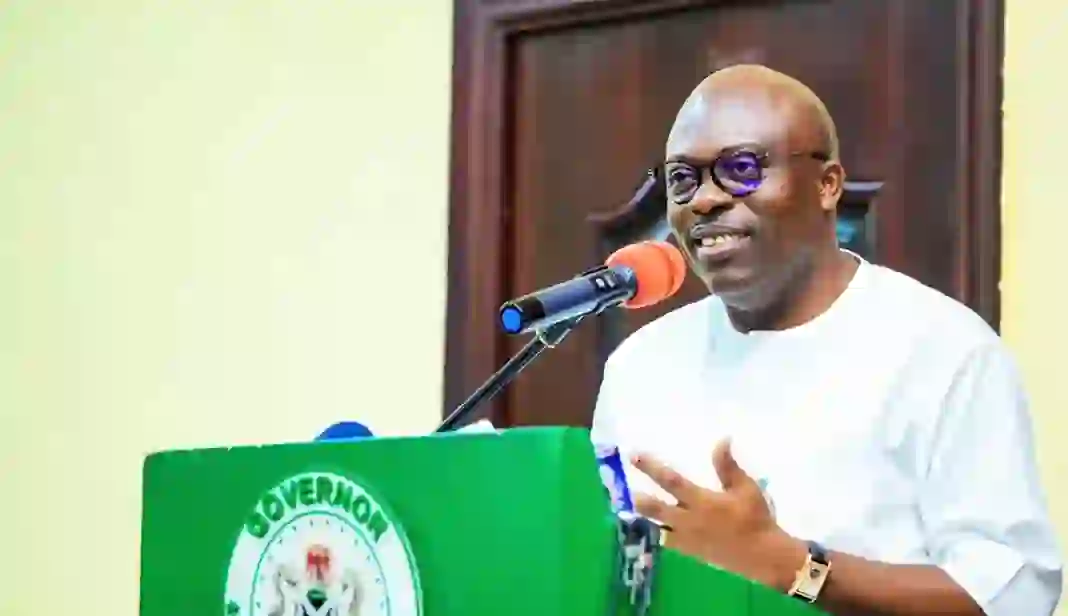
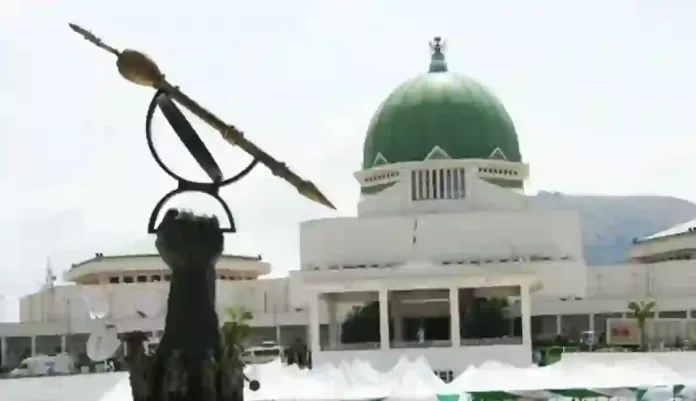
Following the footsteps of the House of Representatives, the Nigerian Senate, has approved the State of Emergency imposed on Rivers State by President Bola Tinubu.
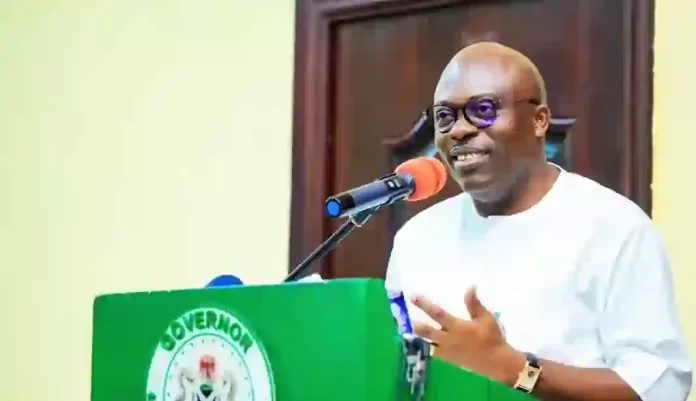
The President had, in a nationwide broadcast Tuesday, suspended Governor Siminalayi Fubara, his Deputy, Dr. Ngozi Odu, and the Members of the Rivers State House of Assembly from office for six months. He, also, appointed a retired Chief of Naval Staff, Vice Admiral Ibok-Ette Ibas as the Sole Administrator for an initial period of six months.
Tinubu’s action was met with outrage from individuals, politicians and groups. And, not a few people harbored the hope that the Senate would either not approve of it, or would modify it.
However, after a closed door session Thursday where Senators deliberated on the President’s request and actions, they were approved.
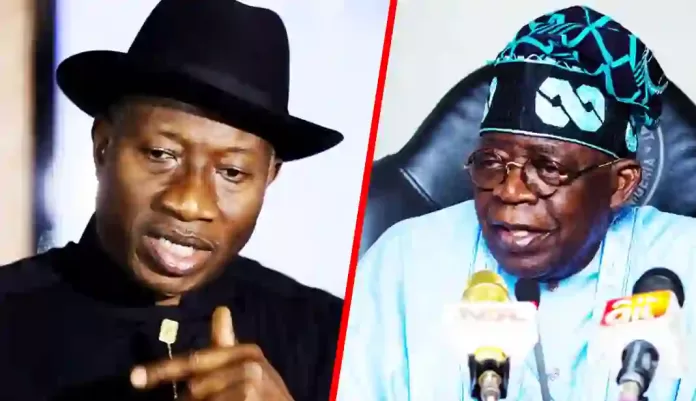
Following was Bola Tinubu’s personally signed, strongly-worded, statement in 2013, attacking then President Goodluck Jonathan for declaring a State of Emergency in three Northern States ravaged by unprecedented insecurity caused by Boko Haram
It is now abundantly clear that President Jonathan has finally bared his fangs, confirming what was widely speculated. By declaring a state of emergency in Borno, Yobe and Adamawa, he has intimidated and emasculated the governors of these states. We are witnessing a dangerous trend in the art of governance and a deliberate ploy to subvert constitutional democracy.
The body language of the Jonathan administration leads any keen watcher of events to the unmistakable conclusion of the existence of a surreptitious but barely disguised intention to muzzle the elected governments of these states for what is clearly a display of unpardonable mediocrity and diabolic partisanship geared towards 2015.
Borno and Yobe states have been literally under armies of occupation, with the attendant excruciating hardship experienced daily by the indigenes and residents of these areas. This government now wants to use the excuse of the security challenges faced by the governors to remove them from the states considered hostile to the 2015 PDP/Jonathan project.
Let me be quick to say that this administration will be setting in motion a chain of events the end of which nobody can predict. Experience has shown clearly that actions, such as this one under consideration, often give root to radical ideologies and extremist tendencies, a direct opposite of the intended outcome of unwarranted and unintelligent meddlesomeness. The present scenario playing out in the country reminds one of the classical cases of a mediocre craftsman who continually blames the tools of his trade for his serial failure but refuses to look at his pitiable state to adjust.
It has become crystal clear, even to the most incurable optimist, that the country is adrift. That the ship of the Nigerian state is rudderless is evident in the consistent and continual attacks ferociously executed by elements often referred to as the insurgents in some northern states of the federation, particularly the Borno and Yobe states, respectively.
Indeed, no part of the country is immune from the virulent but easy attacks, veritable indices of a failing state. Unfortunately, the tenuous and uncoordinated approach adopted by this government betrays a grossly incompetent disposition that stands at variance with current realities in the country, nay, the international community where acts of terrorism are engaged and contained. No governor of a state in Nigeria is the Chief Security Officer. Blaming the governors, who have been effectively emasculated, for the abysmal performance of the government at the centre, which controls all these security agencies, smacks of ignorance and mischief.
Terrorist acts are perpetrated routinely and the government at the centre appears incapable of stemming the tide of the horrendous crimes unleashed on the hapless populace. The considerable ease, with which lives and property are destroyed daily, should excite deep introspection on the part of a government truly desirous of finding a lasting solution.
The Constitution provides that the safety and welfare of citizens shall be the primary purpose of having that structure of any political leadership in the first instance. This Government, through acts of omission and commission, has fallen far short of expectation. It actively encourages schisms and all manner of divisive tendencies for parochial expediency. Ethnicity and religion become handy weapons of domination. Things have never been this bad.
The response to the pervasive chaos in the Northern region of the country has been militarisation, mass arrests and extra judicial killings by the Joint Task Force, JTF, a convenient euphemism for an army of occupation seemingly set loose on the people of the localities concerned. The tenor of the State of Emergency declared by the Federal Government yesterday portends danger for the polity. The full militarisation of security operations in these states will compound the already tense situation.
Both local and international media are awash with news of reckless attitudes of the invading forces. The fact that security operatives are killed cheaply and reprisals from the state find expressions in organised pogroms in the immediate communities is sure evidence of a government, which lacks basic understanding to appreciate the enormity of the current security challenges. If development is about the people, all measures put in place for the sustenance and maintenance of the super-structure of the society must take into cognisance local contents.
It is evident from the grim experiences in recent times that this government has failed, or does not know that it is necessary for it to avail itself of the benefits accruable from exchange of ideas and notes on the latest in terms of technology and human resources among nations of the modern world, especially those which have been fighting terrorist organisations over the years, on the most effective mode of combating this menace. Technologically advanced countries of the world will never discard the idea on the need for the establishment of an effective local intelligence outfit.
Our suggestions along this path have always been met with suspicion and acerbic criticisms from both the informed and the ignorant alike.
A government which stoutly defends its opposition to the decentralisation of the police force from its present over-centralised command structure is already experimenting with all manner of means patently extra-legal.
The massacres of local communities attendant upon the attacks on security agents by unknown elements will further alienate the people who should, ordinarily, partner with the government in securing their immediate environments. An army that invades a community maiming, raping and killing defenceless civilians will end up radicalising the youths whose parents and young ones have been wiped out most cowardly and recklessly. This government should concentrate more on encouraging the development of local intelligence, which will, inexorably, lead to the practice of true federalism. Adopting the use of excessive force against those perceived as harbouring terrorists does not portray this government as possessing the wherewithal to find abiding solutions to the lingering security challenges.
The President’s pronouncement, which seeks to abridge or has the potential of totally scuttling the constitutional functions of governors and other elected representatives of the people, will be counterproductive in the long run. A State of emergency already exists in the states where JTF operates.
Residents of these communities live in constant fear. Their rights are violated with impunity under the guise of searching for terrorists in their respective domains.
Hiding under some nebulous claims that border on the intractability of the security challenges posed by Boko Haram or some acclaimed traditionalists who have killed some policemen to render ineffective the constitutional powers vested in elected governors and other representatives of the people, perceived as not amenable to manipulation for the 2015 project amounts to reducing serious issues bordering on the survival of the country to partisan politics.
Let all those who love this country genuinely advise the federal government not to tinker with the mandates of these governors under any guise. It is a potentially destructive path to take. If the security of a society is about the protection of lives and property of the citizenry, the involvement of the people is a sine qua non to effective intelligence gathering.
Any measures put in place that alienate the people, in particular their elected representatives, should be considered fundamentally defective by every right-thinking person in the country.
Tinubu, now President of Nigeria, was a two-term Governor of Lagos State and a leading voice of the opposition party, the Action Congress of Nigeria, ACN when he wrote this in a fierce attack on then President Jonathan
The much-condemned declaration of State of Emergency in Rivers State by President Bola Tinubu, surprisingly, received an overwhelming endorsement by Members of the House of Representatives on Thursday, during Plenary.
Considering the shouting match in the House on Wednesday between two Members, not a few people thought that its debate on Thursday will be met with a stiff opposition.
But it had a smooth sail, reconfirming President Tinubu’s capacity to maneuver through any political obstacles to his decisions.
The President had, to the shock of many, on Tuesday, declared a six-month State of Emergency in the State over a face-off between Governor Siminalayi Fubara and Members of the State House of Assembly loyal to Fubara’s estranged political godfather, Federal Capital Territory’s Minister, Nyesom Wike, led by Speaker Martin Amaewhule.
Tinubu appointed a retired Chief of Naval Staff, Vice Admiral Ibok-Ette Ibas, as the Sole Administrator, and preceeded to swear him in on Wednesday.
The Governor, his Deputy, and all the Members of the House of Assembly were suspended from office for six months.
It is not known if the Governor will return to his seat as, the President, in his nationwide broadcast, tore him to pieces for being the architect of the crisis. The Attorney General of the Federation and Minister for Justice, Lateef Fagbemi, did the same, but added the step taken by the President saved Fubara and his Deputy, Dr. Ngozi Odu from impeachment by the House of Assembly.
At Plenary on Thursday, using a voice vote, President Tinubu’s decision was upheld by the House of Representatives.
Speaker of the House, Dr. Tajudeen Abbas, who read the letter by the President to the House where he sought approval, said that 240 Representatives were present, and thus, formed a quorum.
The decision of the Senate is being awaited. It is likely to be endorsed too, but probably, not with an overwhelming approval.
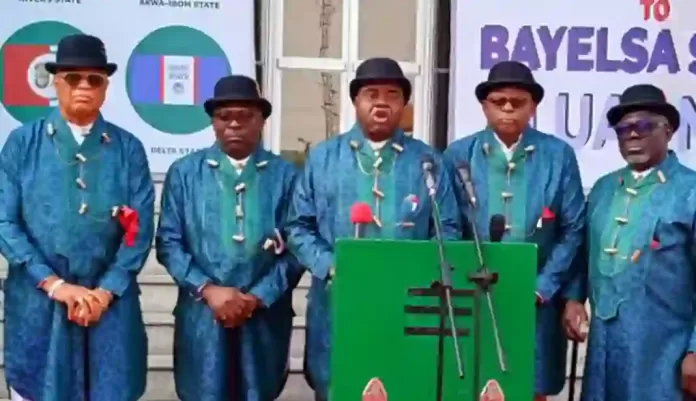
Few hours after President Bola Tinubu swore-in the Sole Administrator for Rivers State, South South Governors’ Forum has observed that the political situation in the state did not call for suspension of the governor, deputy and the House of Assembly.
Chairman of the forum, Douye Diri who is
Governor, Bayelsa State in a statement, advised Tinubu to rescind the decision.
The statement reads: “The South-South Governors’ Forum notes the six-month declaration of a state of emergency in Rivers State, a constituent part of our Forum, and the suspension of two democratic institutions.
“We recognise the President’s constitutional duty to maintain law and order throughout Nigeria, just as we are equally mandated to securing peace and stability in our states.
“However, the South-South Governors’ Forum expresses concern that the current political situation in Rivers State does not satisfy the criteria for declaring a state of emergency as outlined in Section 305(3) of the Nigerian Constitution (as amended).
“This section suggests that such a declaration should be considered under specific conditions like war, external aggression, imminent invasion, breakdown of public order, existential threats to Nigeria, natural disasters, or other significant public dangers.
“It is also worth noting that the Constitution outlines specific procedures for the removal of a governor and deputy governor, as detailed in Section 188, and similar provisions exist for the removal of members of the House of Assembly and the dissolution of parliament.
“In the current situation, it appears that these guidelines might not have been fully considered.
“We believe that the political disputes in Rivers State between the Governor and the House of Assembly should, ideally, be resolved through legal and constitutional means, rather than by executive fiat.
“To reduce tensions and establish a foundation for enduring peace, we propose the Rescission of the State of Emergency.
“In the meantime, we encourage all parties to remain calm, uphold peace and the constitution of the Federal Republic of Nigeria.
President Bola Ahmed Tinubu’s proclamation of emergency rule in Rivers State on Tuesday surprised me for reasons different from those for which he has been severely criticised.
The mildest criticism is that Tinubu’s failure to call the Minister of the Federal Capital Territory, Nyesom Wike, to order was responsible for the crisis. The more severe criticisms range from accusations that the president has subverted constitutional rule to charges of potential destabilisation at the behest of Wike.
A common point of agreement is that a civilian president should never have to declare emergency rule. That is the ideal. But Rivers State before Tuesday presented a dire and complicated situation that stretched idealism to its elastic limits.
Chaos in slow motion
It’s convenient, especially for those who promoted and profited from the crisis, to pretend otherwise. Still, after the 27 state lawmakers loyal to Wike issued an impeachment notice, the outcome, if Governor Siminalayi Fubara had been impeached, might have been far worse for the state than can be contemplated under emergency rule. The proclamation was an unsolicited stitch in time.
If oil pipelines were already being blown up and militants deploying as the impeachment notice reached Fubara, what would have happened if the process had carried through? Rivers State has been chaos in slow motion for nearly two years, the only thriving business in the state being the politics of those who support Fubara and those who are against Wike.
The Supreme Court’s judgment invalidated the budget passed by Fubara and nullified the local government election. It affirmed the position of the 27 lawmakers, making Fubara’s government a lame duck. Emergency rule saved the governor from gunpoint, created a pause for the people to get their lives back, and made room for Wike and Fubara to stop and reflect. It’s a messy situation, but the counterfactual could have been worse.
Between Wike and Fubara
Popular media has framed Fubara as the victim of a grasping, unforgiving godfather, which suits his comportment. But during this inconvenient pause, it might be helpful for the governor to reflect on what he might have done differently, something that pressure by those egging him on for their narrow, selfish reasons might not have given him the space to do.
In the public imagination, control of the state’s “political structure” is at the heart of the dispute between Fubara and Wike. Whether that is so, whether it’s about who the “authentic” party leader is, or it is more than what the public knows, Fubara and Wike know. We can only guess. But they both know.
Siminalayi Fubara
Open war
The open war started after Fubara’s swearing-in when the governor wanted to install his candidate as speaker in the House of Assembly but failed. What was the point of demolishing the State House of Assembly complex built for hundreds of millions of naira with taxpayers’ money in December 2023 simply on the suspicion that the lawmakers were planning to impeach him there? Why did the governor think it was right to convene four of 31lawmakers in his office to present the appropriation bill and then go on to implement it?
And why, after the peace deal brokered in Abuja, was it difficult for him to be his own man, free himself as the hostage of opportunistic local politicians and self-appointed opinion leaders and implement the decisions reached instead of caving into busybodies in the People’s Democratic Party (PDP) whose primary interest is to continue the unfinished war of the2022 Convention by other means?
Atiku No 2.
The PDP leadership and their cousins in Labour have never forgiven Wike for supporting Tinubu’s election. They have been quite loud in condemning the state of emergency. That’s their job as opposition. However, if the PDP is letting its testosterone rush get into its head and impair memory, we may need to remind the party how we got here.
Former Vice President Atiku Abubakar has been quite vocal in condemning emergency rule in Rivers State. In his earnestness, he has forgotten that the government in which he was the Number Two man had a shambolic record of infidelity to constitutional rule. And that is saying it nicely.
One can argue that President Olusegun Obasanjo’s proclamation of emergency rule in Plateau State in 2004, though controversial, was inevitable because of the horrific deaths caused by the sectarian violence, which led to reprisals in other states. Yet, former Governor Joshua Dariye’s suspected links to the crisis made his suspension inevitable.
Bayelsa playbook
Atiku could not have forgotten that when his boss did it again in Ekiti State two years later, it was mainly to facilitate Obasanjo’s hijack of the state for his political convenience after lawmakers claimed to have impeached the governor. Fayose had become a thorn in his side, and he vowed to remove him by all means, fair and foul.
Atiku may argue that he had been estranged from the government then and could not bear vicarious liability. However, he remained a part of the government until the end and must endure its glory and shame.
Or perhaps he would have preferred the impeachment of Fubara from Obasanjo’s Bayelsa playbook? In that case, instead of an emergency rule, Tinubu would have provided a haven where the majority 27 lawmakers would have met under heavy security protection to remove the governor, as Obasanjo did under slightly different circumstances, in the case of former Governor Diepreye Alamieyeseigha.
Amaechi’s forgotten diary
Former Rivers State Governor Rotimi Amaechi, a longstanding foe of Wike, also weighed in, condemning the “power grab’s illegality.” He has a right to intervene and speak his mind. However, since he called the proclamation “an affront” to the rule of law and a power grab, it might be helpful to remind him of a typical, but by no means isolated, example from his record as governor.
In 2013, when the position of chief judge in Rivers State was vacant, Amaechi appointed and swore in the President of the Customary Court of Appeal, Justice Peter Agumagu, against decency and the provisions of law. He joined issues with the National Judicial Commission (NJC), which was at its wit’s end to restrain him and keep him on the path of common sense. The state judiciary reeled under Amaechi’s blatant affront for one year, something he now conveniently forgets.
Apples and oranges
Parallels have been drawn between the state of emergency in Rivers State and the one in 1962 during the Western Region crisis, especially as the latter was believed to have led the country down the slippery slope that eventually ended in the removal of the Tafawa Balewa government and the Civil War.
The underlying currents may be similar – local politics gone rogue – but the consequences or potential consequences are not. Constitutional lawyers can debate the legal triggers because of the lack of clarity in Section 305 of the 1999 Constitution, compared with the 1960 Constitution, a pre-Republican document that gave the prime minister more expansive powers.
While the emergency rule in the Western Region was mainly an opportunistic intervention by the federal government to undermine the Obafemi Awolowo-led opposition, the emergency in Rivers State was an inevitable step to prevent a potential descent into chaos, where the governor was not an innocent bystander.
Water in the coconut
Since 1999, two administrations – Mohammadu Buhari’s and Umaru Yar’Adua’s being the only exceptions – have proclaimed emergency rule. Apart from 2013, when President Goodluck Jonathan left the governors of the three affected states in place because they had no link to the crises in their states, complicity has affected the scope of the application of emergency rule.
When Obasanjo threatened an emergency in Lagos, Tinubu said it was unacceptable because he was doing his best as governor to tackle the sectarian clashes in a small part of the state then. In Rivers, the governor is a part of the problem.
Those opposed to the proclamation should say how to leave Fubara in place and extract the water of peace from the coconut of Rivers State without breaking the shell on the head of the people.
Ishiekwene is Editor-in-Chief of LEADERSHIP and author of the book Writing for Media and Monetising It.
Ebun Adegboruwa has described the suspension of Governor Siminalaye Fubara of Rivers state and the declaration of Emergency Rule in the oil bearing state as a bad omen for the country. The senior advocate of Nigeria, SAN, made the admonition on Thursday on Channels Television as gloom hovers on the restive state following the suspension of the governor and the the state House of Assembly by President Bola Ahmed Tinubu.
The president had on Tuesday declared a State of Emergency on the state, following which he also removed the governor and the lawmakers, saying is action was last potion after the feuding parties in the political crisis failed to come to a truce.
Tinubu had since appointed Vice Admiral Ibokette Ibaz (rtd.) a former Chief of Naval Staff as the Administrator to oversee the state for a period of six months.
Recall that Governor Fubara and his estranged political godfather have face off for months over who controls the power levers in the state.
The president’s decision has however been trailed with mixed reactions, by some who criticised him for lacking powers to remove a sitting governor, and others who insist that the president needed act to forestall total breakdown of law and order.
For instance, Atiku Abubakar, the 2023 Presidential candidate of the PDP and Peter Obi of the Labour Party, have trenchantly knocked the president for the declaration of a state of Emergency.
The Nigerian Bar Association has also berated the president for sacking the democratically elected officials in the state, stating that he misused his powers under the 1999 Constitution which President Tinubu cited for suspending the governor and the lawmakers.
According to Adegboruwa, Tinubu has acted like a ‘presidential dictator’ in his decision to sack the democratic institutions in the state, describing the action as illegal and unconstitutional, that must not be allowed to stand.
The senior lawyer spoke few hours before the National Assembly meet to debate on whether to uphold the president’s decision. The president’s decision is subject to the approval of the NASS.
The law requires two-third members of the Nigerian Senate and House of Representatives to support the president’s action before it can take effect.
Adegboruwa, has however appealed to the NASS to reject President’s decision to remove the governor and the state lawmakers, saying the situation in the state has not resulted to ‘total helplessness’ that required extra-ordinary measures such as the declaration of state of Emergency, adding that other dispute resolution methods have yet to be exhausted by the president.
According to him, the state cannot be an exception after the president failed to take similar measures in Lagos and Osun states which have experienced similar political turmoil lately.
He urged President Tinubu ‘to engage with the people of’ the state, saying nothing can ‘justify’ the sacking of Governor Fubara, adding that the president’s action paints a gloomy picture for the nation’s fledgling democracy.
Tinubu, he affirmed, is fact becoming a presidential dictator.
Meanwhile, a coalition of key opposition leaders such as former Vice President Atiku Abubakar, former Governor Nasir El Rufai met on Thursday in Abuja, the nation’s capital rejecting the State of Emergency imposed on Rivers state.
They called on the president to reverse the action with immediate effect, in other not to further heat up the system.
A former presidential aide, Laolu Akande has appealed to the National Assembly to reject the suspension of Governor Siminalaye Fubara of Rivers state by President Bola Ahmed Tinubu, saying they have the responsibility to defend Nigeria’s democracy.
The former spokesman to Vice President Yemi Osinbajo made the remark on Thursday on Channels Television, as controversy continues to trail the president’s action.
The magazine reported that President Tinubu, on Tuesday, suspended Governor Fubara and members of the Rivers state House of Assembly after declaring a state of emergency in the oil rich state, citing the break down of law and order.
The emergency rule culminated due to the protracted power struggle between supporters of Governor Fubara and his estranged godfather, Nyesom Wike, the Minister of the Federal Capital Territory, FCT, and former governor of the state.
President Tinubu had since appointed former Chief of Naval Staff, Ibokette Ibas as the administrator to run the affairs of the state for a period of six months, saying his action is subject to the approval of the National Assembly.
The NASS, on Wednesday, shifted the debate over the matter to Thursday amid tension across the country.
Speaking earlier today, Akande said President Tinubu has committed a grave mistake by suspending Governor Fubara and the state lawmakers, urging the NASS to reverse the ‘unconstitutional decision.
Akande: NASS Must Save Nigeria’s Democracy
According to him, the president has been advised wrongly and must be told so by the lawmakers, who are in the position to save the country from the anarchy that is bound to trail the president’s action.
He explained that Tinubu should have availed himself all available dispute resolution methods before taking the suspension option, adding that Tinubu should have called Wike and Fubara, the two antagonists in the Rivers political crisis to a ‘room’ and giver them the ultimatum to end the crisis.
Stressing that the president has overreached himself by suspending the democratically elected officials in the state, which he has no power to do, the former presidential adviser said the NASS must endevout to ‘save Tinubu from himself’, because he has derailed from the cause of democracy which he once championed.
The NASS “need to save Tinubu from himself. He taught us in his better days”- what democracy is, but appears to have derailed. “You cannot suspend an elected governor’ Akande said, adding that “constitutionality is the pillar of our democracy.
“The president needs help for his own legacy. The NASS needs to help him do that. The constitution that we have, federal system will not allow you to do so.”
Meanwhile, the Minsiter of Justice and Attorney General of the Federation, Lateef Fagbemi, has defended the president’s action, stating that Tinubu acted at the right time.
Fagbemi said yesterday, while speaking to journalists in Aso Rock, Nigeria’s Presidency that the president needed to declare a state of emergency to forestall a further break down of law and order.
The nation’s chief law officer also disclosed that that the federal government will released the seized funds belonging to the Rivers state government to the new Administrator, thus putting an end to the debate over whether the funds seized following last months Supreme Court order will still be withheld during the period of State of Emergency.
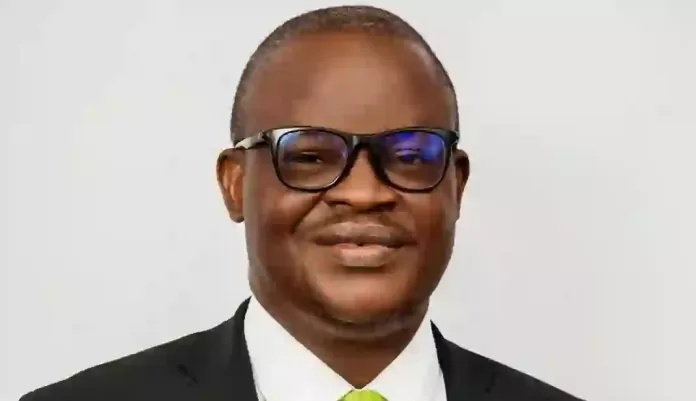
The Board of Unity Bank Plc has announced the appointment of Ebenezer Kolawole (FCA) as the Acting Managing Director/Chief Executive Officer following the retirement of Mrs. Oluwatomi Somefun who has completed her tenure as MD/CEO.
The appointment was announced at the Bank’s 18th Annual General Meeting, AGM, held in Lagos on Wednesday, after securing necessary approval from its primary regulator, the Central Bank of Nigeria, CBN.
Kolawole is a seasoned and consummate Banker with over three decades of industry experience. He began his financial services career at Caribbean Finance Limited (an affiliate of CFL in Cayman Island) in Kaduna in 1992. He later joined Ecobank where he worked in various departments of the Bank, both Operations and Finance suites and rose to the position of Deputy Financial Controller. He moved to Standard Trust Bank (STB) and worked at various strategic areas including Operations, Regulatory Risk Management and Finance suites and played a pivotal role in the STB/UBA merger. Post-merger, he served as Chief Financial Officer (CFO) of the United Bank for Africa. He moved to Mainstreet Bank as the Bank’s Group Chief Finance Officer (GCFO) and actively drove the turnaround and transformation initiatives of the Bank. He had a brief stint at Globacom, a foremost and Nigeria’s leading Indigenous Telecommunication giant, where he served in various capacities for corporate business development.
He joined Unity Bank Plc as Chief Financial Officer, CFO in 2015. He was later, in February 2018, appointed the Executive Director to oversee Finance, Operations and Information Technology, where he played a key role in the Bank’s strategic transformation and cost optimization initiatives which enhanced the Bank’s performance and market feasibility.
In line with the Bank’s succession and business continuity plans, Kolawole is saddled with the primary responsibility of finalizing the Bank’s ongoing corporate programmes and other strategic business initiatives of the institution.
He holds a First-Class (Hons) Degree in Accounting from Obafemi Awolowo University (OAU), Ile-Ife. He has participated in several management/executive education programmes at Columbia Business School, New York, USA and The Wharton School of the University of Pennsylvania, Philadelphia, USA.
Kolawole is a member of several professional bodies including a Fellow of The Institute of Chartered Accountants of Nigeria (FCA); a Fellow of the Institute of Credit Administration, (FICA), an Honorary Member of the Chartered Institute of Bankers of Nigeria (HCIB), Associate Member of The Nigeria Institute of Management (AMNIM); Member of the Institute of Directors etc.
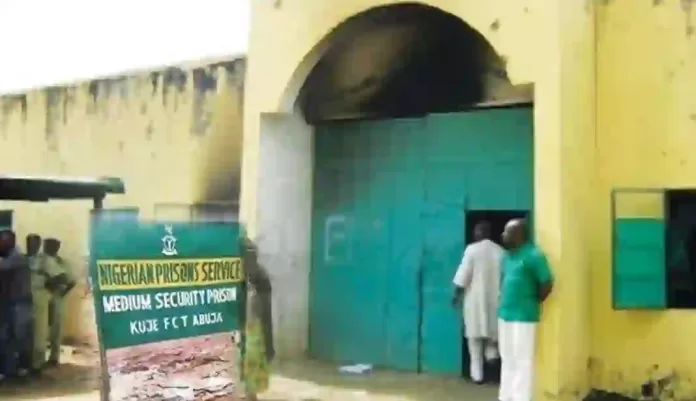
A Federal Government Visitation Panel on Nigeria’s Prisons across the country has said that there are several inmates in detention serving longer periods than prison terms for offences they are being held.
The Visitation Panel came into conclusion that the conditions of the prisons and their inmates are terrible and unbearable.
The Panel headed by a Senior Advocate of Nigeria, (SAN), Mr Olawale Fapohunda, revealed that most inmates are languishing in prisons due to lack of legal representation and the inability of the Legal Aid Council to cope with the huge number of cases.
Submitting the report of the panel to the Attorney-General of the Federation, and Minister of Justice, Lateef Fagbemi, SAN, Fapohunda said that while auditing the prisons, they had interface with categories of inmates and found their conditions unpalatable.
Besides lack of legal representation, Fapohunda revealed that most of the inmates are suffering ailments that the prison authorities could not bear the cost of medication.
He, therefore, pleaded with the AGF and the Federal Government to rescue the Nigerian prisons and their inmates with a view to alleviating their poor conditions.
Fapohunda, a former Attorney-General and Commissioner for Justice, Ekiti State, asked the AGF to convene an emergency meeting of Body of Attorneys-General to deliberate on the issue of the deplorable conditions of prison inmates and come out with concrete remedy that will make life bearable for the inmates.
“It would have been odd in the extreme if the working group had simply focused on the status of Section 35 inmates and ignored the plight of other inmates deserving urgent attention.
“This category of inmates includes those without legal representation. Indeed, several inmates continue to be kept in detention for periods longer than the maximum period of imprisonment prescribed for the offence because they do not have legal representation.
“The working group found that an alarming high number of inmates in the custodial centres under review were without legal representation.
“The AGF is invited to note that although the Legal Aid Council of Nigeria is mandated to provide free legal services to inmates without legal representation, it is presently under resourced and thus barely able to make a significant difference.”
Fagbemi disclosed that the working group was constituted as part of efforts to ensure access to justice and ensure that persons are not unduly detained in custodial centres.
According to the Minister, the move is in line with the Renewed Hope agenda of the administration of President Bola Ahmed Tinubu and in line with the obligations under various national and international instruments.
“This mandate of the working group is crucial to achieving the standards we have set for ourselves in our effort to reform our criminal justice system.
“The vision of Mr. President is for a criminal justice system that maintains law and order, deters crime, punish offenders, while at the same time strives to rehabilitate those offenders in order to facilitate their recovery and reintegration to society.”
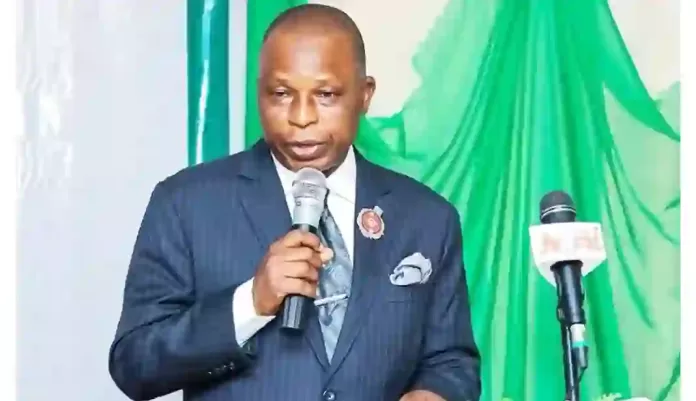
Like his boss, President Bola Tinubu, the Attorney General of the Federation, and Minister of Justice, Lateef Fagbemi, SAN, on Wednesday, March 19, 2025, domiciled the blame for the political impasse, and subsequent declaration of emergency rule in Rivers state on the door steps of Governor Siminalayi Fubara.
This is even as he shockingly distanced Nyesom Wike, the FCT Minister from events leading up to the crisis in the State.
The Source reports that Present Bola Tinubu, on Tuesday, March 18, suspended Governor Fubara, his Deputy, and Members of the Rivers State House of Assembly for six months, after declaring a State of emergency.
A former Chief of Naval Staff, Vice Admiral Ibok-Ette Ibas, has since been sworn-in as the State’s Sole Administrator.
However, the action of the President has so far elicited a deafening condemnation from across the country, with not a few insisting on the reversal of the situation.
Similarly, many, including the Nigerian Bar Association, NBA, have questioned the constitutionality of the emergency declaration, insisting that it smacks of a deliberate and desperate move to muscle opposition voices in the country.
But at a media briefing on Wednesday at the State House, Abuja, Fagbemi, expectedly, justified the exercise, in which he must have played a significant role in prodding as the Nigeria’s Chief Law Officer.
It will be recalled that the President cited the failure of governance ,and threat to the peace and stability of both Rivers and the country among other reasons for his action.
Fegbemi explained that the declaration of the emergency rule became a last resort to save Rivers Nigeria and its critical infrastructural facilities within the State.
The AGF pointedly accused Governor Fubara of not only failing to discourage attacks on vital oil facilities, but subtly goaded the action.
According to him, the Governor played key roles in the twin explosions that rocked some oil pipelines in the State by enabling militants.
The AGF maintained that Fubara, as the Governor, failed woefully to play his role as the Chief Security Officer of the State, and by so doing, wittingly and/or by accident, encouraged needles attacks on oil pipelines and innocent residents.
“There was what I would call telegraphing of the militants by the Governor. He initially suggested that he would let them know when it was time to act.
“Even if we assume that was just a rhetoric, did he come out to disown them when they took action?
“The answer is no. Barely a week after, we saw the vandalization of oil pipelines”, Fagbemi stated.
The Minister of Justice insisted that the President was justified to have acted at the time he did because there were clear and enough signs that there was no effective governance in the State.
According to him, both the Governor and the State Lawmakers failed to create an enabling environment for governance, peace and stability, a development that prompted the president to act.
While noting that the President acted within the confines of the law and the country’s constitution, he, however, stated that it is up to the National Assembly to either reject or approve of the emergency rule.
“The President acted based on the Supreme Court’s judgment ,and also to protect critical infrastructure in Rivers State.
“People were living in fear, and some were losing their lives. This was an extraordinary situation that required decisive action.
“The claim that the action was hasty is not correct .The crisis was escalating on daily basis, and at that point, the President had no other option than to act.
“But it is up to the National Assembly to either overturn the emergency declaration or approve it.
“The ball is now in the court of the National Assembly. If they do not ratify it ,the situation will not stand” Fagbemi noted.
Absolving Wike, from any blame, the AGF, questioned if it was the FCT Minister that ordered the demolition of the State House of Assembly Complex? “For me, I don’t see the hand of Minister of the FCT in what happened”, he submitted.