Home Blog Page 698

Kemi Badenoch Says She No Longer Identifies With Nigeria

0
Kemi Badenoch

By Akinwale Kasali

Kemi Badenoch, Leader of British Conservative Party, has said she no longer wants to be identified as a Nigerian.

The Tory leader said she does not hold a Nigerian Passport since she has not renewed it in the past 20 years, and has no need to do so.

Badenoch said that while she knew the country “very well” and had an interest in what happens there, she felt that her home is where her family is.

She made this assertions while speaking on the Rosebud podcast.

She said: “I have not renewed my Nigerian passport, I think, not since the early 2000s.

“I don’t identify with it any more. Most of my life has been in the UK and I’ve just never felt the need to.

“I’m Nigerian through ancestry, by birth, despite not being born there, because of my parents, but by identity, I’m not really.

“I know the country very well.  I have a lot of family there, and I’m very interested in what happens there.

“But home is where my now family is, and my now family is my Children, it’s my husband and my brother and his Children, In-Laws.

“The Conservative Party is very much part of my family, my extended family, I call it.”

She however recalled when her father, Femi Adegoke, who was a Doctor, died in 2022,  Badenoch said she had to get a Visa to travel back to Nigeria, which she described as a “big fandango”.

Kemi was born in Wimbledon, South West London, in 1980 before her parents took her home to Nigeria.

She was one of the last people to receive Birthright Citizenship rules in Britain, before they were abolished by Margaret Thatcher the following year.

Kemi stated that she felt both British and Nigerian while growing up in Lagos.

“Finding out that I did have that British Citizenship was a marvel to so many of my contemporaries, so many of my peers.

“I think the reason that I came back here was actually a very sad one, and it was that my parents thought there is no future for you in this country.

“I never felt I belonged there”, she said.

Speaking further,  she remembered “never quite feeling that I belonged there” in Nigeria.

It would be recalled that the UK Conservative Party Leader has been slammed on several occasions for her statements that demean Nigeria as a country.

Kashim Shettima, Vice President of Nigeria had slammed her for being more British than Nigeria.

Shettima told her that she has every right to remove the Kemi from her name” if she was not “proud” to be from Nigeria.

Responding to Shettima’a outburst, Kemi’s Spokesman later said that the Tory leader “stands by what she says” and that she is “not the PRO for Nigeria.”

Also, the Chairman of Nigerians in Diaspora Commission, NIDCOM,  Abike Dabiri-Erewa, recently lashed Kemi Badenoch for allegedly spewing lies against Nigeria, and told her that no one was forcing her to love Nigeria.

2027 Polls: Dropping Vice President Shettima Will Be Disastrous – North East Youths Warn

0
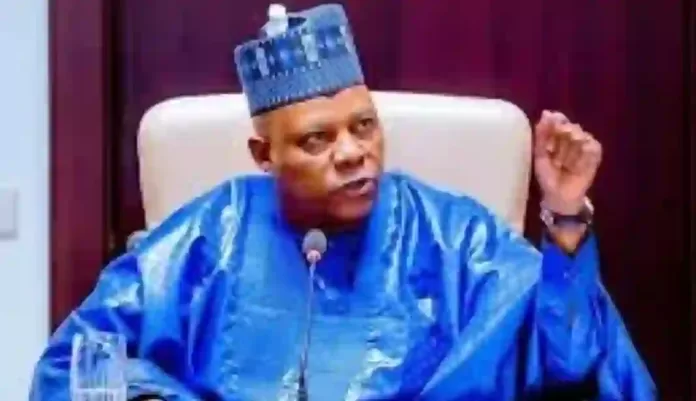
VP Kashim Shettima
VP Kashim Shettima

By Suleiman Anyalewechi

The North East Chapter of the All Progressive Congress, APC Youth Parliament, has warned that severe and disastrous consequences await the party  if the Tinubu/Shettima ticket is  jettisoned in 2027 General Elections.

The North East Youths said that any attempt to reconfigure the victorious ticket will only trigger a chain of reactions and resentment that will reverberate far beyond the 2027 polls.

The Source reports that the group’s warning is coming against the backdrop of speculations  suggesting that plans may have been concluded to supplant Vice President Kashim Shettima as President Tinubu’s running mate.

The Presidency’s inability to categorically clarify the situation has all the more accentuated the rumoured replacement of Shettima.

However, the North East Youths, at a media briefing by their Chairman, Kabiru Kobi in Bauchi, the Bauchi State capital on Friday, August 1, 2025, noted that the unfolding events of recent which point to the fact that some mischievous elements and vested interests have been busy trying to create discontent by way of conjuring plans to substitute Vice President Shettima will only lead to the fracture of APC and its dismemberment.

According to Kobi, the situation which has largely remained unattended to by the authorities has served to create unnecessary tension within the APC.

The group warned that failure to quickly address the emerging symptoms of the ailment could sooner than later brew a devastating storm and inferno that may ultimately consume the party before, and after the 2027 polls.

Further speaking, the APC North East youth leader, called on all the party’s major stakeholders to quickly learn from the PDP’s similar mistake that has successfully turned it into a mere carcass, post 2023 general elections.

“Having keenly observed the development which has taken a centre stage ,and suddenly began to rear its ugly head within the affairs of our  party, the APC, we came together today, under  this platform (North East APC Youth Parliament), not only to reassess our very foundation, but to join in imagination to common purpose, and to take bold steps not only to surmount our present challenges, but also to achieve greater APC project in 2027, devoid of resentment.

“It is unfortunate that murmurs of dissent have continued to grow louder, amplifying speculations surrounding the fate of Vice President Kashim Shettima.

“For APC, the rumour of plans to drop a key figure from the party’s leadership structure if true, is akin to stripping a man naked at the market square.

“Such a nasty and covert move will inevitably be met with resistance by all well-meaning citizens, not only those within the APC.

“We have seen this type of political maneuvering play out before. We have equally seen how disastrous they ended. The speculated move to sideline some strong voices  will only ignite battles that may  leave a big scar on the APC.

“This present conspiracy to oust the Vice President, reminds us such past efforts that only resulted in unintended consequences, the most recent in memory being the Peoples Democratic party PDP’s misadventure in 2023.

“On this note, we want to state  unequivocally, that any attempt to reconfigure the Tinubu/Shettima ticket in 2027 will bring resentment that can linger beyond 2027 general elections.

“Its effects will surely reverberate loudly and clearly on the fortunes of APC.

“It is a known fact that the ghost of the PDP’s missteps in 2023 is haunting the party, and its members. History has only little patience for those who choose to ignore it’s lessons.

“As APC sails through this tumultuous water, one must ask someone pertinent questions: Can the party survive the machinations of some fifth columnists within who have decided to destroy the long term progress so far made with their conspiracy theory just with 2027 elections round the corner?

“Should the party overlook the lessons of history by allowing excessive ambition to becloud its sense of reasoning?

“Everyone knows that Tinubu’s administration inherited a shrinking economy, but is determined to address the challenges through various reforms anchored on the Renewed Hope Agenda and with  His Excellency, Vice President Kashim, heading the robust economic team.

“However, instead of these political marauders to concentrate and align with these pragmatic goals of the administration, they have decided to form shadow coalition aiming to shoot down the Captain of the Economic Ship .

“At this juncture, we wish to inform His Excellency, our popular and charismatic leader, President Bola Ahmed Tinubu, that the entire political shenanigans by the ingrates within the APC and corridors of Government are ultimately after him, and not the Vice President.

“What these dark forces are trying hard to achieve is to instigate the substitution of Shettima with someone with a fragile political antecedent in the hope that he will seek to pacify his followers to accept the situation as an act of God.

“But the development will leave you,;the President, with  the unfortunate situation whereby you  will have to contend with the wrath of the teeming Nigerian populace. This is because God himself abhors injustice.

“It is our belief that His Excellency, President Bola Ahmed Tinubu, is worthy of trust and is someone who has come with lofty visions to rescue the country from the shackles of bad governance.

“We have seen the way he has continued to emphasize the need for difficult decisions in confronting the economic realities on the ground.

“Although the decisions come with initial pains and difficulties, they are nevertheless necessary steps towards recovery in the long run”, the group stated

Consequently,they called on the President to bring his rich and enviable  political trajectory to  bear on the process of handling.the delicate issue of the fate of the Vice President.

Particularly, the youths urged the President  to read in between the lines and avoid falling into the big hole which his political enemies have dug for him.

Let President Paul Biya Resign and Allow Cameroon to Breathe

0
Abraham Amah
Abraham Amah

By Abraham Amah


In a world where democratic transitions are becoming the symbol of a nation’s maturity, the continued stranglehold of President Paul Biya over Cameroon has become an anachronism in African governance. At 95, with over four decades in power, President Biya’s return from a hospital stay in Paris not to rest, but to prepare for another presidential campaign, is not only worrying—it is tragic. A new dawn beckons for Cameroon, and it begins with the graceful exit of its longest-serving leader.


Cameroon, a nation of over 28 million people, is too rich in culture, intellect, youth, and natural resources to remain shackled by the ambitions of a single individual. Paul Biya became president in 1982, a time when Ronald Reagan was in the White House and Indira Gandhi was still Prime Minister of India. Nearly every leader who rose with him has long exited the stage. The irony of his prolonged rule is that it has offered neither political stability nor economic transformation. Instead, it has become a case study in how excessive power consolidation can stifle national potential.


The recent reports that the French Embassy in Yaoundé has been effectively overseeing Cameroon’s affairs during President Biya’s medical absence is a diplomatic red flag. It reflects a dangerous precedent—where the sovereignty of an African nation is subtly compromised under the guise of post-colonial ties. While France, Cameroon’s former colonial power, has every right to maintain diplomatic relations, it must exercise caution. No foreign power, especially one with a colonial legacy, should be seen to usurp the internal workings of a sovereign nation.


France must understand that its role in Africa, particularly in Francophone countries, is being re-evaluated by a younger generation demanding dignity, independence, and mutual respect. The paternalistic model of governance assistance must give way to partnerships based on equality. If France is perceived to be propping up a nonagenarian leader against the will of his people, it risks not only losing credibility in Africa but igniting a backlash that could affect its interests in the region.


For decades, Cameroonians have endured a system characterized by authoritarianism, political suppression, endemic corruption, and economic inertia. The Anglophone crisis, which has festered into a humanitarian disaster, is symptomatic of a deeper rot—an administration that has lost touch with its people and thrives on military repression instead of democratic dialogue. Biya’s continued presence at the helm offers no prospects for national healing, unity, or development.


History is replete with examples of leaders who, in their twilight years, stepped aside and left a legacy of honor. Nelson Mandela ruled for just one term and left with dignity. Julius Nyerere of Tanzania, long before the pressures of time, bowed out and set the tone for peaceful transitions. Even Robert Mugabe, under intense national and regional pressure, eventually relinquished power. President Biya must now heed the call of history and allow a new leadership generation to emerge.


Cameroon’s constitution has been amended multiple times to suit the political ambitions of its ruler. Term limits were scrapped in 2008, allowing Biya to perpetuate his reign. But laws should not be eternal instruments of convenience—they must reflect the collective will and aspirations of the people. Cameroonians want a country governed by vision, innovation, and accountability—not by absenteeism, opacity, and gerontocracy.


Furthermore, the legitimacy of elections under Biya’s administration has always been contested. The electoral commission is widely viewed as compromised, and opposition parties operate under a repressive atmosphere. What then is the essence of another election under the same leadership, using the same tainted structures, to deliver the same recycled results? Cameroon does not need another election—it needs a new beginning.


Biya’s continued quest for power is not only morally and politically unjustifiable, it is medically irresponsible. A man who has spent significant periods of time in European hospitals, away from the very citizens he seeks to govern, should not be considering another term. Leadership is demanding. It requires mental clarity, physical agility, and emotional resilience—qualities understandably diminished with age.


The international community, particularly the African Union, ECOWAS, ECCAS, and the United Nations, must take a principled stand. The silence of multilateral institutions in the face of obvious democratic regression is tantamount to complicity. Africa cannot continue to be the continent where leaders rule until death or disgrace. A framework for peaceful, constitutional transitions must be enforced not only in theory but in real-time diplomatic engagement.


Most importantly, the people of Cameroon must realize that the change they seek will not be handed to them—it must be demanded peacefully but firmly. Civic education, electoral participation, and social consciousness must be rekindled. While football brings national joy, governance determines national destiny. Cameroonians must begin to care more about the quality of leadership than the number of World Cup appearances.


In conclusion, this is not a personal attack on Paul Biya—it is a patriotic call for generational justice. He has had his time—longer than most. But the sunset of his era must not dim the sunrise of Cameroon’s future. Let him step down in honor, so that history may remember him not for how long he ruled, but for the wisdom he showed in finally letting go.


Elder Amah, a frequent commentator on current issues, writes from Umuahia, Abia State

Police Officer Rejects N.8m Bribe To Free Armed Robbery Suspect

0
CSP Ebong Thompson

By Suleiman Anyalewechi

The Akwa Ibom Police Command has lauded the high sense of discipline, dedication to duty and honesty exhibited by the  Officer in charge of the Special Weapons and Tactics, SWAT, Unit ,who rejected a bribe of  N800,000 to free an armed robbery suspect.

CSP Ebong Thompson was, on Wednesday, July 30, 2025, offered the said sum  as an inducement to release a robbery suspect, as well as to sweep the case under the carpet. He refused.

A statement from the Akwa Ibom State Police Command spokesperson, Timfon John, on Friday August 1,2025, disclosed that the suspect, a 53-year old David Samuel Isaac, was arrested, following the trace of an exquisite Samsung mobile phone which was snatched at gun point to him by the Police.

According to the Police authorities, Isaac has a well documented history of similar offences as he was apprehended and charged to court for a similar crime sometime in 2024.

Unfortunately, the Police noted that the suspect has refused to purge himself of criminal activities after his release.

The police stated that another suspect was  arrested while trying to make the inducement offer to the SWAT operatives for the purpose of securing Isaac’s release from custody.

“The other suspect, Emmanuel Mendie Peter, was arrested after he brought the bribe to the SWAT office to secure the release of the main suspect. He was taken into custody after the offer was rejected”, the police Command noted

The State Police Commissioner, CP Baba Muhammed Azare,  also commended all the operatives of the SWAT who ensured the successful execution of the discreet investigation.

CP Azare charged other officers of the Command to emulate the examplary conduct of the SWAT operatives.

Governor Sanwo-Olu Orders LG Chairmen: “Make No Political Appointments Except CoS”

0
Babajide Sanwo-Olu

By Akinwale Kasali


Governor Babajide Sanwo-Olu have ordered the newly sworn-in 20 Local Government Chairmen and 37 Local Council Development Area Chairmen in Lagos State not to make any Political Appointments.


The Governor stated that they are only permitted, for now, to appoint only their Chiefs of Staff, CoS.


The order was contained in a memo issued on Thursday, 31, July, 2025, which was addressed to all the Council Chairmen.


The memo titled: ‘Appointment of Political Office Holders’ was signed by Kikelomo Bolarinwa, Permanent Secretary in the State Ministry of Local Government and Chieftaincy Affairs.


The memo also ordered the Council Chairmen to cancel all other appointments apart from that of the Chief of Staff with immediate effect.

“You Extended CG Customs Tenure To Stop DCG Nwafor From Top Job” – Buhari’s Ex Aide, Onochie, Slams Tinubu

0
DCG BU Nwafor and Lauretta Onochie

By Charles Igbo

A former Aide of late  President Muhammadu Buhari, Lauretta Onochie,  has tackled President Tinubu for extending the tenure of the Comptroller General of Customs, Adewale Adeniyi, by one year.

Onochie said the extension was done with an ulterior motive. She said it was to prevent the next in rank,  DCG BU Nwafor from ascending the top position.

Recall that on Thursday, July 30, President Tinubu, in a release signed by his Special Adviser on Media and Strategy, Bayo Onanuga, extended Adeniyi’s tenure by one year.

Adeniyi was billed to retire in August, 2025, after 35 years in Service, having joined the Customs and Excise in August 1990. But President Tinubu extended his tenure, to, according to him, complete the good job he had started. Adeniyi was appointed to the position by Tinubu.

But Onochie, a former Chairman of the Niger Delta Development Commission (NDDC), slammed Tinubu for, by the extention, deliberately prevented Nwafor, a woman, native of Anambra State, from getting the top job.

DCG Nwafor is billed for retirement from Service in October 2026 when she will be 60 years old.

In a post on X, Onochie reeled out a number of reasons why Tinubu prevented Nwafor from the position. They include her gender, her State of origin, her having no husband or boyfriend in the Presidential  Villa, no Governor’s backing, and more.

Here’s Onochie’s post in which she listed why Nwafor was pushed aside.

“Under Pres. @officialABAT, nothing is in her favour.

  1. She’s a woman
  2. She has no husband in the villa
  3. She has no boyfriend in the Villa
  4. She has no brother in the Villa
  5. She Is Not from Bourdillon
  6. No Governor’s backing
  7. SHE IS FROM ANAMBRA

This is Tinubu’s Nigeria.”

BREAKING: Nigerian Nurses Call Off Strike

0
Medical Doctors in Nigeria

By Akinwale Kasali

After a closed door meeting between Minister of Health, Prof. Ali Pate, the National Association of Nigerian Nurses and Midwives, NANNM, and the Ministry of Labour, the warning strike embarked upon by Nurses and Midwives has been called off.

Prof. Pate informed Journalists after the closed-door meeting Friday, that the decision to call off the strike followed agreements reached with the Leadership of the Nursing Association.

However, the Leaders of the Union declined to speak on the matter after the closed-door meeting this afternoon.

Nurses and Midwives, under the Association had commenced a warning strike on July 29, 2025, following what the Union described as the government’s failure to respond meaningfully to its 15-day ultimatum issued on July 14, 2025.

The warning strike involving Nurses in Public Health Institutions across the country was expected to continue till August 5, 2025.

The strike stemmed from longstanding concerns about Nurses’ welfare and poor working conditions, and the Government’s  reluctance to address their concerns.

The Union had demanded improved welfare, fair allowances, and better working conditions for Nurses across Federal Health Institutions.

The Union’s National Chairman, Morakinyo Rilwan, had stated that the Federal Government failed to engage meaningfully with the association during the window provided.

“As far as we are concerned, there has been no communication from the Government to this moment. That is why we are saying the strike is going on, and nothing is stopping it.

“Even if the Government calls today or tomorrow, it won’t stop the strike. They had enough time,” Rilwan had noted.

The Nurses’ demands include the upward review of shift allowance, adjustment of uniform allowance, implementation of a separate salary structure for Nurses, increased core duty allowance, mass employment of nurses, and the creation of a dedicated Nursing Department in the Federal Ministry of Health.

Rilwan stressed that the decision to down tools was not unilaterally taken by the Union’s leadership, but driven by a groundswell of frustration among members over long-standing neglect.

Jonathan, Barrow Call For Regional Solidarity, Wealth Creation In The Sahel

0
Goodluck Jonathan

Former Nigerian President Dr. Goodluck Jonathan has called for consequential collaborations as a way of addressing the Sahel’s governance challenges noting that the problems of the region could only be solved by an inclusive leadership that focuses on the people’s welfare.

Dr. Jonathan further emphasised that the best way to get the Sahel to be managed properly and earn the people’s trust was to find meaningful ways of creating wealth in the region.

He stated this on Thursday   at a two-day inaugural Sahel Governance Forum hosted by The Gambia in collaboration with the Goodluck Jonathan Foundation (GJF), the United Nations Office for West Africa and the Sahel (UNOWAS), the Office of the Special Coordinator for Development in the Sahel (OSCDS) and the United Nations Development Programme (UNDP). It was held under the theme: ‘The Future of Governance (Rebuilding Social Cohesion and Public Trust’.

The former president described the Sahel as land hugely rich in human and natural resources, with a unique cultural heritage, noting that the potential can be better harnessed to bring an end to the problems of the region.

Also, Gambian President Adama Barrow  called for regional solidarity to address the Sahel’s governance challenges and build a future rooted in justice and trust.

According to Jonathan, global attention has continued to be on the Sahel because of the crises of terrorism, banditry, and instability.  Jonathan drew historical parallels between the Sahel and Somalia, two regions he described as being marked  by drylands and fragile ecosystems. He warned that environmental degradation, as seen in the collapse of empires from Rome to France and Germany, can spell long-term disaster if unaddressed.

He said: “The key to peace and stability in the Sahel lies in enabling farmers to grow crops at least two to three times a year,”, he stated. “If we want peace, we must first build wealth and prosperity.”

Speaking further, he said: “That was why, when I was president, we started rehabilitating all our irrigation projects in northern Nigeria. The outgoing president of the African Development Bank, Dr. Akinwumi Adesina, was my minister of agriculture. We must rehabilitate all the irrigation projects in the Sahelian region and even start  new ones, because farmers must cultivate at least three times in a year, if you must create wealth in these areas. When people are poor, especially young people, they can do anything to survive.”

While encouraging young people to be strategic and not pursue quick wealth, the former President however charged leaders to plan for the youth of the continent and harness their energy for good. “Africa must care for the young people because they are the future of the continent”, he stated

The two-day high-level forum marks a pivotal moment in efforts to rebuild democratic governance, social cohesion, and public trust across the fragile Sahel which is seen as one of the continent’s most volatile regions.

Gambian President  Adama Barrow, who declared the programme open, called for regional solidarity to address the Sahel’s governance challenges and build a future grounded in justice, trust and opportunity for all.

In his keynote address, President Barrow acknowledged both the region’s challenges and its opportunities. “The Sahel is a region of immense promise,” he said. “But over the years, this potential has been overshadowed by insecurity, political instability, and slow development.” He urged leaders and participants to move beyond lamenting failures and to instead focus on bold, home-grown solutions anchored in inclusivity and long-term peace.

The forum brought together an impressive gathering of former presidents and vice presidents, regional and international diplomats, senior government officials, civil society leaders, academics, private sector representatives, and youth advocates from across Africa and beyond.

Also speaking at the event, UNDP Africa Director Ahunna Eziakonwa declared that the problem of the Sahel is that of governance. “We continue to deploy more soldiers but fewer teachers,” she said. “The Sahel is not a security problem; it is a governance challenge and more importantly, a political opportunity to rethink how we lead, how we listen, and how we rebuild trust between citizens and institutions.”

In some Sahel countries, she averred that over 60% of national budgets go to peace and security, while sectors like education and healthcare remain underfunded.

In his address to the gathering, ECOWAS Commission President Dr. Omar Alieu Touray reminded leaders that democracy is not just about elections.  “It is about accountability, discipline, and delivering results. Without these, we will continue to sit on gold mines while our people wallow in poverty, “he said.

The SGF is a collaborative initiative of the United Nations Development Programme (UNDP), the Goodluck Jonathan Foundation,  International IDEA and the Government of The Gambia

How a Grenadian Nurse and a Biafran Brigadier Helped Raise Murtala Muhammed’s Children

0
Aisha Muhammed Oyebode and General Murtala

By Aisha Muhammed-Oyebode

This Thursday,(July 2025) we begin the formal funeral rites for Mrs. Joan Eze, a nurse practitioner from Grenada who became family to us in every sense that mattered. She was married to Mazi Anthony Eze of Arochukwu—our dear Uncle Tony—who passed away nearly ten years ago. In remembering her, I find myself drawn back to the piece I began writing after Uncle Tony’s death but never finished. It is time to complete it now, and to honour them both.

Aunty Joan was one of many Caribbean women whose families moved to the UK in the post-war years as part of the Windrush generation. They left their islands in search of opportunity—armed with crisp certificates, strong faith, and the courage to build new lives in a country that, I have since learned, often greeted them with indifference—or worse. But Aunty Joan, a nurse practitioner, met that world with grace. Her journey from Grenada to the wards of London hospitals, and eventually into our lives, was marked not just by hard work, but by extraordinary generosity of spirit.

Together with Uncle Tony—who had come to Britain from Nigeria for education—they built a life that would become a sanctuary for us. My siblings and I were children in boarding school in the UK, far from home and the comfort of family. My mother, under enormous pressure and faced with the very real threat of my being married off at the age of sixteen by some of the more traditional members of my father’s extended family, made the heartbreaking decision in 1979, to send me to boarding school abroad. It was an act of courage and resilience that laid the foundation for the academic and professional achievements of her and Murtala’s children—and now, respectfully, for their grandchildren too.

At that time, sending children abroad was not the lifestyle statement it is sometimes seen as today. It was a cultural rupture, a sacrifice. And for me, having lost my father at the age of twelve, it was especially difficult. But it was Aunty Joan and Uncle Tony who stood in loco parentis during those early, uncertain years. They became the stability—especially for my late brother Zack and I—in an often unfamiliar world. They showed up when many couldn’t; though not related by blood, they became our family in the truest sense.

If I reflect truthfully, we spent more of those formative years under their care than with many of our own relations. This is not to diminish the love of my father’s family—far from it. Their affection remained, even if tempered by geography, circumstance, and the emotional aftershocks of loss. Although I must admit, surprisingly a few felt a quiet grievance, perhaps rooted in unspoken expectations unmet. In time, distance—and differing understandings of duty, entitlement, and memory—reshaped our bonds. But in the rhythms of daily life abroad, it was these two remarkable individuals who were my constant presence—steady, nurturing, and profoundly parental. I say this not in comparison, but in gratitude—to honour the quiet ways love makes itself known, choosing us even before we realise we need it.

Uncle Tony was a quiet force. When Zack—spirited, energetic, and navigating the turbulence of teenage life—once ran up an eye-watering phone bill during a summer holiday in their home, my mother insisted he work to repay every penny. She was fierce in principle. But Uncle Tony quietly paid it. No lectures. Just love. When Zack was later shot by a friend in 1993—a tragedy that shattered our family—it was people like Uncle Tony and General TY Danjuma who held us together in grief. Their comfort was silent, but steady.

What makes it even more remarkable is that Uncle Tony—our Uncle Tony—had been a Brigadier on the Biafran side. He had proudly commanded the 12th Division in Biafra’s armed forces, just as my father had proudly commanded the Second Division as a Brigadier on the Nigerian side. They were both senior officers—each charged with decisive missions, each carrying the burden of war. He and my father trained together at Sandhurst, and indeed their friendship was forged there. But they would one day find themselves on opposite sides of that brutal conflict. And yet, after the war, they chose something greater. They chose friendship. Chose brotherhood. Chose to raise each other’s children. That, too, is legacy.

I began writing this op-ed after Uncle Tony died in 2016, but I couldn’t finish it then. Grief swallowed the words. It was his youngest son, Chukwuma Eze, who recently caused me to revive it—almost casually—when he reminded me that it was my father who gave him his first bicycle in 1975. That one memory unlocked everything. A small gesture: a bike. But it spoke of something larger—mutual care, belief, responsibility. These friendships were never one-sided. They were deep and sustained.

My father never spoke much to us, his children, about the civil war. But I came to learn that, even before the guns fell silent, he crossed back into Biafran territory—not for politics, but for people. He searched for my mother’s sisters—including her sister, now Senator Ireti Heebat Kingibe—as well as his friends who were trapped behind the lines. He helped them to safety. Gave what little he could to help friends rebuild. He never advertised it. It was simply what needed to be done. That, too, is part of this legacy.

It was these simple acts of empathy that would matter most in the critical years after his assassination. They became the quiet scaffolding that held us up through the hardest times.

In those years, in that distant country, they filled the gaps. My mother struggled financially—especially after she had sent me to school abroad. Her businesses suffered under import bans. As a woman who had built a successful trade early on, it was devastating. It took her several years to find renewed success in real estate and, later, in her passion for horticulture. In the meantime, the Federal Government scholarships promised to us were delayed—and in some cases, never honoured at all.

But we were never truly alone. Because when systems failed, people did not.

Those who surrounded us rallied, especially with emotional support—not out of pity, but because they understood what it meant to belong to one another. Uncle Tony and Aunty Joan, yes—but also Mr. Echi Onyesoh, Mr. Brown Madiebo, and Alhaji Ahmadu Yaro. Men of different backgrounds and tongues, yet united by something deeper: a postwar brotherhood built around my father. None of them related to us by blood, yet each of them stood in the space where love and loyalty lived. These were friendships forged in the aftermath of war—deliberate, resilient, and enduring.

Indeed, while my father was alive, collectively, their care had extended across boundaries. They supported each other’s businesses. Looked after each other’s children. They played together. They mourned together. They showed up for each other—for weddings, for naming ceremonies, for hospital visits, for ordinary days—and for unspeakable ones: the sudden deaths, the silences that follow loss.

Now, almost 50 years to the day since my father became Head of State, I find myself reflecting not just on the weight of his office, but on the quiet decisions that shaped our lives. When each of them died—Uncle Echi Onyesoh, Uncle Brown Madiebo, Baba Ahmadu Yaro, Uncle Tony, and now Aunty Joan—it felt like losing my father again. Because they were all pieces of him. Of the story we shared.

This is not just a tribute. It is a testimony to the kind of love that doesn’t seek recognition. To the kind of solidarity that carried us across continents. To the kind of friendships that made an exiled child feel at home. In this season of remembrance, I choose not only to recall what was lost, but to honour what was quietly built.

So in remembering Chukwuma’s first bike, I remember that love and friendship are never one-directional. As we bury Aunty Joan this week, I remember Uncle Tony too.

And I remember—no matter how hard it was at times—we were never alone.

And we never will be.

In remembering them both, I honour the many people—named and unnamed—who helped support us, and in doing so, helped carry our father’s legacy forward.

Aisha Muhammed-Oyebode is the eldest daughter of Late General Murtala Muhammed. This piece is a personal reflection on the quiet love, friendship, and resilience that sustained her family in the years after his death.


Mrs Muhammed-Oyebode is late Head of State, Major General Murtala Muhammed’s daughter

IGP Moves To Exit Police Pensioners From Contributory Pension Scheme

0
Kayode Egbetokun - Inspector General of Police - IGP

By Ayodele Oni

Amid rising concerns over pension grievances, the Inspector General of Police, (IGP), Kayode Egbetokun, has initiated moves to exit Police retirees from Contributory Pension Scheme.

The police retirees have been clamouring for exit from the pension scheme, and has culminated in a nationwide protest.

Ondo State Commissioner of Police, (CP) Lawal Adebowale, who disclosed this in Akure, on Friday, assured retired police personnel that concrete steps are being taken to address their demands, particularly the call for the Nigeria Police Force to exit the Contributory Pension Scheme (CPS).

This comes ahead of another proposed nationwide protest by retired officers, scheduled for Friday, August 1, 2025.

CP Adebowale, during a monthly officers’ briefing at the Officers’ Mess, called on personnel to maintain professionalism and vigilance, emphasizing that the situation is under control.

According to the CP, the Inspector General of Police (IGP), Dr. Kayode Adeolu Egbetokun, has formally notified the National Assembly and other key stakeholders to begin the legislative process necessary for the police to withdraw from the controversial CPS—a major demand by retirees over the years.

Describing the move as bold and unprecedented, Adebowale said it demonstrates the IGP’s sincere commitment to improving the welfare of both serving and retired officers.

To avoid misinformation and unnecessary unrest, the CP directed all Area Commanders, Divisional Police Officers, and Tactical Unit Heads to conduct sensitization lectures for personnel—active and retired—across the state.

“The IGP has remained consistent in championing initiatives that enhance the dignity and morale of all police officers.”

He appealed to retired officers to exercise patience and allow the reform process to unfold.

The Command reiterated its commitment to maintaining peace and protecting all lawful interests.