Home Blog Page 694

Taraba: School Building Collapses On Students Writing WASCE

0
school in taraba state collapse today

By Ayodele Oni

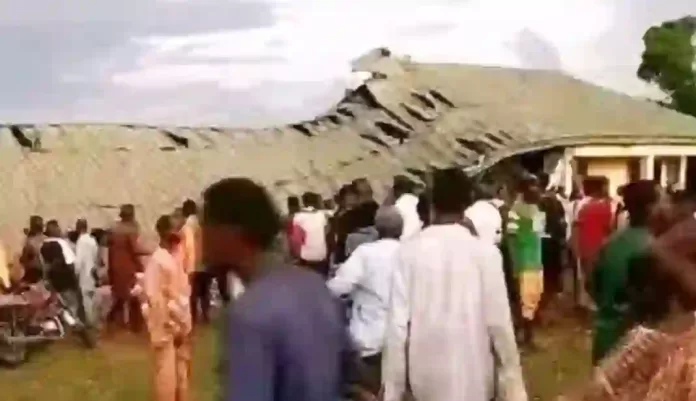
Classroom of a secondary school in Taraba state  in which students were writing the Senior Secondary School Certificate Examination (SSCE)  caved in, leaving several persons injured.

The incident happened at Government Secondary School, Namne, Gassol Local Government Area of Taraba State.

The classrooms collapsed on them during a heavy rainfall which was accompanied by wind storm.

The students and their invigilators were trapped in the collapsed classrooms for hours before some residents rescued them.

A resident, Alhaji DanAzumi Lauris,  that it was the second set of the students that the classrooms collapsed on, as the first set had finished their exams and left the school premises.

He said the incident occurred at about 6pm on Wednesday.

DanAzumi, stated that injured students, teachers were moved to Primary Healthcare Centre located few meters away from the school where they are now receiving treatment.

He said apart from the school, the storm destroyed many houses in the community.

DanAzumi stated that the injured students, teachers and Corps members were moved to Primary Healthcare centre located a few meters away from the school where they are now receiving treatment.

He explained that apart from the school ravaged by the storm, several houses within the community were also affected.

Report added that in Jalingo town, many students went back home after 1.00 am as a result of heavy rainfall, which started when the examinations commenced and lasted hours which prevented many of them from going back home till after 1am.

Fubara To Rivers People On Second Anniversary: “Your Support Has Emboldened Me To Press On”

0
Siminalayi Fubara
Governor Siminalayi Fubara

By Adesina Soyooye

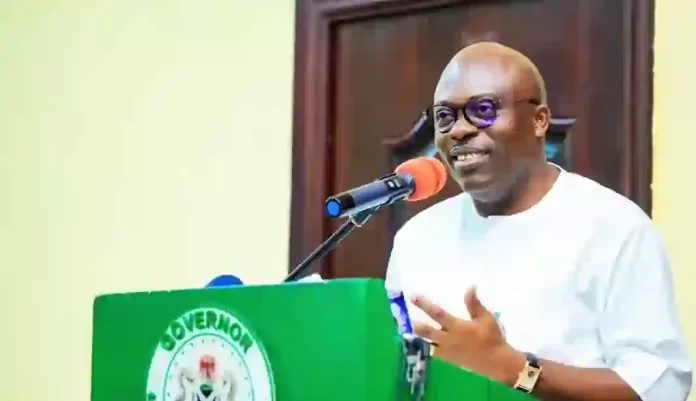
If the message he released on May 29, 2025, the day that could have marked his second anniversary in office but for his suspension in office is anything to go by, then, Rivers State Governor, Siminalayi Fubara, is not tired of the office from which he was suspended by President Bola Tinubu.

Recall that a couple of weeks ago, Fubara had, to the anger of his supporters,  while speaking at one of the events which marked the funeral of late Ijaw Leader, Chief Edwin Clark, given the impression that he was no longer interested in going back to office as Governor; that his spirit already left Government House.

However, from the message he sent to Rivers people on May 29, his spirit is still very much embedded in Government House Rivers. He still wants to go back. In fact in his address, he sounded as if he was still in office. He spoke about the turbulent two years. He spoke about the gradual but solid achievements made. He told the people that their support and belief in him push him to press on. Meaning: He is pushing to get back to office because of the people. “Despite the turbulence, I have remained steadfast and focused, guided by the oath I took and the solemn promise I made to always put Rivers State first”, he said.

He also told them, like an expectant mother: “We are at a point in our journey where difficult decisions must be made. Be assured that every step we take will be guided by your best interests and the enduring good of Rivers State.”

Not a few people have interpreted the difficult decisions he referred to here to mean a decampment to the ruling All Progressives Congress, APC, in order to get his office back. He was elected Governor under the banner of the Peoples Democratic Party, PDP.

The full text of Fubara’s address to Rivers State people, titled Our Journey:  But Progressive And Impactful reads:

“My dear good people of Rivers State,

“Today marks exactly two years since I took the oath of office as your 7th democratically-elected Governor. On May 29, 2023, I was sworn in following the clear and overwhelming mandate you gave me during the March 18, 2023 elections. Once again, I thank you for the trust, honour, and privilege to lead our beloved State.

“In the past two years, our political landscape has undergone significant changes. Despite the turbulence, I have remained steadfast and focused, guided by the oath I took and the solemn promise I made to always put Rivers State first. I pledged to protect and promote our collective interests and ensure you e n joy the real dividends of democracy and good governance. That commitment remains unshaken.

“While we have faced daunting political challenges that have, at times, slowed our pace, these two years have not been without meaningful progress. I am proud of the visible milestones we have achieved, modest but significant strides in healthcare, education, infrastructure, youth empowerment, human capital development, and the inclusion of women in governance.

“These achievements would not have been possible without your unwavering support and hope in the brighter future we all envision for Rivers State. For your sacrifices, contributions, and the roles you’ve played in your respective capacities, I say a heartfelt thank you.

“As we look ahead, I reaffirm my pledge to consolidate on our gains and remain fully committed to the key priorities of this administration: peace, security, community welfare, and the socio-economic advancement of our State. Though our momentum may have been affected by political circumstances, our focus remains clear, and we are determined to emerge stronger, more united, and more result-oriented.

“Your support has emboldened me to press on and not to retreat, but to work harder to foster peace, reconcil i ation, and forgiveness. These are essential to restoring normalcy and delivering transformational infrastructure, impactful programmes, and life-changing services across the State.

“We are at a crucial point in our journey, where difficult decisions must be made. Be assured that every step we take will be guided by your best interests and the enduring good of Rivers State.

“As we reflect on the lessons of the past two years, I am hopeful for what lies ahead. I look forward to working hand in hand with all of you to build a State we can all be proud of: a RIVERS STATE that stands as a model for the rest of Nigeria.

“To those still carrying the weight of our recent political struggles, I appeal to you, let us turn the page, come together, and focus on our shared goal of progress and unity. The time to rebuild and rise is now.

“Thank you once again for the opportunity to serve.

“God bless Rivers State.

“Signed: His Excellency, Sir Siminalayi Fubara, GSSRS
Governor Rivers State
Thursday, May 29, 2025”

Recall that due to the political crisis triggered in the State by the bitter struggle for power between Fubara and his estranged political godfather, Minister of the Federal Capital Territory, FCT, Nyesom Wike, President Tinubu, on March 18, 2025, declared a State of Emergency on the State for an initial period of six months. In doing that, he suspended the Governor, his Deputy and the Members of the State House of Assembly from office, and appointed a retired Chief of Naval Staff, Vice Admiral Ibok-Ete Ibas as the Sole Administrator of the State.

Quite a number of people expected that the President could lift the suspension May 29 to mark his second year in office, but the expectation was in vain.

Akpabio Meets Women Advocacy Leaders On Special Seats Bill

0
Akpabio Meets Women Advocacy

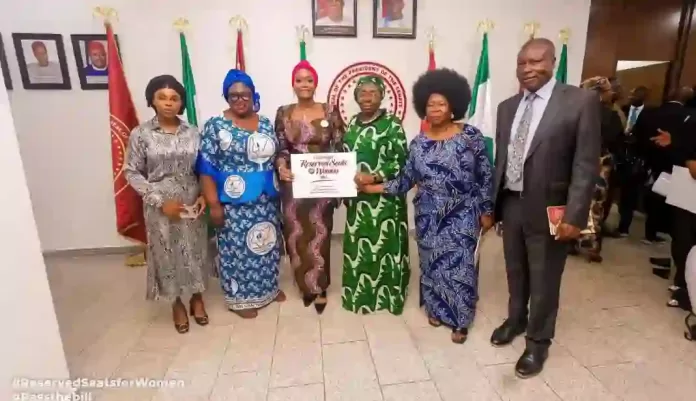
Senate President Godswill Akpabio received leaders of women’s advocacy groups in his office at the National Assembly on Thursday to discuss ways to increase opportunities for women in leadership positions in Nigeria.

Attendees included Hon. Irene Awunah-Ikyegh, President of the League of Women Voters; Barr. Ebere Ifendu, President of Women in Politics Forum; Ms. Ene Obi, a leading gender advocate and former Country Director of Action Aid; and Chief Osasu Igbinedion, Founder of TOS Network and a prominent gender rights advocate.

This visit was part of a series of advocacy efforts aimed at pushing for the passage of the Special Seats Bill, which is currently awaiting public hearing at the National Assembly. The bill seeks to increase women’s representation in politics by amending the 1999 Constitution to create dedicated seats for women at all legislative levels.

Specifically, it proposes one additional seat for women in both the Senate and House of Representatives from each of Nigeria’s 36 states and the FCT, as well as three special seats for women in every State House of Assembly. If passed, the provisions would take effect after the current National Assembly’s term and be reviewed after 16 years. Civil society groups have been mounting pressure for the bill’s passage, highlighting the need for greater female representation in elective positions.

The President of the Senate, Godswill Akpabio has emphasized the importance of women’s representation and their crucial role in the development of the nation, stating that a lack of female participation in politics is a missed opportunity for progress.

The Senate President also acknowledged the crucial role women play in leadership and governance, describing them as “better managers” and strong decision-makers.

He lamented the challenges women face in political spaces, pointing out that women themselves often do not vote for female candidates, a barrier that needs to be addressed for greater female participation in political representation.

“We all came from women. Personally I am blessed with four beautiful daughters. The success of this bill will open the doors of greater political participation for our female children,” he said, while advising the advocates to do more to win more converts for the bill to scale through.

In her speech, Mrs Igbinedion said, “We are here today to speak on behalf of millions of Nigerian women — farmers, entrepreneurs, market traders, doctors, teachers, and mothers — whose voices have for too long been underrepresented in the highest chambers of our democracy.

“The Reserved Seats for Women Bill offers us a rare opportunity to correct that historic imbalance to finally give women a seat at the table where national decisions are made.

“Nigeria currently ranks among the lowest in Africa for women’s representation in parliament, with women occupying less than 5% of seats in the National Assembly. This is not just a gender issue — it is a governance issue, a democracy issue, and a development issue.

“The evidence is clear: when women are involved in policymaking, we see stronger communities, more inclusive legislation, and better outcomes in health, education, and peace-building. Representation matters — not just symbolically, but substantively.

“This bill is not asking for charity; it is calling for justice. It is not about reducing the space for men; it is about expanding the possibilities for Nigeria. By creating reserved seats for women, we are not limiting merit — we are correcting systemic exclusion.

“Mr. President, your endorsement of this bill will be a turning point. It will send a powerful message across Nigeria — that this Senate is ready to lead with integrity, to legislate with empathy, and to act with boldness in pursuit of equality,” she said.”

OPINION: Inside the Oval Office, Trump’s new Lair

0
Azu Ishiekwene
Mr Azu Ishiekwene

By Azu Ishiekwene

The world has never been short of demagogues and fools, but the remedies have often matched the supply. In 1990, during President Nelson Mandela’s thank-you tour of the world, he was asked at the City College of New York, Harlem, NY., why he remained friends with Muammar Gaddafi, Yasser Arafat, and Fidel Castro.

He replied that he didn’t think it was the business of any country to choose South Africa’s friends. These people stood by South Africa in its hour of need; why should he betray them now?His interlocutor turned tail, and Mandela received a standing ovation.

British Prime Minister Margaret Thatcher preached “constructive engagement” to dismantle apartheid. In response to her duplicity in 2004, the President of Equatorial Guinea, Teodoro Obiang Nguema Mbasogo, pointed out to her that “constructive engagement” favoured England, particularly the Prime Minister, whose son, Mark, was involved in gunrunning and coup plots on the continent. Thatcher had no response.

Castro v. Bush

Castro accused President George Bush of a “pirate mentality. ”And he wasn’t being flippant. One of Africa’s worst kleptocrats, Joseph Desire Mobutu, worth $5 billion in the 1980s, visited President Bush in 1989.

Despite Mobutu’s appalling record, Martin Meredith in The Fate of Africa, quoted Bush as saying on the South Lawn of the White House, “Zaire is among America’s oldest friends, and its president – President Mobutu – one of our most valued friends. We are proud and very, very pleased to have him with us today.”

Like Castro, President Olusegun Obasanjo is also reputed not to suffer fools gladly. Stephen Sackur, anchor of the BBC programme HARD talk, might recall when, in response to what Obasanjo perceived as a rude question, the former Nigerian president asked Sackur if he could pose that question to his prime minister.

In the lion’s den

There is a long list of leaders who confronted bullies without flinching. This quality, which is in demand more than ever before, is falling short, as shown by recent high-profile encounters in the White House since President Donald Trump’s second term. The White House, especially the Oval Office, has become for high-profile visitors what the lion’s den is to straying goats.

After Ukrainian President Volodymyr Zelenskyy’s antagonistic exchange with Trump, South African President Cyril Ramaphosa is the latest target. Almost from the moment the first live footage of the visit began airing, it was clear that Trump wanted only one thing.

He wasn’t interested in resetting trade talks or bilateral issues. He wasn’t interested in repairing ties between South Africa and the US or hearing first hand the other view about the so-called genocide against white farmers. He wasn’t interested in conciliation. He was interested in only one thing: having Ramaphosa for lunch. And he did, which was painful and difficult to watch.

‘How did you get my number?’

From Trump’s question about “how did you get my number?”, gestures that suggested he valued the presence of the golfers in Ramaphosa’s entourage – Ernie Els and Retief Goosen – more than the president, to dumping piles of fake documents on the South African president and converting the Oval Office into a cinema while Ramaphosa was still speaking, Trump displayed utter contempt and disregard for his visitors.

The encounter made Zelenskyy’s visit appear like a lovefest. Some have argued that it reflects more poorly on Trump and the US that the hosttreated his guest so shabbily, raking him over the coals with fake and discredited materials, than on Ramaphosa, who kept his smile and rational stance. That is partially correct, but more than anyone else, Ramaphosa has himself to blame for the shambolic treatment.

Yellow flags

There were more than enough yellow flags beforehand. From the Executive Order in February, stopping all US financial assistance to South Africa, to the accusations of “white genocide”, to the expulsion of Ambassador Ebrahim Rasool, and the offer of “refugee” status to white farmers, Trump, mainly instigated by Elon Musk, has never disguised his misguided displeasure against South Africa.

The country’s decision to drag Israel to the ICJ over the war in Gaza and its leadership role in BRICS (which could potentially curtail the influence of the dollar), of course, were also unspoken sources of Trump’s anger.

If a war foretold does not take the disabled person by surprise, how could Ramaphosa have ignored these yellow flags and decided to visit the lair with a golfing picture book as a peace offering, instead of a luxury Boeing 747 jetliner, the perfect sacrifice?

Success. What success?

The South African president has described the visit as “a great success. ”Perhaps that would be correct if he were describing his narrow escape. There is no readout or evidence of the “reset” Ramaphosa requested. As of today, the fake video of the crosses on the roadside, supposed to be memorials for about 1,000 murdered white South African farmers, is still playing on the X handle of the White House. Nothing has changed.

If Ramaphosa believes the visit was a success, his opinion has divided his country as much as it has a largely subdued continent. Femi Badejo, a diplomat and professor of Political Science, used the metaphor of a safari to describe the response across the continent. “If a lion grabs an antelope,” he asked me, “what do you think will happen to the rest of the herd?”

South Africa is not just another African antelope; it’s a leader in the pack. Although many African diplomats are publicly spinning Ramaphosa’s visit as measured and dignified, behind the scenes, they are scandalised at the possible fate that awaits them – and the continent – especially with the African Growth and Opportunity Act (AGOA) expiring in September.

Who’s next?

For many reasons, primarily economic, the Africa that once stood up to bullies or was even deemed worthy allies has become a thing of the past. The Egyptian leader, Field Marshal Abdel Fattah el-Sisi, may receive red-carpet treatment at the White House due to that country’s strategic importance to the US, just as Burkina Faso’s Captain Ibrahim Traore, Russia’s poster boy, may get flowers in the Kremlin. The others, grappling with internal security challenges, discontent and fragile economies, are on their own as they struggle to navigate a hostile and deeply divided world.

It would be a long time before another leader from the continent visits the White House, that is, if Trump has not closed half of the US embassies in Africa before he marks his first year in office. If, at this time, African leaders cannot find good company among themselves, they may as well learn to sit at home.


Ishiekwene is Editor-in-Chief of LEADERSHIP and author of the book, Writing for Media and Monetising It.

Anyanwu: PDP NEC Is Illegal, I Won’t Step Down As Secretary

0
Senator Samuel Anyanwu

Embattled National Secretary of the Peoples’ Democratic Party, PDP, Samuel Anyanwu has double down on his stand that he will not quit his position.

“I will not step down” as PDP National Secretary Anyanwu said on Wednesday few hours after a botched attempt by the party’s National Executive Council, NEC  to remove him as its scribe.

The magazine reported that the PDP NEC would have removed  Anyanwu on Tuesday but for the Independent National Electoral Commission, INEC which insisted that  he’s the legal National Secretary of the party.

The Prof. Mahmood Yakubu-led INEC had on Monday informed the fact-finding Committee set up by the party, to find out the position of the commission on the controversial, that it has recongonised Anyanwu as the authentic occupier of the position. The Committee which was led by Governor Kefas of Taraba state also had as members Governors of Zamfara and Enugu states.

Speaking to journalists yesterday in Abuja, the nation’s capital Anyanwu said he was not ready to vacate his position, saying whatever decision taken at the PDP is illegal, noting that those that wants him out are the ones fueling the crisis in the party.

According to him, the trouble makers are some key leaders of the party and not the Minister of the Federal Capital Territory, FCT, Nyesom Wike who he scribe as his ‘friend.”

He explained that his tenure has not lapsed since he was elected into the position in 2021, saying the trouble makers in the party are the ones ‘demarketing’ it and trying to destroy the PDP. H

Anyanwu message for his political opponents   si that there is no “vacancy” for the PDP National secreatry position.

He said, “There is no vacancy in the office of the PDP national secretary,” he said.

“I was elected in October 2021 as the national secretary of this party. According to the zoning arrangement, it was zoned to the south and micro-zoned to south-east.

“Just like every other state in the south-east, the national secretary position was zoned to Imo state. Every state in the south-east has a representative in the national working committee.

“But assuming that I am no longer the national secretary, for instance, whoever will replace me must come from Imo state.

“I will not give in to anybody trying to mess up my career. It took me time to build my reputation.

“I have been a two-time local government chairman and two-term assembly member, went to the senate, ran for governorship twice, and I am now the national secretary.

“Each time they talk about people demarketing the party, all these PDP leaders who go on national television are the ones destroying the party.

“Instead of saying things that build the party, they are saying things that will destroy and demarket it, and then accuse the minister of the FCT, Nyesom Wike, just because he’s my friend.”

The magazine reported that Anyanwu has rejected his party’s position that he’s no longer the National secretary, that Sunday Ude-Okoye, a former National Youth Leader of the party has been appointed in his place.

FG’s Fresh Borrowing: “Nigeria Is Being Run Like Ponzi Scheme” –  Atiku Abubakar

0
Atiku Abubakar
Atiku Abubakar

By Ayodele Oni

Former Vice President, Atiku Abubakar, has cautioned the Federal Government not to sell Nigeria into debt slavery, going by spate of borrowing by President Bola Tinubu’s administration.

Reacting to the announcement by the Tinubu-led APC government to pursue fresh external and domestic loans, Atiku described it as “a reckless and dangerous move that threatens the future of Nigeria and generations yet unborn.”

He stated that “Despite national outrage, this administration is pushing ahead with plans to borrow $21.54 billion, €2.19 billion, and ¥15 billion — an equivalent of over $24 billion, which is more than 60% of Nigeria’s total foreign exchange reserves.

“This borrowing spree will raise our total public debt from ₦144.7 trillion to a crushing ₦183 trillion. This move comes while Nigeria’s debt burden is already at alarming levels.

“As of December 31, 2024, public debt stood at $94 billion (₦144.7 trillion).

Since President Tinubu assumed office in 2023, public debt has jumped by 65.6%.

“Under the APC-led administration since 2015, public debt has ballooned by 1,048%, from ₦12.6 trillion to ₦144.7 trillion. The debt-to-GDP ratio has exceeded 50%.

“The debt-service-to-revenue ratio is over 130%, meaning the government now spends more on repaying loans than it earns.

“This is not just unsustainable — it is immoral. The Tinubu administration is borrowing money not for development but to service existing loans, fueling a debt spiral that leaves nothing for infrastructure, education, healthcare, or jobs.

“This addiction to borrowing, entrenched under the APC-led administration and now accelerated by President Tinubu, has turned public finance into a Ponzi scheme — borrowing to pay debt, then borrowing again to pay interest.

“Nigeria is now caught in a vicious cycle that mortgages the future to pay for the past. We warn that this is economic sabotage in plain sight.

“We demand that this reckless borrowing plan be halted immediately. We call on lawmakers, civil society organizations, the media, and the international community to take urgent action to stop this looming catastrophe. Nigeria must not be sold into debt slavery.”

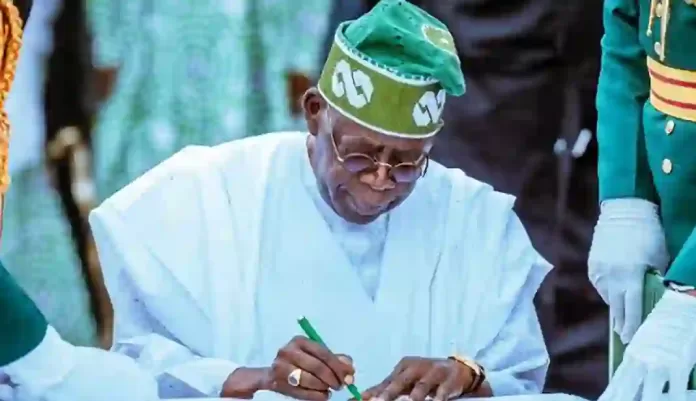
Tax Reform Has Changed Structure Of Economy – President Tinubu

0
Bola Ahmed Tinubu - President
President Bola Ahmed Tinubu

By Ayodele Oni

President Bola Tinubu has put up stout defence in support of his administration’s tax reform saying it is affecting Nigeria’s economy, leading to a rise in the nation’s tax-to-GDP ratio.

In a statement marking the second anniversary of his administration on Thursday, Tinubu said the reforms were not only about raising revenue but about changing the structure of the economy.

“One of our most impactful achievements has been our tax reform agenda, which is already yielding results,” the President said.

He noted that Nigeria’s tax-to-GDP ratio increased from 10 per cent to over 13.5 per cent by the end of 2024. He attributed this rise to changes in tax administration and policies.

“We are eliminating the burden of multiple taxation, making it easier for small businesses to grow and join the formal economy. The tax reforms will protect low-income households and support workers by expanding their disposable income,” he said.

The President said that essential goods and services—such as food, education, and healthcare—would now attract zero per cent VAT. He added that rent, public transportation, and renewable energy are exempt from VAT.

“We are ending the era of wasteful and opaque tax waivers. Instead, we have introduced targeted and transparent incentives supporting high-impact manufacturing, technology, and agriculture sectors,” Tinubu said.

He said the reforms also focus on creating a tax environment that accommodates digital jobs and remote work.

Through new export incentives, Tinubu said Nigerian businesses are now in a better position to compete in the global market.

The President also mentioned the implementation of the National Single Window project, which he said has reduced delays in international trade.

“To promote fairness and accountability, we are establishing a Tax Ombudsman, an independent institution that will protect vulnerable taxpayers and ensure the system works for everyone, especially small businesses,” he stated.

Tinubu said a new national fiscal policy is being introduced to guide taxation, borrowing, and spending.

“This strategic framework will guide our approach to fair taxation, responsible borrowing, and disciplined spending,” he said.

“These reforms are designed to reduce the cost of living, promote economic justice, and build a business-friendly economy that attracts investment and supports every Nigerian.”

President Tinubu’s Mid-term Speech To Nigerians

0
President Bola Tinubu

Below, the full text.

Fellow Nigerians,

As we mark the second anniversary of our administration, I salute your resilience and undaunting spirit. Two years ago, you entrusted me with the sacred responsibility to lead our nation at a time of historic challenges. Together, we have faced these headwinds with courage and determination.

The economic and general situation of the country I inherited required that we redirect the country’s affairs with a bold and new vision. I immediately implemented two necessary policies to stop our country from further drifting into the precipice. It was apparent that if the federal government and the other two tiers of government must remain viable and cater to the citizens’ welfare, we must do away with decades-long fuel subsidies and the corruption-ridden multiple foreign exchange windows. The two were no longer sustainable and have become a chokehold on our nation’s neck, strangling our nation’s future.

While our administration has implemented the reforms to restore and reinvigorate our national economy and strengthen our social fabric as a strong and united country, I must thank my fellow citizens for your unrelenting support and belief in the grand vision we share to uplift our nation and renew our collective hopes and aspirations.

We are halfway through the journey that began 24 months ago. Today, May 29, 2025, offers our administration the opportunity to share again how far we have gone and our progress in steering our country along the critical path of socio-economic development.

When we embarked on this journey, propelled by a burst of hope and abiding faith in Nigeria’s unity and progress, I made a pledge before God and fellow countrymen and women to confront Nigeria’s challenges head-on by rebuilding trust, fostering prosperity, and restoring our nation’s economic health. Today, I proudly affirm that our economic reforms are working. We are on course to building a greater, more economically stable nation.

Under our Renewed Hope Agenda, our administration pledged to tackle economic instability, improve security nationwide, reduce corruption, reform governance, and lift our people out of poverty.

While implementing the reforms necessary to strengthen our economy and deliver shared prosperity, we have remained honest by acknowledging some of the difficulties experienced by our compatriots and families. We do not take your patience for granted. I must restate that the only alternative to the reforms our administration initiated was a fiscal crisis that would have bred runaway inflation, external debt default, crippling fuel shortages, a plunging Naira, and an economy in a free-fall.

Despite the bump in the cost of living, we have made undeniable progress.

Inflation has begun to ease, with rice prices and other staples declining. The oil and gas sector is recovering; rig counts are up by over 400% in 2025 compared to 2021, and over $8 billion in new investments have been committed. We have stabilised our economy and are now better positioned for growth and prepared to withstand global shocks.

In 2025, we remain on track with our fiscal targets. Gross proceeds per barrel from crude oil are broadly aligned with our forecasts as we intensify our efforts to ramp up production. Our fiscal deficit has narrowed sharply from 5.4% of GDP in 2023 to 3.0% in 2024. We achieved this through improved revenue generation and greater transparency in government finances. In the first quarter of this year, we recorded over N6 trillion in revenue.

We have discontinued Ways & Means financing, which has been a major contributor to high and sticky inflation. The NNPC, no longer burdened by unsustainable fuel subsidies, is now a net contributor to the Federation Account. We are also achieving fuel supply security through local refining.

Our debt position is improving. While foreign exchange revaluation pushed our debt-to-GDP ratio to around 53%, our debt service-to-revenue ratio dropped from nearly 100% in 2022 to under 40% by 2024. We paid off our IMF obligations and grew our net external reserves by almost 500% from $4 billion in 2023 to over $23 billion by the end of 2024.

Thanks to our reforms, state revenue increased by over N6 trillion in 2024, ensuring that subnational governments can reduce their debt burden, meet salaries and pension obligations on a timely basis, and invest more in critical infrastructure and human capital development.

One of our administration’s most impactful achievements is our bold tax reform agenda, which is already yielding results. By the end of 2024, our tax-to-GDP ratio rose from 10% to over 13.5%, a remarkable leap in just one year. This was not by accident. It results from deliberate improvement in our tax administration and policies designed to make our tax system fairer, more efficient, and more growth-oriented

We are eliminating the burden of multiple taxation, making it easier for small businesses to grow and join the formal economy. The tax reforms will protect low-income households and support workers by expanding their disposable income. Essential goods and services such as food, education, and healthcare will now attract 0% VAT. Rent, public transportation, and renewable energy will be fully exempted from VAT to reduce household costs further.

We are ending the era of wasteful and opaque tax waivers. Instead, we have introduced targeted and transparent incentives supporting high-impact manufacturing, technology, and agriculture sectors. These reforms are not just about revenue but about stimulating inclusive economic growth.

There is a deliberate focus on our youth, who a friendlier tax environment for digital jobs and remote work will empower. Through export incentives, Nigerian businesses will be able to compete globally. Our National Single Window project streamlines international trade, reduces delays, and enhances Nigeria’s competitiveness.

To promote fairness and accountability, we are establishing a Tax Ombudsman, an independent institution that will protect vulnerable taxpayers and ensure the system works for everyone, especially small businesses.

Most importantly, we are laying the foundation for a more sustainable future by introducing a new national fiscal policy. This strategic framework will guide our approach to fair taxation, responsible borrowing, and disciplined spending.

These reforms are designed to reduce the cost of living, promote economic justice, and build a business-friendly economy that attracts investment and supports every Nigerian. Together, we are creating a system where prosperity is shared, and no one is left behind.

We have breathed new life into the Solid Minerals sector as part of our efforts to diversify the economy. Revenue has increased phenomenally, and investors are setting up processing plants as the sector dumps the old pit-to-port policy and embraces a new value-added policy.

We have also repositioned our health sector despite all odds.

Over 1,000 Primary Health Centres are being revitalised nationwide. An additional 5,500 PHCs are being upgraded under our Renewed Hope Health Agenda. We are establishing Six new cancer treatment centres. Three are ready. We offer free dialysis services in pilot tertiary hospitals and subsidise the service in others. Under the Presidential Maternal Health Initiative, over 4,000 women have undergone free cesarean sections. Lastly, we have expanded Health Insurance Coverage from 16 million to 20 million within two years.

As a result of our bold and deliberate policies, the economy is growing stronger again. Real GDP rose by 4.6% in Q4 2024, with full-year growth of 3.4%. This is one of the strongest in a decade.

Without a responsive and reliable national security infrastructure that can protect lives and properties, our economy will not perform optimally, and those who seek to harm us will impair and disrupt our way of life. Our administration is committed to the security and safety of our people. For our government, protecting our people and their peaceful way of life is the utmost priority.

Since I assumed our country’s leadership, our administration has improved collaboration among security agencies, increased intelligence-driven operations, and better ensured the welfare of our armed forces and security personnel. I use this opportunity to salute the courage and everyday sacrifice of our service men and women. We may not always witness the tremendous efforts they make to keep us safe, but we benefit every day from the results of their dedication. Even if we do not thank them often enough, they willingly face danger so we can go about our lives freely and without fear.

Our military, police, and intelligence agencies are committed to always responding to emerging security threats and new challenges because it is the patriotic duty they owe a grateful nation.

Amid the new security challenges, we can report some successes. In some areas of the northwest, hitherto under the control of bandits, our gallant armed forces have restored order, reducing and eliminating threats to lives and livelihoods. With the success achieved, farmers are back tilling the land to feed us. Highways, hitherto dangerous for travellers, have become safer. Our security agencies have succeeded many times in rescuing the abducted citizens from the hands of their tormentors. I promise you, we shall remain vigilant, as I told security chiefs during the last meeting to up their game and collaborate to end this plague of evil men. Every Nigerian deserves to live without fear.

Outside of Security, we have prioritised human capital development as a central pillar of our national development strategy.

To this end, we have significantly expanded access to quality education through infrastructure investments and the student loan scheme to support indigent students in tertiary institutions. Through the Renewed Hope Health initiative, our administration has begun equipping health facilities and deploying skilled personnel to unserved areas. We are also strengthening our response to public health threats and implementing targeted social investment schemes.

Our youth empowerment initiatives include access to funds, skill development, and creating employment opportunities. Through our MSME support, we empower the next generation and bridge inequality. In our mission to empower the next generation, we have taken bold steps to place young Nigerians at the heart of national development. Nowhere is this more evident than at the National Agency for Science and Engineering Infrastructure (NASENI), where the current management is making giant strides. NASENI has embraced a digital-first approach, introduced real-time dashboards, and implemented end-to-end e-procurement through its Unified ERP System—setting a new governance benchmark for public institutions.

Through bold, high-impact programmes like Innovate Naija, Irrigate Nigeria, the Asset Restoration Programme, and the Renewable Energy and Innovation Park in Gora, NASENI drives inclusive industrialisation at scale. From assembling electric vehicles and reviving idle assets to launching Africa’s most advanced Rapid Diagnostic Kit Factory and training female drone engineers through the NASCAV programme, these initiatives are creating jobs, restoring dignity to work, and opening up a future of possibilities for our youth. This is the movement we promised—a government of action powered by the energy and innovation of young Nigerians.

Agriculture and food security are top priorities of our Renewed Hope Agenda. We have launched aggressive initiatives to boost local food production, support farmers, and stabilise food prices. We have also invested in mechanised farming by procuring thousands of tractors, other farming tools, and fertilisers.

Under the Renewed Hope Agenda, the federal government has continued with major road construction and rehabilitation projects across all geopolitical zones, from the Abuja-Kaduna-Zaria-Kano Dual Carriageway, the 9th Mile-Oturkpo-Makurdi Road, the Lagos-Calabar Coastal Highway, Abuja-Lokoja-Benin Road, Enugu-Onitsha Expressway, Oyo-OgbomosoRoad, Sokoto-Badagry Road, Enugu-Port Harcourt Expressway, Second Niger Bridge Access Road to Bodo-Bonny Road among hundreds of ongoing road projects across the country.

We have launched initiatives to improve electricity generation by upgrading generation and transmission infrastructure and investing in off-grid solar energy to power our homes, business premises, industries, schools and hospitals.

In the spirit of democracy and national renewal, we are preparing to welcome the world to Nigeria soon for the Motherland Festival. This landmark gathering will spotlight our rich heritage, dynamic creative industries, and the vibrant energy of our people. It will showcase Nigeria’s beauty through tourism, culture, and innovation, inviting the world to rediscover our nation.

The Nigerian diaspora plays a vital role in our national transformation. Their expertise, investment, and global perspective are key to shaping the future we seek. In recognition, the government has introduced policies like the diaspora bond and the non-resident Bank Verification Number to make it easier for Nigerians abroad to invest, engage, and contribute meaningfully to the country’s progress.

The Motherland Festival will bring together voices from across the continent and the diaspora in a decisive moment of unity and purpose, affirming that Nigeria is not only a leader in Africa but a committed global partner ready to engage, inspire, and lead.

Once again, I acknowledge the sacrifices many Nigerians have made and continue to make as we reposition our country, not just for today but for generations yet unborn. Our journey is not over, but our direction is clear. So is our resolve to tackle emerging challenges. By the Grace of God, we are confident that the worst is behind us. The real impact of our governance objectives is beginning to take hold. The future is bright, and together, we will build a stronger, more inclusive Nigeria that we can all be proud of.

Thank you all, and May God continue to bless the Federal Republic of Nigeria.
Atiku’s Mid-term Score Card For Tinubu: You Have Failed; Nigeria Now World Poverty Capital

0
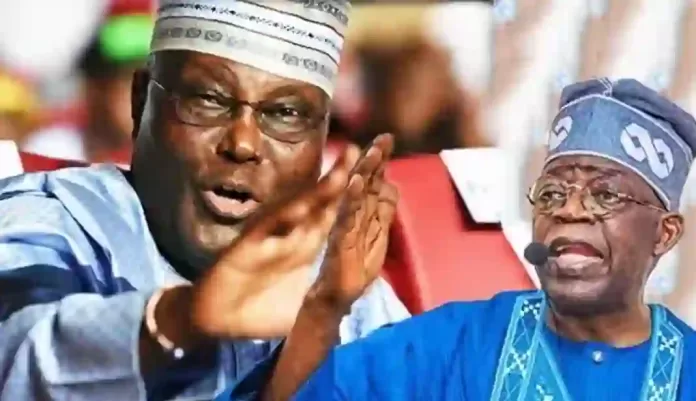
Atiku Abubakar and Bola Tinubu

Atiku Abubakar, the People’s Democratic Party, PDP, says the administration of President Bola Ahmed Tinubu has inflicted pains and hardship on Nigerians within two years in office.

The former vice president said the situation have never been so hard on Nigerians, saying previous administrations in the country did not make Nigerians suffered as the incumbent.

The former PDP presidential candidate made the remark on his Facebook page on Thursday noting also that the Tinubu administration has failed to be accountable to Nigerians as it has failed to show responsible leadership.

Abubakar spoke as President Tinubu marked two years in office as Nigeria’s leader and Commander-in-chief. The administration has rolled out the drums to celebrate its mid-term, saying it has done its best in terms of transforming the country citing the milestones it has achieved in the areas of security, infrastructure amongst others.

As part of the events marking his two years in office, president Tinubu has commissioned some projects , including the multi-trillion naira Lagos – Calabar Coastal Highway.

According to the former vice president the country has never been this bad, saying government officials have abandoned governance, and are now living ostentatious lifestyles at the expense of Nigerians.

He said while many Nigerians are struggling to survive officials in Tinubu’s government “are living in excess and approving budgets that benefit the elite”, the administration has set new records by making the country the world capital of poverty, considering the number of malnourished children in the country.

“This government has not only deepened poverty across the country, but it has also set new records in wasteful public spending. At a time when millions of Nigerians are struggling to survive, government officials are living in excess and approving budgets that benefit the elite at the expense of the common man. It is sad that apart from being the poverty capital of the world, Nigeria has under this administration emerged as the unenviable position as the capital of  malnourished children in Africa having beaten Sudan, a nation that is at war,” Abubakar said.

The poverty level in the country has worsen as the administration is only making the rich to be richer at the expense of poor Nigerians without any concrete efforts to bridge the gap of poverty, a situation that dragged Nigerians to the 18th position in the Global Hunger Index, GHI in 2024.

He said, “According to the Global Hunger Index 2024, our country is one of the most affected by hunger and malnutrition, occupying the 18th position,

Policy after policy under this administration has targeted the poor while providing relief and advantage to the rich. From healthcare to education to identity management and basic public services, Nigerians are now faced with class-based systems where the wealthy enjoy VIP treatment, and the rest are left behind.”

Abubakar accused the administration of making life more difficult for Nigerians, saying Nigerians are now being charged for some essential services that are supposed to be provided free of charge. According to him, the government has also increased its appetite for loans, considering that the total debt stock in the last two years has risen significantly, with the an indication that more funds will still be borrowed locally and from foreign creditors, adding that the nation’s debt crisis under President Tinubu has worsened, noting that  there’s no justification for government to borrow.

“Just two weeks ago, the National Identity Management Commission (NIMC) hiked its fees by 75%, introducing VIP protocols for services that should be a basic right of citizenship. In education, public university fees have been raised far beyond the reach of poor families, with no adequate support mechanisms in place.

“Even more troubling is the scale of borrowing under this government. When President Tinubu assumed office in 2023, Nigeria’s total public debt stood at approximately N49 trillion. In just two years, that figure has skyrocketed to N144 trillion — a 150% increase — with more foreign loans now being requested, which could push the debt to N183 trillion.

“While the federal government racks up debt, state governments have shown more discipline, reducing their debt levels from N5.86 trillion to N3.97 trillion. The implication is clear: the federal government, under Tinubu, is the primary driver of Nigeria’s current debt crisis.

“President Tinubu’s justification — that new borrowing is needed to fund the 2025 budget and soften the impact of fuel subsidy removal — is both weak and dishonest. It was the reckless and insensitive way his government removed the subsidy that created much of today’s economic hardship in the first place,” Abubakar said.

May 30 Biafra Day Lockdown: Police Warns Enforcers

0
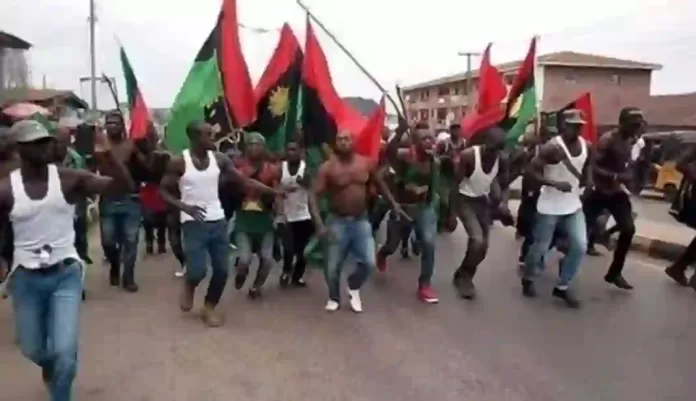
IPOB Members

By Suleiman Anyalewechi

Ahead of the lockdown scheduled for May 30, 2025, by the Indigenous Peoples of Biafra, IPOB, the Anambra State Police authorities on Wednesday moved to checkmate the activities of enforcers.

The Source reports that IPOB, penultimate week, in a statement from its spokesperson, Emma Powerful, declared May 30 as  Remembrance Day for all Biafran heroes and heroines ,and those who lost their lives in the over 30 months of Biafra/Nigeria civil war of 1967 to 1970.

According to Powerful, on the said day, there will be no movement of persons and goods, all markets, schools, public and private offices, banks and others will be closed from 6 am to 6 pm in all the five States of the South East region.

The group called on all residents of the region to ensure a complete observance of the lockdown order.

But  a statement on Wednesday issued by its  spokesperson, Tochukwu Ikenga SP, noted that the State Commissioner of Police, CP Ikioye Orutugu has directed  the deployment of operatives to some known flashpoints with a view to preventing any unlawful enforcement of the  sit-at-home order and or any other activities capable of compromising the security of the State.

According to Ikenga, the Commissioner also directed operatives to intensify surveillance efforts across the State to avoid any illegal gathering.

His directives are coming against the backdrop of the arrest of  a suspected enforcer of the  scheduled lockdown ,Friday Obeta

Obeta ,who is suspected to be a staunch member and informant of IPOB was said to have been arrested in Nnewi.

A motorcycle, branded t-shirt, and an operational identification card of IPOB were some of the items recovered from the suspect, the police stated.

On further interrogation, Obeta, according to the police admitted being both a member and informant of the separatist group.

His arrest, which was effected by operatives of the Rapid Response Squad of the State Command, was sequel to the receipt of actionable  intelligence.

The statement noted that Obeta was arrested while putting finishing touches to the group’s enforcement plans of the declared sit-at-home order.

The Command further informed that the suspect has equally made some useful statements that are assisting in its investigations and apprehension of other members of the group.

This is just as the Police Authorities appealed to parents and guardians  to caution their children and wards to  avoid engaging in any activities likely to breach the peace of the state.

It, however, expressed its readiness to deal decisively with any persons or group(s) that threatens the fragile peace of the State under any guise.