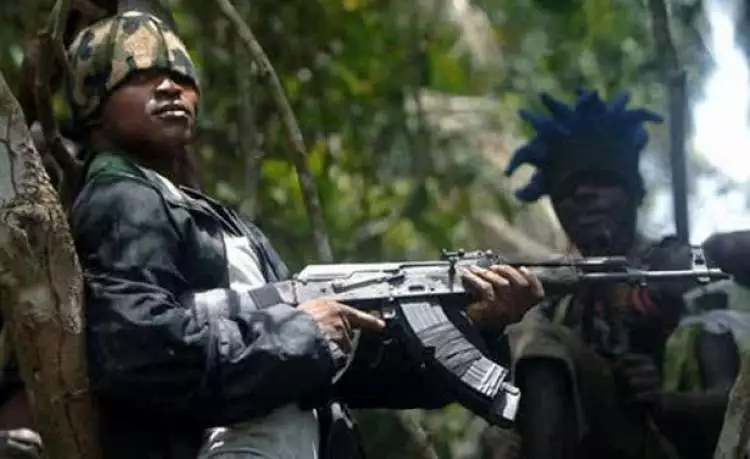
Akeredolu Defies Myetti Allah, Signs Anti-Open Grazing Law
NGE Shocked At NDA Attack; Urges FG To Be More Proactive, Creative In Tackling Insecurity
By James Orji
The Nigerian Guild of Editors (NGE), has described the recent compromise of the security at the the Nigerian Defence Academy in Afaka, Kaduna State, by gunmen as a worrisome dimension to insecurity in the country.
It called on the government at all levels to be more proactive and creative in tackling insecurity, and also in carrying out their constitutional duty of securing life and property in the country.
The NGE, also, announced that its 17th All Nigerian Editors Conference (ANEC) will hold on October 21 and 22, 2021 in Abuja, focusing on the current security challenges in the nation, with a theme: *“Media In Times Of Crisis: Resolving Conflict, Achieving Consensus.”*
In a communique announcing the decisions reached by the Standing Committee in Dutse, the Jigawa State capital signed by the President, Mustapha Isah and the General Secretary, Iyobosa Uwugiaren, the Guild acknowledged efforts by the government to achieve better results in tackling the nation’s security challenges but said much more need to be done.
According to the Guild: “We acknowledge efforts by the federal government to achieve better results in tackling the nation’s security challenges, but the August 24 compromise of the security of the Nigerian Defence Academy in Afaka, Kaduna State, by gunmen is a worrisome dimension to insecurity.
“We call on the government to be more proactive and creative in the fight against insecurity, and in carrying out its constitutional duty of securing life and property in the country.”
The umbrella body of all editors in Nigeria said taking proactive measures was the way to go in order to push back and arrest the spate of banditry and kidnapping for ransom, which has continued to occur in some parts of the country, in spite of continued onslaught by security forces against the perpetrators.
The NGE, also, highlighted the constitutional role of the media in holding government officials accountable to the people, while noting that the government has a duty of providing an enabling environment for the media to perform its role devoid of intimidation, with journalists having the responsibility of ensuring they operate in line with the ethics of the profession.
‘’We restate that a free press remains one of the bedrocks of democracy and nothing must be done to shrink the space. We commend the intervention of the Nigeria Press Organisation in protecting the freedom of press in the country,’’ the Guild stated.
The NGE expressed appreciation to the Government and people of Jigawa State for the conducive environment provided during its Standing Committee Meeting in Dutse.
Meanwhile, the Editors said that this year’s All Nigerian Editors Conference (ANAC), the largest gathering of Nigerian Editors and owners of newspapers, magazines, radio/television stations and online newspapers in Nigeria will hold at the Nigerian Air Force Conference Centre (NAF) in Abuja between October 21 and 22.
It said the Editors conference is aimed at achieving ‘’consensus and collective agreement” among media owners, managers and senior editors on “what role to play in helping government resolve the seemingly intractable conflict enveloping the nation today.”
The Guild said: “The strong argument by conflict management experts is that mass media ever so often, plays a key role in conflict. Their role may take two different and opposed forms: It is either the media takes an active part in the conflict with obligation for increased violence, or stays independent and out of the conflict, in that way contributing to the resolution of the conflict and mitigation of violence.”
The Guild said its annual conference will attract its foreign partners: World Editors Forum (WEF), West African Editors Forum (WAEF), African Editors Forum (AEF), International Press Institute (IPI), World Association of Newspapers (WAN).
Also expected at the two-day conference are top security officers in the country, chief executive officers in the private sector, state governors, lawmakers, academics and others.
Qatar 2022 Qualifiers: 23 Eagles Set To Crush Liberia
CBN Picks Bitt Inc As Digital Currency Partner
By Fola James
The Central Bank of Nigeria, CBN has approved renowned global fintech company, Bitt Inc., as the technical partner for its digital currency, eNaira, due to be unveiled later in the year.
CBN Governor, Godwin Emefiele, disclosed this in Abuja, adding that the country stands to gain immensely from digital currency.
According to him, the benefits include increased cross-border trade, accelerated financial inclusion, cheaper and faster remittance inflows, easier targeted social interventions, as well as improvements in monetary policy effectiveness, payment systems efficiency, and tax collection.
Emefiele said the apex bank’s selection of Bitt Inc. from other bidders is based on the company’s technical competence and efficiency.
The company said on its website that it offers complete financial technology solutions for monetary authorities.
According to the apex bank Governor “In choosing Bitt Inc, the CBN relied on the company’s tested and proven digital currency experience, which is already in circulation in several Eastern Caribbean Countries.
“Bitt Inc. was key to the development and successful launch of the central bank’s digital currency (CBDC), pilot of the Eastern Caribbean Central Bank (ECCB), in April 2021.
He stated that CBDC, known as “Project Giant”, had been a long and thorough process for the CBN, with the Bank’s decision to digitize the Naira in 2017, following extensive research and explorations.
And “Given the significant explosion in the use of digital payments and the rise in the digital economy, the CBN’s decision follows an unmistakable global trend in which over 85 per cent of Central Banks are now considering adopting digital currencies in their countries,” Emefiele said.
ASUU Shelves Proposed Strike
Zenith Bank Shows Resilience, Half–Year Profit Soars By 3 Percent
NDLEA Boss Seeks Ganduje’s Support Against Legalisation Of Cannabis
OPINION: Commodore Olawunmi and the maladies this time
By Festus Adedayo
An early morning inferno broke out in Circus Maximus, Rome on June 19, 64 A.D. It spread like bushfire through the ancient city. Emperor Nero Claudius Caesar’s reaction was immediate: he scapegoated Roman Christians of the time and inflicted a persecution scarcely heard of in Roman history on them.
Highly chagrined by the nauseating no-holds-barred interview granted by Retired Commodore Kunle Olawunmi on Channels television last week which exposed its security underbelly, the current Nigerian Government found the template of this Roman emperor, renowned for debaucheries and political murders, fascinating.
It thereby went on a route similar to Nero’s, unleashing the Nigerian Broadcasting Commission, (NBC) its broadcasting regulatory Rottweilers, on the journalists who conducted the interview.
The Roman fire had wrecked a colossal havoc. In nine days, of the 14 districts in Rome, it totally destroyed three, severely destroying additional seven later. While this fire was raging, classical sources among Roman elite claimed to have sighted Nero, the most infamous among Roman emperors, who had recently acquired an obsession for music and the arts, sitting on his palace rooftop, attired in theatre apparel similar to a performer about to enter the stage. He was said to be reciting by rote a line from the Greek epic, The Sack of Ilium. This new passion of Nero’s for music must have given birth to the typecast that he fiddled as Rome burned.
The emperor then ordered the brutal persecution of these scapegoats. While he decreed some of his victims to be attired in animal skins, preparatory to getting dogs to tear them into shreds and eat their flesh, for some others, he ordered that they be burnt alive at night time pyres.
Last Tuesday, the Nigerian fire got so very intense too. Unprecedented in the history of Nigeria, terrorists caught the self chest-thumping Nigerian security apparatchik literally in flagrante. In the early hours of that day, these murderous elements, unconscionably named bandits, matched their infidel feet on the country’s military university, the Nigerian Defence Academy, (NDA) Kaduna. By the time they were done, they had murdered two officers as if they were snuffing life out of gnats and abducted another big-epaulette soldier. A few other soldiers sustained serious gunshot injuries.
Like itinerant Mullahs, the terrorists walked out of this highly prized, foremost military training institution, unscathed, into the dusk. This came at a time when the whole world, except this government and its palace courtiers, knows and is aghast that, regarding security and governance of the space called Nigeria, Aso Rock lacks a rudder.
Now, entered Commodore Kunle Olawunmi. Clinical, bold and unconventional, the retired military top-brass dissected the malady of governance and leadership afflicting Nigeria to its basest form in that interview. Very seldom saying anything that Nigerians didn’t know already, as a top officer-participant in the Nigerian security equation, his revelation prised the bottom off Government’s can of cant and hypocrisy.
If you had a modicum of respect and regards for Government hitherto, that no-holds-barred interview defrosted them all. It seemed to solve a long-time jigsaw puzzle on the epidemic of violence, banditry and Boko Haram insurgency that has held on tight to Nigeria’s jugular. With the recent take-over of Kabul without a shot being fired by the Talibans and the suspected compromise of Afghan leaders in this roulette, permutations are rife that there is a mathematical permutation to get insurgents to take over Nigeria.
Many analysts have demonised Olawunmi. Typically, they even alleged that his anger at that interview was as a result of the systemic frustrations he encountered in the twilight of his stay in the military. He was unprofessional, they alleged and his revelations were similar to prattles of a chatter-box, unbecoming of a highly placed military officer of his hue. Having been entrusted with sensitive information, he shouldn’t have exposed those information in the glare of the public, they pursued further.
To me, these criticisms are unmindful of the precipice that Nigeria has been pushed to. It is gross irresponsibility to be conventional at a critical moment like this when it is obvious that those who hold the Nigerian steering wheel are bent on crashing the ship of state.
Except for the Islamization agenda alleged by Olawunmi which may seem a bit off-tangent, there was nothing the retired Commodore volunteered in that interview that was not in the public domain about this Government.
Were we hearing for the first time that this is the most divisive Government in the history of Nigeria? Was it new on us that we are trapped with an unrepentant nepotist leadership?
Even Olawunmi’s allegation of Islamization agenda may sound logical when viewed from the background of his revelation that security breach was committed every Friday at the NDA. Even a dimwit will know that, by the opening of doors, weekly, to Jumat prayers and the ease of penetration of the Officers’ Mess, that breach could not but happen. In this kind of equation, it is trite knowledge that spying on this key military institution as a precursor to planning the NDA-type attack was a fait accompli.
The NDA attack may have awoken Nigerians from their slumbers. Allegations that some governors, ministers and Senators sponsor both the Boko Haram insurgency and the banditry of the northwest are ten a dime on Nigerian streets. Ditto, information that the Nigerian intelligence community and the defense headquarters were aware that Bureau De Change operators were covert sponsors of the Nigerian daily blood spillage. It is in the public domain that, recently, the Government of Dubai sent lists of these sponsors to the Federal Government. The veracity of Olawunmi’s claim that the DMI, DSS and Police intelligence know the sponsors too can be easily interrogated, as well as claim that the DSS possesses files of the sponsors.
Shouldn’t it be logical, judging by Isa Pantami’s romance with Islamic extremism, details of which are in the public domain, that “our brothers” in the forest have his sympathy?
Olawunmi merely ignited Nigerians’ sense of disgust at a Government that chose hesitancy in bringing these sponsors to judgment, at the expense of taking action. When you now imagine the cheetah speed with which this Government is mowing down “dots in a circle” who have scarcely spilled a pint of blood and those who are merely calling for self-determination, Olawunmi’s frustration with the escalating Nigerian riddle will come into focus.
The NDA compromise just won’t jell. Under whose purview was such colossal disaster that befell the Nigerian military? Government’s reaction to it too was very tepid, too simplistic and petty. Or a combination of all. Its claim that the attack might have been a ploy by a God-knows-who to embarrass it is sickening and weak.
Presidential spokesperson, Garba Shehu, had said that Government was looking at so many scenarios. “Could this be truly a criminal attempt to violate the sanctity of that military institution? Was this an opportunistic crime? Is it political? Does somebody want to embarrass the Government by doing this?” He then went on a needless voyage to recount what he called the string of victories achieved by the Government: “Look at how Boko Haram is unravelling in the North; they surrendered. All of the victories that have been recorded even in the North-west — these bandits are being taken out in large numbers. So, in a climate — political climate — in which people seek to make political capital out of this unfortunate incident, you don’t rule in anything, you don’t rule out anything.”
What makes the above claim worthless is that sensible Governments all over the world don’t talk like a sissy as this; they act. While it is in the province of malefactors to embarrass Governments, the Government’s job is to make life miserable for them.
Did you hear President Joe Biden after last week’s Kabul blasts where 13 American soldiers were killed? Biden had said, not through any proxy going by the name, “presidency” as we have in Nigeria: “To those who carried out this attack, as well as anyone who wishes America harm, know this: We will not forgive. We will not forget. We will hunt you down and make you pay. I will defend our interests and our people with every measure at my command.”
Terrorists killed soldiers fighting your war and all the President did was to convey his disgust through a voluble character. Nigeria has an infamous policy of granting amnesty to insurgents who kill its people at will, without regard for the philosophy behind forgiveness. In this regard, we shouldn’t be surprised at the bedlam Nigeria has become.
The global concept of amnesty is very ancient. Its principle was taken from the ancient Greek literature, Odyssey written by the great philosopher, Homer. Homer, author of the Iliad as well, had written, “Let them swear to a solemn covenant, while we cause the others to forgive and forget the massacre of their sons and brothers. Let them then all become friends as heretofore, and let peace and plenty reign.”
The concept of amnesty was reinforced by Carl Schmitt, a German lawyer, who argued that a war against everyone was a civil war and “even the cold war turns to civil war” without amnesty. Without amnesty, he said, non-forgiveness becomes a vicious circle of self-righteousness and revenge. Still on the foundation of amnesty, Algerian philosopher, Jacques Derida, said it can only be measured against the fact that “forgiveness, if there is such a thing, measures itself.”
Predicated on the ethics of forgetting and what is called “the politics of a rejected memory,” amnesty is reconciliation and imposes “silence on the memory of the unforgettable.” In other words, the one granting amnesty and the amnestied, though the infraction of the latter is normally unforgivable, must take an oath to make a clean break from their memory of the past.
From the first recorded amnesty in history which happened in Athens in 403 BC, to the pardon of war criminals of the World War II, people who worked as spies, soldiers, politicians, guards etc, amnesty is the banning of recalling of a certain misfortune. As said above, a major essential of amnesty is that both parties freeze the memory of the crime but with a proviso of non-occurrence of the act.
No doubt due to the confusion of the acts of the two criminal groups that have attacked the Nigerian state – Boko Haram and Niger Delta militants – this government has sought to follow the Umaru Yar’Adua route by granting amnesty to insurgents. In 2016, through the Defence Headquarters, government inaugurated what it called Operation Safe Corridor, (OSC) a counter-insurgency approach to rehabilitate what is called “low-risk repentant Boko Haram fighters” so as to reintegrate them into society. It comes with vocational training, de-radicalization and civic programmes. Two years ago, government claimed to have rehabilitated 893 ex-Boko Haram members with the Nigerian Identity Management Commission registering about 900 of them as citizens of Nigeria.
The truth, however, is that, Amnesty should not be a government-militants, two way without a third wave of victims’ involvement. In Nigeria, insurgents’ atrocity is still fresh in the minds of the victims. This freshness elicits stiff opposition to granting amnesty to those who killed their children, parents and consigned them to IDP camps. More instructively, the forgetting that this government forcefully midwives is apparently linear; on government’s side alone, without reckoning with the forgetting of the amnestied. Have the killers of yesterday renounced their atrocities? Have they taken the oath to forget? Have they forgotten their deeds indeed?
Apart from the tragedy of the NDA attack, last week also brought the tragic quality of Government’s interface with the public by Aso Rock to the fore. No matter his personal imperfections, Samuel Ortom of Benue State represents the undisguised antagonism of the people of Benue to this Government’s eerie silence to the spate of killings in Benue, alleged to be handiwork of armed Fulani herders. In response to the Benue people’s umbrage, Nigeria’s Presidency willingly took a shuttle to the sewage.
Alleging that Ortom was engaged in “promotion of ethno-religious politics and divisive utterances,” and “sectarianism and ethnicity,” Government walked on a predictable route that has become a convenient path to tread by ethnic warlords masquerading as Governments. These are people whose governmental style does not represent what they verbalize. This is “the Rwandan genocide.” In the release, shamelessly, the presidency tacitly underscored its Acheulean grazing route while excoriating what it labeled “so-called” Benue’s own Ranches Establishment Law. It abused Ortom for this law which it said was “intended to withhold rights and freedoms from one ethnic group alone, whilst inciting race hatred against them, amongst all others.’’ Purely self-serving and nonsensical!
It is a dramatic irony that this Government would label anyone an ethnic canvasser and their defence of their people “a copy of the language of Hutu Power.” What is the difference between the president’s labeling of Igbo people “dot in a circle” and Hutu’s profiling of Tutsi as “cockroaches,” preparatory to their genocidal rout? Just after that dot labeling, Imo and the east in general have witnessed killings the figure of which seeks to shake hands with the Rwandan genocide casualty. Aso Rock’s obsessive impunity has activated that narrative of some felon dipping the Quran in the sea. It is what is burning Nigeria. The killings of the last 6 years are about rivaling the figure of the Nigerian civil war and they can be linked to promotion of the narrative of a Fulani ethnic ascendancy, just like in Rwanda.
As much as we can blame Retired Commodore Olawunmi for violating the oath of secrecy he swore to as an officer, we must realize that this is a season of anomie and not a time to acquiesce to or be rigid to observance of any ancient norms of engagement. The man dies in him who keeps silent in the face of the brand of tyranny that confronts us in Nigeria today.
We needed an Olawunmi kind of engagement to ensure our sanity and to be sure we are all on the same page about these locusts among us. I agree with him that this is the worst government in the history of Nigeria but Nigeria is greater than the runners of this government.
We should endure this insanity. As interminable as the remaining two years look, before we wake up, the years will soon evaporate into nothingness. What we have endured is not up to what is left. Nigerians are the ones who must be resolved not to allow this affliction to rise a second time.
Adedayo, PhD, is a regular commentator on current and National issues. He maintains a column in the Sunday Tribune
NAFDAC Calls For Stiffer Penalty For Drug Counterfeiters By The Judiciary
By Akinwale Kasali
The influx of fake, counterfeit and unwholesome drugs is on the increase in the country. This, however, goes beyond drugs alone, but even foods and edibles.
Following this which has sent many Nigerians to their early graves, while some are battling with diseases and different ailments as a result of counterfeit drugs the National Agency for Food, Drug Administration and Control, NAFDAC, on Sunday, in Abuja, appealed to the Judiciary to institute stiffer penalty against peddlers of counterfeit and unwholesome drugs.
NAFDAC also called on the National Assembly to pass the Counterfeit Medical Product Bill to strengthen the agency’s war against offenders, and to make the penalty serve as a deterrent to abusers.
This was contained in a statement signed by the agency’s Resident Media Consultant, Olusayo Akintola, in Abuja, the country’s Capital.
The statement quoted NAFDAC Director General, Prof. Moji Adeyeye, as saying that perpetrators of the illicit trade do capitalize on the weak law in the land to wreak havoc on the nation’s health system.
Speaking against the backdrop of the ongoing destruction of falsified and expired medicines, cosmetics, and unwholesome food products across the country by the agency,the NAFDAC boss appealed to the Judiciary to take sterner view of counterfeiting and apply the maximum penalty of the weak laws to deter counterfeiters and fraudsters from the dangers they pose to the society.
It added that the dangerous business would be made unattractive if it carries maximum penalty against offenders, while appealing to NASS to pass Counterfeit Medical Product Bill to reinforce the war against counterfeiting in Nigeria.
Speaking further, she warned that henceforth, there would be no hiding place for the merchants of death who she said derived joy in circulating expired, falsified drugs and putting the health of millions of Nigerians at risk.
Adeyeye said that NAFDAC has resolved to go after those who engage in circulation of counterfeited and expired medicines in the country until they are apprehended and made to face the wrath of the law.
“The agency would not rest on its oars until those merchants of death desist from the nefarious activities, even though NAFDAC had seized and destroyed unwholesome products worth over N 5 billion in five months.
“The agency destroyed unwholesome medicines, expired food items and cosmetics worth N1,429,580,683.00 in Awka, the capital city of Anambra State, in March for South-South and Southeast operations”.
She recalled that such dangerous products, worth N613,300,290.00, were also destroyed in Kano within the same period.
The agency also moved to Gombe in May to destroy counterfeited and expired medicines, and food items worth N515,732.587 as well as mopped up in the Northeast.
It would be recalled that fake and expired medicines, and food products, worth N2,482,600,290, seized in the Southwest were destroyed in Shagamu, Ogun State, last week.
She assured Nigerians that the Agency would stop at nothing to apprehend the people who engage in the illicit business of endangering the lives of undescerning consumers who patronize them.
The operatives of the agency had combed the nooks and crannies of the five geo-political zones of the federation, namely, Northwest, North East, South East, South-South and South West.“
This is to mop up expired drugs and unwholesome food products with a view to safeguarding the health of the Nigerian people,” she said.
Adeyeye noted that the destruction was part of the efforts to rid the Nigerian market of unwholesome products and engender public confidence.
“The destroyed products include drugs such as antibiotics, antihypertensive, antimalarial, herbal remedies, psychoactive, controlled substance, food products such as spaghetti, vegetable oil, non-alcoholic beverages, sachet water, chocolates and noodles.
“The continued destruction of the spurious products would eliminate the risk of their reintroduction into the market.
“Drug counterfeiting is an act of economic sabotage and it poses serious threat to public health.
“This is why NAFDAC has resolved to safeguard the health of the people and ensure that only genuine medicines that are wholesome are sold in Nigeria.
“She said that the flag-off of the Southwest Zonal destruction exercise was in line with the Agency’s mandate and strategy aimed at eradicating the reintroduction of expired, Substandard and Falsified (SFs) medical products.
She, therefore, appreciated the support of the Nigeria Police Force, Nigeria Customs Service (NCS), National Drug Law Enforcement Agency (NDLEA), Department of State Security (DSS) and Nigeria Security, Civil Defense Corps (NSCDC), and solicited for sustained synergy of the security agencies to ensure that the country was rid of illicit, fake and unwholesome NAFDAC regulated products.
The NAGDAC boss appealed to Community leaders, Faith-based organizations, Health practitioners and the media to continue to educate members of the public to desist from patronizing quacks and hawkers of medicines and unwholesome foods.
The agency solicited the help of members of the public to release valuable information that would help in getting information to fight these merchants of unwholesome products.
Qatar 2022: Rohr Rolls Out 30-Man Squad, Gears Up For Liberia, Cape Verde
By Akinwale Kasali
Super Eagles Coach Gernot Rohr is not leaving any stone unturned as he prepares his team for the Qatar 2022 FIFA World Cup qualification series.
The Franco-German tactician has called up 30 players for the September opening rounds of the qualifiers against Liberia and Cape Verde.
Nigeria will host Liberia in Lagos on September 3 and visit Cape Verde in Mindelo on September 7.
A statement by Ademola Olajire, spokesman for the Nigeria Football Federation, (NFF), said Rohr had stuck largely with his dependables in this list.
“Goalkeepers Maduka Okoye and Francis Uzoho, as well as defenders William Ekong, Abdullahi Shehu, Chidozie Awaziem, and Leon Balogun, are on this list of players,” the NFF stated. ”We also have midfielders Wilfred Ndidi and Oghenekaro Etebo, and forwards Ahmed Musa, Alex Iwobi, Moses Simon, and Victor Osimhen on the roster,” he said.
Olajire, however, disclosed that the situation with the team’s UK-based players, who may not be heading to Cape Verde, had enlarged the roster.
Cape Verde is on the red list of the UK with regards to the global coronavirus pandemic.
“Should the situation remain unchanged, in terms of the matter of exemptions, the eight UK-based players on the list will head back to base after the clash with Liberia at the Teslim Balogun Stadium in Lagos on Friday,” he explained.
The team’s 30-player list saw a return for South Africa-based goalkeeper Daniel Akpeyi, defenders Kenneth Omeruo and Kevin Akpoguma, and Greece-based forward Henry Onyekuru.
Former junior international Kingsley Michael was also called up, as Innocent Bonke from Sweden joined the Nigerian camp for the first time.
The Super Eagles, featuring in six of the last seven FIFA World Cup finals, host the Lone Star of Liberia at the Teslim Balogun Stadium in Lagos. The match is scheduled for September 3, with the kick-off set at 5:00 p.m.
They, then, travel to the Island of Mindelo to tango with the Blue Sharks of Cape Verde on Match Day 2 of the series on September 7.
Central African Republic (CAR) is the other team in the group, and they will line up for home-and-away encounters with the Super Eagles in October.
THE FULL LIST
Goalkeepers: Francis Uzoho (APOEL Nicosia, Cyprus); Daniel Akpeyi (Kaizer Chiefs, South Africa); Maduka Okoye (Sparta Rotterdam, The Netherlands)
Defenders: Chidozie Awaziem (FC Boavista, Portugal); Kenneth Omeruo (CD Leganes, Spain); Leon Balogun (Glasgow Rangers, Scotland); William Ekong (Watford FC, England); Olaoluwa Aina (Torino FC, Italy)
Jamilu Collins (SC Padeborn 07, Germany); Abdullahi Shehu (AC Omonia, Cyprus); Zaidu Sanusi (FC Porto, Portugal); Kevin Akpoguma (TSG Hoffenheim, Germany)
Midfielders: Oghenekaro Etebo (Watford FC, England); Wilfred Ndidi (Leicester City, England); Frank Onyeka (Brentford FC, England); Joseph Ayodele-Aribo (Galsgow Rangers, Scotland)
Forwards: Ahmed Musa (Fatih Karagumruk, Turkey); Alex Iwobi (Everton FC, England); Samuel Kalu (FC Bordeaux, France); Victor Osimhen (Napoli FC, Italy)
Kelechi Iheanacho (Leicester City, England); Moses Simon (FC Nantes, France); Paul Onuachu (KRC Genk, Belgium)
SEVEN OTHERS ON STANDBY: Terem Moffi (FC Lorient, France); Henry Onyekuru (Olympiacos FC, Greece); Chidera Ejuke (CSKA Moscow, Russia)
Innocent Bonke (Malmo FF, Sweden); Valentine Ozornwafor (Sporting Charleroi, Belgium); Tyronne Ebuehi (Venezia FC, Italy); Kingsley Michael (Bologna FC, Italy)