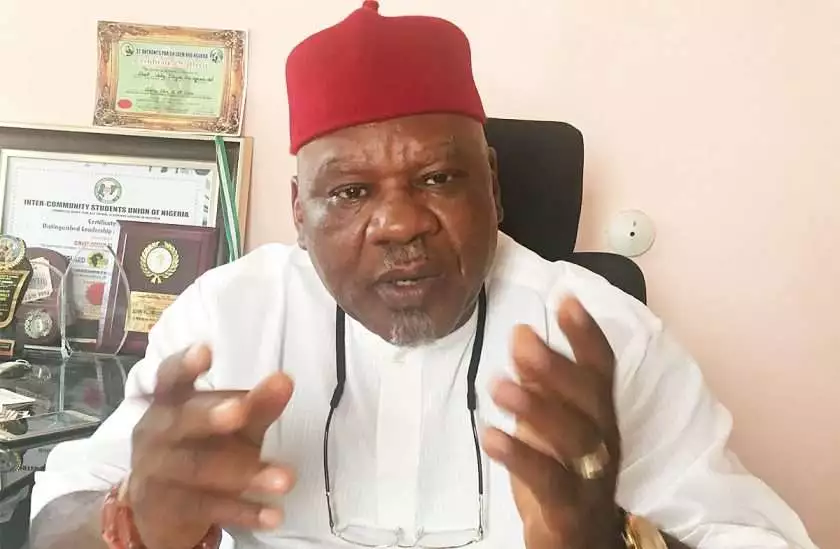
Veteran Nollywood Actor, Chinwetalu Agu got more than he bargained for when he fell victim of the soldiers attached to the Operation Golden Dawn.
Problem started for the Actor in the Upper Iweka area of Onitsha, the commercial town, when his bus, with the inscription Chinwetalu Agu Films, which he was driving, was flagged down by the soldiers.
He was asked to come down and open the booth. He came down in all “his majestic self”, wearing a long attire made of the Biafran flag
That may have provoked the soldiers whose brief is to maintain peace and take care of anything that could provoke a breach of peace.
Apparently, to them, wearing a dress made of the Biafran flag, with its “rising sun” insignia is a no-no.
Onitsha is a heartbeat of the activities of the Indigenous Peoples of Biafra, IPOB, a separatist group asking for an independent South-east (Biafra) from the Federal Republic of Nigeria.
It is not known the questions the soldiers asked him, or the answers he gave them, but the Actor was seen being held both hands by the soldiers. He sat on the ground, as if to resist, and the soldiers carried him up and headed out of the scene.
A couple of gun shots took care of the gathered crowd. They scampered to safety.
But minutes later, some youths took to the streets protesting the treatment and arrest of Chinwetalu Agu for, apparently, wearing a dress made of the flag.
The video of the incident has since gone viral.
At the time of writing this, it was not known if the Actor has been released or not or, even, for what offence he would be detained.
Citing the need to forestall breach of security in the state, the Cross River State Government has waded into the crisis in the State’s Chapter of Ohanaeze Ndigbo and leadership of the Igbo community.
It warned a faction of the group against engaging in any action capable of disrupting peace in the State.
The Cross River Chapter of the apex Igbo socio-cultural group has been embroiled in a crisis with two factions laying claim to its leadership.
The Igbo community is, also, enmeshed in a dispute over the controversial Eze Ndi Igbo stool which one of the prominent Igbo businessmen in the state, Chief Emmanuel Ezenwenyi, has been laying claim to.
In May, a faction opposed to the Ohanaeze leadership of Barrister Ugorji Nwabueze who also doubles as Senior Special Assistant to Governor Ben Ayade on Non-Indigene Affair (Igbo), with the backing of Chief Ezenwenyi, met in Ikom in Central Cross River and purportedly elected one High Chief Festus Odomenam as the new President-General of the group.
However, Ugorji’s camp wasted no time in dismissing the said election as a non-event, saying it negated the Ohanaeze Constitution.
The Ugorji camp also announced the abolition of the Eze Igbo stool, relying on the earlier pronouncement of the Cross River State Council of Traditional Rulers and the Ohanaeze Ndigbo worldwide to that effect.
Chief Emmanuel Ezenwenyi: Lays claim to Eze Ndi Igbo title
Essentially, Cross River Monarchs had, in November, 2018, issued a press statement seriously frowning on the controversial Eze Ndigbo title.
Cross River Monarchs: “The Igbos have every right to assemble as a community in Cross River State and pursue their legitimate rights under a leader who may be known as President General of Ohaneze Ndi Igbo, President of Igbo Community in Cross River State, but not as Eze Ndi Igbo, a revered traditional title reserved for Monarchs in the respective Igbo kingdoms.
“The said leader is not to bear the titles of His Majesty (HM), His Royal Majesty (HRM), or His Highness (HH).”
The statement, signed by Paramount Ruler of Bakassi and the Chairman, Cross River State Traditional Rulers Council, Etim Edit, and the Paramount Ruler of Calabar Municipality, Patrick Agbor, had warned the Igbo leader in Calabar laying claim to the Eze Ndi Igbo title against awarding chieftaincy title, whether traditional or honorary, to any person within the territories of Cross River State.
The Bakassi Monarch had said that he and others sought clearance from the councils of traditional rulers in the South-east before issuing the statement:
“The response I got from the Traditional Rulers in the South-east was that the title of Eze Ndi Igbo was an exclusive one for kings in Igbo land and that we should not allow it in Cross River.
“I now asked, ‘how about those who have been using it?’ and they told me ‘Those using it illegally have been asked to stop forthwith,’” he said.
However, moves by the Odoemenam faction of Ohanaeze to coronate Chief Ezenwenyi was to draw the ire of the Cross River state government which warned, through a press statement dated September 29, 2021, and signed by the Permanent Secretary, Special Services, Governor’s, Dr Alfred Mboto, of dire consequences should any group proceed with the said coronation.
The Government also reaffirmed its recognition of Barrister Nwabueze as the authentic Ohanaeze President in the State.
Entitled “Plan to Disrupt Peace and Security in Calabar by some Unknown Igbo Men, the statement reads in part:
“The attention of Cross River state government has been drawn the plan by a group of Ndi Igbo not only to divide the Igbo but to coronate one Chief Emmanuel Ezenwenyi as Eze Ndi Igbo Cross River state… to distort peace in Calabar and Cross River in general.
“His Excellency, the Governor of Cross River State has frowned seriously on such move capable of rupturing peace and harmony…This government still recognises Barr. Ugorji Nwabueze as the President of the Igbo community in Cross River state”
The statement further quoted Governor Ayade as directing security agencies in the state “to arrest and prosecute anybody parading himself for inauguration in any similar title in the state”
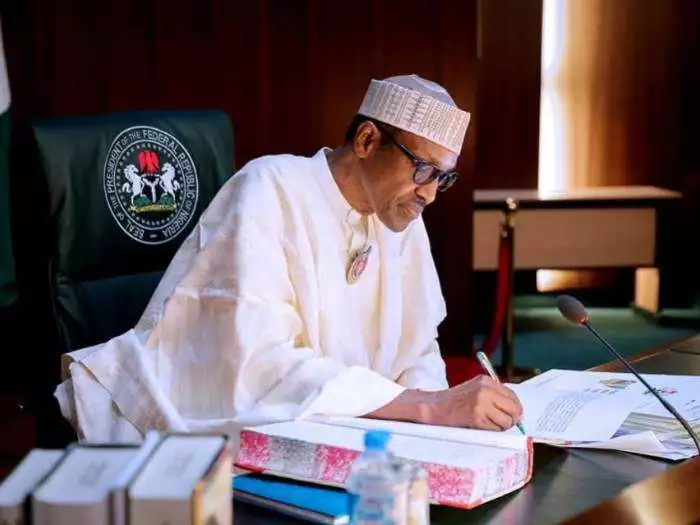
Full text of the 2022 Budget Speech Delivered by President Muhammadu Buhari to the Joint Session of the National Assembly, on Thursday, October 8, entitled:
Budget of Economic Growth and Sustainability
It is my great pleasure to be here once again to present the 2022 Federal Budget Proposals to this distinguished Joint Session of the National Assembly.
Distinguished and Honourable leaders, and members of the National Assembly, let me start by commending you for the expeditious consideration and passage of the Supplementary Appropriation Bill 2021. This further underscores your commitment to our collective efforts to contain the COVID-19 Pandemic and address the various security challenges facing our country.
I will also take this opportunity to thank you for the quick consideration and approval of the 2022-2024 Medium-term Expenditure Framework and Fiscal Strategy Paper. Our hope is that National Assembly will continue to partner with the Executive by ensuring that deliberations on the 2022 Budget are completed before the end of this year so that the Appropriation Act can come into effect by the first of January 2022.
The 2022 Budget will be the last full year budget to be implemented by this administration. We designed it to build on the achievements of previous budgets and to deliver on our goals and aspirations as will be reflected in our soon-to-be launched National Development Plan of 2021 to 2025.
Distinguished Senators and Honourable Members, in normal times, I make use of this opportunity to provide an overview of global and domestic developments in the current year, a summary of our achievements, and our plans for the next fiscal year.
However, these are exceptional times. The grim realities of COVID-19 and its lethal variants are still upon us. From President to Pauper, the virus does not discriminate.
This is why our country still maintains its COVID -19 guidelines and protocols in place to protect its citizens and stop the spread of this disease.
Over the past few days, we have consulted with the Presidential Steering Committee on COVID-19 and the leadership of the National Assembly on how best to present the 2022 budget proposal keeping in mind the deep-rooted traditions in place and the guidelines for safe mass gatherings.
We ultimately decided that the most responsible and respectful approach was to hold a shorter than usual gathering while allowing the Honourable Minister of Finance, Budget and National Planning to provide fuller details of our proposals in a smaller event.
I am sure many of you will be relieved as my last budget speech in October 2020 lasted over fifty minutes.
Still, over the next few minutes, I will provide key highlights of our 2021 performance as well as our proposals for 2022.
PERFORMANCE OF THE 2021 BUDGET
The 2021 ‘Budget of Economic Recovery and Resilience’ is based on a benchmark oil price of 40 US Dollars per barrel, oil production of 1.6m b/d, and exchange rate of 379 Naira to US Dollar. Furthermore, a Supplementary budget of 982.73 billion Naira was recently enacted to address exigent issues in the Security and Health sectors.
Based on the 2021 Fiscal Framework, total revenue of 8.12 trillion Naira was projected to fund aggregate federal expenditure of 14.57 trillion Naira (inclusive of the supplementary budget). The projected fiscal deficit of 6.45 trillion Naira, or 4.52 percent of GDP, is expected to be financed mainly by domestic and external borrowings.
By July 2021, Nigeria’s daily oil production averaged one 1.70million barrels (inclusive of condensates) and the market price of Bonny Light crude averaged 68.53 US Dollars per barrel.
Accordingly, actual revenues were 34 percent below target as of July 2021, mainly due to the underperformance of oil and gas revenue sources. Federal Government’s retained revenues (excluding Government Owned Enterprises) amounted to 2.61 trillion Naira against the proportionate target of 3.95 trillion Naira for the period.
The Federal Government’s share of Oil revenue totalled 570.23 billion Naira as of July 2021, which was 51 percent below target, while non-oil tax revenues totalled 964.13 billion Naira. The poor performance of oil revenue relative to the budget was largely due to the shortfall in production as well as significant cost recovery by NNPC to cover the shortfall between its cost of importing petrol and the pump price.
The National Assembly will recall that in March 2020 the Petroleum Products Pricing Regulatory Agency announced that the price of petrol would henceforth be determined by market forces.
However, as the combination of rising crude oil prices and exchange rate combined to push the price above the hitherto regulated price of 145 Naira per litre, opposition against the policy of price deregulation hardened on the part of Labour Unions in particular.
Government had to suspend further upward price adjustments while engaging Labour on the subject. This petrol subsidy significantly eroded revenues that should have been available to fund the budget.
On a positive note, we surpassed the non-oil taxes target by eleven (11) percent in aggregate. The sustained improvement in non-oil taxes indicates that some of our revenue reforms are yielding positive results. We expect further improvement in revenue collections later in the year as more corporate entities file their tax returns and we accelerate the implementation of our revenue reforms.
Improving Revenue Generation and Administration
We have stepped up implementation of the strengthened framework for performance management of government owned enterprises (GOEs), with a view to improve their operational efficiencies, revenue generation and accountability. The 50% cost-to-income ratio imposed on the GOEs in the Finance Act 2020 has contributed significantly to rationalizing wasteful expenditures by several GOEs and enhanced the level of operating surpluses to be transferred to the Consolidated Revenue Fund (CRF). I solicit the cooperation of the National Assembly in enforcing the cost-to-income ratio and other prudential guidelines during your consideration of the budget proposals of the GOEs, which I am also laying before you today.
On the expenditure side, as at end of July 2021, a total of six point seven-nine (6.79) trillion Naira had been spent as against the pro-rated expenditure of seven point nine-one (7.91) trillion Naira. Accordingly, a deficit of four point one-seven (4.17) trillion Naira was recorded as at end of July 2021. The deficit was financed through domestic borrowing.
Despite our revenue challenges, we have consistently met our debt service commitments. We are also up to date on the payment of staff salaries, statutory transfers, and overhead costs. As at (4th of October 2021, a total of 1.732 trillion Naira had been released for capital expenditure.
I am pleased to inform you that we expect to fund MDAs’ capital budget fully by the end of the fiscal year 2021.
Capital releases thus far have been prioritised in favour of critical ongoing infrastructural projects in the power, roads, rail, agriculture, health and education sectors.
We have made progress on the railway projects connecting different parts of the country. I am glad to report that the Lagos-Ibadan Line is now completed and operational. The Abuja-Kaduna Line is running efficiently. The Itakpe-Ajaokuta rail Line was finally completed and commissioned over thirty (30) years after its initiation.
Arrangements are underway to complete the Ibadan-Kano Line. Also, work will soon commence on the Port Harcourt-Maiduguri Line and Calabar-Lagos Coastal Line, which will connect the Southern and Eastern States to themselves and to the North.
Progress is also being made on several power generation, transmission, and distribution projects, as well as off-grid solutions, all aimed towards achieving the national goal of optimizing power supply by 2025.
I am again happy to report that we continue to make visible progress in our strategic road construction projects like the Lagos – Ibadan expressway, Apapa – Oworonsoki expressway, Abuja – Kano expressway, East-West Road and the second Niger bridge. We hope to commission most of these projects before the end of our tenure in 2023.
The Pandemic revealed the urgent need to strengthen our health system. Towards this end, we constructed 52 Molecular labs, 520 bed intensive care units, 52 Isolation centres and provision of Personal Protective equipment across 52 Federal Medical Centres and Teaching Hospitals.
We continue to push our expenditure rationalization initiatives which we commenced in 2016. For example, on personnel costs, the number of MDAs captured on the Integrated Payroll and Personnel Information System increased from 459 in 2017 to 711 to date.
The recent passage of the Petroleum Industry Act 2021, and consequent incorporation of the Nigeria National Petroleum Corporation should also result in rationalisation of expenditure, as well as increased investments and improved output in the oil and gas industry.\
Distinguished Senators and Honourable Members, you will agree with me that a lot has been accomplished over the last year but there is still much to be done. I will now proceed with a review of the 2022 Budget proposal.
THEME AND PRIORITIES OF THE 2022 BUDGET
The allocations to MDAs were guided by the strategic objectives of the National Development Plan of 2021 to 2025, which are:
Diversifying the economy, with robust MSME growth;
Investing in critical infrastructure;
Strengthening security and ensuring good governance;
Enabling a vibrant, educated and healthy populace;
Reducing poverty; and
Minimizing regional, economic and social disparities.
The 2022 Appropriation therefore is a Budget of Economic Growth and Sustainability.
Defence and internal security will continue to be our top priority. We remain firmly committed to the security of life, property and investment nationwide. We will continue to ensure that our gallant men and women in the armed forces, police and paramilitary units are properly equipped, remunerated and well-motivated.
The 2022 budget is also the first in our history, where MDAs were clearly advised on gender responsive budgeting. These are part of critical steps in our efforts to distribute resources fairly and reach vulnerable groups of our society.
PARAMETERS AND FISCAL ASSUMPTIONS
Distinguished Members of the National Assembly, the 2022 to 2024 Medium Term Expenditure Framework and Fiscal Strategy Paper sets out the parameters for the 2022 Budget as follows:
Conservative oil price benchmark of 57 US Dollars per barrel;
Daily oil production estimate of 1.88 million barrels (inclusive of Condensates of 300,000 to 400,000 barrels per day);
Exchange rate of four 410.15 per US Dollar; and
Projected GDP growth rate of 4.2 percent and 13 percent inflation rate.
2022 REVENUE ESTIMATES
Based on these fiscal assumptions and parameters, total federally-collectible revenue is estimated at 17.70 trillion Naira in 2022.
Total federally distributable revenue is estimated at 12.72 trillion Naira in 2022 while total revenue available to fund the 2022 Federal Budget is estimated at 10.13 trillion Naira. This includes Grants and Aid of 63.38 billion Naira, as well as the revenues of 63 Government-Owned Enterprises.
Oil revenue is projected at 3.16 trillion, Non-oil taxes are estimated at 2.13 trillion Naira and FGN Independent revenues are projected to be 1.82 trillion Naira.
PLANNED 2022 EXPENDITURE
A total expenditure of sixteen point three-nine (16.39) trillion Naira is proposed for the Federal Government in 2022. The proposed expenditure comprises:
Statutory Transfers of 768.28 billion Naira;
Non-debt Recurrent Costs of 6.83 trillion;
Personnel Costs of 4.11 trillion Naira;
Pensions, Gratuities and Retirees’ Benefits 577.0 billion Naira;
Overheads of 792.39 billion Naira;
Capital Expenditure of 5.35 trillion Naira, including the capital component of Statutory Transfers;
Debt Service of 3.61 trillion Naira; and
Sinking Fund of 292.71 billion Naira to retire certain maturing bonds.
Fiscal Balance
We expect the total fiscal operations of the Federal Government to result in a deficit of 6.26 trillion Naira. This represents 3.39 percent of estimated GDP, slightly above the 3 percent threshold set by the Fiscal Responsibility Act 2007. Countries around the world have to of necessity over-shoot their fiscal thresholds for the economies to survive and thrive
We need to exceed this threshold considering our collective desire to continue tackling the existential security challenges facing our country.
We plan to finance the deficit mainly by new borrowings totalling 5.01 trillion Naira, 90.73 billion Naira from Privatization Proceeds and 1.16 trillion Naira drawdowns on loans secured for specific development projects.
Some have expressed concern over our resort to borrowing to finance our fiscal gaps. They are right to be concerned. However, we believe that the debt level of the Federal Government is still within sustainable limits. Borrowings are to specific strategic projects and can be verified publicly.
As you are aware, we have witnessed two economic recessions within the period of this Administration. In both cases, we had to spend our way out of recession, which necessitated a resort to growing the public debt. It is unlikely that our recovery from each of the two recessions would have grown as fast without the sustained government expenditure funded by debt.
Our target over the medium term is to grow our Revenue-to-GDP ratio from about 8 percent currently to 15 percent by 2025. At that level of revenues, the Debt-Service-to-Revenue ratio will cease to be worrying. Put simply, we do not have a debt sustainability problem, but a revenue challenge which we are determined to tackle to ensure our debts remain sustainable.
Very importantly, we have endeavoured to use the loans to finance critical development projects and programmes aimed at improving our economic environment and ensuring effective delivery of public services to our people. We focused on;
the completion of major road and rail projects;
the effective implementation of Power sector projects;
the provision of potable water;
construction of irrigation infrastructure and dams across the country; and
critical health projects such as the strengthening of national emergency medical services and ambulance system, procurement of vaccines, polio eradication and upgrading Primary Health Care Centres across the six geopolitical zones.
Innovations in Infrastructure Financing
In 2022, Government will further strengthen the frameworks for concessions and public private partnerships (PPPs). Capital projects that are good candidates for PPP by their nature will be developed for private sector participation.
We will also explore available opportunities in the existing ecosystem of green finance including the implementation of our Sovereign Green Bond Programme and leveraging debt-for-climate swap mechanisms.
Enhancing Revenue Mobilisation
Our strategies to improve revenue mobilisation will be sustained in 2022 with the goal of achieving the following objectives:
Enhance tax and excise revenues through policy reforms and tax administration measures;
Review the policy effectiveness of tax waivers and concessions;
Boost customs revenue through the e-Customs and Single Window initiatives; and
Safeguard revenues from the oil and gas sector.
Distinguished Senators and Honourable Members, I commend you for the passage of the Petroleum Industry Act 2021. It is my hope that the implementation of the law will boost confidence in our economy and attract substantial investments in the sector.
Finance Bill 2022
In line with our plan to accompany annual budgets with Finance Bills, partly to support the realization of fiscal projections, current tax and fiscal laws are being reviewed to produce a draft Finance Bill 2022.
It is our intention that once ongoing consultations are completed, the Finance Bill would be submitted to the National Assembly to be considered alongside the 2022 Appropriation Bill.
CONCLUSION
Mr. Senate President, Mr. Speaker, Distinguished and Honourable Members of the National Assembly, this speech would be incomplete without commending the immense, patriotic, and collaborative support of the National Assembly in the effort to deliver socio-economic development and democracy dividends for our people.
I wish to assure you of the strong commitment of the Executive to strengthen the relationship with the National Assembly.
Nigeria is currently emerging from a very difficult economic challenge. We must continue to cooperate and ensure that our actions are aimed at accelerating the pace of economic recovery so that we can achieve economic prosperity and deliver on our promises to the Nigerian people.
The fiscal year 2022 is very crucial in our efforts to ensure that critical projects are completed, put to use and improve the general living conditions of our people.
It is with great pleasure therefore, that I lay before this distinguished Joint Session of the National Assembly, the 2022 Budget Proposals of the Federal Government of Nigeria.
The Imo State Government has opened discussion with stakeholders and leaders from some communities in Oguta Local Government Area over its intention to establish a Special Agro-industrial Processing Zone in the area.
Governor Hope Uzodimma of Imo State held a Town Hall Meeting with the people of Ejemekwuru, Akabor, Agwa and Izombe, all in Oguta, to discuss issues surrounding the proposed siting of a Special Agro-industrial Processing Zone in their land and area.
Speaking at Central School Ejemekwuru, venue of the meeting Tuesday, Governor Uzodimma, who was represented by the Deputy Governor, Prof. Placid Njoku told the stakeholders that Imo State is extremely lucky to have someone in the person of Governor Uzodimma with the capacity to attract such a gigantic project to Imo State and the only one for the Southeast.
Prof Njoku said the project which is funded by AfDB, IFAD and other development partners is Agro-based and will focus on poultry, piggery, maize and Soya-bean production and that the bye-products from Anom Gas plant, Adapalm, the proposed Seaport, the Naval Base and the expected Rail line crossing the State will be handy for the farm to use.
He said in addition, the excess of the products from the SAPZ will be easily transported through the Sam Mbakwe International Cargo Airport, Owerri to other places where they would be needed.
The Deputy Governor explained: “The project is an Imo project but Oguta is lucky to be the host Local Government Area.”
He drummed it into their ears that the project is for the overall interest of Imo people and that “Government cannot see anything that is bad and attract it to her people.”
On the benefit of the project, Prof. Njoku, said that it will create over 3000 jobs, stem the tide of unemployment, curtail youth restiveness, and bring electricity, good roads and development in all ramifications.
He appealed to the leaders and the stakeholders made up of men and women including youths and even children to embrace the project and remove the issue of RUGA from their mindset as the Special Agro-processing Industrial zone has nothing to do with RUGA.
In their various contributions, the Special Adviser to the Governor on Petroleum, Rt Hon Goodluck Opia, his Technical counterprt, Hon Jones Uzoka, the former Commissioner for Special Duties, Barr Francis Dibiagwu as well as the General Manager Adapalm Ltd, Dr Goddy Essom Obodo, all appealed to their people to see reason and openly accept the project.
They noted that they had made their people to know that the project is one of the best things that can happen to Imo State in general and especislly, Oguta community.
In his presentation, the project consultant, Prof Chiedozie said that the Special Agro Industrial Processing Zone SAIPZ will start with a modern Livestock production that will provide high quality protein to the community and Imo State in general.
In addition, they said there will be industrial production of maize, cassava and Suya bean.
Most of the leaders from the four communities who spoke expressed concern that surrendering their land will affect their source of livelihood as farmers.
They included Chief Justice Ohaegbu from Ejemekwuru, Chief Felix Uba from Agwa, Mrs Vivian Uloma Achinine, also from Ejemekwuru among others.
However, appreciating the Government’s visit and the discussions, a community leader from the area, Hon Chief Ethelbert Nnanna thanked all for their contributions and appealed to his people to see reason and consider the siting of the noble project in their area.
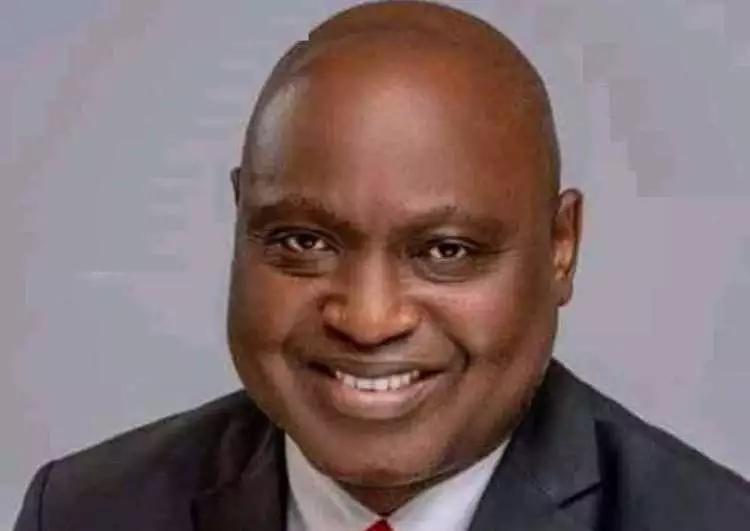
The Governorship Candidate of the All Progressives Congress in the Anambra November 6 election, Andy Uba, has asked Governor Willy Obiano to account for the many Security Paraphernalia, including helicopters, horses and dogs which the Governor claimed to have bought to tackle crimes in the State.
Uba was reacting to Obiano’s buck-passing in the face of the worsening security situation in the State.
In a statement signed by the Director, Media and Publicity, Senator Andy Uba Governorship Campaign Organisation, SAUGCO, Hon. Victor Afam Ogene, Uba said Obiano had all the while shown unseriousness in the face of the dire security challenges in the state, only to wake up late on the wrong side of the bed, and is blaming everybody but himself.
Nothing points to this unseriousness than the Governor’s absence, the statement pointed out, at the Zonal security meeting held in Enugu a couple of days ago. Anambra State was the only State whose Governor was not present, and sent no representative.
SAUGCO wondered why Obiano went on a campaign tour instead of joining others at a meeting where security issues, especially, concerning Anambra State were discussed. Obiano was warned to stop politicising the Security situation in the State, and face the task ahead.
Following is the full text of the Statement
State of Emergency Consideration: Gov. Obiano should rise up to the challenge
…Stop the politicking and tackle Anambra’s insecurity challenges
Governor Willy Obiano of Anambra State
After weeks of prodding Governor Willy Obiano of Anambra state to come off the high horse he bestrides and frontally tackle the deteriorating insecurity in the state, the governor appears to have woken up.
But as is mostly typical of anyone who wakes up from the wrong side of his bed after a deep slumber, Gov. Obiano, like an intemperate workman who quarrels with his tools, is blaming everyone else but himself, for the threats by the federal authorities to declare a state of emergency in Anambra if the current state of anomie persists.
“Is the number of victims of the politically motivated violence in Anambra State anything near what the nation has seen even in such states as Imo and Ebonyi controlled by the ruling All Progressives Congres(APC)? Why hasn’t Malami considered a state of emergency in these APC-controlled states?,” Gov. Obiano thundered in a riposte signed by his Commissioner for Information and Public Enlightenment, Mr. C. Don Adinuba yesterday.
Adinuba was reacting to what ordinarily is tantamount to a wake-up call by the Hon. Attorney General of the Federation and Minister of Justice, Abubakar Malami, for the state government to rise up to its responsibility of addressing the insecurity challenges in the state.
In a reaction to the Anambra State Government’s attempt to befuddle the issues, and by so doing change the narrative, the Senator Andy Uba Governorship Campaign Organisation, SAUGCO urges Gov. Obiano to quit his buck passing tactics.
“When Gov. Obiano speaks about past security challenges in neighbouring Imo and Ebonyi states, the question to ask is: didn’t governors of both states take urgent, practical steps that restored normalcy?
“When only two days ago, on Tuesday, October 5, 2021 governors of the South east met at Enugu to seek solutions to rising insecurity, especially in Anambra, why was Obiano the only governor not in attendance?
“Why did he rather choose to go dancing on a campaign romp at Otuocha, Anambra East LGA of the state, on the same day other serious governors gathered to seek a regional solution to a problem most prevalent in his state; in spite of the fact that he is not a candidate in next month’s governorship election?
“In deed, where are the surveillance cameras, drones, helicopters, horses and dogs which Gov. Obiano claimed to have bought to tackle crime and criminality in the state?
“As a matter of fact, it is high time the governor offered explanation about the whereabouts of these security paraphernalia, especially against the widespread belief among the citizenry that most of the items have been sold and the dogs and horses used as culinary delights.
“In simple language, the problem with Anambra is that Gov. Obiano has long abandoned governance and is more concerned about what he can grab for himself. Seeking, therefore, to whimsically put the blame on politics, or the Attorney General of the Federation is not only disingenuous, but downright false.
“Were there elections in sight when Awka, the state capital, Ihiala and Okija areas was turned into killing fields, in fierce cult clashes; when the commercial city of Onitsha was overwhelmed by criminals and jungle justice resurfaced; or when worshippers in Ozubulu were massacred one Sunday morning, and their killers still at large; or when the whole Omabala part of the state was engulfed in bitter inter communal clashes that has affected no fewer than 10 communities?
“In all of these instances, Gov. Obiano simply refused to take charge – a beaten pathway he is still treading.
“As we noted in our last statement dated October 3, 2021, instead of seeking ways of making restitution to the people of Anambra who have been misgoverned over the last seven years and half, leading to key stalwarts and functionaries of both the party and government leaving in droves to join the APC, Governor Obiano, rather, refuses to act, lending credence to claims in several quarters that he does not want the November 6, 2021 governorship election to hold.
“While the consideration of a state of emergency by the Federal Government may not be hilarious for any democrat, let’s equally conscientiously state that the government has the primary responsibility of protecting lives and property of the people, especially when the governor has obviously abdicated his duties and gone to sleep in the day.
“It suffices to say that the state of emergency being mulled is consequent upon the docility of the Anambra government to secure its territory and protect the people.
“It is still not late for the governor to retrace his steps and act like the governor he is – well, until March 17, 2022 when by the grace of God, Senator Andy Uba would succeed him.”
The Anambra election is slated for November 6, 2021.
The Senate has commenced a process to increase the number of the Nigerian Law School campuses in the country from six to 12.
A bill to that effect, sponsored by Senator Smart Adeyemi from Kogi state, has scaled second reading at the Senate.
The existing law school campuses are located in Lagos (South West), Abuja (North Central, Yola – Adamawa – (North East), Kano (North West), Enugu (South East) and Yenegoa – Bayelsa State – (South South).
The six additional campuses being proposed include Kabba Law School Campus, Kogi (North Central); Maiduguri Law School Campus, Borno (North East); Argungu Law School Campus, Kebbi (North West); Okija Law School Campus, Anambra (South East); Orogun Law School Campus, Delta (South South) and Ilawe Law School Campus, Ekiti (South West).
It was titled: “A Bill for an Act to amend the Legal Education (Consolidation etc.) Act by establishing the campuses for the Nigerian Law School, and for other related matters.”
Senator Adeyemi, Chairman of Senate Committee on Aviation, said it had become necessary to establish six additional Law School campuses to cater for yearly increases of law graduates seeking admission into the six available law school campuses in the country.
He said based on the admission quota of Law Students allocated to Universities annually, 5,640 students are admitted yearly into their Law Faculties.
“The implication of this data is that, about 5500 Law Graduates are produced from the 55 Universities yearly.
“It should be noted that while the records of the Nigerian Law School indicates that it has the capacity to admit 6,510 Students yearly, which ordinarily would have been adequate to accommodate all prospective Law Graduates from the Universities, unfortunately the less than or about 70 per cent yearly performance of the Law School, has over several years accumulated about 30 per cent failure yearly.
“This record implies that about 2000 of the 6510 admitted yearly have to repeat the School for another year, with no automatic guarantee of making it on the second attempt.
“A five year analysis of this spillover of about 2000 students amounts to 10,000, while it builds up to 20,000 over a period of 10 years.
“The consequences of the situation narrated above carries negative financial, psychological, emotional, social and productivity implications on the Law graduates from Universities, their parents, the economy and government of Nigeria.
‘In the last five years or more, Law graduates are made to wait for between two to four years, awaiting admission into the Nigerian Law School, due to lack of vacancy to admit them into the few campuses available.
“Much as the standard of the Nigerian Law School has been one of the best across the globe, any attempt to stretch its admission capacity beyond its facilities and human resources will be counter productive as it will negatively affect the welfare and performance of the students.
“Also, to allow the present situation persist for the next few more years will spell doom for this nation in several ways.
“In view of the imminent disaster in our legal industry, this amendment to the Nigerian Council of Legal Education Act is to encourage the Federal Government of Nigeria to increase the number of campuses of the Nigerian Law School to 12, at the minimum, by establishing additional one each in the six Geopolitical Zones of Nigeria.”
The Senators in their contributions, supported the Bill and approved that it be read for a second time when it was put to voice vote by Senate President Dr Ahmad Lawan.
Dr Lawan later referred the Bill to the Senate Committee on Judiciary, Human Rights and Legal Matters headed by Senator Opeyemi Bamidele for further legislative work and is to report back to Senate plenary in four weeks.
Nigeria’s Vice President, Prof Yemi Osinbajo has left Abuja for London to represent President Muhammadu Buhari at a United Nations High Level event on the Energy Transition in Africa agenda with special focus on Nigeria.
The event, which starts today at the Imperial College, will feature meetings organised by UN Energy ahead of the UN Climate Conference COP26 which would be hosted by the United Kingdom in Glasgow, Scotland.
Spokesman to the vice president, Laolu Akande said in a release that Prof Osinbajo would also hold talks with the President Designate of COP26, Mr Alok Sharma, a cabinet rank UK Minister and the Chair of the UK Government’s COP26 Energy Transition Council (ETC).
According to him, “Prof Osinbajo and Sharma will be discussing issues regarding the 2050 global Net-Zero emissions target and the need for the international community to align on the key elements of a just and equitable transition for all.
“The meeting holds at Whitehall.
“The Vice President will also deliver an address at the Imperial College London, where he is billed to interact with the academic community on the global energy transition and Nigeria’s position on a just transition.
“Imperial College is at the forefront of research on generating a new understanding of the investment opportunity in renewable energy, clean technologies, and climate-resilient infrastructure.
“Nigeria is playing a prominent role in shaping the energy and climate agendas in 2021.
“In its role as a Global Theme Champion for the theme on Energy Transition at the UN High-Level Dialogue on Energy, Nigeria led the advocacy on behalf of developing nations for the clean energy offer and recognition of various transition fuels.
“Nigeria also put forward an ambitious Energy Compact focused on accelerating energy access both through electrification and access to clean cooking solutions and has been a focus country for the Energy Transition Council (ETC) of the UN Climate Change Conference (COP26).”
On the Vice President’s delegation are the Minister of State for Environment, Mrs Sharon Ikeazor and the Special Adviser to the President on Economic Matters, Dr Adeyemi Dipeolu, among others.
Prof Osinbajo, who is expected back in the country on Sunday 10th October, 2021, may also likely use the opportunity to visit his political godfather, Asiwaju Bola Tinubu, who is presently reparcurating in London after undergoing surgery for an undisclosed ailment.
The atmosphere in the Super Eagles camp is tensed, as the 23-Man team invited by Coach Gernot Rohr to prosecute the Group C encounter of the Qatar 2022 FIFA World Cup Qualifiers against Central African Republic are battle ready in getting the maximum point.
By 5pm Nigeria Time today, Thursday 7th October, 2021, the Super Eagles will trade tackles with their Central African Republic opponent at the Teslim Balogun Stadium, Surulere, Lagos, Nigeria, with the sole aim of getting victory.
According to Rohr, “The team is in top shape and are ready to put smiles on the faces of their fans by getting the needed victory”.
Having won their two previous qualifying matches against the Blue Sharks of Cape Verde in Mindelo and Liberia in Lagos, the three time African Cup of Nations Champion sit atop their Group with Six point, while their opponent today have One point from their draw with Cape Verde.
Possible line up for the Super Eagles in the crunchy tie are; Maduka Okoye in goal, Leon Balogun, William Troost Ekong, Olaoluwa Aina and Jamiu Collins in the defense set up.
In the midfield, Joe Aribo, Frank Onyeka, Moses Simon and Ahmed Musa, while Victor Osimhen and Kelechi Iheanacho would spearhead the attacking line.
Newly invited Taiwo Awoniyi of Union Berlin Football Club of Germany could make his debut, likewise Calvin Bassey depending on the way the game turn out to be.
Faisal Maina, the son of Abdulrasheed Maina, the controversial former Pension boss, who has been sentenced to Fourteen years in jail for money laundering, was sentenced in absentia.
An Abuja High Court presided over by Justice Okon Abang had handed down the sentence Thursday.
The father had been sacked by the administration of Goodluck Jonathan, but the Muhammadu Buhari administration brought him back. At a time he was nursing governorship ambition.
Faisal was shown to have a fictitious account with the United Bank for Africa, UBA. His father was said to have laundered N58.1 million through the account.
The account name was Alhaji Faisal Farm 2.
He was said to have withdrawn from the account between October 2013 and 2019.
Faisal is 21.
However, during the trial, he jumped bail and has been absent at sittings.
Justice Abang continued the trial in his absence, and, during the sentencing, declared that he should be arrested anywhere he is sighted and taken to prison.
In the event he has left the country, the Federal Government, “shall legally or lawfully commence extradition proceeds to bring him into the country to serve the jail term”.
He ordered that Alhaji Faisal 2, the corporate entity in whose account the money is laundered, be closed down.
The EFCC said that the defendant has fled to the United States of America.
Governor of Imo State, Senator Hope Uzodimma has flagged off the Armed Forces exercise that would help bring sanity in the State ahead of the Yuletide, tagged Operation “Golden Dawn” with a promise to support the leadership of the security agencies succeed in the three months assignment.
The headquarters of the Operation is at Super Camp Orlu, in Orlu LGA, Imo State.
In his address while flagging off the ceremony on Wednesday, Governor Uzodimma commended the Security Agencies for their vision in creating the Centre to address the peculiar nature of the security situation in the South East zone and Imo State in particular.
Governor Uzodimma said: “This is a special period and season in the lives of not only Christians all over the world but the people of South East who are predominantly Christians coming back for the celebration of Christmas which usually starts from October to December.”
He reasoned that “the exercise would go a long way in improving on the security situation in the South East region and also give our people sense of security and further encourage our brothers and sisters who are resident abroad to come home because the area is safe and secure.”
The Governor acknowledged that it is a great achievement on the side of the security agencies, hence “they should be commended, encouraged and supported.”
He reiterated that Operation Golden Dawn is an exercise that will create an enabling environment for people to go about their businesses without fear of molestation.
To the officers and men of the Armed Forces, the Governor thanked and assured them that Government will continue to stand by them, encourage and support them.
He acknowledged the sacrifices the agencies of the Armed Forces have made and are still making to secure Imo State and assured them that “government will show sufficient appreciation at the appropriate time.”
In his brief welcome address, the Commander 34 Artillery Brigade Obinze, Brigadier General R.T. Utsaha explained that “Exercise Golden Dawn” is meant to “build on the gains so far recorded over the menace of IPOB and ESN by the security agencies so far” and that all “security agencies are involved in the exercise.”
He noted that the aim of the exercise is to further secure lives and property of the people of the South East in general and Imo in particular and to reassure citizens of the South East returning for the Christmas celebration of adequate security. He said the Operation will start in October and end December 31, 2021.
He informed that troops of the Operation Golden Dawn will be quartered at Orlu for the rest of the year to ensure that socio- economic activities in the region and Imo State in particular will continue to take place unhindered.