Home Blog Page 1751

Guinness World Record Dismisses Chef Dammy’s 120 Hours Cook-A-Thon, Says No Application Received

0
Damilola Faparusi

By Akinwale Kasali

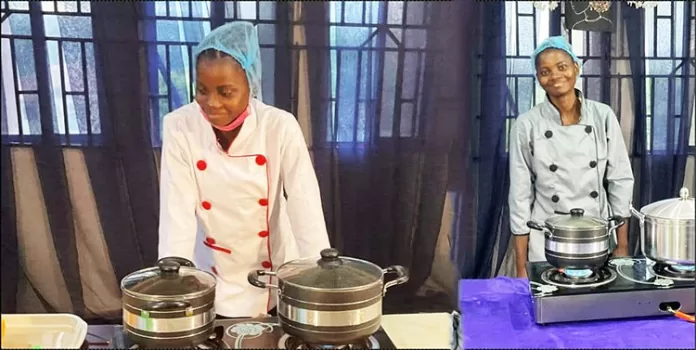
After 120-hours of energy, stress, sleepless nights and cooking, the Guinness World Record has dismissed receiving any application from the Federal University of Oye-Ekiti in Ekiti State undergraduate, Damilola Faparusi popularly known as Chef Dammy.

Chef Dammy had trended on social media after she embarked on a 120-hour cooking marathon, attempting to break the record of Nigerian chef Hilda Baci, who currently holds the world record for the longest cooking time of 93 Hours by an individual.

Her decision to challenge Hilda Baci’s record generated mixed feelings and ignited a widespread debate on social media, as many had said that she could have allowed Baci enjoy the limelight and savour the moment before another Nigerian embark on the feat.

It would be recalled that on Wednesday morning, June 14, Chef Dammy reached her target of 120 hours, leaving many wondering if Guinness World Records would approve her feat.

A Press Inquiry was however sent to Guinness World Record through Legit.ng.

Shattering the dream of Chef Dammy, the Guinness World Record Organization stated that the chef did not seek their approval before beginning the cook-a-thon, as there are procedures and rules that would have been sent to her to follow.

“We have not received an application for this attempt. Applications can be made via the Guinness World Records website for our records management team to review.

“Once an application is accepted, the record claimant receives a set of detailed guidelines specific to that record category that must be adhered to.

“This also details a list of evidence that must be submitted for our team to verify the record. Guinness World Records maintains a rigorous review process to uphold the integrity of each Guinness World Records title,” Legit.ng quoted the organization as stating.

Anti Corruption Group Applauds Tinubu Over Emefiele, Bawa, Urges Him To Stretch War To Malami, Sirika, Farouk, Others

0
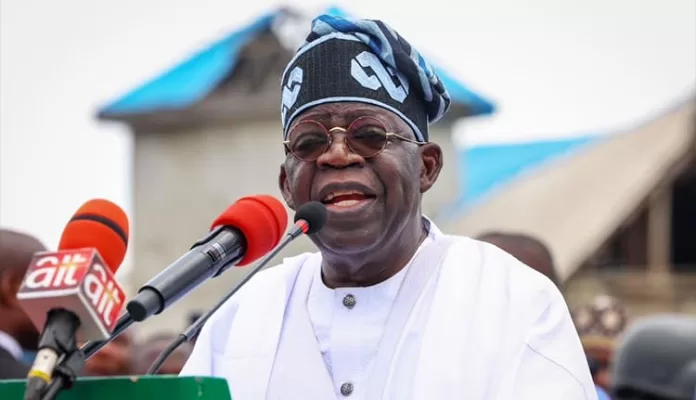
Bola Ahmed Tinubu

By Akinwale Kasali

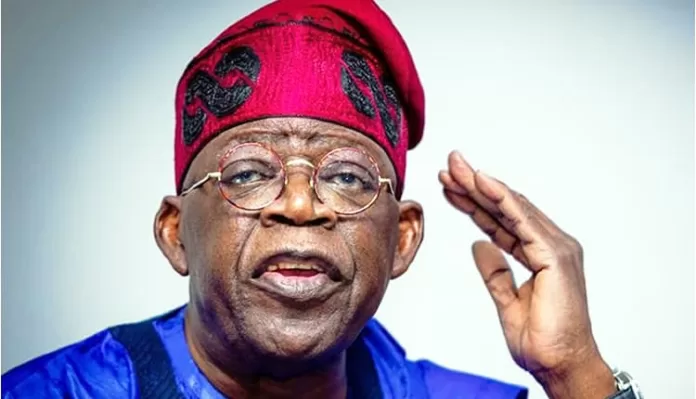
An Anti-Corruption Group, Niger Delta Youth Congress, (NDYC), a leading coalition of anti-corruption crusade groups has showered praises on President Bola Tinubu over his decisive action in suspending the Governor of the Central Bank of Nigeria, CBN, Godwin Emefiele, and the Chairman of the Economic and Financial Crimes Commission, EFCC, Abdulrasheed Bawa.

The Group stated that it is a move in the right direction.

It, however, urged President Tinubu to include prominent figures such as the immediate past Attorney General of the Federation, Abubakar Malami, the Minister of Aviation,  Hadi Sirika,  the Minister of Humanitarian Affairs, Saadiyya Umar Farouk, and  other top officials in former President Muhammadu Buhari’s administration who were, allegedly, involved in corrupt practices.

In a statement signed by the National Coordinator of the NDYC, Israel Uwejeyan, on behalf of the over 107-member Coalition of Anti-corruption crusade groups, the Coalition noted that the “bold step showcases the President’s unwavering commitment to tackling corruption and upholding the principles of good governance.”

The groups said they recognize that “the decision to suspend the CBN Governor and EFCC Chairman was made in the best interest of our nation and its citizens. It signifies a significant stride towards ensuring accountability, transparency, and the restoration of public trust in key institutions.

“We urge President Tinubu to ensure that the investigations into the alleged misconduct are conducted with the utmost thoroughness and impartiality. It is of paramount importance that due process is followed, and justice is served.

“This will not only set a strong precedent but also demonstrate the President’s dedication to establishing a fair and just society.

“Furthermore, we want to emphasize the urgent need for a comprehensive overhaul of the EFCC as a whole. Corruption has deeply permeated the system, compromising its effectiveness in combating economic crimes.

“We urge President Tinubu to seize this opportunity to initiate wide-ranging reforms within the EFCC, strengthen its internal mechanisms, and equip it with the necessary resources to carry out its mandate effectively.

“In light of these recent developments, we respectfully request that the President extends the scope of investigations to include prominent figures such as the immediate past Attorney General of the Federation, Mr. Malami, the Minister of Aviation, Mr. Sirika, the Minister of Humanitarian Affairs, Mrs. Saadiyya Umar Farouk, and various other officials allegedly involved in corrupt practices within President Muhammadu Buhari’s administration.

“We implore President Tinubu not to relent or be deterred in his fight against corruption. Corruption has been a major impediment to our country’s progress, hindering economic growth, exacerbating social inequality, and eroding public trust.

“By taking decisive action against corrupt practices, the President demonstrates his firm commitment to advancing Nigeria and ensuring a brighter future for all its citizens.

“Lastly, we strongly pledge our unflinching support to President Tinubu in his quest to rid our nation of corruption. We stand ready to collaborate with the government in promoting transparency, accountability, and good governance.

“Together, we can build a Nigeria where justice prevails, where opportunities abound, and where the rule of law reigns supreme”, the groups said.

OPINION: Sanwoolu Should Intervene In The Proposed Anti-Settler Lagos Assembly Laws

0

By Uche Nworah

I Was touched by the show of brotherly love and friendship shown by Lagos State Governor, Babajide Sanwoolu, to his predecessor in office, former Governor Akinwunmi Ambode, when he visited him at his private residence on Thursday this week to share in the celebration of the former Governor’s 60th birthday.

Lagos has been progressively blessed with good governors. Perhaps it is one of the great strengths of the former Governor of Lagos state, President of the Federal Republic of Nigeria, and Commander -in-Chief of the Armed Forces, Asiwaju Bola Ahmed Tinubu. His ability to chose and empower men to take over the mantle of leadership of Lagos state, Nigeria’s gateway state.

From the administrations of Asiwaju Bola Ahmed Tinubu, Babatunde Fashola, Akinwunmi Ambode to that of Babajide Sanwoolu, evidence abound of great improvements in governance, law and order, and infrastructural development.

Watching Governors Sanwoolu and Ambode exchange pleasantries and showering each other with words of encouragement really touched me. This is because of the bitter politics both men were engulfed in during the 2019 gubernatorial elections which saw incumbent Governor Ambode losing out to Sanwoolu after just one tenure. It was as if Ambode was disgraced out of office. Words, very unpleasant ones were said from both camps then.

Fast forward to 2023, with the Godfather and Kingmaker now busy with federal government duties in faraway Abuja, it appears that Governor Sanwoolu is coming to his own and the peace move to Ambode’s house is a welcome development. Hopefully, this will bear good fruits and just like Governor Ambode remarked, it would lead to more support for the programmes of Governor Sanwoolu to enable him leave a good legacy.

There are lessons to learn by South East governors here, past and present. There is need to close ranks among former Governors and the incumbents. Enough of the bickering and personal wars. What should matter is the continued development of the various states so that the people will enjoy more dividends of democracy.

Since we are in the spirit of national reconciliation and unity, may I plead with Governor Babajide Sanwoolu to extend the olive branches to settlers and non-Lagosians living in Lagos. The elections have been won and lost and to the Glory of God, the governor of Lagos state is Governor Babajide Sanwoolu. Yes, there may have been perceptions of non-Lagosians swinging with Labour Party during the last election but all that is in the past now. As Ndigbo will say, let all that bit us last night be regarded as mosquitoes.

Lagos is on the move and settlers living in Lagos who have journeyed from all over Nigeria wish to be part of this movement. They want to be carried along. The rhetoric that Lagos is no man’s land which gained currency during the last election is false. It was only promoted by people bent on destroying the cordial settler-indigene relationship that has remained the hallmark of living in Lagos state over the years.

It is this falsehood that may have given rise to the reported plans by the Lagos state House of Assembly to pass laws that will protect indigenes and their rights regarding lands, properties etc. The said laws are set to disenfranchise settlers and rob them of their rights with regards to ownership of properties they bought in Lagos.

History will continue to be kind to Governor Babajide Sanwoolu if he is able to help settlers avert this impending economic disaster. As the father of the state, the Governor should spread his umbrella arms to shield settlers. His government should integrate settlers through giving them political appointments, attend their events and make accommodating statements. After all, the strength of Lagos has always been its unique diversity, men and women drawn to the city of lights working hard, paying taxes and contributing their own quota towards the continuing development of Lagos state.

* Nworah, PhD, a Media and Communications Consultant writes from Lekki.

Plugging Gaps in The Students’ Loan Scheme

0
Azu Ishiekwene

By Azu Ishiekwene

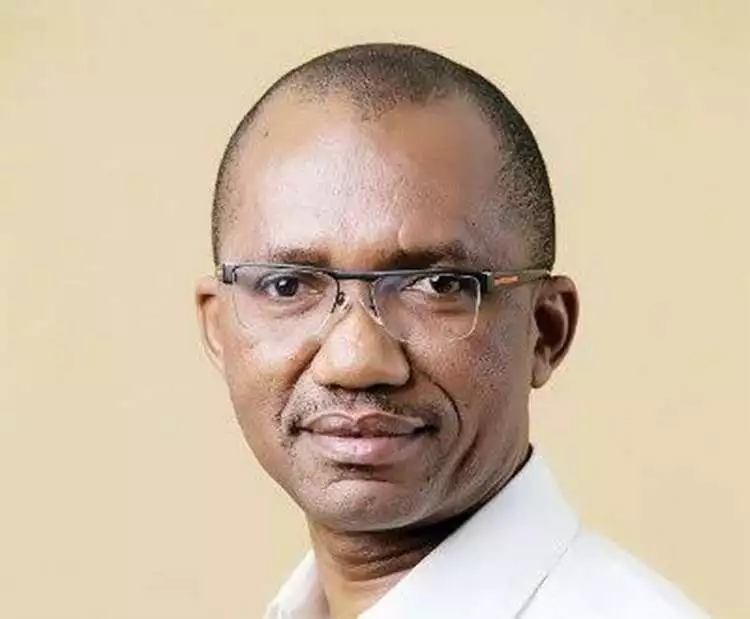
Within minutes of the release of the video of President Bola Tinubu signing the students’ loan bill into law, it was trending on Twitter as was the name of Chief of Staff Femi Gbajabiamila, who sponsored the bill in his former life as Speaker.

Apart from the Nigeria Maritime University which was charging N81,500 per semester in 2019 – the highest in a federal university – the average tuition is about N45,000. State universities charge between N60,000 and N120,000, while polytechnics and colleges of education charge less of course, but only slightly less than federal universities.

Strangely, the word, “tuition,” does not exist in the bills of public universities. In the make-believe world of officialdom, tuition is “free,” in the sort of way that salvation is free, but the message is delivered at a cost. Universities still charge under sundry headings like acceptance fees, departmental charges, course registration, result verification and so on, but shy away from calling it tuition.

Private universities are in a class of their own. A number of them charge fees almost comparable to those in schools in neighbouring countries, particularly Ghana, a favourite destination of middle-class Nigerian families.

But the bulk of higher education students — in fact, about 90 percent according to the Joint Admissions and Matriculation Board (JAMB) — are in public schools. Out of the 110 private higher institutions, only about two or three, particularly Covenant and Afe Babalola universities, are able to fill their quota. The rest are struggling.

If public institutions of higher learning are charging about N90,000 per session, a fraction of what even those below middle class pay for their children in private secondary schools (increasingly the place of choice for Nigerians across income levels), it would seem rather awkward, if not ridiculous, that they’re unwilling to pay more for higher education.

In an article in ThisDay last September 23, former pro-chancellor of Ambrose Alli University, Lawson A. Omokhodion, said he believed that a typical public university could survive on tuition fees of N250,000 per session, whereas universities currently receive only about one-third of that as fees.

How, therefore, can students’ loans be justified under this unsustainable cost structure? I think it can, but not at the scale contemplated by the new law. And certainly not within the existing structure of the public university system. With a few exceptions, the public university system is no longer fit for purpose. The system is retrograde, stifling and underperforming.

Pouring resources into the system as it currently is, whether directly, or indirectly through infusion of students’ loans, is throwing good money after bad. I’m aware that long-established systems are difficult to dismantle. But the present economic difficulties make it foolish to turn a blind eye to structural changes for temporary political benefits.

Nigeria has 49 federal universities, 59 state-government-owned universities and 110 private universities. The first two categories are underperforming and overwhelmed. It’s difficult to say exactly how much of it is a funding or management problem.

For example, federal allocations to Nigeria’s top 10 federal universities in 2023 range from N25.84 billion to Ahmadu Bello University, to N22.37 billion to the University of Lagos; and from N19.28 billion to the University of Ibadan to N14.31 billion to the Federal University of Technology, Owerri. Yet, the bulk of these sums can hardly cover overheads, a malaise that tends to highlight corruption and sheer lack of imagination.

A number of private universities are glorified secondary schools. On top of the pie sits the Tertiary Education Trust Fund (TETFund), a federal bureaucracy that struggles to find its left from its right. Except the system is fixed – and quickly – the students’ loan would at best be a waste or at worst an enabler for producing more garbage.

Students’ loan is not new in Nigeria, and is quite different from bursary which is still provided by a number of states for indigenes, and is not repayable. Some states even provide scholarships for students in specific areas of need. The students’ loan board was set up by General Yakubu Gowon’s government in 1974 to provide loans to students repayable after 20 years of graduation. At the time, the loans were disbursed to students through the universities.

Beneficiaries of state or federal government bursaries were excluded from the loans, which targeted the poorest of the poor. But then there were only six federal government universities with an estimated total student population in 1970/71 of about 16,000.

In 1993, the military promulgated a decree to establish the Nigeria Education Bank and eight years later the university autonomy bill was passed, which was supposed to unleash the creative capacity of the schools, but sadly this has not been the case.

The state of our universities reminds me of what Israeli Prime Minister, Benjamin Netanyahu, once told university administrators at a time when he had to tackle Israel’s backwardness and unleash its innovative and creative spirit.

“Even though I have the utmost respect for the study of humanities,” he said, “If I had to share government shekel between Tibetan poetry and microelectronics, I would have no hesitation putting the money in the latter.”  Nigeria’s institutions of higher learning, especially public universities, have lost their way, led astray by the military, politicians, and sadly, university administrators, too.

For a start, the federal university system has to be dismantled and reduced to only two or three per zone, at least one of which should be devoted to STEM, the study of science, technology, engineering and mathematics.

The rest can be taken up by either state governments who wish to do so and can afford it or may reorganise into autonomous units for teaching special skills. It’s only after such a restructuring that students’ loans can make any significant long-term impact. And the loan cannot and should not be for all courses, as is contemplated in the current law.

It should be restricted to only students in any of the STEM courses rather than making it an all-comers affair.  Also, as it was in the Gowon era, and for wider coverage, beneficiaries of bursary should be excluded and universities must start charging tuition and betting on outstanding STEM students and innovators.

The financial threshold for the students’ loans should also be adjusted from applicants/families earning less than N500,000 yearly to those earning N720,000 or less. Over time, schools with a demonstrable capacity to attract higher endowments could get less than others.

I find it difficult to understand the rationale for having the Education Bank branches in all 36 states of the country as proposed by the law, if the loans will be disbursed through the schools to the students. With a strong ICT backbone, the country does not need more than two branches of the bank at this time.

Boards of the numerous parastatals, MDAs and commissions are some of the major public sector waste pipes. We don’t need another 12-member board with all the costs attached to compound our misery.

I understand the temptation among politicians to milk every opportunity, including this one. The branches would yet be fresh dumping grounds for incompetents dispatched by politicians either to fill quotas or to settle IOUs. The danger in multiplying branches, however, is that they would also multiply bureaucracy, inefficiency and sooner than later, we might be spending funds set aside for students’ loans to service overheads.

The bank board should be leaner. I honestly do not know what the Nigeria Labour Congress (NLC) and the Nigerian Bar Association (NBA) and the Academic Staff Union of Universities (ASUU) are doing there, whereas the National Association of Nigerian Students is excluded. It doesn’t make sense.

The law is a good start but needs to be saved from the surrounding ruins to be useful to students and serviceable to the schools.


Ishiekwene is Editor-In-Chief of LEADERSHIP

National Economic Council Holds Inaugural Meeting With VP Shettima Presiding

0
Kashim Shettima and NEC Members

By Ayodele Oni

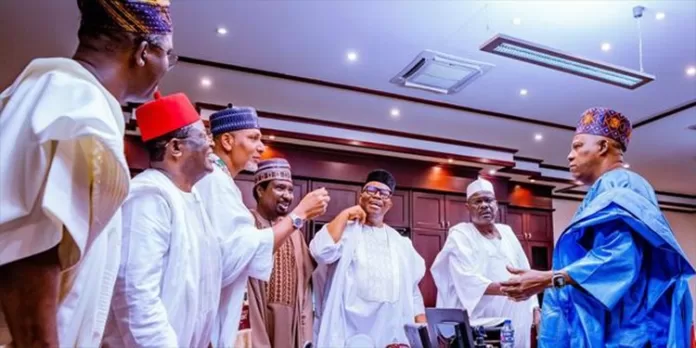
Few hours after its inauguration by President Bola Tinubu, Vice President Kashim Shettima has presided over the National Economic Council (NEC) meeting at the Presidential Villa, Abuja.

The meeting, being held at the State House Council Chambers on Thursday, is the first since the inauguration of President Bola Tinubu’s administration on May 29.

The vice president, by the provisions of Nigeria’s Constitution, is the chairman of NEC.

The NEC meeting, holds monthly and  deliberates on the coordination of the economic planning efforts and economic programmes of the various levels of government.

The council comprises the 36 state governors, the governor of Central Bank of Nigeria, Minister of Finance, Secretary to the Government of the Federation and other government officials and agencies whose duties hinge on the economy.

Governors who are old members of the council include Charles Soludo of Anambra, Yahaya Bello of Kogi, Seyi Makinde of Oyo, Duoye Diri of Bayelsa, Babajide Sanwo-Olu of Lagos, and Godwin Obaseki of Edo States.

Others are Umaru Fintiri of Adamawa, Inuwa Yahaya of Gombe, Bala Mohammed of Bauchi, Babagana Zulum of Borno, Hope Uzodinma of Imo, Rotimi Akeredolu of Ondo, Abdullahi Sule of Nasarawa, Mai Mala Buni of Yobe and Abdulrahman Abdulrazaq of Kwara States.

Newly elected governors are also in attendance. President Tinubu had earlier inaugurated the council before it proceeded with its meeting.

The first major task before the council is deliberation on Palliatives for Nigerians to cushion Effect of the withdrawal of subsidy on petrol.

President Bola Tinubu had last week before the inauguration of the council directed it to kickstart the process of working on interventions to ameliorate the impact of subsidy removal on the people.

Tinubu Appoints Ribadu, Alake, Six Others As Special Advisers; Ribadu Is Special Adviser, Security

0
Bola Ahmed Tinubu

By Ayodele Oni

President Bola Tinubu has appointed eight  Special Advisers.

The Senate had last week approved the appointment of 20 Special Advisers for the President.

Those named in a statement on Thursday by the Director of information, State House, Abiodun Oladunjoye, include  a former Chairman of the Economic and Financial Crimes Commission, Nuhu Ribadu, a retired Assistant Inspector General of Police, AIG, rtd, as Special Adviser on Security, Dele Alake, Special Adviser, Special Duties, Communications and Strategy; Yau Darazo, Special Adviser, Political and Intergovernmental Affairs.

Others are Wale Edun, Special Adviser, Monetary Policies; Mrs. Olu Verheijen, Special Adviser, Energy; and Zachaeus Adedeji Special Adviser, Revenue.

Also named are John Ugochukwu Uwajumogu, Special Adviser, Industry, Trade and Investment and Dr (Mrs.) Salma Ibrahim Anas, Special Adviser, Health.

War Against Corruption: Agbakoba Asks Tinubu To Remove INEC Chairman

0
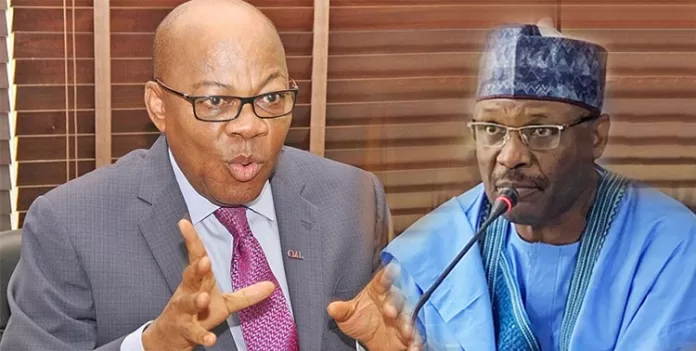
Mahmoud Yakubu and Olisa Agbakoba

By Ayodele Oni

The gale of suspensions currently sweeping across allegedly identified  suspected corrupt officials who worked with the immediate past President Mohammadu Buhari, should be extended to the Independent National Electoral Commission, (INEC), a very senior Lawyer has submitted.

Senior Advocate of Nigeria and former President of Nigerian Bar Association (NBA), Olisa Agbakoba, has asked President Bola Tinubu to remove the Chairman of the Independent National Electoral Commission (INEC), Mahmoud Yakubu.

The senior lawyer, in a statement on Thursday, said the 61-year-old INEC boss must leave office by resignation or removal, otherwise the electoral reform task in Nigeria will be impeded.

In the statement signed on his behalf by his Media Assistant, Niyi Odunmorayo, Agbakoba commended the President for “getting rid” of Godwin Emefiele as the Governor of Central Bank of Nigeria (CBN); and AbdulRasheed Bawa as the Chairman of Economic and Financial Crimes Commission (EFCC).

He stated: “Full congratulations go to President Tinubu for getting rid of Emefiele and Bawa and fuel subsidy and forex corruption. Endemic corruption has suffered a massive blow.

“Next door is for the President to dismantle INEC. Everyone will agree that logistically, the 2023 elections are the worst in our history. I do not refer to the merits of the results of the elections.

“Many results are disputed and are in Tribunals. Both petitioners and respondents suffered at the hands of an incompetent INEC.

“As we await rulings from the courts, massive reforms of the electoral framework ought to begin but this means that the INEC Chairman will have to leave office by resignation or removal, otherwise the reform task will be impeded.

“I add very quickly that the suggested reforms have nothing to do with the merits of election results at all. Both winners and losers of the elections were victims of the failure of INEC. Confidence in Nigeria’s democracy will be enhanced by a deep cleansing of INEC.

Former President Muhammadu Buhari appointed Yakubu as INEC chair in November 2015 to succeed Attahiru Jega, who supervised the 2015 general elections. In October 2020, Buhari reappointed Yakubu as the electoral commission boss.

Can Tinubu’s Copycatting Obi Erase The Dirty Spot Of Dented Mandate?

0

By Edward Musa.

Should Peter Obi and the Labour Party worry at the apparent copycatting of his policies and programs by the tremulous and doddering government of the All Progressives Congress, APC, and President Bola Ahmed Tinubu?

No, they should not, people who rely on others’ work as their sole source of inspiration won’t last in the long run, and worrying about them takes away from focusing on you. The worry really should be on the muddling up of these programs because of the shallow understanding of what it entails.

Especially when such a person has issues with legitimacy, goodwill, and trust from the people.

During the last electioneering period In Nigeria from September 2022  to February 2023, the ruling party’s Presidential candidate, Bola Ahmad Tinubu blatantly shunned all media appearances, refusing to grant a single interview even to explain his manifesto.

Hardly did he take any message to Nigerians as a reason why he should be voted for. The only visible message he kept repeating to the irritation of Nigerians was that he will continue the good work of the immediate past President, Muhammedu Buhari.

Even when he appeared at the Chatham House in London, United Kingdom during the campaign, he had no response to questions and his sides had to come to his rescue answering questions on his behalf.

While Tinubu snubbed and spurned Nigerians disdainfully during the campaigns, Peter Obi seized the stage with his disarming messages, throwing up issues and pragmatically explaining its workings. In every sector of governance, Obi provided a verifiable way to address pertinent issues.

In the turbulent power sector, Obi told Nigerians in practical terms how he intend to solve the perennial problem. He explained how he went to Egypt to study the German firm Seamen that handled their power challenge making Egypt an exporter of power to other countries. During the ChannelsTV Presidential debate which Tinubu snubbed, Obi was there to declare that if South Africa with a population of less than 60 million is generating 58, 095 and yet declared an emergency on power, Nigeria with over 200m people and generating below 5000, should be declaring war on power if he is voted into office.

On subsidy in petroleum products, Obi was unmistaken in his position which dates back to his time as a member of the Presidential Economic Management Team under the Goodluck Jonathan era that he will remove subsidy because it’s an organized crime but will do it in a way that the poor will not suffer. He said he was going to carry the people along showing statistically and empirically what is being generated and how it’s being deployed. Obi even challenged the figure of fuel consumption in the country as unrealistic.

Obi was also brutal on what he would do if elected with the persisting crude oil theft as he exposed it as another organized crime of the people in government. Indeed it was OBI’S exposition that led to the Nigeria Navy and other critical stakeholders coming out to state their roles in the fraud.

The Labour Party’s standard bearer was also forthright on Education describing Education and Health as a critical measure of a nation’s growth and development.

It was all these sector-by-sector explanations of his agenda for Nigeria if elected that endeared Obi to Nigerians across the country. During the campaigns, Obi virtually occupied the stage as a sole candidate with a defined mission while the ruling party flag bearer remained conspicuously missing in action, but possibly as it turned out planning the abracadabra of February 25, 2023, election that has become the darkest day in our democratic journey.

But since his swearing-in on May 29 amidst grumbling and groaning from all corners of our land and beyond, Tinubu said nothing and promised nothing, in fact in a big rally in Kano he just danced at the stage and left without telling the people anything. The only verifiable thing on record he promised Nigerians was to continue the good work of Buhari.

But today he appears to be in a hurry in an unprecedented copycatting of all the things Obi promised Nigeria for which they came out massively to vote for him.

In subsidy removal and the Education sector, Tinubu copiously copied Obi but like in every imitation, if it’s not panadol, it cannot be panadol. in his rush to diminish Obi and win over the obidient adherents, he is not stopping at stealing the mandate but also the programs. He is currently running the country virtually as a sole Administrator. Tinubu’s first meeting with service chiefs was to address the oil theft issue that Obi had unravelled.

Political watchers are looking at the rush by Tinubu to implement OBI’S programs from various angles, one to try and impress on the people to gain the people’s confidence; preparing for an election in case the election tribunal nullifies the election and he is still lucky to be on the ballot if not disqualified; hurrying to distance himself from Buhari to win the people hence the suspension and arrest of the Central Bank Governor Godwin Emefiele who was Buhari’s man Friday.

The way and manner Tinubu is doing the copycatting clearly exposes him as lacking a sense of self, his actions picture him vividly as one green with envy of Obi as he strives desperately to want what Obi has to win his people.

But what is perhaps not privy to APC and Tinubu is that copycats are rarely successful in the long run, it may seem as if Tinubu is successfully stealing OBI’S gains and deploying them, but hardly will it last.

Should Obi and the Labour Party lose sleep at this calculated attempt to hijack their thoughts and even use it to undermine them.? Yes, they should worry at the shameless imitation going on but must remain confident that the heart of his work cannot be duplicated and that is what Nigerians are yearning for. OBI’S unique hardworking self they saw and admired during the electioneering is what the people are waiting for not an imitation of him.

The truth is that no amount of mimicking or impersonating will erase the dirty spot in Tinubu and APC’s dented mandate. That a thief used his loot for charity does not remove the criminality of his action which is paramount. Let’s wait for God’s time which is the people’s time because a new Nigeria is POssible and Obi is coming. God help us.

Fidelity Bank: Fitch Affirms Lender’s Ratings With Stable Outlook

0

Fitch Ratings has affirmed the Nneka Onyeali-Ikpe-led Fidelity Bank Plc’s credit rating at ‘B-‘ with a stable outlook, according to its recent report.  The global rating agency also upgraded the bank’s National Short-Term Rating to ‘F1+(nga)’ from ‘F1(nga)’.

It said the upgrade reflects the improvement in the bank’s local-currency funding profile, as evidenced by the increase in the share of low-cost current and savings accounts in the bank’s customer deposit base to 87.1 percent at the end of the first quarter (1Q2023) from 75 percent in 2021.

According to Fitch, Fidelity Bank’s rating affirmation is driven by its standalone creditworthiness, as expressed by its Viability Rating (VR) of ‘b-‘, reflecting a growing franchise and a low share of impaired loans, as well as good capitalisation and funding.

In Nigeria, banks continue to contend with US dollar shortages and the Central Bank of Nigeria’s, CBN, highly burdensome cash reserve requirement. Fitch expects reform progress under the new administration, including the elimination of fuel subsidies and gradual liberalisation of the naira.

However, Fitch said there is a risk of sharp naira depreciation due to the large disparity between the official and parallel exchange rates. The CBN has increased its policy rate by 700 basis points since April 2022 due to rising inflation.

Fidelity is Nigeria’s sixth-largest bank, representing five percent of domestic banking system assets at end-2022. Strong balance sheet growth in recent years has increased market shares.

“We expect these to increase further but remain below those of the five largest banking groups.”, Fitch said.

Power: Tinubu Moves Against Buhari’s Men

0

President Bola Ahmed Tinubu has started cleaning the Augean stables left by his Muhammadu Buhari, his predecessor.

Just barely two weeks in office as president and Commander-in-Chief the former Lagos governor who came to power on May 29, has taken some bold steps to prove that he wants to be his own man.

If anyone is in doubt of this, watchers of the Presidency insist, the indefinite suspension of the Chairman of the Economic and Financial Crimes Commission, EFCC, Abdulrasheed Bawa, by the president on Wednesday, is a pointer that the incumbent has started asserting himself.

Bawa, according to a statement released by the Secretary to the Government of the Federation, SGF, yesterday, was suspended for abuse of office, including graft allegations against him while he presided over the affairs of the agency.

The statement read, “President Tinubu has approved the indefinite suspension from office of AbdulRasheed Bawa, CON, as the Chairman, Economic, and Financial Crimes Commission to allow for proper investigation into his conduct while in office. This follows weighty allegations of abuse of office leveled against him.

“Mr Bawa has been directed to immediately handover the affairs of his office to the Director, Operations in the Commission, who will oversee the affairs of the Office of the Chairman of the Commission pending the conclusion of the investigation. “

Bawa was directed to handover immediately to the most senior official in the agency.

The president had earlier suspended the Governor of the Central Bank of Nigeria, CBN, Godwin Emefiele on allegations bordering on terrorism financing and economic sabotage.

Emefiele and Bawa have since been arrested by the Department of State Services, DSS, for further investigations.

The duo was appointed by former President Buhari, and those close to the former government informed the magazine that they enjoyed the confidence of the former Nigerian leader.

Their removal from office, therefore, some say is a pointer that President Tinubu does not want to have anything to do with the legacies left by Buhari, that he wants to be his own man, even though he promised during his inauguration that he would continue where his predecessor stopped.

According to those monitoring what is going on in the polity, this is just the beginning of the president’s plan to weed out some government appointees under Buhari who have lost public trust, particularly, those who have corruption allegations hanging on their necks.

For instance, Bawa, before his suspension was accused by a former governor of Zamfara state, Bello Matawalle of demanding a $2 million bribe from him, to compromise corruption allegations against the former governor.

The former EFCC boss has also been accused of living beyond his means as a government official.

On his part, Emefiele was punished for two major reasons; the botched Naira swap policy, that threw the country into a serious financial crisis early this year, and his involvement in partisan politics contrary to constitutional provisions.

Not a few Nigerians accused Emefiele of deliberately introducing the failed Naira Swap policy, to punish Nigerians after his bid to succeed former President Buhari failed to materialise.

Recall also that Tinubu, the All Progressives Congress,  APC, presidential candidate at the time accused Emefiele of targeting him with the policy.

Therefore, the removal of Emefiele was not unexpected by those who have followed his trajectory since he became the boss of the government-owned bank in 2014, particularly after Buhari re-appointed him for a second term in office against popular public opinion.

This cannot be said of Bawa who many had thought would manage to remain in office, despite the very serious allegations that he used his office to enrich himself.

But some sources who spoke with the magazine on his suspension, said embattled EFCC boss may have offended some APC stalwarts who wants him punished for his action.

“Apart from Matawalle,  other governors and APC bigwigs have reported him to President Tinubu. You remember his problem with Governor Yahaya Bello and former Governor Abdullahi Ganduje. May be, he could have survived under Tinubu, at least for some time, what really nailed the EFCC  boss is that he is also not clean,” a Presidency source said

Meanwhile, another source informed the magazine on Thursday that “more heads’ will still roll in government “as the president is planning to bring in those that fit into his agenda.”