Kogi indigenes resident outside the State has handed down a 72-hour ultimatum to the Economic And Financial Crime Commission, EFCC, within which to discontinue its prosecution of the immediate past Governor of the State, Yahaya Bello, or face a mass ,but peaceful protest.
The group under the auspices of Kogi in Diaspora Association condemned the decision of EFCC to slam corruption charges on the former Governor. They noted that it is a grand design to ridicule both Bello and the good people of Kogi States.
Former Governor Bello, who recently handed the baton to Usman Ododo, is currently facing corruption charges from the EFCC over alleged misappropriation and diversion of public funds in the region of #80 billion,
In a Communique issued on Wednesday February 7 2024 in Abuja, the Kogi Group said it vehemently rejects attempts by the EFCC to link Yahaya Bello with an alleged diversion of about N80 billion from Kogi state funds in September, 2015 , months before he mounted the saddle.
“This assertion is not only contentious, but preposterous . How can someone divert Government funds long before gaining access to the levers of leadership? the group queried.
The Communique which was signed by the Convener of the Association, Hon Seyi Olorusola, demanded an immediate halt to what it described as a pursuit of smear campaign against the person of former Governor Yahaya Bello,.
The Kogi indigenes expressed serious concern that the EFCC’s actions are capable of impeding efforts being made to attract investments from the state’s Diaspora citizens.
They emphasized that previous attempts by the anti graft body to rope in Bello failed judicial test ,and wondered why again trying to use same watery issues to hunt the former Governor.
“The Kogi in Diaspora Association, hereby issues a 72 hour ultimatum for the EFCC to halt its Unwarranted witch hunt of former Governor Yahaya Bello . Failure to comply will result in civil disobedience protests by the Association’s members in Abuja and other major cities across the country” the Kogi indigenes stated.
A Maternity in Anambra State, ‘Mother and Child Maternity’ where babies are being born and sold has been discovered.
A joint operation of officials of the State Government and Security Operatives rescued six pregnant teenagers from the baby making factory.
The baby-making factory was reportedly discovered at Umunya in Oyo local government area of the state.
Dr Afam Obidike, the State Commissioner for Health, told journalists that the baby factory, where babies were being sold was named: “Mother and Child Hospital and Maternity”.
The maternity is located at No. 1, School Road, in Umunya.
Obidike said that the State’s Health Facility, Accreditation and Monitoring Unit arrived at the centre for its routine inspection when it burst the operation.
He explained that the nurses they saw locked up the facility and ran away after they requested to see the doctor on duty to find out why the facility was not registered with the state government.
According to him, security operatives including OCHA-Brigade, the Civil Defence Corps and the Police later assisted the monitoring team in gaining access to the facility.
“When we gained access to the facility, what we saw was shocking. We discovered six underaged pregnant girls, between ages 14, 15,16, 17 and 21 years, allegedly camped against their wishes.
We interviewed these girls and they told us that they were being camped by one self-acclaimed doctor, who they identified as Mr Odili Ossai from Delta State, now at large.”
The commissioner stated that the centre has been sealed up while the pregnant girls were taken to government hospital to determine their state of health.
As the troubled Economic Community of West African States (ECOWAS) convenes its Ministerial Council meeting in Abuja on February 8 to discuss the quit notice served by three of its members – Mali, Burkina Faso and Niger – the situation in Senegal might well be the elephant in the room.
Three weeks to the presidential election earlier scheduled to hold in that country on February 25, President Macky Sall announced that the election had been postponed, without immediately giving a new date or any believable reasons. After a wave of protests, he instigated the Senegalese Parliament to announce December 15 as a possible new date.
It’s not the postponement that will worry ECOWAS leaders as ministers meet in Nigeria, where presidential elections have been postponed twice in the last 10 years even on the eve of voting; it’s Sall’s recent shifty habit – first eying a third-term and then denying it, followed by his government’s crackdown on opposition candidates.
The problem in Mali, Burkina Faso and Niger — three delinquent countries that have accused the community of complicity and negligence in its obligations and signalled an intention to quit — is bad enough.
That threat alone has not only put trade in the community estimated at $208.1 billion at risk, minus informal trade amongst citizens which constitutes about 30 percent of the transactions; it also threatens to complicate the security situation in the subregion that is already facing serious problems from violent extremism and banditry.
Hypocritical oath
A politically unstable Senegal is the last thing that the community needs at this time. Of course, it’s unlikely that the situation in Senegal will feature at the ECOWAS meeting, where an allegiance of hypocrisy, elegantly called the principle of “non-interference”, forbids members from telling one another the truth.
The point, however, is that the resurgence of military rule in a number of African countries today, particularly in Mali and Burkina Faso, is partly traceable to blatant disregard for constitutionalism, the rule of law, and rigged transitions – the sort of bad habit that Sall is showing in his old age.
Sall looked like the most unlikely candidate for this nonsense. In some ways, he reminded me of Senegal’s founding president, Leopold Senghor – urbane, intellectual and sensible. A geologist and widely travelled man, Sall built his way up from the bottom of the political ladder. Although he started his journey as a minister under former president Abdoulaye Wade, he soon returned to his base where he took up position as mayor of his hometown.
He took up other ministerial positions later on and also became the president of the country’s parliament. He fell out with his mentor, Wade, after he dragged Wade’s son to parliament to answer corruption charges. But his quarrel was not personal.
President Macky Sall of Senegal
Sall seduced
Senegal was drifting, the cost of living was rising and infrastructure collapsing. Wade’s answer, if he had any, was to attempt to bend the constitution to extend his rule. Sall rallied the opposition. At a stage, the PartiDemocratiqueSenegalais (PDS), where Sall had risen to become prime minister, could no longer contain Wade and Sall. He broke off to form his own Hope Alliance on which platform he challenged Wade in the 2012 presidential election and defeated him, with the assistance of a coalition, after a run-off.
This same Sall, who is losing his way and dragging his country along with him, set a high mark when he assumed office. He cut the size of his cabinet as he had promised, ploughed funds into the renewal of infrastructure and even made a proposal to parliament that would have reduced his term from seven to five-year two-term limit!
Strong arm tactics
All of that now appears to have been in the former life of a fairytale. As Sall’s reset two terms of 12 years neared its end, he slowly became the worst possible version of Wade, toying with an extended tenure and hounding the opposition with a number of his strongest opponents, including Ousmane Sonkoh, who has now been bumped off the trail on contrived charges.Sall, in short, has been seduced by what he hates.
ECOWAS will not be bothered if Sall changed his mind by December and sought an illegal third term. In the last four years, two regional leaders wangled illegal tenure extensions – Alpha Conde of Guinea and Alassane Ouattara of Cote d’Ivoire. The first didn’t quite get away with it after soldiers struck and removed him from office, setting off the region’s coup spiral; while the second is the current host of the African Cup of Nations (AFCON).
Perhaps if there’s one person left in the community on whom the burden falls to whisper to Sall that this is not the Senegal that we used to know, it’s Nigeria’s President Bola Ahmed Tinubu. As surely as a stumble imitates a fall, the signs from Dakar are those that presage what could become a full-blown political crisis for the region if left unattended.
Tinubu, who promised to promote a coup-free region when he assumed office as chair of ECOWAS last year, cannot afford another country added to the regional coup belt. The same way he requested regional leaders at a meeting in Abuja to give George Weah a standing applause for the exemplary transition in that country, he needs to pull Sall’s ear, behind closed doors, and ask him to stop playing games.
For ECOWAS to achieve the African Union (AU) objective to Silence the Guns in Africa by 2030, the community must pay attention to the underlying factors that breed resort to guns violence, a few of the obvious ones being rigged elections, suppression of dissent, and the rule of strongmen. When regional leaders like those in the delinquent states complain that the community is insensitive to problems caused by Western or foreign meddling, it’s the elite, like Sall, that open the door enabling such meddling.
Oasis in jeopardy
An oasis of stability and a shining light in a highly politically volatile region, Senegal was one of the few countries on the continent that others looked up to. According to Martin Meredith in his book entitled, The Fortunes of Africa, “Over the course of 150 elections held in 29 countries between 1960 and 1989, opposition parties were never allowed a single seat. Only three countries – Senegal, Botswana and the tiny state of the Gambia – sustained multi-party politics, holding elections on a regular basis that were considered reasonably free and fair.”
That’s the reputation that Sall threatens to drag in the mud. Tinubu needs to remind Sall that it was he, Sall, and Nigeria’s former President, Muhammadu Buhari, who led the regional response to flush out Yahaya Jammeh in neigbouring The Gambia when Jammeh was on the verge of disrupting the outcome of the elections there because they did not favour him.
By railroading a 10-month postponement of elections through Parliament, Sall is obviously hoping to succeed where Wade and Jammeh failed. And he doesn’t care the cost. But ECOWAS should. The community cannot afford to wait until Senegal becomes another basket case before weighing in.
The National Body of the Sport Writers Association of Nigeria, SWAN and the Nigeria Union of Journalists, NUJ, have been thrown into mourning following the death of Veteran and Versatile Sports Journalist, Kayode Tijani.
The Late Tijani died on Wednesday, February 7th 2024, at the Lagos State University Teaching Hospital, LASUTH, after a protracted illness.
His death came as a surprise to many of his colleagues, friends and families, as he was consistently a guest at Television Stations, analyzing the ongoing African Cup of Nations championship in Côte d’Ivoire.
The Nigerian Institute of Journalism, NIJ, graduate began his sports journalism career at Complete Communications Limited, Publishers of Complete Football magazine and Complete Sports newspapers in the late 1980s.
Thereafter, he worked for many years as the pioneer Sports Editor of FAME magazine, a society publication, before travelling to England where he was a correspondent and sports presenter for an Afrocentric television station, BEN TV.
On his return to Nigeria, Kayode set up a private media outfit, ‘Sport Xclusive,’ which he ran as a sports producer and visual content consultant. He was renowned for his rich library of historical videos on Nigerian and African sports heroes and heroines which he put at the disposal of government establishments and private companies.
On several occasions, he worked with major television stations including the Nigeria Television Authority (NTA) and the African Independent Television (AIT) to cover international sports events by providing rare footage to enhance their presentation. He also collaborated with private broadcast companies to produce TV commercials and sports documentaries.
In 1995, Kayode teamed up with two other colleagues to launch ‘Sportlight,’ a daily sports newspaper, which however was rested after only a few weeks. Amongst several volunteering works on national service, he was a member of the Organising Committee of the 8th All-Africa Games, “COJA Abuja 2003” hosted by Nigeria.
At the advent of Social Media in Nigeria, Kayode was very active in circulating timely sports news and information to his numerous followers on Facebook and “X” (formerly Twitter). Unfortunately, he had to scale down his Social Media activities on medical grounds when he took ill before he finally passed away on Wednesday.
Kayode will be buried according to Muslim rites on Thursday, 8 February 2024 at Atan Cemetery in Yaba, Lagos at 2.00pm.
He is survived by his wife, children, siblings and other relatives.
He will surely be missed by the Sporting World for his distinctive analysis, professionalism and his commitment to his job.
Chairman of the Nigeria Governors’ Forum, (NGF) and the Kwara State Governor, AbdulRahman AbdulRazaq, has called for an end to the Central Bank of Nigeria, (CBN) funded Anchor Borrowers Programme, describing it as total failure.
The programme introduced and being funded by the CBN was intended to assist farmers to provide loans in kind and cash to boost agricultural production.
Upon harvest, benefitting farmers are expected to repay their loans through produce. As at 2022, the CBN announced that it’s lending under the programme stood at N629 billion.
The NGF chairman said it is high time the Tinubu-led administration returned all agricultural programmes under the Central Bank of Nigeria, CBN, back to the Federal Ministry of Agriculture and Food Security for meaningful impact.
According to Abdulrazaq, the Anchor Borrowers Programme was a failure and never met the aims and objectives of setting it up, hence a lot of indebtedness recorded.
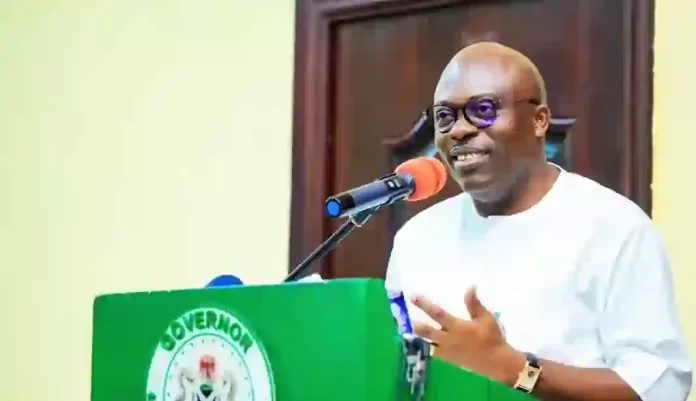
The governor was speaking when he led his three other counterparts on a visit to the minister of Agriculture and Food Security, Senator Abubakar Kyari in Abuja.
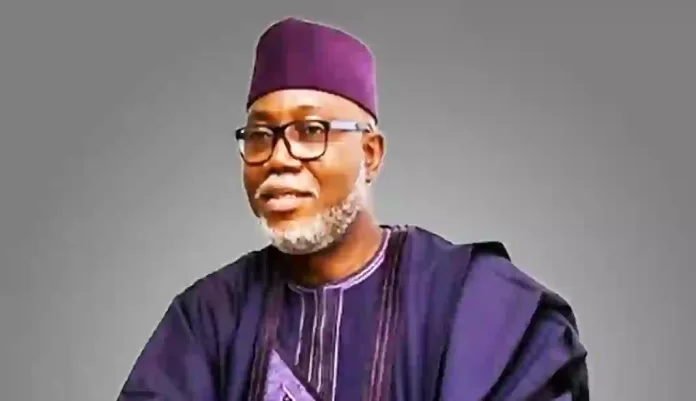
Other governors on the entourage were Governor of Ondo State, Lucky Aiyedatiwa, Governor of Taraba State, Dr Agbu Kefas; and Governor of Kogi State, Ahmed Usman Ododo.
He also boasted that Nigeria can feed itself and the entire West Africa, pointing out that the cheap food in West Africa is in Nigeria, hence most West African countries are coming to buy food from Nigeria.
The NGF chairman acknowledged and commended the Minister and his team for the initiative to closely work with the State Governments to achieve the long expected food security under the ‘Renewed Hope’ Agenda of President Bola Tinubu.
He called for resuscitation of the moribund Agricultural Development Programmes, (ADPs), in some States, and the active role of River Basin Development Authorities, (RBDAs), including National Agricultural Lands Development Authority, (NALDA), to embark on land clearing for more agricultural activities along various value chains.
Earlier, the minister expressed excitement over the endorsement by State Governors of the food security programmes rolled out through the Federal Ministry of Agriculture and Food Security.
Kyari, stated that “This visit is without a doubt a huge endorsement for the progressive drive towards the much-needed collaboration between the Federal Ministry of Agriculture and Food Security and State Governments.
“This is with a view to creating an Agricultural Sector fit for a nation as endowed as Nigeria with massive arable fertile land, abundant water resources and agricultural labour force.
“Your Excellencies, we are aware that in your respective states, agriculture has witnessed noticeable development over the years.
“The bigger picture we seek to create now is to vastly increase agricultural production all-year round with the cardinal objective of driving down food inflation, creating employment, reducing poverty, engendering economic growth and development, as well promoting inclusivity.
“We are confident that we can partner in the realization of these objectives. There is no question that if we get things right now, and with all hands on the plough, future programmes and projects will enable us more seamlessly achieve all-year-round agricultural production.
“It implied Your Excellencies, that the more involved the sub-national governments are the more sustainable agricultural production becomes and the higher the chances of realizing the interconnected 8-Point Agenda of President Bola Ahmed Tinubu, GCFR.”
The All Progressives Congress, APC, has been thrown into mourning following the sudden death of one of its top Chieftains, Dr. Cairo Ojougboh.
The former House of Representatives Member, who represented Ika Federal Constituency, Delta State, was said to be watching the African Cup of Nations Championship semi final match between the Super Eagles of Nigeria and the Bafana Bafana of South Africa.
It was gathered that as soon as the referees cancelled the Super Eagles second goal, and instead, awarded a penalty kick against Nigeria he allegedly slumped.
Following the decision of the Video Assistant Referee to upturn Super Eagles goal scored by Victor Osimhen, the late Ojougboh was said to have shouted, slumped, and died before he could be rushed to the hospital.
The vocal APC Chieftain was a lover of football and passionate about the National team.
Taking to the social media, Nigerians have lamented this tragedy.
@Morris_Monye wrote on X (formerly Twitter) “ Anyways we are to speak good of the dead
“RIP to Dr. Cairo Ojougboh. May God forgive all our shortcomings.”
The Late Ojougboh, a medical doctor turned- politician, was a former Director of projects in the interim board of the Niger Delta Development Commission (NDDC) and before he defected to the APC, a top member of the Peoples Democratic Party, PDP.
The Nigerian National Petroleum Company Limited, NNPCL says it has commenced the production of 14,000 barrels per day of crude from offshore Akpo West Field.
The spokesman of the state-owned oil company, Olufemi Soneye made this known in a statement on Wednesday in Abuja, the nation’s capital.
The development, according to him, is in line with President Bola Ahmed Tinubu’s directive to the company to increased the nation’s oil production.
At least, Nigeria must produce 2 million barrel a day of crude oil in other to sustain the struggling economy, experts say.
The current production level is far below that figure, according to checks from the NNPCL.
Soneye said: “In line with President Bola Ahmed Tinubu’s directive to the Nigerian National Petroleum Company Limited (NNPC Ltd) to optimise production from the nation’s oil and gas assets, the company has announced the successful commencement of oil production from the Akpo West Field.
“The development of Akpo West which is on Petroleum Mining Lease (PML) 2 (formerly OML 130) leverages the existing Akpo Floating Production Storage and Offloading (FPSO) facility via a subsea tie-back to keep costs low and minimise greenhouse gas emissions.
“The milestone was enabled by the strategic leadership of the Group Chief Executive Officer (GCEO), Mr. Mele Kyari, and the Upstream Directorate of the NNPC Ltd whose support played no small role in propelling the operators to actualise the short- and mid-term hydrocarbon production goal of the President Tinubu administration.
“Located 135 kilometres offshore, Akpo West Field is one of the discoveries on PML 2 with proximity to the Akpo main which started up in 2009 and produced 124,000 barrels of oil equivalent per day in 2023.
“PML 2 is operated by TotalEnergies with a 24 percent interest in partnership with CNOOC (45 percent), Sapetro (15 percent), Prime 130 (16 percent), and the NNPCL as the concessionaire of the Production Sharing Contract (PSC).”
Wale Edun, the Minister of Communication and Coordinator of the Economy, recently remarked that the only way out of the current economic crisis is to produce more crude oil in other to increase government revenue.
The organized Labour in the country has been thrown into a serious financial crisis following the federal government decision to seize check up dues accruing to them from members of the various unions.
The financial crisis has hindered the activities of key unions including the NLC, TUC, as well as affiliated unions such as Amalgated Union of Public Corporations, Civil Service Technical and Recreational Services Employees , AUPCTRE; Non-Academic Staff Union of Educational and Associated Institutions, NASU; and Nigeria Civil Service Union, NCSU.
Others caught in the web are the Nigeria Union of Public Service Reportorial, Secretarial, Data Processors and Allied Workers, NUPSRAW; National Association of Nigeria Nurses and Midwives, NANNM, and Association of Senior Civil Servants of Nigeria, ASCSN.
According to a letter sent to the federal government by the NLC, dated January 31, 2024, the unions warned that the decision to withhold the funds is a direct interference in their activities, which they insist posed a serious threat to industrial peace in the country.
NLC accused the Minister of Finance and Coordinator of the Economy, Wale Edun of being behind the problem, which it said contradicts “Article 2 and 3 of the ILO Convention Number 87 on Freedom of Association and Protection of the Right to Organise, as well as Sections 17 and 18 of Nigeria’s Trade Union Act, LFN, CAP T14.”
It calls on the Accountant- General immediately “ensure the release of all withheld check-off dues accruing to trade unions in Nigeria’s public sector.’
Part of the letter reads : “The Continuing unfortunate deliberate withholding and piecemeal release of Check-off dues accruing to public sector trade unions in the country has been brought to our notice by our affiliates in the sector. These unions have therefore accordingly expressed their grievances regarding this intentional withholding or partial release through the Integrated Personnel and Payroll Information System, IPPIS, platform. We understand that this illegal act was at the instance of the Minister of Finance.
“This practice is totally unacceptable and runs counter to the traditions and principles guiding our engagement as social partners within the nation’s Industrial Relations sphere. We have had cause to have written to the Minister of Labour last year on this but report reaching us speaks to its unfortunate persistence. We find it inconceivable that check-off dues, deducted at the source from the salaries of public sector workers, would be subject to withholding or released in a piecemeal fashion when salaries themselves are not owed or disbursed piecemeal.
“We wish to draw your attention to the fact that this worrying development not only deprives our affiliates but also national labour centers of the financial resources necessary for their effective operation as workers’ representative organisations. Such actions represent a fundamental threat to trade unions and trade unionism in Nigeria, given that financial stability is crucial for the functioning of our organisations. We do not want to believe that this may be part of the ongoing onslaught against workers’ and trade union rights in Nigeria.
“It is imperative to remind you that the withholding of check-off dues accruing to trade unions amounts to interference in the activities of these unions. This interference is explicitly condemned by Article 2 and 3 of the ILO Convention Number 87 on Freedom of Association and Protection of the Right to Organise, as well as Sections 17 and 18 of Nigeria’s Trade Union Act, LFN, CAP T14.
“We must also stress that sitting on already deducted check-off dues amounts to impounding or illegal hijack of monies belonging to the trade unions. We may be forced to begin to see this as an intentional misappropriation of funds that rightly belong to trade unions driven by other motives if nothing is quickly done to put an end to it.
“As the supervising authority over public financial flows in Nigeria, we trust that you will act promptly to rectify this anomaly to avoid creating unsavory workplace outcomes. We have followed as always due process in handling this and have exercised unusual patience but allowing this to continue may put undue strain on our relationship.”
Femi Falana, a human rights activist has called on the Economic Community of West African Countries, ECOWAS, to sanction President Macky Sall of Senegal for postponing the presidential election.
The Senior Advocate of Nigeria, SAN, said all Senegalese government officials involved in the shift of the presidential poll should be sanctioned too.
President Sall had shifted the election amidst various human right violations by his government, including the arrest and harassment of opposition leaders, Ousmane Sonko in the west African country.
The election was billed originally billed for February 25, and campaign were billed to start in few days before the government announced the shift.
It’s the fist time that the presidential election was postponed in the country where democratic government has endured despite some frictions among various parties trying to take power.
The shift has caused a division in the country after the National Assembly postponed the election for 10 months.
In a statement on Wednesday, Falana said Sally and other government officials need to be sanctioned by ECOWAS for trying to truncate democracy in the now very volatile country, adding that the sudden postponement was a constitutional coup by President Sally, stressing that the action is inconsistent with the provisions of ECOWAS treaties and protocols including Article 45 (2) of the ECOWAS Protocol on Democracy and Good Governance signed by Senegal.
Part of the statement, said, “The ECOWAS leaders should consider imposing targeted sanctions, including imposing travel bans, asset freezes and other targeted sanctions on Mr Sall and officials of his government responsible for serious violations of the democratic rights of the people of Senegal.
“Since then, he (Sall) has been manipulating the democratic process to install his surrogate. The illegal postponement of the elections is due to President Sacky Mall’s fear that his chosen candidate would be rejected in the polls by the Senegalese people,” Falana said.
“The postponement of the elections is also a fundamental breach of the Lome Declaration and the African Charter on Democracy, Elections and Governance which Senegal has signed. Senegal signed the charter on December 15, 2008, and as such, the government has a good faith obligation to comply with the provisions of the charter.
“The postponement of the elections suggests a deliberate ploy by Mr Sall to manipulate the country’s constitution in order to hold onto power against the will of the people and popular aspirations.”
Not a few watching what is happening in the country insist that the postponement could lead to instability and the prospect of a forced unconstitutional change of government, similar to what happened in Niger recently and some other neighbouring West African countries as a result of leaders trying to sit-tight in power.
After an 11 years wait to be in an African Cup of Nations championship final, the Super Eagles finally did it. The team defeated high flying Bafana Bafana of South Africa in a pulsating semi final match at the Bouake Stadium in Côte d’Ivoire.
It took penalties for Nigeria to zoom into the AFCON final after a 1-1 draw score line for the entire 120 minutes of football action.
After a goalless first half with Nigeria creating few chances, while the South Africans tested the Nigerian goalkeeper, Stanley Nwabali several times, and made him make crucial saves, it all ended in penalty shoot-out.
It took 67 Minutes to get the much needed goal courtesy of a spot kick converted by William Troost Ekong after Victor Osimhen was brought down by Mothobi Mvala.
The Super Eagles thought they had doubled their lead when Osimhen tapped in a low cross from Samuel Bright Osayi, but the Video Assistant Referee cancelled the goal, citing an infringement in the Super Eagles box, as Yusuf Alhassan fouled a South African player.
Teboho Mokoena converted the resulting penalty to give South Africa the much needed eqauliser.
The South Africans could have scored a last gasp goal as Nwabali parried a free kick to the path of a Bafana Bafana player who ballooned the ball over the bar.
The game went into extra time, with South Africa slowing the pace of the game, while the Super Eagles mounted pressure.
This paid off as South Africa’s Grant Kekana fouled Terem Moffi who replaced Victor Osimhen. It earned him a red carded, but the resulting freekick was not converted by Kelechi Iheanacho.
As the game went into penalties, Teboho Mokoena and Evidence Magkopa lost their spot kicks, while William Troost Ekong, Terem Moffi, Kenneth Omeruo and Kelechi Iheanacho converted their Spot kicks. Ola Aina lost his.
Coach Jose Peseiro started the match with his regulars first eleven but Samuel Bright Osayi came in for the injured Zaidu Sanusi in the starting line, while Samuel Chukwueze, Joe Aribo, Terem Moffi, Kenneth Omeruo, Kelechi Iheanacho and Yusuf Alhassan werep substitutes used in the game coming in for Alex Iwobi, Frank Onyeka, Ademola Lookman, Moses Simon and Victor Osimhen.
With this victory, the Super Eagles will meet the host country, Côte d’Ivoire which defeated the Democratic Republic of Congo by a lone goal in the finals scheduled for Sunday, February 11th, 2024.