

Home Blog Page 1217

CBN: Cardoso Juggles To Save Naira, Forex market

0

Amidst the declining value of the Naira, the Central bank of Nigeria, CBN, on Thursday introduce more sweeping reforms in its quest to stabilize the national currency as well as the foreign exchange market.

The magazine reports that CBN issued some policies recently as it struggles to save the naira against other world major currencies.

For instance, International Money Transfer Operators, IMTOs, last week notified their customers that they would no longer pay foreign remittances in dollar, in line with CBN directive to now pay such in naira.

“it’s no longer possible for any money transfer to be paid out in USD in Nigeria. But please don’t worry. You can still enjoy the same quick, safe and affordable WorldRemit service to Nigeria by sending money in Naira instead. If you have any questions or concerns, our dedicated support team is always here to help,” said Worldremit, one of the IMTOs in a notice to customers.

At least, three circulars were issued yesterday by the apex bank, described by experts as a desperate move to tighten the noose on the nation’s foreign exchange market.

According to the circulars which came simultaneously from the CBN’s Director of Trade and exchange, Dr. Hassan Mahmud, the CBN has now made it impossible for International Oil Companies, IOCs to repatriate 100 percent foreign exchange proceed from the country. The apex bank has now made it possible for the IOCs to repatriate their forex in two tranches of 50 percent in the spate of three months.

Apart from this, the CBN said it will no longer allow cash for Business Travel Allowance, BTA, and Personal Travel Allowance, PTA, as such allowances are to be issued in cards.

The CBN directed commercial banks in the country to comply with the new forex Order, saying they are part of the Yemi Cardoso-led apex bank effort to save the naira from further declining.

The naira has experienced its worse performance in the last few weeks after exchanging for more than N1,500 to the American dollar.

The CBN took the action after the World Bank described naira as the worst performing currency in Africa.

The Bretton wood US based organization had classified the Nigerian currency among those of other 12 other countries which performed woefully in 2023

Other countries whose currency were listed include South Sudan, Burundi , the Democratic Republic of Congo , Kenya , Zambia , Ghana, and Rwanda, amongst others.

“So far this year, the Nigerian naira and the Angolan kwanza are among the worst performing currencies in the region: these currencies have posted a year-to-date depreciation of nearly 40 per cent,” the bank said in a report

“The weakening of the naira was triggered by the central bank’s decision to remove trading restrictions on the official market. “

In the first circular issued by the CBN, it said the action was meant to stop “cash pooling’ by the IOCs which according to the apex bank has impacted negatively on liquidity in the local foreign exchange market.

Such cash, the CBN said are usually pooled by the IOCs to fund their off shore parent companies, saying “it has become necessary to take measures to address this trend.”

Part of the circular read: “In line with the ongoing reforms in the foreign exchange market, it has become necessary to take measures to address this trend, consequently, the CBN hereby directs as follows:

*Banks are allowed to pool cash on behalf of IOCs, subject to a maximum of 50 per cent of the repatriated export proceeds in the first instance;

*The balance may be repatriated after 90 days from the date of inflow of export proceeds.”

Speaking on the restriction placed on IOCs by the CBN, Kenvin Ekhalufoh, the chief executive officer of Star Advisory Limited said on Thursday that the apex bank took the right decision.

According to him, other countries such as China, Canada had taken similar measure in the past to stop the outflows of forex from their countries.

He said: ‘It behooves on the CBN to stop the pooling of forex from the country. You need to slow down the movement of forex from the country due to the shortage in forex.

“Nigeria is not the only country doing this. Canada also dealt with the issue of forex pooling. If unchecked it has negative effect on the economy.”

Concerning the BTA, the CBN stated in the circular referenced: TED/FEB/PUB/FPC/001/006 and titled, “Allowable Channels for payout of Personal Travel Allowance and Business Travel Allowance,” that it took the decision to ensure transparency and genuineness of travelers seeking to obtain BTA and PTA.

The allowance, CBN stated in the circular will now be paid by banks through various electronic channels.

The Circular read in part :“Memorandum 8 of the Foreign Exchange manual and the circular with reference FMD/DIR/CIR/GEN/08/003 dated February 20, 2017, stipulate the eligibility criteria for accessing Personal and Business Travel, allowances (PTA/BTA),” CBN said.

“In line with the Bank’s commitment to ensure transparency and stability in the foreign exchange market and avoid foreign exchange malpractices, All Authorized Dealer Banks shall henceforth effect payout of PTA/BTA through electronic channels only, including debit or credit cards. For the avoidance of doubt, payment of PTA/BTA by cash is no longer permitted. Authorized Dealers and the general public are hereby to note and comply accordingly.”

Insecurity: Why Tinubu Is Opting For State Police

0
President Bola Tinubu

By Ayodele Oni

As efforts are being intensified to find lasting solution to the unending insecurity ravaging the country, President Bola Tinubu and 36 state governors have endorsed the establishment of state police.

This is coming even before the commencement of work by the constitution review committee, which was set up on Wednesday by the Senate.

It is the believe that state police may likely be one of the demands to be put before the review committee when it eventually commences sitting.

The agreement for a state police, was one of the resolutions made during an emergency meeting held at the Presidential Villa in Abuja on Thursday.

The Minister of Information and National Orientation revealed that discussions surrounding state police have gained momentum, with the federal and state governments recognizing the necessity of such a development.

The Minister emphasized that while this marks a significant shift, further meetings will be conducted to refine the modalities for implementing state police across the country.

He said, “But now, there is also a discussion around the issue of state police. The federal government and state governments are mulling the possibility of setting up state police.

“Of course, this is still going to be further discussed, a lot of work still has to be done in that direction. But what the federal government and state governments are agreeing to the necessity of having state policy.

“Now, this is a significant shift. But like I said, more works need to be done in that direction. A lot of meetings will have to happen between different government and sub nationals to see the modalities

FG Seeks States’ Collaboration To Check Soaring Costs Of Food Items

0
Bola Ahmed Tinubu

By Ayodele Oni

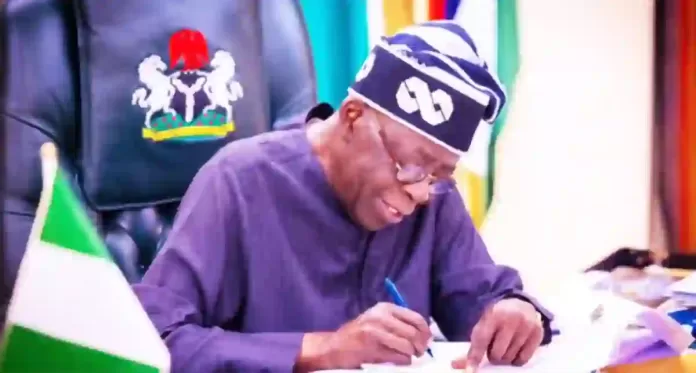
As part of move to curtail continued soaring prices of food items, President Bola Tinubu has directed State Governments to collaborate with Federal government to increase local food production.

Special Adviser to the President on Information & Strategy, Bayo Onanuga stated that at a meeting with governors in Abuja on Thursday, the President advised against the idea of food importation  and price control when local food producers should be encouraged to produce  more food.

The President advised Governors to follow the example of Kano State in dealing with hoarding of food for profiteering by commodities merchants, while he directed the Inspector-General of Police, National Security Adviser, Department of State Services  to monitor warehouses hoarding food items across the country and stop profiteering by merchants.

He charged Governors to pay attention to livestock development in their states and increase production most especially poultry and fishing products.

Tinubu pleaded with Governors to ensure all salary arrears to workers, gratuities to retired workers and pensioners are cleared as a way to put money into the hands of the people since states are now getting more monthly FAAC revenue stressing “Spend the money, don’t spend the people.”

President Tinubu further implored Governors to create more economic opportunities for the youths in their states to keep them more productively engaged.

Support For Parliamentary Govt Intensifies

0

The call for the Nigeria to return to the parliamentary system of government is gaining more momentum following the decision of an elder statesman Aminu Dantata who threw his wight behind it.

“Parliamentary system is better and cheaper for Nigeria but the presidential system is very costly, especially with the current economic situation in the country,” Dantata said on Thursday in Kano

There has been calls recently to ditch the Presidential system which the country currently practices over its cost that has become too unbearable for the country.

Not a few Nigerians have demanded a return to the parliamentary system which the country practiced after Independence in 1960 before the government was overthrown by the military.

On the return to democracy in 1979, the presidential system was introduced, and has since been in practice.

Earlier in the week however, some lawmakers in the house of Representatives demanded a return to the former system which they contended was more beneficial in terms of cost effectiveness.

On Wednesday, 60 lawmakers in the House of Reps sponsored a bill titled “The Bills proposing constitutional alterations for a transition to parliamentary system of government,’ which they said was intended to change Nigeria to a parliamentary democracy.

According to the sponsor of the bill, Kingsly Chinda, who is also the Minority Leader of the House, the change has become imperative due to the high cost of running a presidential system of government.

The bill was read for the first time on the floor of the House during Wednesday’s plenary session in Abuja, the nation’s capital.

The leader of the group, Wale Raji while speaking remarked that the parliamentary system promotes a robust policy debates aside from reducing the cost of governance.

Another lawmaker Abdulssamad Dasuki who spoke at a press conference after the bill has been read, disclosed that a change to parliamentary would have a sweeping impact of the nation’s political landscape.

He explained that the system worked for the country for the six years it was in operation before the government was truncated due to the military incursion into power in 1966.

The lawmaker said in part, “Our founders in their wisdom and in a political atmosphere devoid of compulsion, and having considered the interests of their native peoples and their desire to live together in a country where truth and justice reign, where no man is oppressed, and where all citizens live in peace and plenty, adopted the parliamentary system of government.

“That was the governance system of the First Republic, a period when legislative and executive powers were exercised by the representatives of the people in parliament and in the executive, and by the nature of the system, these representatives were accountable to the people.

“For six years while it was in operation, the system worked for the country.”

“The collapse of the First Republic and the long stretch of military rule culminated in the adoption of a new system of government, theoretically fashioned after the presidential system of the United States but in practice, imbibed the uttermost attributes of military rule.

“No wonder the Nigerian President appears to be one of the most powerful presidents in the world.

“Over the years, the imperfections of the presidential system of government have become glaring to all, despite several alterations to the constitution to address the shortcomings of a system that has denied the nation the opportunity of attaining its full potential.

“Among these imperfections are the high cost of governance, leaving fewer resources for crucial areas like infrastructure, education, and healthcare, and consequently hindering the nation’s development progress, and the excessive powers vested in the members of executive, who are appointees and not directly accountable to the people.

“The bills presented today (Wednesday) seek a return to the system of government adopted by our founders, which made governance accountable, responsible and responsive, and ultimately less expensive.”

The magazine notes that under the parliamentary system, the Head of State shares power with the Prime Minister who is the head of government.

How Obi Paid N800m To Settle LP Litigations

0
Aisha Yesufu

Peter Obi, the Presidential Candidate of the Labour Party singlehandedly paid the legal bill that arose from last year’s presidential election for this party, the party has said.

The LP presidential candidate in the 2023 presidential election paid close to N800 million for this purpose, the party said yesterday.

This was made known on Thursday by Aisha Yesufu, the chairperson of the Obi-Datti Fundraising Team while giving account of how money was raised and spent during the campaign.

The revelation comes on the heels of counter allegations over alleged financial misappropriation against the National Chairman of the party, Julius Abure.

Abure was accused of misappropriating over N3.5 billion raised to prosecute the election by the party National Treasurer, Ozuchi Opara, an allegation that has been denied by the Chairman.

The party’s presidential candidate has demanded a thorough probe of the allegation.

The party lost the election as its candidate came third in the election won by the incumbent President Bola Tinubu.

LP later went to challenge the election results from the Tribunal to the Supreme Court. The party lost all the litigations up to the nation’s apex court.

Speaking on the expenses incurred before, during and after the election Yesufu noted that close to N1 billion was realized from donations, while Obi also donated N800 million out of which N744 million was spent to offset the litigations arising from the election.

“For the election promotion expenses, we had N10,808,948 and deployed N744,500,000 to cover legal expenses. We thank everyone who donated in cash and kindness.”, Yesufu said.

Obi, who garnered 6,101,533 votes to emerge third in the February 25, 2023 presidential election won by Bola Tinubu of the ruling All Progressives Congress, along with the Labour Party, rejected the results as announced by the Independent National Electoral Commission.

MURIC Blames Hardship On Global Recession; Says Tinubu Not Responsible

0

The Muslim Rights Concern, MURIC, has urged Nigerians to be cautious over the current economic situation in the country.

The Islamic body said it would be wrong for Nigerians to destroy their country due to the hardship they are going through, noting that Nigeria is not the only nation facing the current economic crisis.

The group in a statement on Friday signed by its leader, Prof. Ishaq Akintola named countries that are going through hard times, including France, Britain, Canada, the United States of America, USA.

According to Akintola, some countries like the United Kingdom and Japan are currently facing economic recession, saying what Nigeria is experiencing at the moment is the effects of globalization.

The MURIC leader also absolved Nigerian leaders from the economic hardship facing the nation, noting that the country is part of a global village which cannot be isolated from the bad times facing the world at the moment.

“Something must be very wrong with the world economy,” MURIC said.

The statement read in part: “Something must be terribly wrong with the world’s economy if great democracies like Britain, France, Canada and America are facing worse economic decline. Nigerians in diaspora have been complaining of tough times and it all began with the COVID-19 lockdown when the world’s economy was totally shut down. Things have not been the same since then.

“Nigerians have two major lessons to learn from this ugly developments. Firstly, Nigeria is merely suffering from the bandwagon effect of a distraught global economy. We are not an island. What is happening to the naira and the skyrocketing prices is not isolated. Neither can we blame our leaders for it. It is a natural concomitant of events in a global village. We can only blame globalisation for it.

“Secondly, although there are reports of recession in those countries, their citizens have not resorted to violence. Public properties are not being attacked. Neither are there threats by their military to stage coups because they are sensible enough to know that the military are not trained for politics or management of battered economies.

“The threat of a military coup allegedly issued by the former head of state, General Ibrahim Babangida is therefore in bad taste and it is most unfortunate. We advise Nigerians to ignore him if indeed the report is true.

The military’s past incursion into politics brought Nigeria to where it is today. Characterized by lack of probity, total absence of accountability, disrespect for the rule of law, dehumanisation of the citizenry, tyranny, totalitarian dictatorship, etc, military rule is a hydra-headed monster which Nigerians must avoid at all cost.

“The worst civilian rulers are better than the best military rulers. You can change a civilian president at the polls but you are permanently at the mercy of a military ruler. Military rule has no timeline whereas a civilian ruler has just four years to prove his mettle or be changed at the polls.

“We therefore urge Nigerians to shun all undemocratic attempts at changing the system. We are aware of incitements to demonstrations and some have actually taken place. We admit that demonstrations are our right to express grievances but we must be wary of hijackers whose evil plans are more luciferous than that of the authors of #EndSARS.

“Nigerians must not listen to those who incite them to destroy public property. Only sadists can look at the hundreds of brand new luxurious buses of the Lagos State Government which were all burnt down and feel a sense of achievement. Those buses were about to be launched for use as public transport by the citizens. We must never allow such madness again,” the group said.

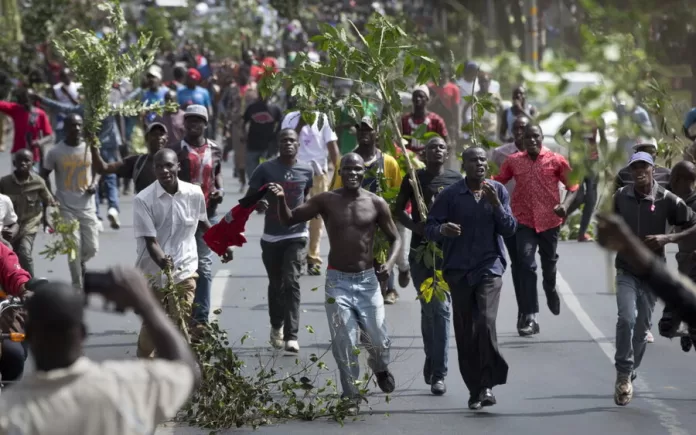
Recall that not a few Nigerians have taken to the street in recent days to protest the high cost of living in the country.

Some opinion leaders such as the Emir of Kano, Ado Bayero last week counselled President Bola Ahmed Tinubu to deal with the economic crisis before it is too late.

Kano: After Killing 14-Year Old, Kidnappers Demand Four Million Naira

0
Kidnappers Arrested in Kano

By Daniel Maduka

Arrested By Kano Police

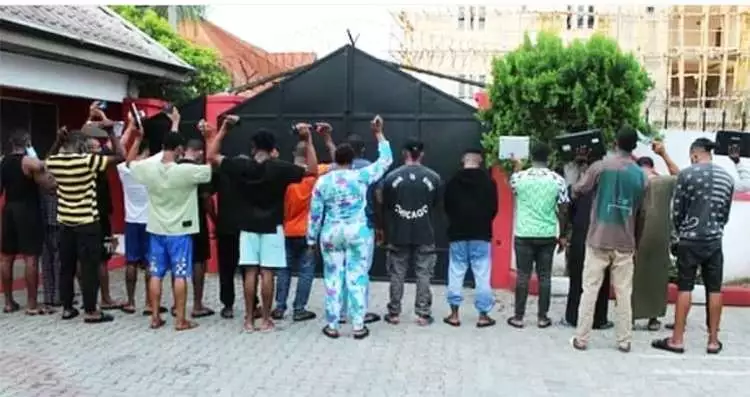
The Kano State Police Command, on Thursday, February, 15, 2024, announced the bursting and subsequent arrest of a three-man gang that kidnapped and killed their neighbour’s 14.year old son, and still  demanded a ransom of four million Naira thereafter. However they were arrested in the process of negotiation for payments.

According to a statement issued by the  Kano State Police Command Spokesperson, Abdullahi Haruna Kiyawa ( SP)  , the kidnapers after stabbing and killing 14 year-old  Abdullahi Sani of Hotoro quarters in Kano metropolis, proceeded to throw his lifeless body into a soakaway at an uncompleted building in the Sabuwar Zara Quarters also in Kano .

The kidnapers,  namely Ismail Adamu ,22, Musa Usman 17 and Abdullahi  Usman after killing their victim , contacted his father Alhaji Rabiu Abdullahi and  demanded the sum of four  million Naira as ransom.

The Kano Police authorities said their discreet investigative efforts, following official a complaint lodged by the deceased father led to the  arrest of the three kidnapers,with Ismail Adamu as the ring leader.

Kidnappers Arrested in Kano
Leader Ismail Adamu ,with his two accomplices backing Camera

“In the course of investigations Ismail Adamu confessed to having conspired with one Risi of Mariri Quarters to kidnap the victim. The suspect further revealed that they took the victim to Sabuwar Zara Village where they stabbed him in the neck and threw him inside a soakaway and later contacted the father and demanded  four million Naira for his release

“The crime scene was later visited by the police operatives with the deceased body retrieved from the soakaway and evacuated to Abdullahi Wase Specialist Hospital kano where medical personnel confirmed the deceased dead. His corpse has been deposited at the hospital’ s mortuary.”

The State Commissioner of Police,  Alhaji Mohammad Husseini Gumel while appreciating the people of Kano for their support and understanding, said the suspects upon completion of investigations will be prosecuted.

LAHA Urges LASG To Support Schoolgirl Victim Of Teargas

0
Mudashiru Obasa

By Akinwale Kasali

The Lagos State House of Assembly has urged the Lagos State Governor, Babajide Sanwo Olu and the Lagos State Government to support Amina Alege, a 12-year-old student of the Adam Yakubu Memorial High School in Lagos State, who suffered an eye injury after she was, allegedly, tear-gassed by the police.

The incident occurred on Friday, February 9, 2024, in front of a mosque near Adam Yakubu Memorial High School in Iloro, Cement, Agege, Lagos.

The House called on the Commissioner for Health, Professor Akin Abayomi, and the Ministry to offer necessary support to the young girl, who is billed for surgery.

The matter was brought to the attention of the House by Hon. Abiodun Orekoya, chairman of the House Committee on Sports and Youth Development during a plenary session on Thursday presided over by Deputy Speaker Mojisola Lasbat Meranda on behalf of Rt. Hon. Mudashiru Obasa.

Orekoya said he received the information through a human rights organisation, adding that  the incident happened when two schools were embroiled in a clash and the police intervened with tear-gas.

He said the student’s parents have been borrowing money to pay for her treatment and that she is currently admitted to the Lagos State University Teaching Hospital (LASUTH).

Orekoya pleaded with the House to call on Governor Babajide Sanwo-Olu to offer support to the parents and help save Amina’s life before the situation worsens.

Supporting Orekoya’s appeal, Hon. Kehinde Joseph (Alimosho 2) emphasised that since the student attends a government-owned school, it was necessary for the governor to step in.

Joseph further requested that the House investigate the incident to prevent similar occurrences in the future.

Deputy Speaker Meranda directed the Chairman of the House Committee on Education (Secondary) to summon the management of both schools involved in the clash and investigate what led to the clash.

They are expected to report back within one week.

Uzodimma Directs Orie To Take Custody Of All Vehicles Assigned To Former Political Appointees

0
Charles Orie and Hope Uzodimma

Governor Hope Uzodinma of Imo State has directed the Managing Director of Imo State Oil Producing Areas Development Commission (ISOPADEC), Hon Chief Charles Orie, to take custody and carry out proper inventory of all official vehicles assigned to his former political appointees.

This directive affects all former Principal officers to the Governor, all former Commissioners, all Special Advisers, all General Managers of Agencies of Government, among others.

Orie was further urged to ensure that no former political appointee, no matter how highly placed, refuses to surrender his or her official vehicles.

On January 16, 2024, when Governor Uzodimma dissolved his expanded Executive Council, he had directed that the Commissioners should hand over their official vehicles to the Permanent Secretaries in their ministries while the Special Advisers should submit their official vehicles at the Office of the Chief of Staff.

While some former political appointees complied to the directives, others are yet to do so, raising concerns they may have ulterior motives.

Poised to ensure that  government directives are respected by all and sundry, Governor Uzodimma has mandated Orie to use all means lawful to extract compliance from the former appointees.

Those Governor Uzodimma expects Chief Orie to take custody and inventory of the vehicles assigned to them as former appointees are his former principal officers, his former Commissioners, his former Special Advisers, former General Managers of Agencies of Government, among others.

Compliance is said to be immediate and non negotiable.

Cost of Living Crisis: A Personal Story

0
Azu Ishiekwene

By Azu Ishiekwene

I was going through some old files in my closet the other day when I saw some documents and receipts that absolutely cracked me up. Among the browning, time-worn papers was the receipt from a private primary school for the payment of my first daughter’s fees.

It was a middle-class school that charged N5,000 naira per term. Attached to the fading receipt was a thank you note by the bursar. I rocked with laughter. This was in 1995 when, after nearly seven years of working, my monthly salary was around 60k or so. I will not forget how my mother reacted when she found out how much I was paying for her granddaughter’s termly fees. “Did your university tuition cost that much?”, she asked despairingly.

Of course, it did, but not by a lot. As I held that rusty receipt in my hand on that day, the shock and despair in my mother’s face about how prices had gone up and how things had changed, for the worse, flooded my mind.

Yet, within three decades of my mother showing concern, the joke was on me. By this time, it was no longer a laughing matter.

“Ilu le o…!” 

I had somehow managed to find out how much my daughter was paying for my granddaughter’s school fees in a school certainly more upscale than the one she attended, but by my reckoning, unlikely to be among the A-List schools in her part of town.

What she was paying for my granddaughter’s kindergarten per term was roughly ten times my salary after seven years of working. I couldn’t help wondering what my mother would have said or done if she had lived to see the school fees of her great-granddaughter, a kid enrolled barely out of her diapers! And this was only three years ago.

Many things in the old files in my closet reminded me of how the times are changing. When I think of Victor Olaiya’s famous highlife song, “Ilu le o!” (literally meaning, Country hard!) released over 40 years ago which was supposed to have captured the misery of men and women complaining about the hard times, I wonder exactly what the moaning was about.

Nuts for the rich

A few days ago, I had a conversation with my local cashew nut seller. I had been buying cashew nuts from her since when a bottle cost N800, which was not up to four years ago. Slowly, but steadily, the price climbed to N1,000, then N1,200, then N1,500 and before you could say, “cashew,” it became N4,000 per bottle – roughly the cost of my daughter’s one-term school fee in the late 1990s.

How do you buy a bottle of nuts for N4,000? Perhaps because I drive a big car – which is a Tokunbo, by the way – the nut seller thought she had me hooked; that I should be able to afford the nut, whatever the price. Well, she was mistaken and I told her so. Of course, she pleaded that it was not her fault that it was – you guessed right – the exchange rate! Dollar or not, I won’t buy cashew nuts now priced as luxury items.

Of course, I know about the fiber, protein and healthy fats that come from cashew nuts, not to mention blood sugar control, heart health and weight loss. But at 72.5kg, and with the gift of a stature that can eat both pounded yam and mortar without them showing, why should I lose sleep over weight? Whatever cashew nut offers, especially in fiber, I will get from sweet potatoes.

But cashew nuts are not the whole story of this cost-of-living crisis. Even potatoes have doubled in price. According to a BBC report, prices in Nigeria are rising at their fastest rates ever in the last 30 years.

This was how the BBC report described it: “A standard 50kg bag of rice, which could help feed a household of between eight and 10 for about a month, now costs N77,000,” that is, about double the price last December. The prices of other staples such as beans, garri, maize and millet have also gone up, costing the average worker two months’ minimum wage for a bag.

Portion control

Portion control was a frequent point of argument in my house. It’s a problem with men, of course, but it’s worse with African women brought up to believe that the proof of spousal care is in the size of the husband’s weight, measured by the amount of food on his plate. It’s considered taboo in many places, especially in the South of Nigeria, for example, for a man’s plate of soup to have only one piece of meat or fish. Or for his dough, famously called swallow, to appear miserly.

This well-intended culture of culinary excess is captured in Chinua Achebe’s Things fall apart, where the story is told of a wealthy man who gave a feast at which guests on one side of the table did not see those on the other side from morning until night when they managed to level the mountain of food set before them during the new yam festival.

If, however, Okonkwo’s guests were living in today’s Nigeria, where a sachet of water in a 50cl plastic bag costs N20, more than twice the price last year, they would be lucky to find enough water to drink after a meal of afafata, chaff of rice grain, which is now a staple in parts of Northern Nigeria.

My point about portion control is that after years of struggling to convince my wife, and often the female domestic staff, that measurements and smaller food portions, including far fewer pieces of protein in my meals don’t mean lack of care, the cost-of-living crisis is finally driving the point home!

As for other things such as the cost of petrol and other energy costs, which increased by 216 percent from N195 per litre after the removal of subsidy last May, I threatened to buy a bicycle to augment my transportation cost before a concerned staff warned me of the risk of cycling nearly 15 kilometres to work across two major highways.

There is, however, one area of adjustment, which after futilely struggling to contain without luck, I have decided to seek “divine intervention”, as we say: my BP medication. In a country where less than five percent of the population have health insurance and the rest pay out-of-pocket for treatment, persons with underlying medical conditions have been badly hit by the current inflation rate of 28.9 percent.

It’s not a laughing matter. Last year, for example, a packet of Co-Diovan 80/12.5mgs, my recommended BP management medicine, cost about N8,000. Now, it is N24,000 and still rising for the same packet which lasts 28 days.

Trouble in the world

Of course, it’s not a uniquely Nigerian problem. From New Zealand to Nepal, countries around the world have been battling with a serious cost-of-living crisis. This crisis is a combination of factors ranging from COVID-19 and the supply chain problems that followed, to the war in Ukraine and extreme climate changes across the world.

In fact, Nigeria is not listed among the 10 African countries with the highest cost of living, a list that features Senegal at the top, with others such as Cote d’Ivoire, Zimbabwe, South Africa, Cameroon and Kenya, among others.

Just like economic problems imitate physical diseases, countries with underlying structural problems have been the worst hit. The difference from place to place, however, has been in how leaders repaired trust and mobilised resources in response.

President Bola Ahmed Tinubu campaigned for his current job knowing full well there won’t be a honeymoon from day one. I’ll need to file something urgently in my closet that my granddaughter might see someday to show that my vote for him was not a mistake.


Ishiekwene is Editor-In-Chief of LEADERSHIP