Home Blog Page 1165

Hunger Protest Day 1: Wike Makes U-turn, Begs Protesters To Dialogue With Govt

0
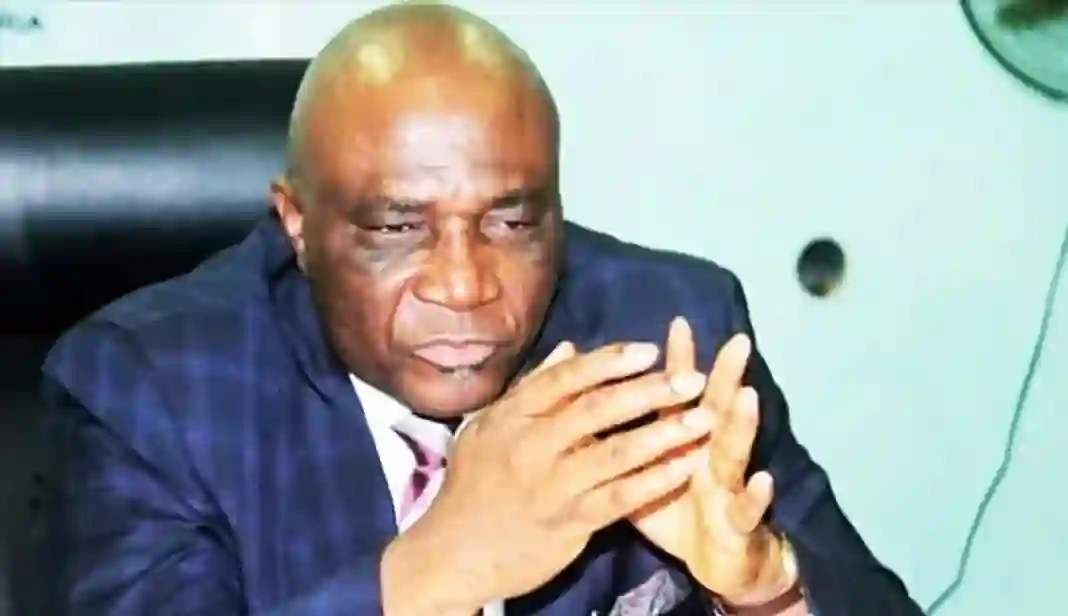
Nyesom Wike - FCT Minister

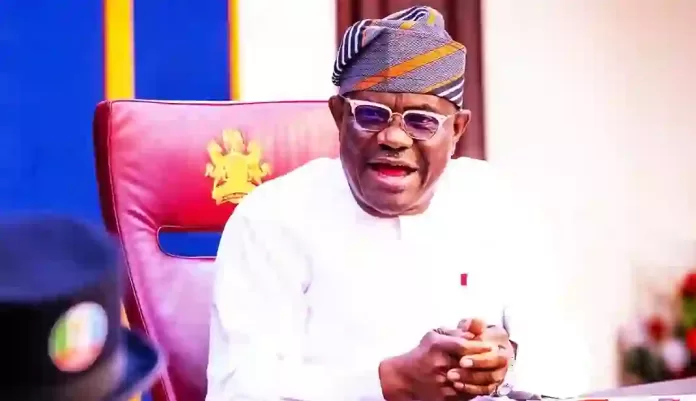
Amidst the ongoing demand for governance in the country by protesters Nyesom Wike, the Minister of the Federal Capital Territory, FCT, has appealed to Nigerians to dialogue with the government.

The minister made the appeal on Thursday following the nationwide protests by Nigerians under the aegis of #endbadgovernace, demanding from the Bola Ahmed Tinubu administration to end the economic hardship in the country.

The Source Magazine has reported that some civil societies organisation in the country had declared a 10-day protest to drive the demand home, for government to make life easy for Nigerians.

]The protest started today and has been spreading across the country including the FCT.

Recall also that the FCT minister had earlier warned that protest will not be allowed in the nation’s capital, and had also denied the prostesters’ demand to use the Eagle  Square as a place of convergence.

The minister’s actions have been widely condemned by Nigerians who said the Square is a public property and does not belong to the former Rivers state governor.

However speaking today while presenting staff of office to the four newly appointed graded chiefs of Karu, Kwali, Pai, and Yaba in the territory, the minister said the government is ready to dialogue with the protesters.

According to him peace is still the best option because “it is better to dialogue with the government and keep the peace,” adding that the Tinubu administration has not been well understood by Nigerians.

Wike said: “Let me take this opportunity to commend the people, the youths of Abuja for not being violent. We have said severally that it is better to dialogue with the government and keep the peace. He who makes peace will at the end of the day enjoy the dividends of peace. I still want to talk to our people that we are still ready to sit down and dialogue with them and let them know things that they may not know because information is power. I commend the protesters in Abuja who have refused to be violent.”

Meanwhile, the magazine learnt that more state governments are planning to follow in the foot steps of  Kano, Gombe, and Borno states which have already declared 24-hour curfew after the protests turned violent in their states.

Edo APC Asks Gov Obaseki To Account For Financial Support, Palliatives From FG

0
Godwin Obaseki
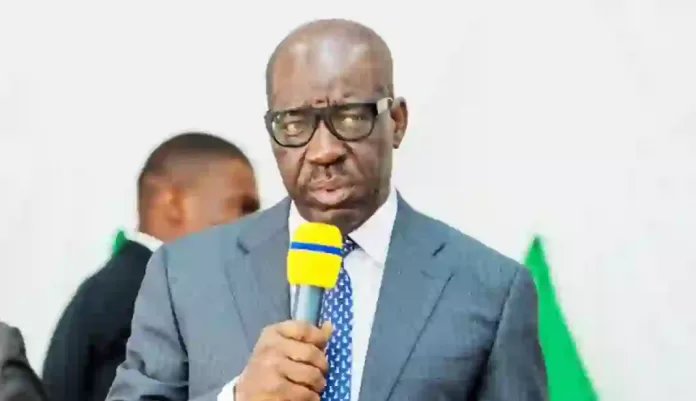
Governor Godwin Obaseki

By Ayodele Oni

The All Progressives Congress, (APC) in Edo state has accused Governor Godwin Obaseki of aiding diversion of food palliatives allocated to the state by the federal government.

The party was of the view that corrupt administration, bad agricultural policy coupled with  diversion of federal government palliatives are responsible for hunger in Edo State.

The allegations is coming amidst looting of bags of rice by protesters in Benin city on Thursday allegedly hidden at a private residence which belongs to the governor’s relative.

One of the protesters, in a viral video had diverted the attention of other protesters to a building, which belongs to one of the governor’s relations and they stormed the premises to loot bags of rice kept there.

The All Progressives Congress in a statement by the chairman, Jarrett Tenebe expressed concern over plan by Governor Obaseki and his faction of the People’s Democratic Party to frustrate the genuine efforts of the Federal Government to considerably reduce the impact of economic hardship on Nigerians, especially here in Edo State.

The governor was accused of refusal to account for the various financial grants and other palliatives his administration has received from the Federal Government.

“Instead, as usual, he wobbled and fumbled while struggling to blame his failure on his imaginary fictional story of plans by APC to attack government institutions in Edo State.

“For the avoidance of doubt, we are once again calling on Edo people to hold their governor, Godwin Obaseki responsible for the hardship in their state, including the collapse of physical infrastructures across the state.

“The various initiatives put in place by the Federal Government have been frustrated by Obaseki and PDP in Edo State. For instance, the FG extended relief in the transportation sector, where citizens from States without rail lines were directed to pay 50 percent of transport fares at selected private transportation companies in Edo State for a specific period.

“Obaseki collected the reimbursement from Federal Government for services that were not provided on the pretence of free ride by Edo City Transport Service.

“Like the ostrich, Obaseki has been one double-face so called economic expert in the vanguard that pushed for subsidy removal but later acted like chameleon that he has become, and has been demonizing President Tinubu for refusing to put easy money in the pockets of few Nigerians.

“Obaseki and his PDP in Edo State had earlier commended President Tinubu for the decision to remove fuel subsidy and floating of the Naira.

“The PDP had said that, the two economic policies were spot on, and that it is the best way to go round the economy that had been grounded before the present Federal Government came on board. The PDP position was voiced by Tony Aziegbemi, it’s state chairman.

“For clarity sake, the APC on behalf of Edo people are asking Obaseki to give account for the financial, sectoral and institutional support from the Federal Government, World Bank and other bilateral agencies.”

South-east Shuns Nationwide Protest On Day One, As Gov Uzodinma Preaches Restraint

0
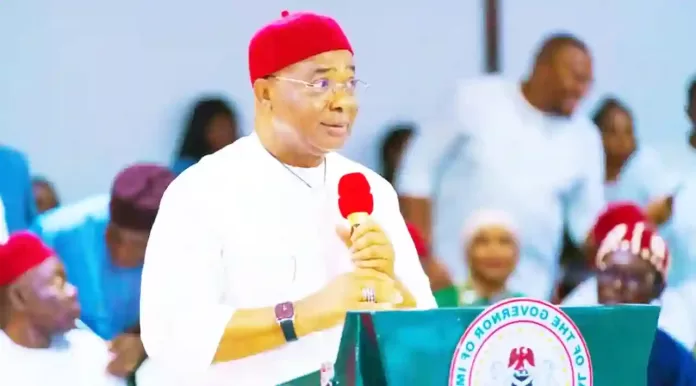
Hope Uzodimma- Governor of Imo State

By Suleiman Anyalewechi

On day one of the  #EndBadGovernance protest, the South-east region made good their resolve to shun the exercise.

The Source reports that in most parts of Abia, Imo, Ebonyi, Enugu and Anambra states, residents  preferred to remain indoors .

Their position to remain at home, it was gathered, stemmed more from being proactively  cautious.

But a few also opened their business premises for  normal activities,  amidst near empty streets and roads,  with a few vehicular traffic recorded .

In all, the region acted positively to earlier admonitions by its leaders and opinion moulders who had collectively and individually urged a refrain from the protest .

Most commercial banks, public offices and institutions were equally deserted.

Public and private educational institutions had, before now, been closed.

The people on their own had  exacted self  restraint on the grounds that such past protests resulted in them being made the sacrificial lambs.

The South-east Governors, Ohaneze Ndigbo, National Assembly members from the region, Community and religious leaders in the count down to the August 1 commencement date of the protest had all  called on the people not to participate in the exercise.

Much as they acknowledged the hardship in the land, and the right of the people to protest, they insisted that the exercise was prone to hijack by hoodlums.

Early Thursday morning, Governor Hope Uzodinma of Imo state and Chairman of the Southeast Governors Forum reiterated his earlier call for patience and restraint.

Writing on his official site after a meeting with stakeholders, the Imo state Governor appealed  for patience and understanding on the part of the people.

Rather than engaging in protest, he urged everyone to put heads  together on how to come  out of the present situation.

He wrote: “The economic challenges Nigerians face are complex and cannot be resolved within a year.

“However, with collective support and understanding, all can work towards sustainable solutions, navigate these trying times and emerge stronger as a nation.”

During the meeting with the State’s stakeholders, Governor Uzodinma also urged the people of the State not to participate in the nationwide protest.

He further expressed the fear that the protest may be hijacked by undesirable elements, which can lead to dire consequences for both the state and the country.

“My message is clear. President Bola Ahmed Tinubu is deeply attuned to the plights of our citizens. He has initiated numerous interventions and programmes aimed at providing immediate relief while laying the groundwork for long term solutions.

“These efforts demonstrate the Government’s commitment to addressing our concerns and improving our collective wellbeing.

“Therefore, I urge all stakeholders to convey this message of patience, trust in the Government’s plans to their constituents.

“This was the highlight of my engagement with various stakeholders in our state ,urging our people to reconsider participating the planned nationwide protest.

“I emphasised the potential dangers of hijacking the protest which could lead to unintended consequences ,despite their  legitimate right to peaceful protest” Governor Uzodinma wrote

#EndBadGovernance Protests Turn Violent As 3 States Declare 24-Hr Curfew

0
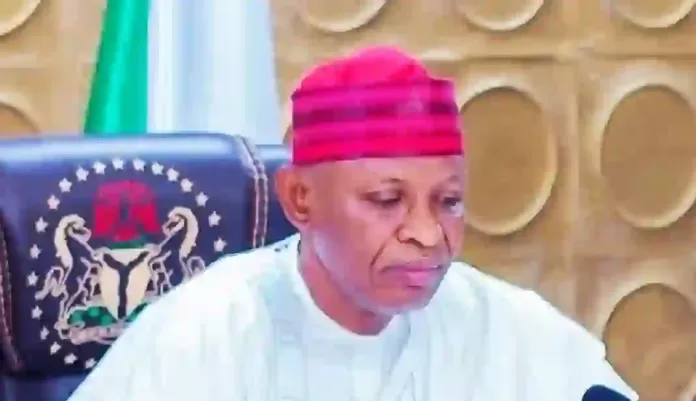
Governor Abba Kabir Yusuf

Three states have declared 24-hour curfew in view of the ongoing nationwide protest by Nigerians who are demanding good governance.

The states are Kano, Gombe and Borno where some protests have turned violent with the governments in those states saying the only way to contain the violent protest from spreading is the declaration of state of emergency.

Report claimed that some protesters have looted and destroyed public property apart from attacking security agencies in these states since the protest started today.

For instance, hoodlums were reported to have looted the multi-million naira National Communication Commission, NCC Industrial building in Kano State apart from destroying other public properties.

In response, Governors Babangana Zulum, Muhammad Inuwa Yahaya and Abba Yusuf of Borno, Gombe and Kano have declared 24-hour emergency citing their powers as chief security officers of their states.

The magazine reported that angry Nigerians have planned a 10-day protest from August 1-10 to call government’s attention to the economic hardship in the country which they blamed on the austerity measures imposed by the Bol Ahmed Tinubu administration.

The hunger protest tagged Endbadgovernance effectively started today in some states and it’s fast spreading to other parts of the country even as the government continue to appeal for calm.

Speaking on why the state of emergency was imposed, Governor Yusuf said the measure is necessary to restore order and peace in the commercial city, adding that the government must also protect lives and property apart from protecting government-owned institution.

According to governor Yusuf in a statement issued by his spokesman, Sunusi Tofa, the government would not allow the state to be taken over by anarchy.How We Spent 24 Years In Prison For A Murder We Didn’t Commit – Ex-inmates

0.00 / 0.00

Part of the statement said: “The imposition of this curfew is a necessary measure to restore order and ensure the safety of our communities.

“It is paramount that we protect our citizens from further harm and preserve the sanctity of our state’s institutions and businesses,” he said.

“Let us not allow the actions of a few selfish individuals to divide us.

“Together, we can navigate these challenges and fortify our resolve to build a stronger, more resilient Kano State,”

PSC Promotes 7,194 Police Inspectors To ASP

0
Nigerian Police

By Ayodele Oni

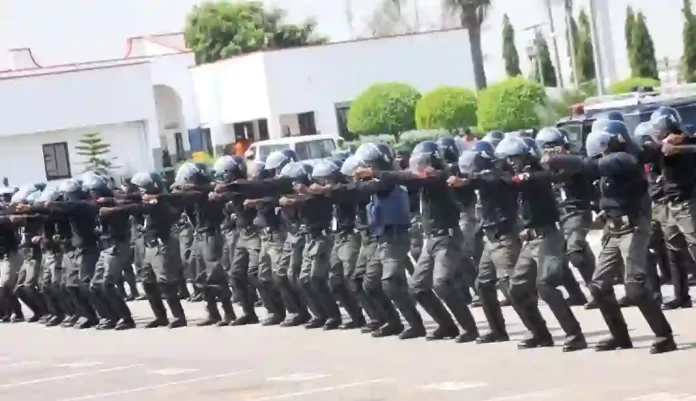
The Police Service Commission, (PSC) has approved the promotion of 7,194 Inspectors of Police to the next rank of Assistant Superintendents of Police, ASP II.

This was contained in a Press Statement signed by Head, Press and Public Relations, PSC, Ikechukwu Ani in Abuja.

The officers were products of the recently concluded Inspectors Board interview which took place in all the Police Zonal Command Headquarters in the country.

He noted that Nigeria is currently undergoing some positive restructuring which may have come with temporary discomfort and people’s anger, but called on the Officers to join hands in ensuring that the nation’s nascent democracy is preserved.

The chairman promised that the Commission will continue to ensure that promotions in the Nigeria Police Force are timely and predictable.

Argungu however cautioned  that this gesture should however not be taken for granted as the Officers must reciprocate by conducting themselves within established laws and ensuring that banditry and terrorism are eliminated.

The Commission’s approval has been conveyed to the Inspector General of Police, Olukayode Egbetokun for implementation.

Fears, Panic Trail Nationwide Protest In Kano, Other Northern States As Looting, Vandalization Reign

0
EndBadGovernance Protest

By Suleiman Anyalewechi

Strong indications have emerged that unless the organizers of the ongoing nationwide #EndBadGovernance protest, stakeholders and security agencies produce uncanny dexterity in crowd control and crisis management, the exercise is poised to produce unintended results in most parts of Northern Nigeria.

Fears are rife, that the much touted peaceful protest, may snowball into violent demonstrations when the people congregate for the Jumat prayers on Friday.

The high apprehension of   possible violent eruptions are premised on the high level of hunger and general hardship among a larger part of the populace.

Not a few are doubting the abilities of both the protest organizers and security agencies to manage the situation, post Friday prayers.

Already, on day one of the protest was overshadowed by invasions, vandalizations and outright looting of some public facilities by mostly hunger-ravaged participants .

More of such hunger- induced wanton destructions are expected from day two, unless there is a change of approach and/or an outright suspension of the protest.

In Kano on Thursday, protesters vented their frustrations on the multi million naira National Communication Commission NCC-ICT edifice.

The building just awaiting commissioning was raided bare by scavenging protesters.

An attempt was also  made to penetrate the Kano State seat of power, just a  trekking distance by same protesters. They were resisted by Security Agents.

Elsewhere, economic activities, both private and public, bore the brunt of day one of the protest march in the commercial centre of  Northern region.

On his official site ,the Minister of Digital Economy Bosun Tijani, lamented the destruction of the NCC building located on State Road Nassarawa area of Kano .

He described the vandalization as a huge set back to efforts to empower the youths through technology.

“Sad to learn that our Digital Innovation Park in Kano slated for launch next week to support our technical talent accelerator (3MTT) has been set ablaze and looted by protesters .

“Along side #3MTT, this building is set to host our  buildathon holiday maker programme for secondary school kids starting next week.

“A slight setback for our journey to deepen our workforce for technology while creating job opportunities for the youths. Millions of Naira down the drain”, the Minister lamented .

The Kano State Police Command said about 13 persons have been arrested for alleged destruction and vandalization of some vehicles at the High Court premises.

The Commissioner of Police, CP Salma Dogo Garba, who announced the arrest, also, noted that some proactive measures are in place to guarantee the protection of lives and properties of residents.

“The police in collaboration with sister security agencies are conducting intensive patrols to guarantee the safety of the residents and protesters.

“The collaboration aims to maintain law and order in the state during the duration of the protest.” CP Garba stated.

Nonetheless, the police ,and other Security Agencies may have to think out of the box to be able to contain the situation, particularly the one that may be presented before, during, and after Friday prayers.

Ondo Collaborates With Investors To Revive Ailing Industries

0
Lucky Aiyedatiwa

By Ayodele Oni

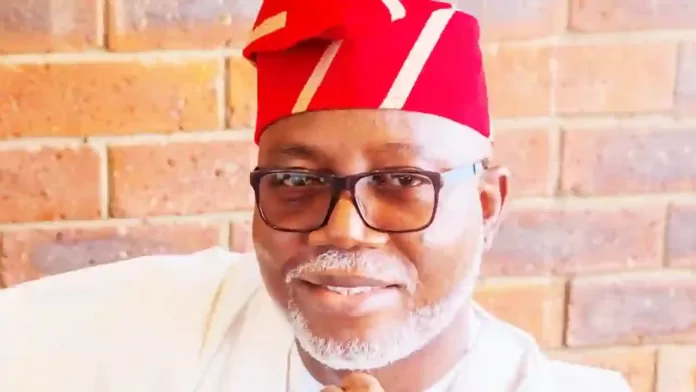
Ondo State Governor, Lucky Aiyedatiwa, has disclosed his administration’s engagement with investors to revive ailing industries in the state.

According to a statement by the Chief Press Secretary to the governor, Ebenezer Adeniyan, those to be affected are Ifon Ceramic Company, Okitipupa Oil palm, bitumen exploration and other moribund industries in the State.

The Governor said the decision to revive the companies is hinged on the determination of his administration to provide employment opportunities for the youth and enhance the economy of the State.

This is in addition to the ongoing efforts to reach agreement with other investors in developing the Sea Port, bitumen exploration and waste to energy initiative.

The Governor disclosed this in Akure, during a consultative meeting with religious leaders in the state.

Aiyedatiwa, who briefed the clergymen on the activities of his administration so far, thanked them for their support and prayers, as well as their contributions in maintaining peace and tranquility in the State.

The Governor emphasized the importance of peaceful coexistence among residents and stressed the need for dialogue in resolving the current economic challenges facing the nation and its people.

“We must prioritize dialogue to address the economic challenges facing our nation and its people. In light of global economic realities, it’s crucial that we increase production to help lower the high prices of commodities.”

In response, the Chairman of the Christian Association of Nigeria (CAN) in the state, Anselm Ologunwa, expressed gratitude to the governor for organizing the meeting and recognizing the contributions of religious leaders.

“Thank you, Mr. Governor, for convening this meeting and for the recognition given to religious leaders.

“It is important that we understand the root causes of the current challenges we face. We appreciate the palliative measures provided to us and acknowledge the government’s efforts in advancing our state.”

#EndBadGovernance: Thousands Of Youths Join Protest In Rivers, Shops, Offices Under Lock

0
EndBadGovernance Protest In Rivers

By Akinwale Kasali

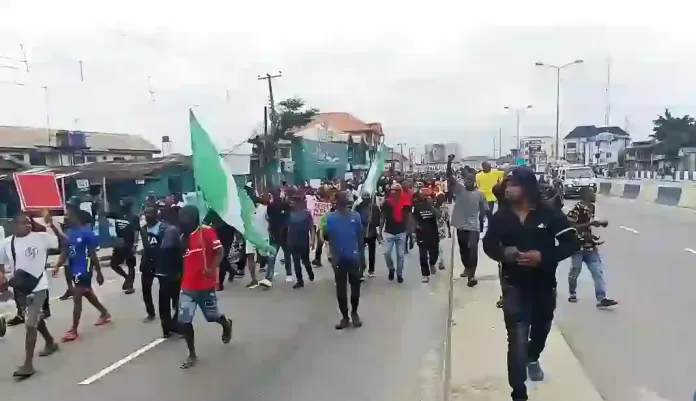
Thousands of enraged youths stormed the streets of Port Harcourt, the capital of Rivers State, on Thursday to express their displeasure with Nigeria’s current economic situation under the leadership of President Bola Tinubu and his policies.

The aggrieved youths carried placards with different inscriptions, and wrapped themselves with the Nigerian flag. They called an end to bad governance and blamed the Federal Government and the All Progressives Congress Federal Government for the current economic woes bedeviling the nation.

The inscriptions on the placards read: “We deserve better governance not corruption,” “Nigerians are dying daily, let us take it back,” and “we are saying no to high fuel prices, food prices, hunger, and bad governance”. They began the protest around the Rumuola axis of the Port Harcourt-Aba motorway and ended at the Government House.

The protesters stated that they were not protesting against the State Governor, Siminalayi Fubara, but against the Federal Government.

Spokesperson for the protesting youths stated: “We are not here to protest Governor Fubara; rather, we are here to protest Tinubu’s bad government; we want Tinubu and Akpabio to resign.”

Addressing the crowd, the Governor urged the youths to be peaceful. He, however, expressed fear that the peaceful protest could be hijacked by enemies of the State, and urged them to be civil and peaceful with their protest.

He, however, promised to relay the youths’ concerns to  President Tinubu.

OPINION: I Wish The President Could Heed To Those Words

0
Bola Ahmed Tinubu - President
President Bola Ahmed Tinubu

By Emeka Asinugo, KSC

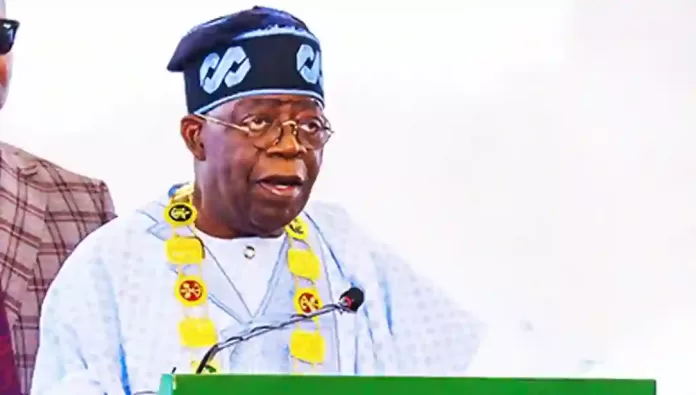
In a public statement trending in the social media and purportedly made by President Ahmed Tinubu to his “fellow Nigerians” it was said in part: “I stand before you today with a heavy heart, but also with hope and determination. Our beloved nation faces unprecedented economic challenges that demand bold and decisive action. As your President, I am committed to leading by example and making the difficult decisions necessary to put Nigeria back on the path to prosperity”.

The idea of the Nigerian President delivering such a speech, full of bold reforms and unwerving commitment to national sacrifice, as the viral social media post portrayed, naturally stirred the imaginations of many Nigerians. Many rejoiced in the belief that the days of “can any good thing come out of Nazareth?” were over, and that the peoples’ Messiah had arrived at last. Others called for caution, wondering what the Jargaban was up to this time.  But before the dust settled, the speech was confirmed as a fabrication by Chief Bayo Onanuga, a senior adviser to President Bola Ahmed Tinubu.

All the same, the situation once again raised critically sensitive questions concerning the art and science of governance in Africa’s most populated country, the challenges that Nigerian politicians face in trying to implement genuine reforms, and the yet to-be-tapped potential for transformative leadership.

In that fabricated speech, it was imagined that President Ahmed Tinubu announced a series of radical measures aimed at cutting down on the cost of governance, promoting fiscal responsibility and revitalizing the economy. Those measures included a 50% reduction in presidential salaries, the abolition of the Office of the First Lady, the sale of redundant presidential aircraft, consolidation of 36 government ministries, restoration of fuel and electricity subsidies, and mandates for government officials to use only locally manufactured products, including automobiles. Other steps the government was to take included a drastic reduction in the number of advisers to political appointees, the implementation of e-governance, renegotiation of government contracts, performance-based budgeting, a freeze on non-essential foreign trips, and a ban on foreign medical trips and treatment for all government officials, including the Presidency.

To all intents and purposes, those proposed measures were comprehensive and they addressed both the symptoms and root causes of Nigeria’s governance and economic challenges. In fact, the enthusiasm generated by the fake speech reflected the deep yearning among Nigerians for genuine leadership and tangible change in the way things were done in the country. The response from the government, dismissing the speech as a fabrication, merely spiked the scepticism and frustration many Nigerian citizens feel towards their leaders. The quick denial from the Presidency actually underscored the complexities and challenges that were inherent in actualizing such drastic but welcome reforms.

The current Tinubu administration, like many before it, will continue to face significant hurdles to implement meaningful reforms. For our convenience, we can categorise these hurdles into political, economic, social and structural challenges. For example, one of the most significant barriers to reform in Nigeria is the presence of deeply entrenched interests. These include political elites, business magnates and various power brokers who benefit from the status quo. Any attempt to disrupt the existing order often meets with strong resistance from these groups.

Another hurdle is official corruption. Corruption in Nigeria remains one of the most pervasive problems that affect all levels of government and society. Efforts to combat corruption have always  been inconsistent and surprisingly often compromised by those who were supposed to enforce the law. The emphasis on fiscal responsibility and transparency made in the fake speech actually struck at the heart of this issue. But Nigerian governments have ineffectively continued to battle the evil because of the value system the politicians put in place in the society. In addition to that, Nigeria’s political landscape is characterized by unpredictable changes in leadership, by electoral disputes, and at times, by violent conflicts. This instability makes long-term planning and consistent policy implementation quite difficult. Reforms require a stable and predictable political environment, and this has, unfortunately, been elusive in Nigeria.

Again, Nigeria’s economy is heavily dependent on oil revenues, which makes it vulnerable to global oil price fluctuations. This dependency has more or less stifled the growth of other sectors and made economic diversification difficult. The hypothetical speech, for example, makes a case for the restoration of fuel subsidies. While this would definitely be popular with the people of Nigeria, it would require careful balancing to avoid worsening the country’s fiscal deficits. Indeed, Nigeria’s debt levels have been rising over time. Significant portions of the budget are allocated to debt servicing. This, and the bloated cost of governance, limit the government’s ability to invest in critical infrastructure and social services. Any reform agenda, therefore, must address this debt burden to free up resources for development.

Bayo Onanuga
Bayo Onanuga

We will not gloss over the prevailing high inflation rates and unemployment levels either. They are the persistent issues that enhance poverty and inequality. Addressing these problems requires comprehensive economic policies that will stimulate job creation and control inflationary pressures. Nigeria is a huge country with about 250 ethnic groups and tens of religious affiliations. These divisions often lead to tensions and conflicts, stretching policy implementation and  governance. Building a sense of national unity, as the fake speech suggests, is crucial and challenging. The trust level between the government and the citizens should be substantial enough to allow both work in harmony for the good of everyone. But years of unmet promises and high levels of corruption succeeded in eroding the confidence of the people in their government. Rebuilding this trust requires not just promises but visible and sustained actions.

Nigeria’s infrastructural facilities, its educational institutions, the roads leading from rural producing to urban consuming areas, the power supply and healthcare facilities are all obsolete and unsupportive of its steadily growing population. The situation is seriously impeding economic growth and the delivery of public services. The focus of the hypothetical speech on reducing non-essential expenditures to fund critical infrastructure is a step in the right direction that requires substantial investment by government. And since the public sector is often characterized by inefficiency and red tape, implementing reforms such as e-governance to streamline operations and improve efficiency, as suggested in the speech, is essential and challenging in practice.

Despite the clear need for reforms, successive Nigerian governments have struggled to implement what they see as necessary. Several factors contribute to this difficulty.

First is that political leaders often focus on short-term gains and electoral cycles rather than long-term national interests. This myopic view leads to policies that are more about winning elections than solving fundamental national problems. Genuine reform requires strong political will and courage to confront powerful vested interests. Many leaders lack the determination to take on these challenges, and rather prefer to flow  with the tide and maintain the status quo.

One other factor is that the institutions responsible for implementing reforms in Nigeria are often weak and under-resourced. Strengthening these institutions is a prerequisite for any successful reform agenda. Some reforms, particularly those involving subsidy removal or austerity measures, can lead to public backlash. Managing this resistance requires effective communication and measures to mitigate the impact on vulnerable populations.

President Tinubu, like any Nigerian leader, has the opportunity to seize the moment and make a lasting impact, create a lasting name for himself. Tinubu no longer needs money. He has enough. With properties scattered around the world and an oil refinery in Malta, what other money is he looking for? He only needs to consolidate his name. He needs to carve his name boldly in gold letters in the history of this country. The hypothetical speech outlines a roadmap for transformative change that, if implemented, would address many of Nigeria’s pressing issues to his credit. And there are more reasons why President Tinubu should consider embracing such bold reforms as the fake address suggested.

Such significant reforms would cement President Tinubu’s tenure in history as a leader who rose to the occasion and made tough but necessary decisions for the good of the nation. Addressing the economic challenges head-on would lead to a more stable and prosperous Nigeria, thanks to the good and sensitive leadership of the Jargaban. We know that Nigeria’s economic stability is essential for attracting investment, creating jobs, and improving living standards. Therefore, bold actions that demonstrate a commitment to transparency, accountability, and national unity would help government rebuild public trust and foster a sense of collective purpose. A reformed and prosperous Nigeria would enhance its standing on the global stage, attracting more foreign investment and playing a more influential role in international affairs.

While the speech attributed to President Tinubu remains a fabrication, it epitomises the hopes and aspirations of many Nigerians for a better future. It highlights the urgent need for comprehensive reforms to address the country’s political, economic, social and structural challenges. While the road to reform is full of obstacles, the potential rewards are immense. President Tinubu, and indeed any Nigerian leader, has the opportunity to chart a new course for the nation. By embracing bold reforms like the ones mapped out by the fake speech, and demonstrating genuine leadership, President Tinubu can transform Nigeria into a more prosperous, united, and resilient country. The time for action is now, and the responsibility lies with both his government and Nigerian citizens to work together towards a brighter future. Looking back at that trending speech, by God, I just wish President Tinubu could heed to those words.

The Price We Pay When Legislators Die

0
Azu Ishiekwene
Mr Azu Ishiekwene

By Azu Ishiekwene

We met last on April 21. I went to Asaba from Lagos to promote my new book, Writing for Media and Monetising It, at Delta State University, which, according to JAMB statistics, is one of the country’s highest subscribers to Mass Communications in 2021.

Senator Ifeanyi Ubah was on the flight to Asaba that morning. I didn’t see him until we entered the arrival hall. He seemed to have added some weight for a man his height. I teased him about hisrobustly prosperous looks.He replied that journalists like me tend not to add weightbecause we’re too busy causing trouble, to which I replied that he should not go there.

We laughed and parted ways outside the terminal building. And then,on July 26, news broke that he had died only days after arriving in London. A few days earlier, he shared a video of himself looking slimmer than when I saw him in Asaba in April. He videoed himself singing ona London street with his family, and everyone looked happy.

Gone too soon

He was 52 and only reelected to the Senate last year under the Young Progressives Party (YPP) platform before he defected to the ruling All Progressives Congress (APC).Ubah was the fourth member of the current National Assembly to die this year, bringing to 29 Federal lawmakers who have died in office from 2015 to date.

The others who died this year were Isa Dongoyaro, APC member of the House of Representatives representing Garki/Babura Federal Constituency, Jigawa State, who died on May 10; Ekene Adams of the Labour Party, representing Chikun/Kajuru, Kaduna State, who died on July 16; and APC member MusiliudeenAkinremi, representing Ibadan North Federal Constituency, Oyo State, who died on July 10.

It’s not just the number of deaths that is striking. None of all four legislators who died in office this year was up to 55. The outlier was the Federal legislator Abdulkadir Jelani Danbuga, an APC member from Isa/Sabon Birni, Sokoto State, who passed away in October at 64. He diedthree months after he was sworn in, bringing the total dead in one year to five.

At 52, Ubah was the oldest federal lawmaker who died in office this year. Dongoyaro was 47; Adams 39; Akinremi 51.

By life expectancy projection, you could argue that for a country with a life expectancy of 52 years, the average age of the deceased legislators shouldn’t be too unusual.Yet, if a company specialises in life policies for lawmakers, the recent events may force it to review its premium.

Beyond the numbers

There are 469 lawmakers in both chambers of the National Assembly, with the states proportionally represented in the Senate. Representation in the House of Representativesis based on population (favouring the North), among other factors.

However, the constitutionally provided numerical advantage for the Northonly partially explains the higher proportion of legislators who died in office from the regionsince 2015.

When I raised the trend of sitting legislators dying at relatively your age, one immediate response was that it’s the prayers of discontented, ordinary citizens at work. Divine recompense, if you like. Why wouldn’t the discontents come out to vote or hold their representatives to account instead?

I have only anecdotal evidence to support my theory, but the trend elsewhere does not support the view that the deaths of our lawmakers in office are the outcome of spiritual warfare. If religion or culture plays any role at all, it reinforces conditions that not only potentially increase the chances of early deaths but also increase the casualties among the affected population.

Different elsewhere?

What do the statistics elsewhere show? According to the Congressional Research Service, 84 U.S. Congress members – 69 Representatives and 15 Senators – died in 39 years between 1973 and 2012. The average life expectancy was 72, similar to that of white males in the larger population.

In 2015, relevant data about members of the British House of Commons between 1945 and 2011 showed that mortality among the 650 members was 28 percent lower compared to the general UK population. The figure in South Africa showed that in its Fourth Parliament 2009-2014, out of 103 members of parliament replaced, 18 passed away, four of them in car accidents.

The common causes of death in these countries range from coronary artery disease to cancer, especially in the U.S. and the UK, to complications from HIV/AIDS in South Africa to diabetes, kidney-related diseases and accidents.

Because of the availability of data in these countries, it is possible to determine the cause of death and take steps to enhance safety, well-being, and longevity. It’s different in Nigeria, where disclosing the cause of death is treated as taboo.

Cost of taboo

The norm, not just in the legislature but in the broader population, is not to discuss it – an attitude more prevalent in the predominantly Muslim North, where deaths are accepted as “the will of God”, and any discussion of a post-mortem is out of the question.

Such cultural attitudes, reinforced by religion, tend to encourage poor record keeping and further nudge the population to ignore pre-existing health conditions in the fatalistic belief that “something must kill a man” when early detection or greater care could have prevented fatality. A cultural taboo that is useless to the dead and increasingly expensive for the living needs to be reviewed.

It’s bad enough that sometimes bereaved families have to bear the avoidable losses of loved ones. In the case of legislators, the death of sitting members also has consequences for the constituents and the electoral management body. The constituents are deprived of representation, and the electoral management body has to conduct by-elections.

In the last election cycle in 2023 alone, N335 billion was budgeted for elections. Still, that sum, later supplemented with N18 billion due to inflation, was not entirely for the general election but also for by-elections that have become a norm.

Court-determined results, political appointments, and, increasingly, deaths have increased legislative turnover and turned the Independent National Electoral Commission (INEC) into one of the world’s most overworked and undervalued election management bodies. It’s a thankless job.

New approach

We can’t continue this way. Small changescould start with journalists understanding that it is vital to get and include the cause of death in their reports instead of allowing prevailing taboos to take them hostage. Of all five deaths, including Ubah’s, there was not a single case in which the press reported the possible cause of death.

The data of consequential deaths for Nigerian lawmakers cited earlier do not include deaths of sitting members in state houses of assembly, seven of which occurred in the last nine years, bringing the total recorded in that time to 36.

Knowing the cause might not raise the dead; it might help the living take greater care.

The process for replacing dead legislators also needs to be reviewed. We have a system that makes everything expensive and unnecessarily complicated. The Constitution stipulates a by-election on top of other by-elections to fill vacancies for political appointees and court-ordered reruns. Three senatorial by-elections in any state are equivalent to the cost of a governorship election.

Beyond the tears

One way to reduce such unnecessary costs is to use the example of Germany, New Zealand or South Africa, where the next candidate on the party’s list takes the deceased’s place. Or to allow the party to nominate the replacement for the deceased since a candidate holds the seat at the party’s pleasure.

Beyond the tears of this mourning period, we should find a sustainable way to fill parliamentary vacancies. That’s one way to honour the memory of Ubah and the other dead members of the National Assembly.

Ishiekwene is the Editor-In-Chief of LEADERSHIPand the author of the new bookWriting for Media and Monetising It