



By Valentine Obienyem

There are evidently several factions within the opposition calling for Peter Obi’s political head. They differ in methods, intensity, and motivation, but they share a common objective: to diminish his influence and halt his growing acceptance among Nigerians.
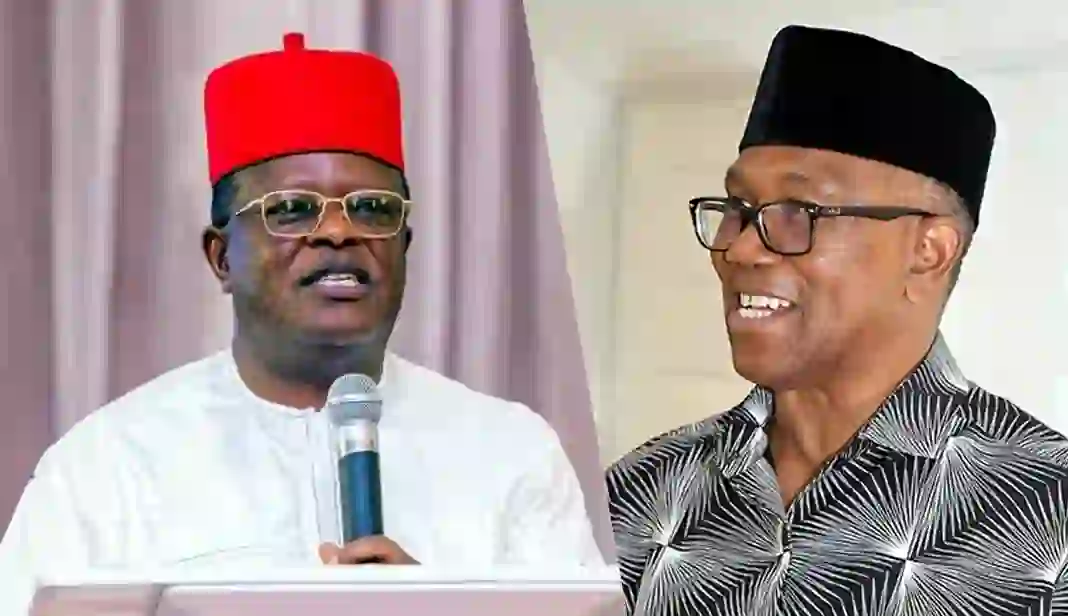
The most significant faction, however, is the one led by Engr. Dave Umahi. Unlike the others, this group appears to believe that Obi must not merely be opposed; he must be politically annihilated – they seek nothing less than a knockout blow. Every opportunity becomes an occasion to diminish his achievements, question his integrity, or weaken his appeal before the public.
Engr. Dave Umahi is the former Governor of Ebonyi State and the current Minister of Works. Few Nigerian politicians display such acute sensitivity to another politician’s popularity as he does towards Obi. He appears deeply troubled by Obi’s growing acceptance and seems determined to seize every opportunity to undermine it. Umahi has become notorious for his habitual truculence in controversy. His personality, alas, appears wholly ungovernable. He is painfully sensitive to criticism and bears opposition with little patience, as though disagreement itself were an offence. He seldom entertains the possibility that he might be wrong. Such traits, which some people term arrogance, naturally provoke strong antipathy from those who encounter him.
His public language towards Obi has often been unusually harsh. Rather than engaging with Obi’s arguments, he frequently resorts to sweeping denunciations and invectives, giving the impression that he is confronting an existential enemy rather than a political opponent. This hostility did not begin today.
In 2019, when Alhaji Atiku Abubakar selected Obi as his running mate, Umahi stood prominently among those who vehemently opposed the choice. Even members of his administration who openly identified with Obi found themselves under immense pressure. His Chief Press Secretary at the time, who happens to be a personal friend of mine, faced severe victimisation and hardship for daring to show support.
I recall accompanying Obi on a visit to Umahi in Abakaliki in 2019. At one point, Obi asked me to bring a bag from his vehicle, which he presented to Umahi. As Umahi escorted us out, he aggressively impressed upon Obi the need to extend similar bags to a list of names he mentioned. Watching that scene play out, I completely wrote him off from that day forward.
As we drove away, I remarked to Obi that I had expected South-East governors, particularly those within the same political family, to support his vice-presidential aspiration through concrete, collaborative efforts rather than looking for bags whose contents, I am sure, eventually ended up in their own houses.
Anyone who carefully observes Umahi’s public appearances cannot fail to notice the burdened, agitated manner in which he often speaks. One can see it in the twitching of his cheek muscles and the constantly changing expressions on his face. His interviews frequently contain glaring contradictions, a due quota of nonsense, exaggerations, and statements that are incredibly difficult to reconcile. One is often left wondering whether raw passion has completely overtaken rational reflection.
Recently, he challenged Obi to a public debate. Someone should gently remind him that he has yet to conclude the debate he earlier proposed with Barrister Nyesom Wike. Those two men – coins of the same mould – appear to operate on the exact same wavelength and would undoubtedly understand each other much better.
Ultimately, public life rewards neither loudness nor invective. It rewards character, consistency, and credibility. These are qualities that cannot be manufactured by propaganda, nor can they be destroyed by abuse. They are earned over time through steadfast conduct. It is on that ground that every public figure, including Peter Obi, Dave Umahi, and indeed every aspirant to leadership, must ultimately be judged.
Shall we recapitulate the latest major scandal, among many, in which he has emerged? In early 2026, a major controversy erupted when businesswoman and supplier Mrs. Tracyniter (Tracy) Ohiri publicly accused the Minister of Works, Dave Umahi, of outstanding debts totalling over ₦200 million for campaign promotional materials she supplied during his 2014 governorship bid. Alongside the financial claim, Ohiri levelled explosive allegations of sexual harassment, claiming that during a business trip to Ebonyi State, Umahi had improperly entered her hotel room wearing only a towel and demanded sexual favours in exchange for settling his debt. Umahi has denied these allegations. Regardless of their eventual legal or factual resolution, the controversy has further intensified public scrutiny of his conduct and public image.
This controversy, much like his often combative political style, reinforces the sharp contrast many perceive between Umahi’s approach to politics and the movement Peter Obi represents. While one relies heavily on confrontation and aggressive political rhetoric, the other has built his appeal largely on public perception of prudence, restraint, and accountability. In the final analysis, history is a patient judge. Long after the echoes of political invectives have faded and concrete monuments have begun to weather, it is character, dignity, and genuine reverence for the people that will endure. Dave Umahi may continue his quest to deliver what he considers a political knockout blow, but he may yet discover that enduring political ideas are not easily extinguished by persistent attacks.
Discover more from The Source
Subscribe to get the latest posts sent to your email.