



By Wole Olaoye

Candidate Bola Ahmed Tinubu is formidable enough without the presidential halo. Now, with all presidential powers at his command, he has to be considered a frontrunner in the forthcoming elections. But there are headwinds signalling the fact that although he is redoubtable, he is not unbeatable.
The problem with many of his opponents over the years is that they took him for granted. Part of that mindset is demonstrated when the opposition relies on rehashed stories of Tinubu’s failings to sway the electorate instead of presenting alternative programmes to some of his manifestly unpopular policies.
Dream Ticket
The way things stand at the moment, none of the other presidential candidates has enough gravitas to unseat Tinubu. The ruling APC is the only party that has unveiled its campaign structure and rolled out its vote-catching machine. All the opposition parties have barely 83 days to overtake the current order.
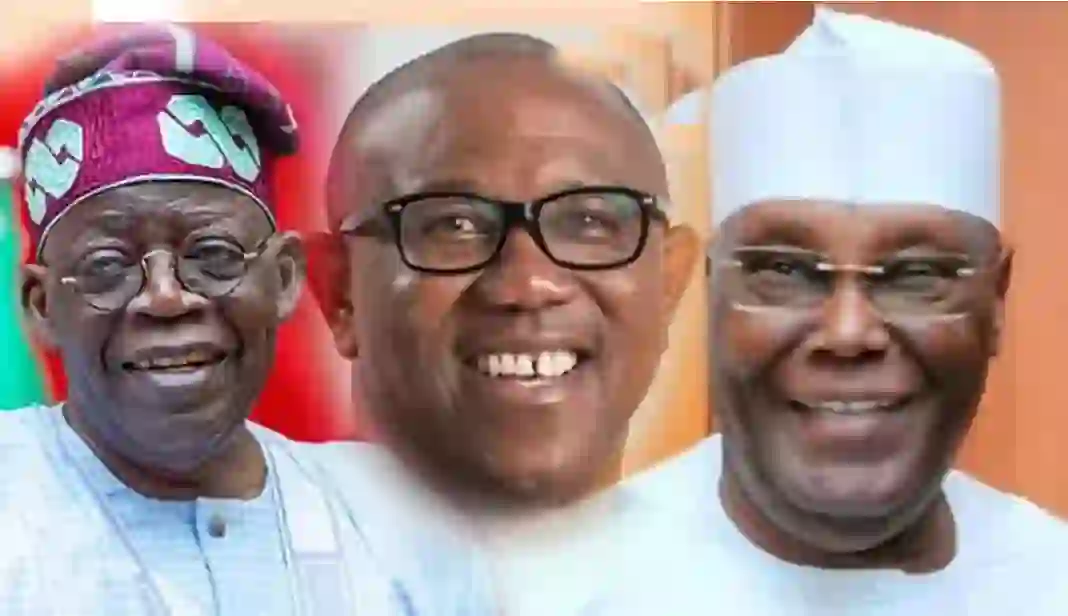
Where the game will begin to appear interesting is if, as I argue later in this piece, Atiku Abubakar of the ADC and Peter Obi of the NDC team up to present what Anti-Tinubu elements have described as a dream ticket.
In 2023, the opposition vote was split among the PDP, Labour Party (LP), and NNPP. A unified ticket between Obi and Atiku could pool their substantial voting bases—bringing together Obi’s strong momentum in the Southeast, South-South, and urban youth demographics alongside Atiku’s established political machinery and influence across parts of the North.
Under the Nigerian Constitution, a winning candidate must secure a plurality of votes and at least 25% of the votes in two-thirds of the states (24 out of 36) plus the Federal Capital Territory. A dispassionate assessment of the current state of affairs shows that neither Obi nor Atiku can singlehandedly attain this threshold.
The most significant hurdle in any merger would be deciding who takes the presidential slot. If Atiku heads the ticket, it might alienate Obi’s supporters in the Southeast and many reform-minded voters who view Obi as a symbol of structural political change. If Obi heads the ticket, it could face friction from impatient traditional northern political elites who can’t wait for power to return to the North.
The accepted wisdom in political circles is that 80-year-old Atiku cannot conceivably accept being vice president to Obi, while Kwankwaso will rue being left out in the cold in the event of an Atiku/Obi ticket. It’s all about self-interest. Until the elections come and go, you cannot vouch for where some of the major players will eventually cast their lot.
The recent gathering of anti-Tinubu elements in the G-100 is a significant development. The coalition has tried to bypass direct ego clashes by setting up joint legal and media committees to manage expectations, but individual loyalists often pressure their preferred principals not to compromise.
Local Firefights
While national opposition leaders negotiate a mega-coalition in Abuja, local state chapters operate under entirely different survival tensions. In many states, opposition parties (such as factions of the PDP, SDP, and ADC) are fierce rivals at the local level. If a national coalition mandates that a specific party yield its structure in a particular state to accommodate another coalition partner, local party executives often rebel, leading to localised anti-coalition friction or secret parallel alignments.
An example of how local politics and personal ambition affect loyalty can be seen in the case of the former deputy senate president, Ovie Omo-Agege, who defected to the National Democratic Congress (NDC) after he officially quit the All Progressives Congress (APC) in May 2026. Internal friction and ticket rivalries within the APC played a central role in his defection to NDC, whose flag he will be flying in the race for the Delta Central Senatorial District in 2027.
The looming ghost of tribal/geopolitical manoeuvres cannot be discountenanced in the calculus. If the wishes of many northern opposition elements were horses, Peter Obi will subordinate his ambition to Atiku and agree to play second fiddle. As already stated, an alliance of the two leaders would fundamentally reshape the political landscape, presenting a formidable challenge to President Tinubu and the ruling All Progressives Congress (APC).
But diehard Obi supporters will not be receptive to their hero reverting to the role of a spare tyre. Obi is the most credible face of the Southeast in the current electoral race. The Southwest has multiple notable aspirants, including President Bola Tinubu, Prince Adewole Adebayo and Governor Seyi Makinde, while the Northeast features figures such as Atiku Abubakar and Mohammed Hayatuddeen. The South-South has Rotimi Amaechi. The North-Central and Northwest regions are yet to produce strong frontline contenders.
Perhaps the three regions in the North are strategically avoiding multiple aspirants to prevent vote splitting?
Northern Wind
There are other strategic machinations in the mix. If you have your ears to the ground, you will hear the whispering campaign in the north of a plan to encourage political attrition between the southwest and southeast so that while the Yoruba and Igbo Turks of the south are at each other’s throats, the northern elite can perfect their plan of installing one of their own in power.
It sounds so childishly pedestrian at first until you re-analyse the verbal effusions of one of the perennial appointees whose definition of the ‘North’ is “I, Me and Myself”.
The Northern Elders’ Forum and other such bodies who could have led the way in campaigning for their elected governors to banish the almajiri system (which hides under the cloak of religion to legitimise destitution), and other social drawbacks in the region are suddenly awake in this season of political horse-trading. Their critics are asking where they were when Buhari was running for a second term after his uneventful first leg.
There will always be jostling for elbow room between various ethnic nationalities, but I think the Yoruba and Igbo wouldn’t be foolish enough to swallow the bait of seasoned provocateurs determined to drive a wedge between them. Elections will come and go. People will remain.
The same admonition goes to the fake reprisalists in the north, who are always ready to justify ethnic cleansing and forceful takeover of other people’s ancestral lands in the name of revenging some ancient indeterminate wrongs done by the routed victims. In this season of electioneering, we are seeing how some people are digging up their demons from infernal depths in the name of political strategy.
Difficult as it may seem, the opposition should either come together to put their best combination forward or be prepared to lick their wounds as disparate vanquished wannabes.
Outcome
There are two possible outcomes:
(a) If the election were contested under the existing multi-candidate dynamic (APC, PDP, LP, NNPP), despite economic headwinds, President Tinubu and the ruling All Progressives Congress (APC) can secure a national plurality even with a reduced vote share, dependent on state spread requirements.
(b) If major opposition figures (Obi, Atiku, Kwankwaso, Adebayo, or a broader coalition platform) successfully present a single consolidated ticket, they would have aggregated core voting blocs across the South-East, South-South, urban centres, and northern strongholds, creating a direct head-to-head race with a real possibility of an opposition victory or, at worst, triggering Nigeria’s first-ever presidential run-off.
Discover more from The Source
Subscribe to get the latest posts sent to your email.