



By Valentine Obienyem

Seneca was a notable philosopher who lived under Emperor Nero. He preached ascetic virtues but was accused of accumulating enormous wealth. Being a man of letters capable of defending himself, Seneca wrote: “I persist in praising not the life that I lead, but that which I ought to lead. I follow it at a mighty distance, crawling” – of which of us is this not true?
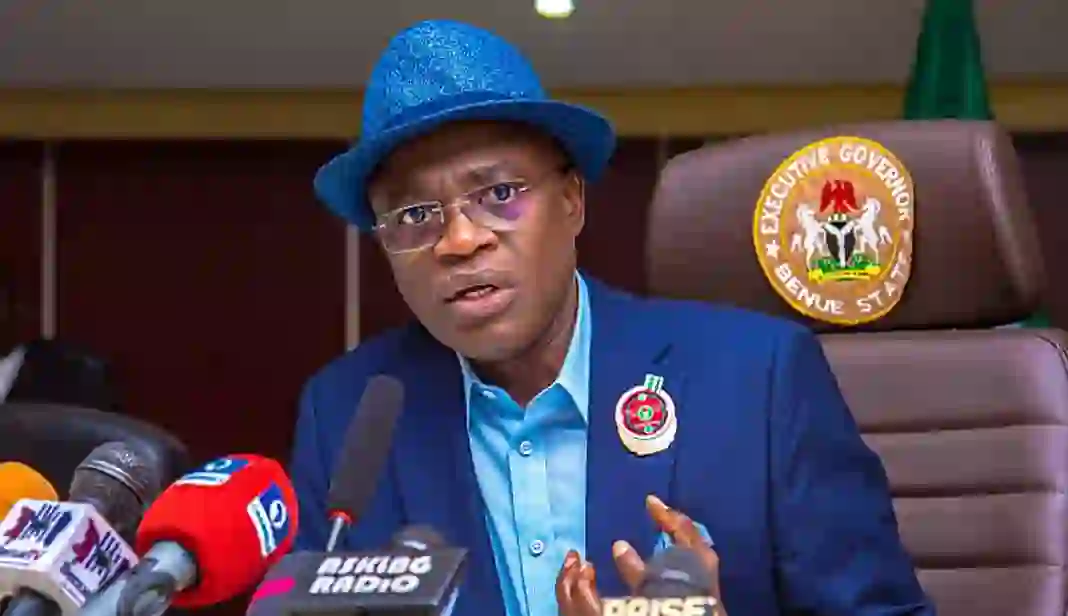
Rev. Fr Hyacinth Alia, the Governor of Benue State, is entirely human and a Nigerian politician, and as such cannot be living the ideal life. Furthermore, he does not live in Plato’s Republic. Yet, Nigerians have lately been burning him in an acidic pot of ink for being merely human and Nigerian.
I have followed the excoriation and have come to note that Alia, as an ordinary mortal, is not the true target under assault; it is the Church – most especially the Catholic Church – that stands accused. In the court of uninformed public opinion, the Church is blamed for foisting him upon Benue State, largely by critics who fail to realise that the Church opposed his political adventure vehemently, just as Canon Law (Canon 285 : 3) strictly forbids her ordained ministers from assuming public offices that entail the exercise of civil power.
When we turn the pages of history, however, it becomes obvious that clerics have regularly defied ecclesiastical authority to plunge headlong into temporal governance. In seventeenth-century France, Cardinals Richelieu and Mazarin wielded absolute political power as Chief Ministers to the crown, frequently subordinating Christian charity to the cut-throat demands of the state.
In the twentieth century, Archbishop Makarios III governed Cyprus as its first president, intertwining the episcopal crosier with ethno-nationalist statecraft; while in Latin America, during the turbulent rise of Liberation Theology, priests like Ernesto Cardenal in Nicaragua took cabinet positions under the Sandinistas, facing canonical suspension from Pope John Paul II. We also witnessed Jean-Bertrand Aristide in Haiti.
Nigeria itself has walked this troubled road before. Long before Alia, Rev. Fr Moses Adasu contested and won the governorship of Benue State in the Third Republic under the Social Democratic Party (SDP). Like Alia, Adasu incurred canonical suspension, insisting his mission was to sanitise the murky waters of politics. We now see the bitter irony of that supposed cleansing through the actions of Alia. Why must it be ordained priests who bring such disgrace upon the face of the Church? Intoxicated by the headiness of transient authority, some of them even turn on their own bishops, blinded by the fleeting illusions of petty power.
During the last general election, no fewer than five Catholic priests approached me, asking to be linked to Mr Peter Obi because they fancied their chances of contesting elective offices. Most of them belonged to the cadre of what we commonly call “charismatic priests.” One would imagine that any priest chosen by God to exercise extraordinary spiritual gifts – healing, deliverance, and prophetic consolation – would see that as the pinnacle of service, never stooping to trade divine charisma for temporal power. Yet, it became painfully evident that these clerics merely wanted to weaponise their religious following and cash in on their popularity among the desperate masses to seize political power. This was precisely the chariot upon which Fr Alia rode into Government House in Makurdi: a fame built upon healing ministries and charismatic gatherings, swiftly converted into an electoral machine.
Nothing extraordinary has been observed in his governance. Instead, he is proving that when a priest falls into the political arena, he can be worse than those he criticised. Interact with the long-suffering people of Benue and read the litany of charges against him: he has proven maddeningly slow and irresolute in determining policy, hopelessly at home with contradiction, tardiness, incompetence, and administrative paralysis.
While living in grotesque luxury, he displays neither the charm nor the grace, neither the humour nor the wit, neither the intellectual refinement nor the elevated manners of cultured Catholic priests. Have you looked at his pictures closely? All one discerns is a countenance sombre and severe, masking a tragic capacity for malice, ruthless ambition, and unjust combat.
Now, as an ordained Catholic priest – suspended or not – the indelible character of Holy Orders remains imprinted upon his soul (tu es sacerdos in aeternum). Fr Alia cannot plead ignorance of the foundational tenets of Catholic Social Teaching: the Dignity of the Human Person, the Common Good, Subsidiarity, and Solidarity. Instead, he lives a public life shockingly inconsistent with Catholic morality.
In Benue, his refusal to allow Mr Peter Obi to visit the state on a mission of charity completed his cycle of woes. To cover up this petty sabotage, he acted like an Odysseus who could hardly speak without lying or act without treachery. He claimed through his aides that he was unaware of the visit; yet official letters delivered to his office and to the security agencies clearly proved the contrary. Worse still, his administration issued a blizzard of combative press releases to deny the obstruction – a frantic energy he never mustered when his people were being massacred.
Who could have imagined that a Catholic priest would descend to mobilising platoons of state security personnel and political thugs against a peaceful guest, when those very resources, had they been mobilised against the bandits and kidnappers terrorising Benue, would have earned him everlasting acclaim?
Consider the painful irony: on the 22nd of December 2023, Governor Hyacinth Alia travelled to Umueri in Anambra State to attend a burial. He arrived on the 21st, spent the night peacefully, attended Holy Mass at Our Lady of Victory Parish, Umueri, and departed without hindrance, harassment, or protest. No one blocked him; no state apparatus was deployed to humiliate or restrict him. What a sharp, damning contrast to the hostile, impudent, and shameless barricade he erected against Peter Obi in Benue!
If the leadership in Anambra were genuinely invested in fraternal solidarity and democratic decency, this offered a profound opening: an opportunity for Obi’s governor to condemn that arbitrary blockade, remind the priest-governor of the hospitality and peace he freely enjoyed across the Niger, and defend the sacred constitutional right of every Nigerian to travel and comfort the afflicted. They would rather send characters like Ejimofor Opara, Izuchukwu Adichie, and the homosexual pervert, Dr Chukwuma Kpontus Okafor from Omasi, to support that affront to freedom.
Even more damning is how such pettiness strikes at the heart of the Corporal Works of Mercy, the definitive criteria by which Christ warned we shall all be judged at the Last Day (Matthew 25:31–46): these charitable actions meet human physical needs – feeding the hungry, giving drink to the thirsty, clothing the naked, sheltering the homeless, visiting the sick, visiting the imprisoned and displaced, and burying the dead. By standing between a suffering child of God in an IDP camp and someone bearing food, medicine, and genuine fraternal comfort, Governor Alia obstructed a man carrying out the injunction of the Bible in a rightful manner.
During the tenure of Governor Samuel Ortom, whatever his political shortcomings, one could feel his raw, visceral love for his people; Ortom preferred to suffer every political extremity, confront the federal might, and face isolation rather than betray his bleeding citizens. Today, we witness under Alia a tragic indolence that has pushed the state to the brink of ruin. He does not hesitate to flatter the presidency from the fresh graves of his slaughtered constituents, merely to secure his personal tenure.
While his local Catholic bishop cries out in agony over the atrocities visited upon his flock, the priest-governor shouts even louder to dismiss the cries, practically accusing his own bishop of lying to appease his political benefactors. He has become a misfortune for Benue, a disgrace to Nigeria’s democracy, and an instrument ready at hand for those who wish to calumniate moral authority.
The news of Alia’s descent coincided recently with reports of a former Italian priest who traded his collar to dance and marry a Kenyan lady. It reminds us that the priesthood has its own circus, and renegades performing in it are never in short supply. Yet, the Catholic priesthood cannot be judged by its tragic aberrations.
Civilisation would grind to a halt if vital institutions and liberties were abolished simply because human fallibility corrupts them, an enduring reality captured in the ancient maxim “abusus non tollit usum” (“abuse does not take away the use”). Free speech inevitably generates sensationalism and demagoguery, democracy breeds political manipulation, marriage endures domestic strife, and medicine suffers from quackery and malpractice; yet dismantling these pillars to eliminate their flaws would merely trade the imperfect friction of progress for the complete paralysis of tyranny.
The Church has always produced pastors who understood the authentic majesty of their calling. Consider Father Jerzy Popiełuszko in Poland, whose “Masses for the Fatherland” dismantled communist tyranny without him ever picking up a party card. Consider Archbishop Óscar Romero in El Salvador, who was martyred at the altar because he dared to shield poor peasants from a murderous junta. Consider Nigeria’s own Catholic Bishops’ Conference (CBCN), whose courageous pastoral letters and visits to the President consistently speak truth to power.
When the history of the Church’s role in human emancipation is written, the CBCN and its faithful pastors will be remembered with honour, while the likes of Alia will – and should – be forgotten. History has a merciful way of remembering its moral geniuses and burying its fools; an age seems noble only because the towering peaks endure while the petty actors sink into the obscurity of time.
Contrast this tragic trajectory with the noble witness of Julius Nyerere, the founding father of Tanzania. Nyerere was not a cleric; he was a devout Catholic layman. Yet, he understood the Gospel infinitely better than many who wear the collar. He walked to daily Mass, lived in austere simplicity, translated the Catechism into Swahili, and unified his country under the ethos of “Ujamaa”(familyhood), leaving office with clean hands and only a modest house to his name. Because Nyerere governed with the true spirit of Christian servant-leadership, the Church has opened his cause for beatification, naming him a Servant of God.
Nyerere showed that a humble layman in the corridors of power can reflect the radiant light of Christ. Rev. Fr Hyacinth Alia, by contrast, stands as a mournful warning: that when an ordained priest strips off the vestments of Christ to wear the “agbada” of partisan rule, he does not elevate politics; he simply proves that a priest who abandons his higher calling is capable of descending into the lowest infamies of power.
Discover more from The Source
Subscribe to get the latest posts sent to your email.