



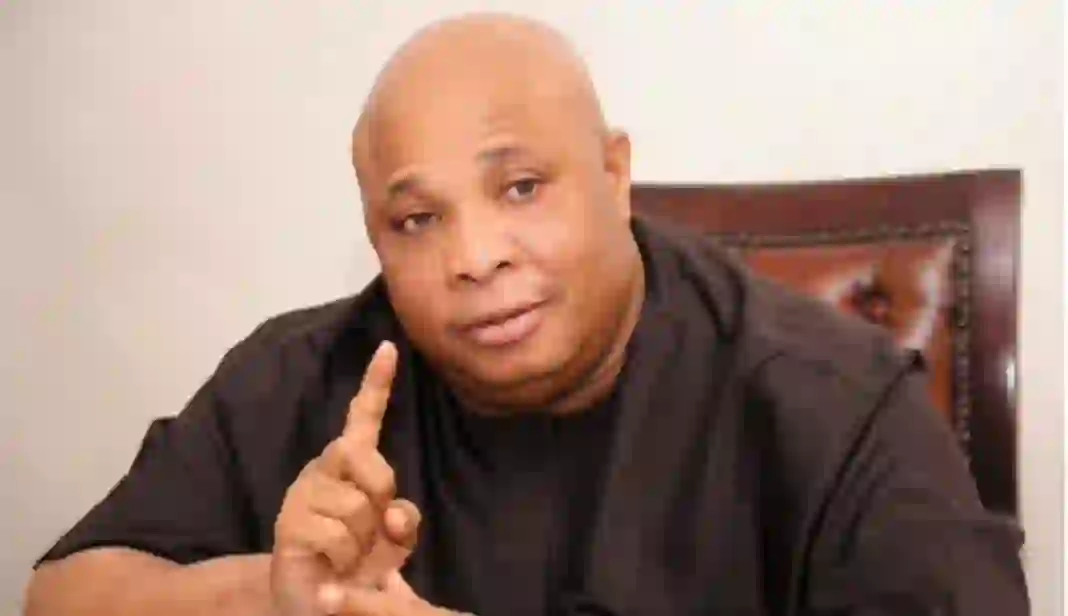

By Victor Okey Okwarugo

A few days ago, I was having a conversation with a friend.
In the middle of our discussion, he asked me a simple question.
“Victor, what do you really know about Chief Martin Agbaso?”
I paused.
Like many people, I had heard countless stories.
Some admired him.
Others criticized him.
Some spoke about the 2007 election.
Others remembered his business empire.
But when I was honest with myself, I realized I knew very little about the man beyond what people had chosen to tell me.
That conversation stayed with me.
A few days later, I came across a recent public message from Chief Martin Agbaso.
What caught my attention wasn’t why he wrote it.
It was the tone.
There was no bitterness.
No anger.
No attempt to reopen old political wounds.
Instead, I found a man talking about sacrifice, service, faith, patience, and hope. A man who wrote that he chose not to allow disappointment to become bitterness, but instead allowed experience to become wisdom. A man who believed that while circumstances may delay a journey, they cannot stop a destiny ordained by God.
That was the moment I decided to dig.
What I discovered was far more remarkable than I expected.
I discovered that Martin Agbaso’s story did not begin in politics.
It began in Emekuku, where he was raised on the values of faith, integrity, humility, compassion, and hard work. Those who knew him as a young man spoke about his character long before they spoke about his achievements.
As I kept digging, I became even more fascinated.
From a humble beginning in Imo State, he travelled to Rome, Italy, where he became the first African elected Secretary General of the International Students Committee at the Pontifical University.
From there, he proceeded to the United States, earning degrees in Finance from the State University of New York, receiving academic honors, and distinguishing himself as a young African among his peers.
Then came his corporate journey.
Rather than chasing titles, he deliberately started as a Management Trainee at Prudential in New York. Within a short time, he earned the respect of one of the world’s most competitive financial environments, became a member of the New York Stock Exchange, and built an impressive career in international finance.
Then I asked myself another question.
Why would someone who had achieved so much abroad choose to return to Nigeria?
The answer became obvious.
He believed his knowledge, experience, and success should benefit his own people.
He returned home and built businesses in construction, commodities, oil and gas, and several other sectors. He transformed Nathan’s into Nigeria’s largest dry cleaning chain and created employment opportunities for hundreds of Nigerians.
Long before politicians began talking about job creation, he was already creating jobs.
Then I dug into the political chapter of his life.
This was where the story became even more compelling.
Politics did not come looking for a man seeking wealth.
He had already achieved success.
Politics came looking for a man whose people believed could lead.
One of the discoveries that surprised me most was that, while still in his 30s, Martin Agbaso was elected Senator for Imo East Senatorial District under the platform of the Democratic Party of Nigeria (DPN) in the National Assembly elections conducted on 25 April 1998.
Sadly, history took an unexpected turn.
Before the elected senators could be sworn into office, General Sani Abacha died on 8 June 1998. The new Head of State, General Abdulsalami Abubakar, dissolved the five political parties created under the transition programme and cancelled every election conducted under that transition programme.
Despite being elected by his people, Martin Agbaso never had the opportunity to represent them in the Senate.
As I continued digging, another chapter completely captured my attention.
The 2007 governorship election.
The more I examined the events surrounding that election, the more I understood why, nearly two decades later, people still speak about it with emotion.
On 14 April 2007, Martin Agbaso won what many still regard as one of the freest governorship elections ever conducted in Imo State.
Then came the twist.
INEC cancelled the election, citing violence in five locations, and ordered a fresh election on 28 April 2007.
The more I dug, the more questions I found.
If the alleged violence occurred in only a handful of locations, why was the governorship election across all 27 local government areas cancelled?
Why were the House of Assembly elections, conducted in the same polling units, with the same electoral officials and the same ballot boxes, allowed to stand while only the governorship election was cancelled?
Martin Agbaso refused to walk away.
For four years, he fought in court, believing that the mandate freely given to him by the people deserved judicial protection.
Justice, in his view and in the view of many of his supporters, never came.
Many still regard that episode as one of the worst political injustices in Imo State’s democratic history.
Then I remembered the letter that started this journey.
Suddenly, one sentence made perfect sense.
“I chose not to allow disappointment to become bitterness. Instead, I allowed experience to become wisdom.”
After digging into his life, I understood those words.
They were not written for applause.
They were written by someone who had lived them.
The more I dug, the more I discovered another side of Martin Agbaso that rarely makes headlines.
His philanthropy.
His support for widows and orphans.
His contributions to churches and communities.
The countless acts of kindness carried out quietly, without cameras or publicity.
Perhaps that is why people call him Ochoudo, “The Peacemaker.”
Not because it is a political slogan.
But because it reflects the life he has lived.
By the time I finished digging, I had learned something important.
Leadership is not built in a season.
It is built over a lifetime.
It is revealed through character, resilience, sacrifice, compassion, and an unwavering commitment to serve others.
When I started digging, I thought I was trying to understand a politician.
When I finished, I realized I had uncovered the story of a man whose life has been shaped by service, tested by adversity, and defined by resilience.
Whatever anyone’s political views may be, I believe we owe ourselves one duty.
Before we form an opinion about anyone, we should first know their story.
I’m glad I took the time to know him.
Okwarugo writes from Isiekenesi, Ideato South Local Government Area, Imo State.
Discover more from The Source
Subscribe to get the latest posts sent to your email.