




By Valentine Obienyem

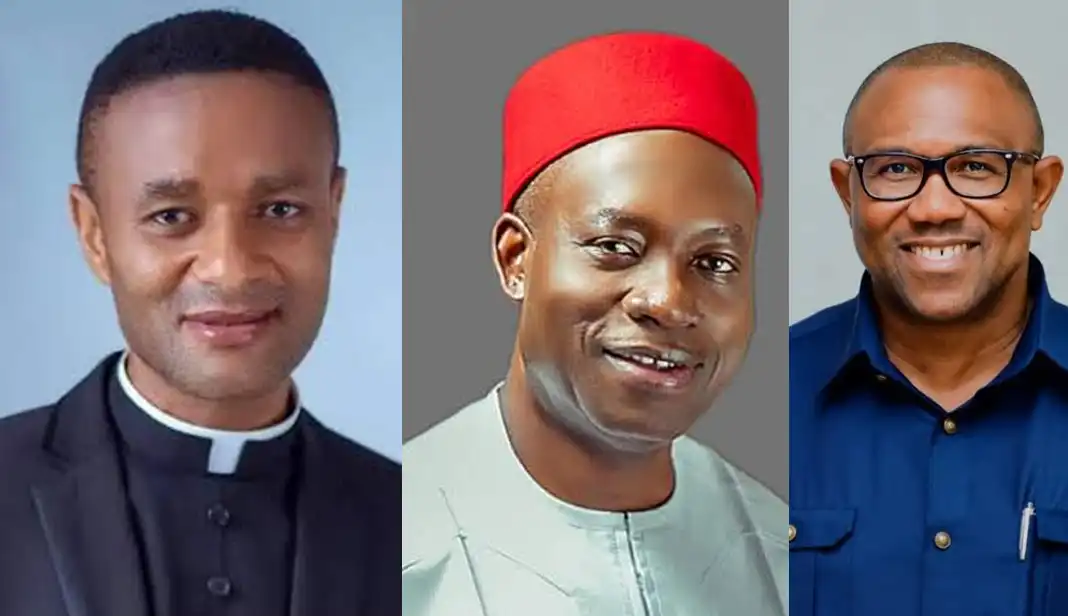
Fr Oluoma is one of those Priests after my heart. I enjoy his deep sense of analysis, his intellectual confidence and, especially, his strong knowledge of exegesis. Another priest I admire greatly online is Fr. Kelvin Ugwu.
Fr. Oluoma’s physiognomy is amusing: a small head built to slip through barricades, cherished by burglars; pinholes for eyes that have seen more than their share; no useless ounces of flesh to burden him; and a countenance made effervescent by the flame of intellectual integrity. He possesses a suppleness of posture yet retains the clear, unclouded gaze of an honest observer, backed by a luminous gift for synthesis.
There is something particularly fascinating about Fr. Oluoma’s approach to complex theological questions. He has a merry, almost unserious manner of presenting them, often beginning in a way that leaves you wondering where he is going and even makes you apprehensive that he may eventually get himself into trouble. Yet beneath this playful exterior lies the exact structural mechanics of the Thomistic method. Just as St. Thomas Aquinas systematically laid out objections, weighed counter-authorities, delivered his resolution, and dismantled opposing arguments, Fr. Oluoma adopts this exact dialectical blueprint. He sets up positions with formal precision and structures his delivery as a disciplined exercise in inquiry – harnessing the step-by-step framework of medieval scholasticism. By the time he arrives at the end, the argument has somehow become clear, coherent, reasonable, and theologically sound.
I once suggested that theology students should study Fr. Oluoma’s presentations and make him the subject of their academic projects. I meant every word of it. He is, in the best sense of the expression, an unserious serious theologian.
Fr Oluoma is also very confident and sure of himself. I admire, too, his objectivity, which he tried to demonstrate in his recent intervention on Peter Abel Obi and Charles Cain Soludo. Thinking of the added names remind us of the story of Cain and Abel.
For those who may not have read what prompted this response, let me state Fr Oluoma’s position fairly. His argument is essentially that Peter Obi and Charles Soludo are both illustrious Igbo sons from Anambra State who have each governed the state and that their disagreement over national politics should not become a reason for their supporters to insult or disparage one another. He points out that Soludo is not enthusiastic about Peter Obi’s presidential ambition, just as other Igbo people support Atiku or Tinubu, while some non-Igbos, such as Dele Farotimi, strongly support Obi.
His appeal is therefore for restraint. In his words, one can “support Sir Peter Obi with all your heart without antagonizing, insulting and disparaging Soludo or anyone else that doesn’t.” He makes the same argument in reverse: those who support Soludo should be able to do so without antagonising Peter Obi. He argues that politics, like religion, can stir emotions and throw people into frenzy, and that Obi’s supporters should concentrate on securing votes and persuading others rather than insulting opponents.

He goes further to condemn what he describes as the tendency of some Igbos to insult not only fellow Igbos but Yorubas, Hausas, Fulanis, Edos and others who support candidates other than Obi. His point, in summary, is that political opponents may become allies or even people one needs tomorrow, and that we should therefore avoid burning bridges.
I have no quarrel whatsoever with that principle. Indeed, I agree with much of it. Political disagreement should not become an excuse for personal abuse, ethnic hatred or the destruction of relationships. Nobody should be insulted merely because he supports another candidate.
Much as I can defend Fr Oluoma’s right to his position, however, I respectfully disagree with the way he frames the particular issue between Peter Obi and Soludo. He presents the matter largely as though Obidients are angry with Soludo simply because he does not support Peter Obi’s presidential ambition. That, in my view, misses the central issue.
First, who exactly are the Obidients? Although some people have been nominated or recognised as leaders of different Obidient platforms, the Obidient movement is not a formal, centrally organised political organisation whose members receive instructions from Peter Obi. It is largely a spontaneous aggregation of Nigerians who became exasperated by the direction of the country and found in Obi a political alternative. Indeed, many people who are Obidient do not belong to any organisation, have never attended an Obidient meeting and may not even know the names of those who lead the movement. So, when people criticise Soludo, it is too simplistic to say that they are doing so because he does not support Peter Obi.
Soludo can support President Tinubu. He can support Atiku. He can support Peter Obi. He can support whoever he chooses. That is his constitutional and political right. And he does not have to be a supporter of Peter Obi to command respect.
The argument goes beyond that. The anger against Soludo, particularly among many people in Anambra, is connected to his own conduct, statements, policies and relationship with the political legacy of Peter Obi. From conversations I have had with people in and around his administration, including some of his aides and appointees, there is considerable frustration with aspects of the way the government is being run. Whether every criticism is justified is another matter, but it is wrong to reduce all of this to a demand that Soludo must support Obi.
Lately, Soludo and his group have been scrambling to publicize “loans” tied to Mr. Obi, attempting to frame them as a contradiction of his well-known aversion to borrowing”a fiscal prudence that has long been his political hallmark. At its core, this is a petty bid to dim a public light. Soludo seems bent on extinguishing that beacon for no justifiable reason, holding Obi to a dishonest standard he refuses to apply to himself.
During his tenure, Obi participated, for example, in the NEWMAP initiative without incurring traditional debt, as those were concessional arrangements brokered between the federal government and international partners. Yet Soludo, who has paid counterpart funding of 500 million Naira for NEWMAP phase 11 programme and proudly boasts of not borrowing under the exact same logic, hypocritically turns around and classifies Obi’s NEWMAP obligations as “borrowing.” That glaring double standard is the crux of the matter.
There is also something about Soludo’s political style that continually provokes this reaction. He sometimes comes across as the “ezeonyeagwanan”- the man who knows everything. When a leader creates the impression that he knows everything, people naturally become reluctant to tell him what is actually happening around him. That is not merely an Obidient complaint; it is a broader question of governance.
Take even the matter of Peter Obi’s comment about being godparents to Soludo’s daughter. What Obi said, to my mind, was a mature recognition that politics should not destroy every personal and family relationship. He was essentially saying that whatever our political disagreements, families can remain cordial.
What followed from Soludo’s side, particularly the response attributed to his wife, was unnecessarily dismissive. The impression created was almost: do not mind this man; we are not friends. Why should a simple gesture of maturity have to descend into such pettiness?
And this brings me to something else. Many years ago, Quintus advised, in words recorded in Cicero’s “Commentariolum Petitionis”: “Be lavish in your promises”; men, he observed, often prefer a false promise to a flat refusal. He also advised creating new scandals against political rivals involving crime, corruption or immorality.
It appears that Soludo has literally taken political lessons from this ancient Roman manual of electioneering. The passage is striking because it describes an enduring feature of political competition: sometimes, destroying the reputation of a rival becomes almost as important as building one’s own.
This is where Peter Obi’s case is different. Obi’s strongest political asset is not merely that he is from Anambra or that he is Igbo. His appeal to millions of Nigerians rests substantially on a personal integrity and a political record that many people regard as unusually clean. This is what has led even people who once opposed him to speak of him in almost saintly terms.
I remember our last open encounter with Rev Fr Prof. Josephat Oguejiofor, my inimitable lecturer in Ethics and, to my mind, one of those priests who represent the intellectual tradition of Catholic priesthood. I am sure Fr Oluoma knows him.
Fr Oguejiofor spoke about how he once opposed Obi vehemently when Obi was governor. He was never a man afraid of expressing his opinion. Yet, after years of observing and studying other governors in Nigeria, he came to a striking conclusion. In his words: “I opposed Obi vehemently. However, after I had seen and studied other governors in Nigeria, I came to realise that he is a saint when compared to others.”
That statement is important, not because Peter Obi is a saint – he is not – but because it captures the extraordinary perception of integrity that forms the bedrock of his political capital. That perception is precisely why coordinated attempts to diminish it provoke such fierce pushback. When the public recognizes a politician who has established a genuine reputation for financial prudence and a different ethical standard, they will naturally resist efforts to redefine him through relentless caricature. Why else would critics dismiss substantial investments that directly and indirectly employed thousands of Anambra people as “next to nothing”? Why twist concessional credits into traditional debt to attack a leader who governed alone while contemporaries borrowed billions in commercial loans and bonds without matching his output – leaving behind over 75 billion Naira and 150 million dollars instead? If not for Obi’s robust defence, they are at the verge of even denying the dollar savings.
It is equally baffling to watch unexecuted contracts and uncompleted certificate payments wickedly bundled together and presented as his personal liabilities. What manner of partisan accounting practice is that? One must wonder: if applied to his immediate predecessor – who failed to complete even ten percent of the roads he awarded – would those total contract sums similarly be weaponized as liabilities?
So, yes, Fr Oluoma is right: Obidients should not insult Soludo merely because he does not support Peter Obi. They should not insult Tinubu supporters, Atiku supporters or anybody else. Political persuasion should be based on argument, evidence and the ballot, not abuse.
But there is another side to this conversation: criticism of Soludo should not automatically be classified as an attack on an Igbo man for refusing to support Peter Obi. Sometimes, people are simply responding to what they perceive as his own actions, words and record in government.
I therefore agree with Fr. Oluoma on the principle of civility, but I disagree with his diagnosis of the ailment. A proper diagnosis requires a rigorous textual analysis of the written and spoken words emanating from figures like Bayo Onanuga, Daniel Bwala, Fani-Kayode, Kenneth Okonkwo, and Reno Omokri. To that list must be added characters like Izuchukwu Adichie, Ejimofor Opara, Law Mefor, and Dr. Chukwuma Kpontus Okafor – the Omasi-born pervert with a sordid past. Behind them stand upwards of 30,000 other state-backed (federal and Anambra) media minders whose default mode is relentless character assault against one man rather than any engagement with facts.
And perhaps that is precisely what makes Fr Oluoma worth engaging: even when I disagree with him, I know I am dealing with a serious mind. His “merry frolicsome” manner may sometimes make the beginning of his argument look unserious, but by the time he reaches the end, you discover that the theologian was there all along.
Discover more from The Source
Subscribe to get the latest posts sent to your email.