



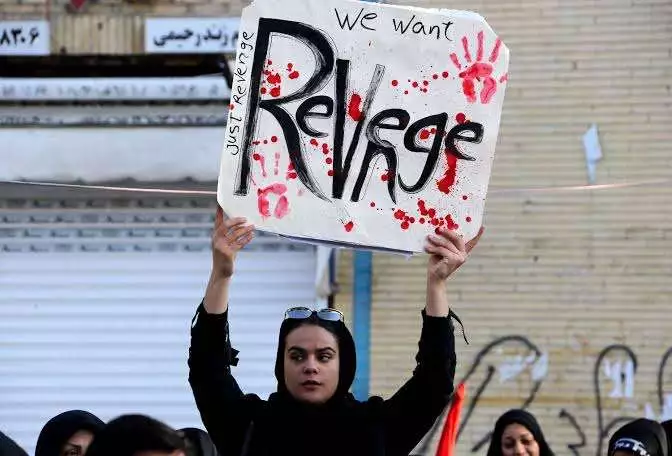

The Islamic Republic of Iran have sentenced four people to death, including a woman BitaHemmati, her husband Mohammadreza Majidi-Asl, along with two other men, Behrouz Zamaninejad and Kourosh Zamaninejad, believed to be her relations, over the January anti- government protest.
The four were said to be living in the same building in Tehran, Iran’s capital during the protest that lasted for days before the government forcefully put it down.
The sentenced was handed down by Tehran’s Revolutionary Court under Judge Iman Afshari. The sentence must now be approved by a higher body headed by Mojitaba Khamenei, the nation’s Supreme Leader before the execution can be carried out.
They were convicted on charges, including carrying out actions on behalf of the United states and Israel, as well as throwing concrete blocks from a residential building into security forces in the capital during the protest.
Global human rights groups have however criticized the convictions, accusing the Iranian government of forcing the accused to confess publicly, video of which was later aired to the public.
A human rights body, the Abdorrahman Boroumand Center said it believed that Hemmati was the woman who appeared in a video broadcast on state television in January, being personally interrogated by judiciary chief Gholamhossein Mohseni Ejei.
‘The recording and broadcasting of forced confessions from defendants in an opaque process… constitutes a blatant violation of the defendant’s rights,’ the centre said.
Rights groups accuse the Islamic Republic of using the death penalty as a tool of repression to instil fear in society, and fear it will ramp up capital punishment in the wake of the war against Israel
and the United States.
Norway-based Iran Human Rights (IHR) and Paris-based Together Against the Death Penalty (ECPM) said on Monday in their joint annual report on the death penalty in Iran that at least 1,639 people have been executed in 2025, including 48 women.
Of these, 21 women were executed for the murder of their husbands or fiancés, the report said. Rights groups have said women executed for killing spouses or relatives were often in abusive relationships.
The number of executions represented an increase of 68 per cent on the 975 people Iranian authorities put to death in 2024.
The figure amounted to an average of more than four executions per day.
The report said the number of executions was by far the highest since IHR began tracking it in 2008, and was the most reported since 1989, in the earlier years of the Islamic revolution.
Earlier this month, Iran hanged a teenage musician in the notorious Ghezel Hesar prison outside the capital, despite hopes he would be spared because of his age.
Amirhossein Hatami, 18, was arrested on January 8 and accused of committing arson against the feared Basij paramilitary’s base in Tehran during anti-regime protests.
Amirhossein was convicted of ‘Moharebeh’ (‘Enmity Against God’) and sentenced to death on February 7.
On April 2, the judiciary announced he had been ‘hanged at dawn’.
Earlier this month, Iran hanged a teenage musician in the notorious Ghezel Hesar prison outside the capital, despite hopes he would be spared because of his ageBiglari and Kalour’s family were not granted final visits or allowed to say goodbye before they were put to death (pictured is Mohammadamin Biglari, 19)
Both were convicted of ‘Moharaebeh’, or ‘enmity against God’, and sentenced to death by ‘Death Judge’ Abolghassem Salavati (pictured is Shahin Vahedparast Kalour, 30)
Two days later, Mohammadamin Biglari, 19, and Shahin Vahedparast Kalour, 30, were executed at Ghezel Hesar Prison.
Biglari and Kalour’s family were not granted final visits or allowed to say goodbye before they were put to death.
The young men had been seized during the protests on January 8 and accused of arson over a fire at the base of the feared Basij paramilitary base.
They ‘confessed’ after weeks held in prison, where there are extensive reports of torture, before being brought before the feared Revolutionary Court in Tehran on February 6.
Both were also convicted of ‘Moharaebeh’ and sentenced to death by ‘Death Judge’ Abolghassem Salavati.
Also convicted of the capital charge by Salavati that day were Abolfazl Siavashani, 51, Shahab Zohdi, 38, Ali Fahim, 23, Yaser Rajaifar, and Hatami.
As well as the seven already executed, death sentences have been issued against at least 26 other people arrested over the January protests, and several hundred more are facing charges that could see them executed, IHR warned.
‘Dozens of individuals arrested during the January 2026 protests have been sentenced to death following grossly unfair, fast-tracked trials conducted without due process, access to independent counsel and reliance on torture-tainted forced ‘confessions’ as evidence,’ said the New York-based Center for Human Rights in Iran.

Discover more from The Source
Subscribe to get the latest posts sent to your email.