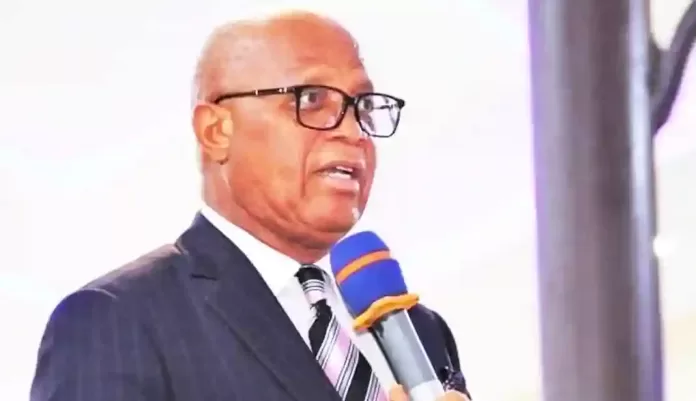


Former Inspector General of Police (IGP), Sunday Ehindero, has said that the President has the power to determine who becomes his Police Chief.
Reacting to controversies surrounding the elongation of the tenure of incumbent IGP, Dr. Kayode Egbetokun, Ehindero pointed out that there is no pressure, no matter how strong, that will make an incumbent President work with an unfriendly IGP.
He declared in a statement that “The appointment and elongation of tenure of Inspectors General of Police will always generate controversies. Such an appointment is political.
“And politics is riddled with controversies. In politics there is no right answer. The question is not whether your action is wrong or right, it is whether your action is valid.
“The President is given the power to choose an Inspector General of Police from serving members of the force with the concurrence and concordance of the Police Council.
“It is his right to determine the Inspector General of Police he could work with. No amount of pressure would make him work with an Inspector General of Police who is not his preference.
“You can force a horse to a river, but you cannot force the horse to drink water. There must be that chemistry between an appointed Inspector General of Police and the President.”
Kayode Egbetokun – IGP
He however emphasized that despite the power of the president on IGP’s appointment, it does not make such an appointee a stooge.
“In my case, President Obasanjo demanded one hundred percent loyalty, not ninety nine percent. That did not make me a yes sir man. There were times when we disagreed on directives given to me. On finding out the facts, he conceded to me.
“In the case of Egbetokun, I know him very well. He was the ADC to President Tinubu while I was the Assistant Inspector General of Police in Zone 2, Lagos and Ogun states, while Mr. Okiro was the Commissioner of Police of Lagos State in the year 2001.
“If President Tinubu chooses to work with him for the duration of four years and that is backed by law, so be it. He is his choice.
“You cannot by any yardstick say Egbetokun is incompetent or not qualified for the job. Competence backed by law should be the overriding factor in the appointment and tenure of an Inspector General of Police.
“Let Egbetokun serve his four years tenure extension in peace. He deserves it by virtue of his competence, performance and academic qualifications.
“The extension of the tenure of Inspectors General of Police had always been controversial. My tenure extensions twice in 2005 for one year beginning from March 2006 and 2007 for three months were not without controversies.
“In fact, the President and I were taken to court for my tenure elongation. At the end of the day, the court ruled that it was a non-issue and dismissed the case. At that time in 2006, there were no legislations in relation to the tenure elongation of an Inspector General of Police other than the Civil Service Rules and the Police Act and Regulation, CAP 359, Laws of The Federation of Nigeria, 2004.”
Over 23,000 final year students of Senior Secondary Schools in Ondo State are to have their 2025 West Africa Examination Council (WAEC) Secondary School Certificate Examination levy paid by the State Government.
Already, Governor Lucky Aiyedatiwa, has approved the sum of N633, 918, 000.00 to cover the payment of registration fees for public secondary school students in the State.
Chief Press Secretary to the Governor, Ebenezer Adeniyan, in a statement at the weekend explained that the gesture is to alleviate the financial burden of parents and guardians.
“Governor Aiyedatiwa gave the approval on Friday and the payment will cover a total of 23, 048 secondary school students who passed the Joint Senior Secondary School II Promotion Examination in the State conducted by the Ministry of Education, Science and Technology.
Governor Lucky Aiyedatiwa
“Over the years, the payment of WASSCE registration fees for public secondary school candidates in Ondo State has been a significant relief for parents, guardians, and stakeholders alike, especially in the face of prevailing economic challenges.
“The WASSCE represents a crucial academic milestone for students, serving as a gateway to higher education and professional opportunities.
“Ensuring that the state government covers the registration fees annually, invariably promotes equitable access to education, allowing all eligible candidates to participate in this pivotal examination without financial hindrance.
“This initiative effectively reduces disparities among students from varying socio-economic backgrounds.
“The commitment of Governor Aiyedatiwa to fund the WASSCE registration aligns with the Education, Human Capital Development and Entrepreneurship objectives outlined in the ‘OUR-EASE’ policy thrust of the administration.”
However, in the past, despite announcement of government that it would pay the examinations fees of the students, they found it difficult to access their results when released, due to inability to back up the announcement with cash.
Osun State Governor, Senator Ademola Adeleke says he is as fit as a fiddle.
The Governor spoke in response to worries expressed by some people over his use of a walking stick, always. Some have attributed that to perhaps a kind of ill-health for which he needs a walking stick for support.
But the Governor whose hobby is dancing says perish the thought. He said when it comes to his health, he is as clean as a whistle.
He explained that the walking stick he uses is for his traditional status in the society; that is a status symbol; that he is a multiple Chief; that more important, he is the Asiwaju of Ede. The walking stick goes with the office; a paraphernalia so to say.
Adeleke to Reporters: “I am hale and hearty. I am not sick in any way. Walking stick is common practice in many regions of Nigeria, especially in the South-south and South-east; signifying dignity and respect, particularly, among high ranking individuals.”
Said one of his Aides: “If anybody needed any pointer to Governor Adeleke’s good health status, the way he dances, vigorously, swirling round, seals it. They need to see him exercising.”
Adeleke explained that the Governor of Bayelsa State, Douye Diri, gave him his first walking stick. He also said he got another one in Asaba at a recent PDP Governor’s Forum where each Governor was given a beautiful and shiny walking stick.
An Abia State High Court, sitting in Umuahia the State Capital, on Friday, February 28, 2025, adjourned to June 18 and 19 ,2025, commencement of hearing in the suit filed against a former Governor of Abia State, Senator Theodore A Orji, his son Engr Chinedu Orji, the immediate past Speaker of the Abia State House of Assembly, by the Economic and Financial Crime Commission, EFCC .
The EFCC had arraigned the Orjis on a 16-count charge bordering on conspiracy, corruption and diversion of public funds to the tune of N60 .85 billion.
Docked alongside the forner Governor and his son, were the erstwhile Finance Commissioner, Dr Philip Nto, Onwumene King Obioma, and Romanus K Madu.
According to the anti-graft agency, the accused, between 2011 and 2015, conspired severally and collectively to siphon and divert the said sum being part of the federal allocations to Abia State.
The EFCC said the offence is contrary to the provisions of Section 390(5) of the Criminal Code Law of Abia State.
The Commission avers that the said sum of over N60 billion were diverted in tranches as security votes and other nebulous subheads between 2010 and 2015.
“That you, Chief Theodore Ahamefule Orji ,Engr Chinedum Orji ,Dr Phillip Nto ,Onwumene King Obioma and Romanus K Madu ,sometime between 2011 and 2015 in Umuahia Aba state within the jurisdiction of this honourable court stole and converted the Sim of N22,500,000,000.00 ( Twenty two Billion ,Five Hundred Million naira only ) being allocation to the the Abia state Government as security votes and thereby committed an offence contrary to the provision of session 390 (5)of the Criminal Code Law of Abia state”, one of the 16 charges reads.
However, all the accused pleaded not guilty when the charges were read to them.
The presiding Judge, Justice Lillian Obai, granted all the defendants bail in the sum of N50 million each with one surety in like sum.
In addition, each of the surety must be a landed property owner with evidence of relevant title deeds, including a Certificate of Occupancy C of O.
As part of the conditions for the perfection of the bond, the accused must deposit their international passports with the Court Registrar.
The Source reports that the EFCC had earlier announced the final forfeiture of over N 228 million by the former Governor in another case of corruption and diversion of public funds .
Although Senator Orji had denied any knowledge of the said forfeiture, the anti-graft Commission recently went ahead to perfect all the conditions precedent to the final forfeiture.
While Senator Orji presided over the affairs of Abia State between 2007 and 2015, his son, Chinedu, was the Speaker of the state House of Assembly between 2015 and 2023.
Also declares Friday, February 28th, black day for democracy
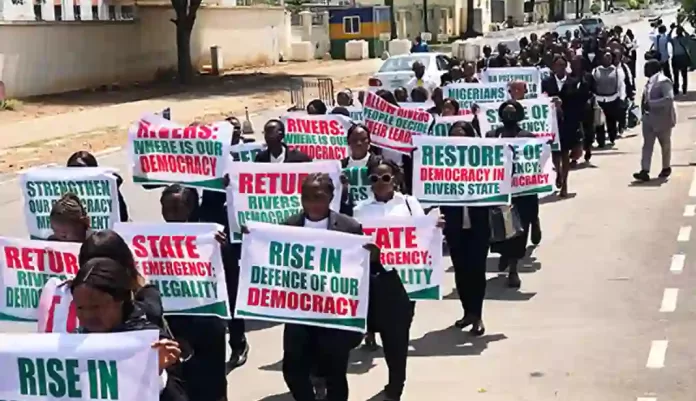
The Supreme Court judgment, Friday, February 28, 2025 ,on some issues central to the festering Rivers State crisis has been described as an open declaration of war on the good people of the State.
A chieftain of the factional All Progressive Congress, APC, in Rivers State, Chief Chukwuemeka Eze, in a statement issued on Friday, also called the day ” a black Friday for Democracy ” in the country.
The Source reports that a Supreme Court panel of five Justices had, in its ruling affirmed the 27pro-Wike defected law makers as members of the State House of Assembly.
Similarly, the panel led by Justice Uwani Abba-Aji, but whose verdict was read by Justice Emmanuel Agim, directed the State Governor to re-present the State’s 2025 appropriation bill to the Legislators.
The Supreme Court described the presentation of the budget to only four members of the House, as done by Governor Siminalayi Fubara, an aberration.
Subsequently, the Apex Court directed the Central Bank of Nigeria, CBN, and all other relevant authorities to withhold the monthly statutory allocations to Rivers State, pending when the State’s 2025 appropriation bill will be considered and passed by the legislators including the 27 Pro-Wike law makers.
However ,while reacting to the development, Chief Eze expressed serious concern about the implications of the judgment.
He expressed regret that the nation’s Apex Court could rule to reinstall the Martin Amaewfule-led Lawmakers after the overwhelming evidence confirming their defection from the Peoples Democratic Party PDP to the APC.
According to him, it is a known fact that the 27 Lawmakers had, in December, 2023, openly declared allegiance to the APC, after resigning their membership of the PDP that provided the platform for their election.
” For the Supreme Court to ignore these facts and ask Amaewhule and his group to continue sitting is not only unfortunate, wicked, evil and undemocratic, but also a direct declaration of war on the people of Rivers State and Nigeria’s democracy” Chief Eze stated.
The APC stalwart whose group is battling the Tony Okocha-led faction for the control of the soul of APC in Rivers State, therefore, called on well meaning Nigerians to see the situation as not just an attack on Governor Fubara, but as a dangerous assault on the country’s democracy.
Particularly, Chief Eze expressed serious worries over the decision of the Supreme Court to halt Federal Allocations to Rivers all in a bid to satisfy the whims and caprices of one man, he said.
According to him, the halting of the remission of the State’s Statutory allocation, is a clear attempt to cripple Rivers, incidentally the State that oils the country’s economic machine.
While commending the State Governor for having so far fought to bring to the public glare how the selfish interests of one man has sought to stifle the growth and development of Rivers State, he nevertheless foresees the unfolding of some events within the political landscape.
The Police Service Commission has approved the appointment of AIG Sulieman Amuda Yusuf, AIG incharge of Zone 9 Umuahia and AIG Rhoda Adetutu Olofu, Force Secretary as Deputy Inspectors General of Police.
AIG Yusuf and AIG Olofu are appointed to occupy the vacancies created by the retirement of the Deputy Inspectors General in charge of Operations and Information and Communication Technology . They are also the most senior Officers representing the North Central Geo-political zone in the Nigeria Police Force.
The two senior Police Officers have also maintained clean service records and the Commission notes that their promotion will serve as an incentive and motivating factor for improved performance.
AIG Yusuf was until his appointment the AIG Zone 9 Umuahia, former AIG Fed Ops Force Headquarters and Commissioner of Police Taraba State. He also served as CP Police Mobile Force; Deputy Commandant, Police College Kaduna and Oji River respectively; Deputy Commissioner of Police, Operations, Jigawa State and Assistant Commissioner, CIID. Bauchi state Command.
AIG Rhoda Adetutu Olofu was until this appointment, the Force Secretary, former AIG Maritime Police Command, Lagos; Commissioner of Police Ports Authority Police Western Ports Command; CP X- Squad, Force CID; and CP Servicom, Department of Research and Planning.
She also served as Deputy Commissioner of Police Research and Planning; DCP Admin, Department of Training and Development; DCP Investment, Department of Logistics and Supply and Assistant Commissioner Establisment, Force Secretary’s office.
She was appointed a Cadet Assistant Superintendent on 3rd of March 1990 and was trained at the Police Academy where AIG Yusuf was also trained.
Chairman of the Commission, DIG Hashimu Argungu rtd congratulated the new DIGs for attaining this height in their meritorious career in the Nigeria Police Force.
He urged them to remember to give back to the Force either in service or in retirement as their experience would remain valuable to the growth of the Nigeria Police Force.
DIG Argungu reiterated the Commission’s commitment to ensure that Police Officers are promoted as and when due and that these promotions would be based on merit.
The Commission’s decision has been conveyed to the Inspector General of Police for implementation.
There is tension in Bauchi State following the shut- down of Primary and Secondary Schools in the State due to the forthcoming Ramadan.
Parents have lamented and frowned at the directive made by the Bauchi State Ministry of Education to keep children at home during the month of Ramadan.
The move has led to series of complaints by parents who queried the motive behind the one month break.
Several parents are worried for their children’s education while noting that most children will forget all they have been taught when they are faced with their exams after the break.
In an interview with Vanguard Newspaper, a parent, Ali Ayuba, whose child schools in the Rafin-Zurfi area of Bauchi metropolis, appealed to the State Government to consider making it optional for schools to adopt the policy or make all schools close early every day to make it all inclusive.
“I am really confused, seriously. I had hoped that before this kind of policy goes mainstream, parents’ would be carried along, because after all, we are the most affected by such policies.
“I thought that they would, at least, make it optional for schools to adopt the policy because it’s not in all parts of Bauchi that people are fasting. If they must make it a state-wide policy, why not reduce the hours spent in school so that the children can close early?” he queried.
Another parent who requested anonymity lamented that children will forget all they have learnt when they return to write their exams.
“Honestly, this will be counterproductive. How can you reconcile teaching children for 2 months and sending them on a one-month break, then asking them to write exams immediately after they return from the break? I can’t understand it.
“The state governor, who, in my opinion, has done very well in many other things, should look into this policy so that the system he has fought so hard to build will not collapse,” she appealed.
Members of the Lagos State House of Assembly have dismissed embattled and impeached Speaker, Mudashiru Obasa, as an impostor.
Stephen Ogundipe, Chairman of the House Committee on Information and Strategy, who spoke on the ongoing Legal Battle accused certain individuals of staging unnecessary drama.
Though he didn’t mention names, but it was clear that he was referring to Obasa.
According to Ogundipe, “Our Counsel was very clear in court. The person causing the drama was just an imposter, and I am sure the Court will follow due process.
“By the next hearing, the imposter’s true identity will be exposed,” Ogundipe stated.
He described the recent events as “a show of shame” and criticized contradictory statements made by those challenging the Assembly’s proceedings.
“Imagine, they are now openly claiming that there was no court procedure, yet we were in court today. The same person who initiated the case is now saying there’s no court process. You also saw the drama his Lawyers created in Court today.
“It’s unfortunate, but when we get to the bridge, we will cross it,” he added.
Ogundipe however reassured Lagosians that the Assembly remains committed to upholding the law and serving the people.
“We want to assure the public that we are law-abiding and are doing everything within our power to ensure that this situation does not escalate further,” he said.
Following the Court proceedings, Lawmakers proceeded to the Assembly complex to inspect the premises, but it had been occupied by Obasa, the Lawmaker stated.
Deputy Speaker, Hon. Fatai Mojeed, assured that everything was in order, adding that the House remained under the control of its legitimate members.
The Lagos State House of Assembly Complex have been taken-over by impeached Speaker, Mudashiru Obasa alongside thugs and hoodlums. They were protected by a large number of Police, Civil Defense Officials and Department of State Security, DSS, Operatives.
Obasa, alongside alleged thugs and hoodlums forcefully took over the Assembly Complex, Friday afternoon, before the Lawmakers returned from the Court where they had gone to for Obasa’s case against them and Speaker Mojisola Meranda.
On seeing this development, Speaker of the House, Rt. Hon. Mojisola Lasbat Meranda, expressed her disappointment on the issue.
She described the as a “total show of shame” that must be condemned.
“This is actually just the beginning, and as you saw in Court, both parties had their representatives. We should allow the legal process to run its course,” she said while speaking to journalists.
Despite the political tension, Meranda reassured that the House remains intact and united, vowing to uphold due process and legislative order.
She acknowledged that Obasa remains a member of the House and has the right to attend plenary sessions.
However, she expressed concerns over the manner of his entry.
“The invasion and breaking into my office—that is really a serious issue,” she emphasized.
She however raised concerns over the drastic reduction in her security detail, stating that she normally has twelve policemen, four DSS officers, and two anti-riot officers in her convoy, but, at the moment, she only has Four Policemen with her.
Speaking further, Meranda described the Plenary presided over by Obasa I which he adjourned sitting with just three lawmakers, as political theatrics.
“That was just a show of shame. In our job, we have a required number to form a quorum. If you are sitting with just three or four members, you are only putting on a theatrical display,” she said.
As at the time of filing this report, no one had been allowed into the Assembly Complex, as it was gathered that Obasa is currently at the Complex with some of his loyalist.
The political crisis in Rivers State, culminating in Governor Sim Fubara’s resounding defeat at the Supreme Court, is a stark reminder of the unchecked absolutism that thrives in Nigeria’s political landscape. The court’s verdict, which sacked Fubara’s loyalists from local government positions and restored a hostile House of Assembly controlled by former Governor Nyesom Wike, has not only deepened the state’s crisis but also laid bare the brutal, zero-sum nature of politics in societies where institutions are weak and power is wielded arbitrarily. The Supreme Court has spoken, and the implications are clear: Fubara is cornered, and an impeachment move by the emboldened Assembly appears imminent. This saga is not just about two men fighting for supremacy; it is a reflection of the broader structural failings that make Nigerian politics a theater of perpetual conflict, where political actors, once ascendant, seek total dominance.
At the heart of this crisis is the classic struggle between a former political godfather and his rebellious protégé. Wike, unwilling to relinquish control, sought to maintain his grip on Rivers State’s political structure. Fubara, in defiance, charted his own course, attempting to consolidate his power by removing all vestiges of his predecessor’s influence. What followed was an unrestrained political war in which both men demonstrated an insatiable thirst for control, turning the state into a battlefield. In societies with strong democratic traditions, transitions of power are moderated by robust institutions that prevent such political excesses. But in a system where power operates with little to no checks, the contest for supremacy becomes a war of attrition—one in which governance takes a backseat to the endless pursuit of dominance.
Governor Fubara’s attempt to dismantle Wike’s influence was no less authoritarian than Wike’s attempt to maintain it. In his bid to consolidate power, Fubara installed his own loyalists as local government chairmen through a proxy party, sidelining due process and disregarding political plurality. He unilaterally reduced the House of Assembly to a rubber stamp legislature of just three loyalists while not awaiting the courts to decide on the legitimacy of the larger Assembly that opposed him. Rather than building consensus, he weaponized ethnic sentiment, mobilizing Ijaw nationalism to create a political base that would insulate him from broader public scrutiny. These tactics were not rooted in democratic principles but in a desperate bid to secure unchallenged control—mirroring the very methods he accused Wike of using against him.
Collins Opurozor
This culture of absolutism thrives because the institutions that should moderate power struggles are weak, compromised, or outrightly non-functional. The Judiciary, though it has now asserted itself with a decisive ruling, is often a tool in the hands of political actors, delivering judgments that align with the prevailing power dynamics rather than serving as an independent arbiter. The legislature, which should be a counterweight to the executive, is easily co-opted at will, as seen in Fubara’s unilateral reduction of the House to three loyalists. The security agencies, rather than upholding the rule of law, often serve as enforcers for those in power. In such an environment, governance is reduced to personal rule, with state power being deployed for vendettas rather than service delivery.
A glaring example of this was Fubara’s use of state power to economically strangulate Wike’s loyalists. A former local government chairman, for instance, saw his hotel sealed and was slapped with over N100 million in taxes, rates, and operational costs—an unmistakable case of political retribution. This mirrors the political persecution Fubara himself suffered when Wike’s loyalists tried to render him powerless. In both cases, the message was clear: power is not a means to govern but a weapon to subdue opponents. Such arbitrary use of power does not only undermine democratic governance but also fosters instability, as political actors anticipate and prepare for the day when they, too, will become victims of the same ruthless tactics.
The Supreme Court’s decision to halt federal allocations to Rivers State further underscores the fragility of governance in the absence of strong institutions. While the judgment may be rationalized on the facts before the court, its political ramifications are enormous. It leaves Rivers State in a precarious financial position, punishing not just Fubara but the entire populace, who will bear the brunt of an administrative paralysis. This is yet another demonstration of how political conflicts in Nigeria often escalate to the point where governance becomes hostage to power struggles, with little regard for the ordinary citizens caught in the crossfire.
The broader implication of this crisis is that the exercise of power in Nigeria remains fundamentally despotic, despite the nickname of democracy in view of periodic elections. Elections are held, but political transitions are rarely smooth; power struggles are settled not through negotiations or institutional checks but through sheer political force: those in power seek absolute control, while those ousted fight to finish to regain it by any means necessary. The absence of moderation ensures that every transition of power is fraught with tension, instability, and a cycle of retributive governance.
Ultimately, the Fubara-Wike conflict is not unique; it is merely the latest manifestation of a deeply entrenched political culture where power is an all-or-nothing game. Until Nigeria builds institutions that can withstand the ambitions of individual politicians, these crises will continue to define governance.
The lesson from Rivers State is clear: in societies where power is unchecked, political actors will always prioritize personal survival over democratic principles, and the people will always be the collateral damage. In the coming days or weeks, the nagging perplexity, namely: “Is it over for Fubara?” would have been resolved.
The worst form of democracy is still better than the best form of military rule.
Opurozor, a prolific commentator on current issues writes from Owerri