Home Blog Page 451

Peter Obi Says Hon. Justice Margaret Obi Not His Wife, Celebrates Her

0
Hon Justice Margaret Obi and Peter Obi

The 2023 Presidential candidate of the Labour Party, Peter Obi, has expressed delight over the appointment of Mrs Margaret Obi as a High Court Judge in England and Wales .

In a post shared on his verified X handle on Friday, the former governor of Anambra State hailed the elevation as historic, noting that Mrs Obi has become the first African-born person to be appointed to the High Court in England and Wales.

He wrote: “I warmly congratulate Mrs Margaret Obi on her well-deserved appointment as a High Court Judge in England and Wales.

“By the elevation, Mrs Obi makes history as the first African-born High Court Judge in England and Wales.

“Her remarkable journey from solicitor to the Bench, with over 27 years of legal practice and seven years of judicial service, stands as a testament to hard work, integrity, and professional excellence.”

Obi further clarified that, despite the similarity in their names, Mrs Margaret Obi is not his wife.

He explained: “Due to the similarity in name, Mrs Obi is often mistaken for my wife, but for clarity, she is not. It’s also necessary to note that my wife, from inception, officially identifies herself as Mrs Margaret Peter-Obi.”

The former Anambra governor added that Mrs Obi’s achievement underscores the excellence and potential of Nigerians making global strides, urging the nation to create an environment where such success can also thrive at home.

“Her achievement once again highlights the outstanding potential of Nigerians who continue to excel globally when given the right environment to thrive. We are challenged by the remarkable attainments of Nigerians in other climes to build a nation that fosters such excellence within our own borders,” he stated.

Obi Calls For Port Decentralzation, Lists  Benefits

0
Peter Obi
Mr Peter Obi

The Labour Party Presidential Candidate in the 2023 election, Peter Obi, has advanced reasons why Nigeria’s seaports should not be concentrated in Lagos.

Reacting to the approval of N1.5 trillion for the modernisation of Apapa and Tin Can Ports all in Lagos, Obi said in his X handle titled “The Imperative of Diversifying Port Development in Nigeria” that the blue economy all over the World is better when decentralised.

Writing on the x handle on Friday, Obi said, “I have noted the Federal Government’s recent approval of $1 billion (₦1.5 trillion) for the modernisation of the Apapa and TinCan Island Ports in Lagos. While any effort to improve efficiency and embrace technology in our maritime sector is commendable, such an initiative must be guided by accountability, transparency, and equity for all Nigerians. However, this development once again exposes a longstanding concentration of our port development only in Lagos.

“Nigeria’s infrastructure investment remains excessively concentrated in Lagos, often at the expense of other strategic ports such as Warri, Port Harcourt, Calabar, and Onne. If fully developed, these ports could enhance productivity, drive trade, create jobs, and open new economic corridors that would lift millions out of poverty across the federation.

“Around the world, countries that have decentralised port development are reaping immense economic benefits. Vietnam operates over 300 ports — from Haiphong in the north to Da Nang in the centre and Ho Chi Minh City in the south — ensuring nationwide connectivity. Indonesia boasts about 111 commercial ports distributed across its territory to guarantee balanced access to trade. South Africa maintains eight major seaports — from Durban and Richards Bay on the Indian Ocean to Cape Town and Saldanha Bay on the Atlantic — reflecting a vision of maritime inclusion. Egypt runs about 15 commercial ports along both the Mediterranean and the Red Sea coasts; Morocco has about 14 ports open to international trade, including Casablanca, Tangier Med, and Agadir, distributed along its Atlantic and Mediterranean shorelines; and Algeria operates about 10 commercial ports spread across its extensive Mediterranean coast. Even Ghana, with only two major ports — Tema and Takoradi — ensured they are geographically decentralised on opposite ends of its coastline.

“These nations have grasped a simple truth: no country seeking to maximise its blue economy concentrates all maritime activities in a single city. “Decentralisation reduces congestion, improves logistics, enhances national security, and promotes balanced economic growth. In Nigeria, however, more than 70 per cent of port activities are still concentrated in Lagos, burdening the city with chronic congestion, high demurrage costs, environmental degradation, and delays that discourage investors and inflate the cost of goods nationwide. “Developing other ports is, therefore, not merely an infrastructural necessity but a national imperative. Revitalising Warri, Port Harcourt, Calabar, and Onne would decongest Lagos, reduce shipping costs, attract investment, create employment, and stimulate regional economies.

“As one who understands the critical link between infrastructure, trade, and national growth, I believe that a truly national blue economy must carry every region along. Beyond physical infrastructure, reform must also address corruption, reduce bureaucracy, and embrace technology to create a seamless, paperless port system that enhances turnaround time and global competitiveness. If prudently managed, the Lagos modernisation project could become a model for broader maritime transformation — a reference point from which similar development radiates across the nation.

“Now more than ever, Nigeria must rebuild with fairness, guided by equity, integrity, and a clear vision to transform our nation from one of consumption to one of production and shared prosperity.

A New Nigeria is POssible ”

E-sign

Ibrahim Umar

POMR Spokesman

October 24, 2025.

Nigerians Present Ask For 55 New States, 278 LGs Before Committee On Constitutional Amendment

0
Deputy Senate President Barau Jibrin
Deputy Senate President, Barau Jibrin

By Ayodele Oni

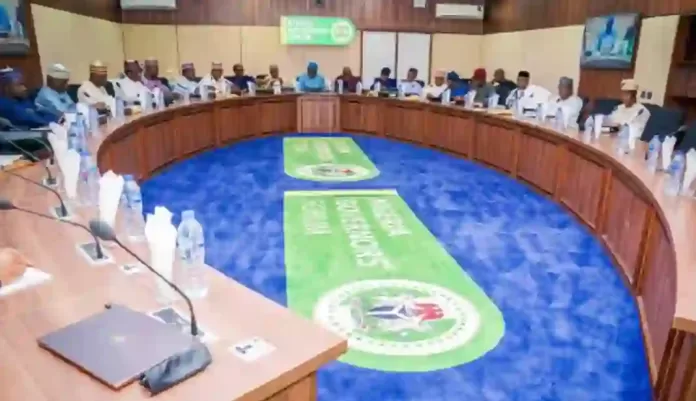
The National Assembly committee on constitutional amendment is confronted with requests for the creation of 55 new states and 278 additional local councils as it  commenced deliberations on far-reaching amendments.

Ismail Mudashir, spokesman for the Deputy President of the Senate, Senator Barau, who  disclosed this in a statement issued in Abuja on Friday, stated that the committee is currently holding a two day retreat in Lagos.

Deputy President of the Senate, Barau Jibrin, reaffirmed the legislature’s commitment to delivering “people-centred and timely” amendments to the constitution.

Barau, who also chairs the Senate Committee on Constitution Review, urged lawmakers to work towards fulfilling their promise of transmitting the first set of amendments to the state Houses of Assembly before the end of the year.

“It has been a long journey to bring the Senate and the House of Representatives’ Constitution Amendment proposals that cut across several sections and deal with different subject matters.

“We have been in this process for the past two years, engaging our constituents, critical stakeholders, institutions, civil society organizations and interest groups in town hall meetings, interactive sessions and public hearings, harvesting and synthesizing views and perspectives which has ultimately culminated to what we have here today, 69 bills, 55 state creation requests, two boundary adjustments and 278 local government creation requests.”

Barau noted that members are expected to resolve these issues and make recommendations to both chambers, expressing optimism that progress could be achieved within the two-day session.

“It is not going to be a simple task to achieve within two days, but I believe we can do it, especially as we have promised Nigerians that we will deliver the first set of amendments to the State Houses of Assembly before the end of this year.”

While stressing the need for patriotism and unity in the review exercise, Barau—who also serves as the First Deputy Speaker of the ECOWAS Parliament—urged participants to avoid divisive tendencies.

“We are seated here as one committee. There should be no ‘we’ and ‘them’; we should be guided by the interests of Nigerians. I wish all of us a very fruitful deliberation and hope for recommendations that will meet the approval threshold of the provisions of Section 9 of the Constitution,” he said.

Oborevwori Suspends Three Principal Officers Of Delta State Polytechnic

0
Governor Sherrif Oborevwori

By Ayodele Oni

Delta state Governor, Sheriff Oborevwori, has approved the immediate suspension of the Rector and Bursar of the state Polytechnic, Ogwashi-Uku, for a period of six months.

Acting in his capacity as Visitor to the Delta State Polytechnic, he also upheld the earlier suspension of the Registrar by the Polytechnic’s Governing Council.

A statement signed by the Secretary to the State Government (SSG), Dr. Kingsley Eze Emu, on Friday, explained that the suspension of the principal officers is to allow for a thorough and unbiased investigation into allegations of administrative misconduct and financial breaches levelled against them by the Governing Council.

The statement further directed that the Deputy Rector shall act as Rector during the six-month suspension period, while the most senior accountant in the Bursary Department will serve as Acting Bursar for the same duration.

In another development, the Executive Assistant to the Governor of Delta State on Public Enlightenment (Projects and Policies), Mr Olisa Ifeajika, has described the state’s whistle-blowing policy as a transformative tool for deepening transparency, accountability, and value-for-money governance under Governor Sheriff Oborevwori.

Speaking on Niger Delta Today on Advocate Broadcasting Network (ADBN) on Friday, Ifeajika explained that the initiative, introduced by the governor, empowered citizens to actively monitor public projects and report lapses directly to the government through dedicated communication channels.

According to him, the whistle-blowing mechanism was conceived as part of Governor Oborevwori’s vision to ensure that every naira spent on public infrastructure translates into tangible benefits for Deltans.

He said that the policy was a natural extension of the governor’s inspection culture, aimed at sustaining project quality and preventing waste.

“The essence of whistle-blowing is to make sure that citizens get value for the money government spends on their behalf.

“These projects are sited in communities for the people. The governor cannot be everywhere, nor can commissioners or officials. So, the people themselves have become part of the inspection process.

“Since the policy’s introduction, the level of compliance among contractors has improved significantly, with many adopting stricter quality control measures due to increased community scrutiny.

“Even the contractors are now cautious.They don’t know who among the residents may report irregularities. Everyone wants to do better. It’s now a healthy competition to deliver quality projects.”

Ifeajika assured Deltans that the government had built strong confidentiality safeguards into the policy to protect whistle-blowers from any form of victimization or witch-hunt.

“No one will be punished for offering developmental information. This is public ownership. The infrastructure belongs to all Deltans, not to the governor or the commissioner. Everyone is a stakeholder.”

The governor’s aide further explained that reports received through the whistle-blowing channels “are immediately verified before any action is taken.”

He said that the system focused on practical and visible infrastructure such as roads, schools, hospitals, and other public utilities, and also extended to the public service where officers were encouraged to expose corruption or administrative misconduct.

He cited cases where engineers and supervising officials had been sanctioned for negligence or complicity in substandard work, stressing that the government was uncompromising about accountability.

“Some government officials have been reprimanded for looking the other way. The whole idea is to make sure that public funds yield durable infrastructure and that we don’t keep revisiting the same projects.

“We’ve turned governance into a collective enterprise. When people see that their input is respected, they become more interested in protecting public assets.”

He expressed confidence that the whistle-blowing policy would outlive the current administration, noting that its effectiveness and acceptance across the state had made it a model for sustainable governance.

“This is one good legacy that will endure. Future administrations will continue with it because it works. It’s not about politics, it’s about accountability, good governance, and ensuring that Delta remains on the path of progress,” he affirmed.

Shake Up In Military As Tinubu Appoints New Service Chiefs, Musa Out As CDS

0
President Bola Tinubu

By Ayodele Oni

As part of efforts to strengthen the country’s national security architecture, President Bola  Tinubu has approved major changes with the appointment of new Service Chiefs.

According to a statement issued on Friday by Sunday Dare, Special Adviser to the President on Media and Public Communication, the reshuffle affects the heads of the Army, Navy, and Air Force, as well as the Chief of Defence Staff.

Under the new appointments, General Olufemi Oluyede replaces General Christopher Musa as the Chief of Defence Staff (CDS); Major-General W. Shaibu has been named the Chief of Army Staff (COAS), while Air Vice Marshal S.K. Aneke takes over as the Chief of Air Staff (CAS).

The new Chief of Naval Staff (CNS) is Rear Admiral I. Abbas and Major-General E.A.P. Undiendeye retains his position as Chief of Defence Intelligence (CDI).

President Tinubu expressed deep appreciation to the outgoing CDS, General Musa, and other departing Service Chiefs for what he described as their patriotic service and dedicated leadership to the nation.

He urged the newly appointed military heads to justify the confidence reposed in them by upholding the professionalism, vigilance, and comradeship that define the Nigerian Armed Forces.

“All appointments take immediate effect,” the statement concluded.

OPINION: Nicolas Sarkozy And The Nigerian Reality

0
Valentine Obienyem
Valentine Obienyem

By Valentine Obienyem

I came across a post on the Facebook page of my friend, Chijioke Precious, SAN. He did not write it merely to inform, but to invite reflection – that nobler function of thought through which truth slowly reveals itself. Permit me, then, to share and ponder its hidden message.

First, let us summarise the learned SAN’s post: Following threats from inmates, two police officers have been stationed beside former French President Nicolas Sarkozy’s cell at Paris’s La Santé prison. The 70-year-old, serving a five-year sentence for raising campaign funds from Libya, described his first night as ‘frightening,’ prompting an investigation and added security.

Beneath its cold lines lies the warmth of civilisation: a society that has learned to hold even its kings answerable to the same laws that bind the peasant. France, like other mature nations, has built a moral architecture where no man, however exalted, stands above justice.

Going by the history of France, the nation has indeed endured many political upheavals along its tortuous path. From the rise and fall of Napoleon Bonaparte to the restoration of the Bourbons, and from the extravagance of its queens to the fires of revolution they helped ignite, France has passed through storms that ultimately shaped its modern conscience.

Across the world, similar stories echo. In South Korea, two former presidents – Park Geun-hye and Lee Myung-bak – were imprisoned for corruption and abuse of power. In Israel, Ehud Olmert, once the nation’s head of government, exchanged the corridors of power for a prison cell. Brazil’s Luiz Inácio Lula da Silva was condemned for corruption before destiny, and the people, restored him. In China, the once all-powerful Zhou Yongkang was brought low by the same state he had ruled. In South Africa, Jacob Zuma, hero of the anti-apartheid struggle, was not spared when he defied the law.

In these examples lies a moral symmetry –  the kind that suggests civilisation begins not with buildings or machines, but with the subordination of power to principle. It is sustained when leaders realise that they are not above their countries.

Now let us turn our gaze homeward. In Nigeria, the same crimes flourish like wild grass in the rainy season, yet the reapers of justice are blind. Our prisons overflow with the poor, while the rich dine like Lucullus at the banquets of impunity.

Who was Lucullus? A Roman general of courage and conquest who, after years of war, exchanged the rigours of the camp for the softness of luxury. His feasts were so lavish that his name- Lucullan – became a byword for extravagance. When Cicero once teased him about his indulgence, Lucullus replied proudly, “Today, Lucullus dines with Lucullus.”

So too in Nigeria: our public officers, having plundered the commonwealth, withdraw into a Lucullan peace – dining richly upon the spoils of their own corruption. Of course they are always above the laws of the land.

Ours is a country that adores even its worst leaders. Agencies created to fight corruption often end as instruments of vengeance or bargaining chips in political chess. Justice in Nigeria moves with lightning speed against the weak, but limps like an aged pilgrim when the accused wears the robe of privilege.

The ancient Scythian sage, Anacharsis, once said that “laws are like spiders’ webs; they catch the small flies, but let the big ones break through.” The centuries have not dimmed the wisdom of that saying. In Nigeria, our legal system glistens in the sun, but its beauty is deceitful. It catches the petty thief and the market woman, but the grand looter, swollen with public wealth, tears through it with ease – and even grace.

The tragedy is not merely legal; it is moral. Every time a hungry youth is jailed for stealing a loaf of bread while a politician accused of stealing billions walks free, we announce to the world that our nation reveres theft when it is grand, and punishes it only when it is small.

Walk through Abuja or any of our great cities. Behold our monuments, our streets, our airports – most of them bear the names of men whose deeds were a wound upon the nation’s conscience. We celebrate them because they once held power, not because they used it well.

What irony! Some of those whose names adorn our landmarks seized power through coups, annulled constitutions, and ruled by decree. They silenced dissent, squandered fortune, and corrupted our moral soil. In a just world, such names would inspire solemn remembrance, not veneration. Yet we immortalise them in marble and concrete – as if to mock Nigerians.

This inversion of values teaches our youth a cruel lesson: that to be remembered in Nigeria, one must first have betrayed her. Our honours, our institutions, our monuments are testimonies of usurpations.

In France, a former president sits behind bars – a message to the living that power does not sanctify wrongdoing. In Nigeria, those who have plundered the nation are serenaded in songs, celebrated in ceremonies, and embalmed in stone.

Perhaps one day, when our collective conscience awakens, we shall build a society where even the mighty fear the law; where power bows to justice; and where honour, once lost, cannot be bought back with monuments.

Until then, Sarkozy sits in prison –  and Nigeria, still free of justice, remains in chains

Sowore Re-arrested  Outside Abuja Court

0
Omoyele Sowore

By Ayodele Oni

The bail granted Activist Omoyele Sowore by the Kuje Magistrate Court in Abuja on Friday was shortlived as police officers re-arrested him.

Eyewitnesses said Sowore was punched and dragged into a waiting police van by officers led by CSP Ilyasu Barau, the Officer-in-Charge of the Anti-Vice Section, DC-CID, FCT Command.

The incident reportedly occurred while his legal team was processing his bail conditions.

Eye witness account recollects that “The IPO punched him, dragged him on the ground, and pushed him violently into the van. When we demanded to see a remand order, they refused to produce any document.”

Sowore and 13 others had earlier been granted bail by Magistrate Abubakar Umar Sai’id in the sum of ₦500,000 each. The court also ordered them to present a verified National Identification Number (NIN), three-year tax clearance certificates, and submit their passports.

The defendants, including Aloy Ejimakor, counsel to detained IPOB leader Nnamdi Kanu, were arraigned on charges of unlawful assembly and disturbance of public peace following their participation in the recent #FreeNnamdiKanuNow protest in Abuja.

Despite the court order, witnesses alleged that the police ignored the ruling and whisked Sowore away, citing what they called a “secret remand order.”

Court Grants Kanu’s Request To Receive Visitors Weekend Preparatory To Open Defence

0
Nnamdi Kanu - IPOB Leader

By Ayodele Oni

The detained  leader of the proscribed separatist group, the Indigenous People of Biafra (IPOB), Nnamdi Kanu on Friday told a Federal High Court in Abuja that he

will be expecting witnesses from all over the world, including the United Kingdom, the United States of America, Kenya and Ethiopia for his defence.

He therefore applied for an order of the Court that the DSS should allow him access to people even on Saturday and Sunday for the purpose of preparing his defence.

The remark came after Kanu failed to open his defence in the ongoing terrorism trial before a Federal High Court in Abuja on Friday

Kanu blamed his inability to open his defence on the failure of his former counsel, Godwin Kanu Agabi SAN to hand him over his case file and enable him adequately prepare his defence.

Kanu was slated to open his defence on Thursday. Instead, he dramatically announced the sacking of his legal team led by a former Attorney General of the Federation (AGF), Kanu Agabi, and, thereafter, prayed the court to grant him a short adjornment till Friday.

When the case was called on Friday, the prosecuting lawyer, Adegboyega Awomolo (SAN), told the court that the case was scheduled for the defendant (Kanu) to open his defence.

When it was Kanu’s turn to speak, he told the court that he would not be able to open his defence, blaming the move on his inability to access his case file from the legal team he debriefed on Thursday.

Kanu further told the court that those who were to bring the case file to him,

where he is currently being held in the Department of State Services (DSS) facility, did not.

He prayed the court for an adjournment till Monday, October 27, to enable him gain access to the case file and familiarise himself with the contents.

Awomolo did not object, following which Justice James Omotosho ordered the DSS to allow Kanu receive visitors on Saturday and Sunday.

The judge thereafter adjourned till October 27 for the defendant to open his defence, warning that the six days granted Kanu to conduct his defence, which began on October 23, will not be extended.

North East Insurgency: How Nigerian Army Vanquished ISWAP Top Commanders

0
Soliders on Duty

By Aina Akinjide, Abuja Bureau Chief

It was a bad day and  heavy blow to the Islamic insurgent group, Islamic State West Africa Province (ISWAP) Thursday as five of its senior top field commanders met their Waterloo during fierce encounter with troops of the Nigerian Army fighting nearly a two decade long insurgency in the North Eastern zone of the country.

The five eliminated terrorist Commanders were part of the 50 terrorists killed when troops from Operation Hadin Kai (OPHK) successfully repelled several coordinated attacks in Borno and Yobe states early Thursday morning.

According to military sources the

offensive was one of the most significant defeats the terrorist group has faced this year. A counter-insurgency expert,  Zagazola Makama, corroborated the military encounter and the terrorists’ losses in a post on X.

iswap BokoHaram
Islamic Insurgents

The neutralised ISWAP Commanders were identified as Ari Kolo (Munzir Abbagajiri), Ya Muhammad (from Dosula), Abu Aisha (from Abba Gajiri), Hamzalah (Qaid at Gambo Gege and Faruk villages), and Abu Rijal (from Dosula).

They were killed during simultaneous battles that erupted in Dikwa, Mafa, Gajibo, and Katarko.

Military sources informed the magazine that ISWAP fighters initiated the attacks from the neighbouring Republic of Cameroon region, while other terrorist elements converged from the Timbuktu Triangle, a well-known insurgent hideout.

General Christopher Musa
General Christopher Musa, Chief of Defence Staff.

The terrorists then attacked troops from various directions but were met with a fierce response from ground and air forces, resulting in over four hours of intense fighting.

In Dikwa, Gajibo, and Katarko, troops successfully repelled the attacks and inflicted heavy losses on the terrorists, while in Mafa, insurgents briefly infiltrated the area and set some vehicles ablaze before being overpowered.

Military sources indicated that the slain commanders were among ISWAP’s leading battlefield tacticians responsible for numerous previous attacks on military bases, ambushes on patrol convoys, and the deployment of drone-assisted improvised explosive devices (IIEDs).

Their deaths, counter insurgency experts opine, mark a significant setback for ISWAP’s command and operational capabilities in the North-East.

A source revealed that the five commanders coordinated the failed offensive from different fronts, utilizing rocket-propelled grenades (RPGs), anti-aircraft weapons, and suicide units in an attempt to overwhelm troop positions.

“They met their end in a large-scale combined air and ground counter-offensive that resulted in the deaths of dozens of their fighters,” the source added.

The Joint Task Force North-East confirmed that a total of 62 terrorists were killed, while clearance and mop-up operations continued.

Abuja Magistrate Court Grants Bail To Sowore, 13 Others

0
Omoyele Sowore
Omoyele Sowore

By Ayodele Oni

The Police on Friday arraigned Activist Omoyele Sowore and 13 Others arrested in connection with last Monday protest in Abuja over continued detention of the leader of Independent People’s of Biafra, (IPOB) Nnamdi Kanu.

Magistrate Abubakar Sai’l’d sitting in Kuje, Abuja, has granted bail to the human rights activist, Omoyele Sowore and some protesters arrested during the #FreeNnamdiKanuNow protest on Monday.

Others granted bail are Aloy Ejimakor, lawyer to the detained leader of the Indigenous People of Biafra (IPOB), Nnamdi Kanu; his brother, Prince Emmanuel Kanu and 11 others.

Magistrate Sai’I’d issued the bail order on Friday after the defendants were charged with unlawful assembly and disturbance of public peace.

The court granted the defendants bail in the sum of ₦500,000 each, subject to the condition that they present a verified National Identification Number (NIN).

The magistrate also directed the defendants to present their three-year tax clearance certificates and submit their passports to the court as part of the bail conditions.

Sowore was arrested on Thursday by the Police at the premises of the Federal High Court in Abuja after meeting with Nnamdi Kanu, while others were picked up on Monday during the #FreeNnamdiKanuNow.