


Home Blog Page 369

Aisha Buhari: I have No Plans To Remarry

0
Aisha Buhari

Nigeria’s former First Lady Aisha Buhari says she has no plans to remarry following the death of her husband, late President Muhammadu Buhari. Buhari died in July 2025.

Aisha said her decision was basically a pragmatic one which has nothing to do with morality, saying as a widow she’s blessed with children and grand children who are “enough” for her.

The former First Lady was quoted in a book, titled ‘From Soldier to Statesman: The Legacy of Muhammadu Buhari’, a biography authored by Dr Charles Omole and unveiled at the State House, Abuja, on Monday.

The event, the magazine reports was attended by President Bola Ahmed Tinubu, Vice President Kassim Shetima, Speakrer of the House of Representatives, Tajudeen Abass, among other top government officials, including well meaning Nigerians, friends and associates of the late Nigerian President.

“She will not remarry, she says, almost with a shrug,” Aisha was quoted in the book by Omole.

“It is not a moral pronouncement so much as a pragmatic one: she has grandchildren; one husband was enough,” the author said.

Following the demise of her husband, the magazine reported that the immediate past First Lady embarked on a mourning period of four months, which she completed in November.

Also, there were suggestions on the rumour mill at a point, to the effect that the couple was divorced before Buhari died. But those carrying the rumour were unable to substantiate it, even as Aisha insist that she was married to her husband until he died six months ago.

Buhari, died on July 13, 2025, in the United Kingdom at the age of 82. He was buried in Daura, Katsina state.

“Anti-Corruption, Not Anti-Opposition”

0
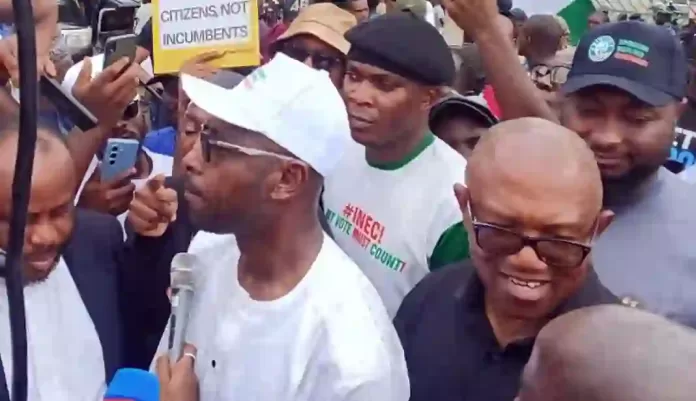
David Mark and Atiku Abubakar and Peter Obi and John Oyegbun

A Joint Statement By Opposition Leaders From Nigeria’s Six Political Zones on alleged Growing Politicisation of State Institutions for Persecution of the Opposition

“We are compelled by duty to nation and conscience to issue this statement to alert our compatriots and the international community to the unfortunate and gradual slide of our country into a state where key national institutions – particularly the Economic and Financial Crimes Commission (EFCC); The Nigeria Police; The Independent Corrupt Practices and Other Related Offences Commission (ICPC) are increasingly perceived as tools of political intimidation, selective justice and systematic persecution of opposition leaders.

Across our nation, there are mounting concerns that state power is being deployed not for prevention of economic crimes, but for persecution of perceived political adversaries, with the ultimate aim of weakening opposition voices and dismantling Nigeria’s multiparty democracy.

A Dangerous Agenda Unfolding

More than ever before in our democratic experience, Nigerians have witnessed what many now describe as a covert, undemocratic agenda: to ensure that all state governments fall under the control of the President’s party – not through transparent electoral contests, but by secretly intimidating opposition governors via the anti-corruption apparatus until they succumb and defect. Recent defections of opposition governors into the ruling party have reinforced public suspicion that political pressure, not ideological or personal persuasion, is driving this realignment. This pattern forms part of a broader project that targets not only elected leaders but also key opposition figures perceived as architects of emerging coalitions ahead of the 2027 general election.

We must warn that this project, if allowed to continue unchecked, poses a grave danger to Nigeria’s democratic future.

Weaponisation of the EFCC

There is a discernible pattern of persecution of the opposition by the EFCC with the sole objective of weakening same for the benefit of the ruling APC. This disturbing pattern mirrors a long-standing sentiment openly expressed years ago by a former National Chairman of the ruling APC, Adams Oshiomhole, who declared when receiving defectors from the PDP: “Once you have joined APC, all your sins are forgiven.” Whether intended as political rhetoric or not, this statement has come to symbolise a troubling reality: allegations against members of the ruling party are routinely perceived to be overlooked, while even unsubstantiated accusations against opposition figures are vigorously pursued and subjected to media trial.

A few recent examples reinforce this perception. Months ago, a minister was implicated in a financial scandal so blatant that only sustained public outrage forced her resignation. Yet, long after stepping down, she has neither been charged nor arraigned by the EFCC and is now actively involved in the President’s re-election campaign. Similarly, another minister remained in office despite the university he claimed to have attended publicly denying his academic certificate. He, too, resigned only after intense public pressure, Months later, no charges have been filed.

Such selective enforcement undermines the legitimacy of anticorruption efforts and erodes public trust. Furthermore, Nigerians are not blind to the sudden empowerment of certain political actors, including individuals appointed to federal executive positions after crossing from the opposition but still claim to be members of opposition party – whose unstated mandate, in the public’s eyes, appears to include the systematic destabilisation of opposition parties through the creation of factions, inducement and the exploitation of judicial processes, allegedly funded by state resources.

Erosion of EFCC’s Independence

The EFCC is a critical national institution, created to safeguard Nigeria’s economic integrity.

Yet today, many Nigerians fear that its independence is steadily being eroded. An agency designed for prevention and accountability risks becoming an instrument of political persecution, undermining both justice and democracy.

The President must recognise that evident social and political injustice could snowball into mayhem as the nation approaches another election cycle. This trend must be halted immediately if the nation must be spared a major catastrophe.

Our demands

  • Depoliticise EFCC: The operations of the EFCC must be urgently shielded from political interference and must not serve the whims and caprices of any President, party or political faction.
  • Return EFCC to Its Statutory Mandate: The Commission must refocus on genuine detection and prevention of economic crimes across board, not selective prosecution, media trials or intimidation of opposition figures. For the avoidance of doubt, the Functions and Powers of the Commission are expressly provided for under Sections 6 & 7 respectively.
  • Defend Multiparty Democracy: Nigerians must remain eternally vigilant to ensure that the President does not transform the country into a de facto one-party state – as witnessed in Lagos over the last 25 years, where opposition leaders were silenced, coerced or induced into irrelevance.
  • Embed Preventive Anti-Corruption Mechanisms: Relying on the Supreme Court ruling on the powers of the EFCC over all public accounts, for true prevention of financial crimes, anti-graft operatives should be embedded in all the payment processes of governments at all levels to ensure compliance with rules of transparency,

accountability and probity in public financial transactions.

Put differently, the EFCC must recognise and exercise their function as covering both pre and post expenditure. operatives must also be held accountable for any unreported but later detected economic and financial infractions in their respective areas of oversight.

To further strengthen the EFCC, we propose that the EFCC Act should be amended for this purpose.

  • Establish an Independent Review Body: We call on the Attorney General, in consultation with the National Assembly, to set up an independent review body which should be granted full access to the public accounts of the federal, all states and all local governments covering from 2015 to 2025, with a mandate to conduct a transparent, comprehensive review of financial transactions and publish its findings. Such a review will expose the EFCC’s pattern of selective prosecution of opposition figures and reveal that many current officials of the federal government—and those of ruling-party-controlled states—should have long been prosecuted for economic and financial crimes, but were shielded due to their political affiliation. Based on its findings, the independent body should also propose amendments to EFCC’s enabling law to strengthen the agency for more effective and efficient prevention of financial crimes.

This proposed body is to be chaired by an eminent judge, and composed of the following:

– Representatives from civil society organisations

– Representatives of the Nigerian Bar Association

– Representatives of Institute of Chartered Accountants of Nigeria

– Representatives of Institute of Chartered Bankers

– The Nigerian Financial Intelligence Unit

– Representatives of anti-graft agencies

– Representatives of the Police

– Representatives of the DSS

– Representatives of the Armed Forces

– Representatives of all political parties with a seat in the National Assembly.

A Call to Defend Nigeria’s Democracy

We call on all patriotic Nigerians across party lines, professions, regions and faiths to stand firm. Our democracy is under threat through the deliberate and systematic weakening of opposition forces, with the EFCC as the central instrument in this troubling strategy.

In the coming weeks, we will provide more details, and also engage foreign partners of Nigeria’s anti-graft agencies and diplomatic missions, including United States, UK, Canada, EU, World Bank Office, United Nations, to express our deep concern about the EFCC increasingly becoming a willing tool in a broader scheme to weaken opposition in Nigeria, and also demand a reform of the anti-graft agency.

Nigeria’s democracy demands our vigilance, courage and unity, as Edmund Burke, an Anglo-Irish statesman and philosopher, warned: “The only thing necessary for the triumph of evil is for good men to do nothing”.

We are equally guided by the enduring words of Martin Luther King Jnr: “Silence in the face of evil is itself evil ……In the end we shall remember not the words of our enemies, but the silence of our friends.” Now is the time for all of us to rise in defence of our cherished multiparty democracy, and indeed, in defence of the very soul of our nation.

We must make a deliberate choice not to be remembered by posterity for our Silence.

Nigeria belongs to all of us – not to a single party or a single leader.

■Signed:

  • Sen. David Mark, GCON
  • Alh. Atiku Abubakar, GCON
  • Mallam Lawal Batagarawa
  • Chief Bode George
  • Mr. Peter Obi, CON
  • Chief John Odigie-Oyegun

Tinubu Acting As If Under A Spell- Atiku’s Spokesman

0
Bola Ahmed Tinubu
President Bola Ahmed Tinubu.

Kenneth Okonkwo, a spokesman to former Vice President Atiku Abubakar has described the administration of President Bola Ahmed Tinubu of acting as if it’s under a spell. “ President Tinubu is behaving like he’s under a spell,” Okonkwo said.

Okonkwo stated that President Tinubu came to power under the cover of darkness, through the back door, and that this may be the reason why he’s acting as such, stressing that the current government has no empathy for Nigerians, judging from the manner it’s running the country.

“The Tinubu govt has zero empathy for the people,” he said.

The former Nollywood actor-turned politician made the remark on Tuesday, while  responding to the Supreme Court judgment which ruled that the president has the powers to suspend elected state officials, including the governor and state Assembly lawmakers during a period of Emergency Rule.

The magazine reports that the nation’s highest court, on Monday, ruled on a suit filed by the Attorneys-General of Adamawa, Enugu, Osun, Oyo, Bauchi, Akwa Ibom, Plateau, Delta, Taraba, Zamfara, and Bayelsa states against  the Federal Government and the National Assembly, on the propriety of the six months Emergency Rule declared by President Tinubu in Rivers state in March this year, under which Governor Siminalayi Fubara and the State House of Assembly were suspended.

The nation’s apex court gave a split judgment of five to one justices on the suit yesterday.

Asked whether the Supreme Court made the right judgment, Okonwko, who’s also a lawyer argued that the  judgment was  not a true reflection of the rule of law, and the Nigerian Constitution, noting that the justices violated the Constitution by making a judgment which negated the provision of the nation’s extant laws.

According to him, judges are expected by law to make judgment which promotes good governance in the country, in this case, however, this is not the case.

He urged the National Assembly to overrule the Supreme court by amending the law, for instance, to show that the president has no power to remove elected officials.

He, however, said the current National Assembly may not be able to that, because, according to him, the lawmakers  are rubber-stamp of the Presidency, as they are doing the bidding of the president.

The Supreme Court had yesterday upheld the constitutional power of the President to declare a state of emergency in any state to prevent a breakdown of law and order or a descent into chaos and anarchy.

According to a split decision of six to one Justices of the apex court, the President has authority under the Constitution to proclaim a state of emergency, and may suspend elected officials, provided any such suspension is for a limited duration.

In the lead majority judgment delivered by Justice Mohammed Idris, the apex court held that, Section 305 of the 1999 Constitution empowers the President to adopt extraordinary measures to restore normalcy where a state of emergency has been declared.

He noted that the provision does not specify the exact nature of those extraordinary measures, thereby vesting the President with the discretion on how to act in such circumstances.

The judgment followed a suit brought before the court by the Peoples Democratic Party (PDP) governors, challenging the declaration of a state of emergency in Rivers State by President Bola Tinubu, during which elected state officials were suspended for six months.

The Supreme Court had, in October, reserved judgment in the matter to a date to be communicated to parties.

The suit has the Attorneys-General of Adamawa, Enugu, Osun, Oyo, Bauchi, Akwa Ibom, Plateau, Delta, Taraba, Zamfara, and Bayelsa states as plaintiffs, while the defendants were the Federal Government and the National Assembly.

In the suit, marked SC/CV/329/2025, the plaintiffs asked the Supreme Court to determine whether the President has the constitutional authority to suspend a democratically elected government in a state and whether the procedure adopted in declaring a state of emergency in Rivers State contravened the 1999 Constitution.

Among other reliefs, the plaintiffs urged the apex court to determine, “Whether, upon a proper construction and interpretation of Sections 1(2), 5(2), 176, 180, 188, and 305 of the Constitution of the Federal Republic of Nigeria 1999, the President of the Federal Republic of Nigeria can lawfully suspend, or in any manner whatsoever interfere with, the offices of a Governor and the Deputy Governor of any of the 36 component States of the Federation and replace them with his unelected nominee as a Sole Administrator, under the guise of, or pursuant to, a Proclamation of a State of Emergency in any of the Plaintiffs’ States.

“Whether, upon a proper construction and interpretation of Sections 1(2), 4(6), 11(4) & (5), 90, 105, and 305 of the Constitution, the President can lawfully suspend the House of Assembly of any of the 36 States under the guise of, or pursuant to, a Proclamation of a State of Emergency in such States.”

Earlier in the judgment, Justice Idris upheld the preliminary objections raised by the Attorney-General of the Federation (AGF) and the National Assembly (Defendants in the matter) against the competence of the suit and held that the plaintiffs failed to establish any cause of action capable of activating the original jurisdiction of the Supreme Court.

In the six-to-one majority judgement, the apex court agreed that the plaintiffs did not demonstrate the existence of an actionable dispute between them and the Federation to warrant the exercise of the court’s original jurisdiction.

Consequently, Justice Idris struck out the suit for want of jurisdiction.

However, in a dissenting judgement, Justice Obande Ogbuinya held that the suit of the plaintiffs succeeded in part.

He agreed that the President has the power to declare a state of emergency, but held that such power cannot be used to suspend elected state officials, including governors, deputy governors, and members of state legislatures.

Plateau Governor Set To Dump PDP For APC

0
Governor Caleb Mutfwang

By Adesina Soyooye

After initial denials, Plateau State Governor, Caleb Mutfwang, is finally set to dump the the Peoples Democratic Party, PDP, for the All Progressives Congress, APC.

This was disclosed by the Governor’s Political Adviser, Istifanus Nwansat, in Abuja to newsmen.

According to him, given the political chaos in the PDP, dumping the Party for the APC remains the best option for the Governor.

He, also, said that Muftwang’s  defection to the APC would “align with President Bola Tinubu’s political and governance trajectory on the Plateau.”

He noted: “That is why the governor is moving into the APC. And again, the governor believes that it is good and reasonable enough as a leader for him to move his people to align with the President.

“This is because by our own assessment as a state, even though members of the PDP, we appreciate and recognise the efforts of Mr President in putting things right.”

Within the past two week, the PDP has lost four State Governors – Governors Ademola Adeleke, Siminalayi Fubara, Agbu Kefas and Mutfwang of Osun, Rivers, Taraba and Plateau respectively.

Ondo PDP Says Gov. Aiyedatiwa Statewide Tour Meaningless

0
Lucky Aiyedatiwa
Ondo State Governor, Lucky  Aiyedatiwa.

By Ayodele Oni

The Peoples Democratic Party (PDP) in Ondo State has criticised the statewide thank-you tour being undertaken by Governor Lucky  Aiyedatiwa, describing it as misplaced and inappropriate two years into his tenure as substantive governor.

Aiyedatiwa had earlier served out about two years left behind by late Oluwarotimi Akeredolu before his inauguration in February as elected Governor.

The tour commenced on Monday with the four Akoko local government areas of Akoko North-West, Akoko North-East, Akoko South-East and Akoko South-West, where the Governor thanked residents for their support this year and galvanised backing for the re-election of President Bola Ahmed Tinubu in 2027.

The Source (Magazine) reports that the tour looks like a two-fold event- to thank people of the state for his election and to sensitize them for the next general election, especially second term ambition of President Bola Tinubu.

In a statement on Monday by the PDP Director of Media and Public Communications, Wande Ajayi, the party pointed out that the governor should be embarking on a commissioning tour of completed projects, rather than visiting communities with what it described as handouts and token gestures.

The opposition party argued that after two years in office, the governor ought to account for funds accrued to the state, including federal allocations, internally generated revenue and special intervention funds.

According to the PDP, residents of the State deserve tangible development outcomes such as functional schools, well-equipped hospitals, motorable roads, job creation and economic revitalisation.

The party further alleged that public infrastructure across the state has deteriorated, claiming that schools and healthcare facilities are in poor condition, roads have become unsafe, and civil servants and pensioners continue to face economic hardship.

The PDP, also, questioned the pace of project execution by the current administration, stating that projects announced by the government are allegedly far from completion, with contractors absent from sites in many cases.

Describing the thank-you tour as a reflection of misplaced priorities, the party maintained that governance should focus on delivering results rather than public relations activities.

It called on the governor to provide explanations for stalled projects and the continued decay of public infrastructure despite what it described as steady inflows of funds to the state.

The PDP insisted that Ondo State deserves accountable leadership and effective governance, not what it termed charity politics, urging the government to address pressing developmental challenges facing the State.

“We May Seek Alliances With Other Political Platforms If The PDP Crises Persist” – Sule Lamido

0
Sule Lamido

By Suleiman Anyalewechi

Former Governor of Jigawa State and one of the members of the G-34 that midwifed the now troubled Peoples Democratic party PDP in 1998  has signalled his intention and that of his teaming followers to explore the option of the formation of an alliance with other parties should the leadership and internal crises bedeviling the party continue to fester.

This is as he reaffirmed his continued membership of and loyalty to the PDP.

At an interactive session with the media on Monday December 15, 2025 at his office in Kano, the President Olusegun Obasanjo-era Minister of Foreign Affairs warned that the outcome of reconciliatory parley scheduled for December ending with the leadership of the PDP will determine his next line of action.

It will be recalled that Lamido a two-term Governor of Jigawa State on the platform of the PDP had, in the count down to the November 15 and 16 Ibadan National Convention, engaged in a legal battle with the party over his exclusion from the National Chairmanship contest.

However, despite a Federal High Court Abuja ruling stopping the Convention and ordering that Lamido be allowed to be on the ballot, the party proceeded with the Convention, a development that forced the former Minister of Foreign Affairs and his supporters to shun the gathering in Ibadan.

Lamido, who is also a member of the PDP’S Board of Trustees, BoT, had, last month, during a courtesy visit by his supporters from the 27 Local Councils of Jigawa, assured them that efforts are ongoing to settle the party’s crisis.

But on Monday,while speaking after another round of meeting with his followers, Lamido warned that they may have no other choice than to enter into an alliance with other parties in the count down to the 2027 general elections if things are not working out as envisaged within the PDP.

He has, however, appealed to his supporters to exercise a little more patience till the end of December, 2025, as he has been assured by some prominent figures and stakeholders, including former President Olusegun Obasanjo, that efforts are underway to resolve the crisis .

“By the end of this month ( December 31,2025 ), we shall know where we are going. But my supporters and I are open to alliances with any political parties if the problem in the PDP is not resolved”, Lamido stated

He reiterated his earlier position on the illegality of the Ibadan National Convention as well as his demand for the dissolution of the National Executive Committee NEC produced from the Convention and constitution of a Caretaker Committee.

Edo: Gov. Okpebholo Promises To Bring Back Life To AAU, Ekpoma

0
Governor Monday Okpebholo

By Ayodele Oni

Edo State Governor, Monday Okpebholo, has stated that his administration is aware that the Ambrose Alli University, (AAU), Ekpoma, a state government owned institution, is currently on life support, which requires immediate intervention .

The governor has, therefore, assured the Management of the University of his administration’s commitment to addressing accumulated unpaid salaries, gratuities and other critical challenges inherited from past administrations.

A statement by Ebojele Akhere Patrick,

Chief Press Secretary to Governor, stated that Okpebholo gave the assurance when he received the Vice-Chancellor of the university, Prof (Mrs.) Eunice  Omonzejie, and members of her management team on a courtesy visit at the Government House, Benin City.

He congratulated the Vice-Chancellor and her team on their appointments, noting that their presentation clearly revealed the depth of challenges confronting the institution.

The governor said, “From what you have outlined today, it is clear that Ambrose Alli University is on life support. I must commend the progress you have recorded so far since assuming the office.

“I am impressed by your efforts, and I want to assure you that in any way possible, this administration will support the university to reposition it and restore its lost glory.”

Addressing the issue of accumulated salary arrears, the governor described the non-payment of staff salaries for several years as unfair and unacceptable.

“It is not right for people to work and not be paid. The issue of unpaid salaries, pensions and gratuities running into billions of naira is something I will take as a project. These are issues inherited from the past government, and we will address them.”

Okpebholo also acknowledged other concerns raised by the management, including hostel infrastructure, accreditation-related challenges and facilities needed for programmes such as Medical Laboratory Science.

He added, “This year’s budget is already at an advanced stage, but I expect that these critical needs will be properly captured in your budget proposals. Once that is done, we will see how best to move the institutions forward,”

Earlier, the Vice-Chancellor, Prof Omonzejie, explained that the delay in visiting the governor was due to a recently concluded accreditation exercise and the need to carry out a thorough assessment of the state of the university.

She added that the University she inherited was in a moribund state, facing series of infrastructural problems, unpaid salaries, accreditation amongst other.

She expressed profound appreciation to Governor Okpebholo for what she described as “life-saving interventions” since his assumption of office.

According to her, the governor’s approval of increased monthly subvention, restoration of affected staff to the payroll, support for graduating backlog medical students, improved security logistics, and facilitation of road construction through the NDDC have significantly revived the university.

She also formally presented pressing needs requiring urgent attention, including accumulated unpaid salaries, pensions, gratuities, union deductions, as well as the construction of lecture theatres and hostels to enhance accreditation and expand student intake, particularly in the College of Medicine

Ngige To Remain At Kuje Prison Till Thursday

0
Chris Ngige in Court
Dr Chris Ngige

By Ayodele Oni

Former Minister of Labour, Dr Chris Ngige’s stay at  Kuje prison has been extended  till December 18, when his bail application would be decided by the High Court of the Federal Capital Territory sitting at Gwarimpa in Abuja.

Both Counsels for the plaintiff and defendant took the time of the court on Monday to argue for and against the bail request by Ngige.

The court had, last week, deferred action on the bail application till Monday.

Justice Maryam Aliyu Hassan issued the order on Monday shortly after taking arguments for, and against the bail request.

Counsel to Ngige, Patrick Ikwueto, SAN, pleaded with the Judge to admit the former Minister to bail, mainly on health grounds.

He submitted that the former Minister would not jump bail or interfere with witnesses if admitted to bail.

On the other hand, counsel to the Economic and Financial Crimes Commission, (EFCC), Sylvanus Tahir, SAN, vehemently opposed the bail request.

While noting that Ngige was a flight risk, Tahir told the Judge that the former Anambra Governor was granted administrative bail by the anti-graft agency and allowed to travel abroad for medical care, but never reported back to the Commission.

The legal luminary further argued that the international passport released to Ngige; to facilitate the trip abroad was never returned till today.

According to Tahir, it was when Ngige was re-arrested that he came up with a purported claim that he lost his passport.

The lawyer maintained that the claim of passport loss was an afterthought and should not be believed by the court.

After the submissions, Justice Hassan fixed December 18 to deliver ruling in the bail request.

Supreme Court Rules In Favour Of Fidelity Bank In Sagecom Case

0
Fidelity Bank Plc
A five-member panel of the Supreme Court, led by Justice Lawal Garba, on Friday ruled in favor of Fidelity Bank in its appeal against Sagecom Concepts Limited. Given previous rulings, this marks a significant victory for Fidelity Bank in a long-running legal dispute.
The judgment brings definitive closure to a legacy case that has attracted attention across the financial sector for more than two decades.
In a motion dated October 8, 2025, Fidelity Bank sought clarification from the Supreme Court, requesting a consequential order that the judgment debt be paid in Naira. The bank also asked that the interest rate be set at 19.5% per annum rather than 19.5% compounded daily. Additionally, it prayed that the exchange rate used for conversion be the rate on the date of the High Court judgment, in line with the Supreme Court’s decision in Anibaba v. Dana Airlines.
Fidelity Bank further requested that the judgment debt be fixed at ₦30,197,286,603.13 and that interest on this amount be payable at 19.5% per annum until full settlement.
In a ruling delivered by Justice Adamu Jauro, the apex court granted the bank’s first three prayers but declined the fourth and fifth. As a result, the judgment sum will be paid in Naira at an annual interest rate of 19.5%, rather than the daily compounded rate previously awarded by the High Court. The Supreme Court also affirmed that the applicable exchange rate should be that of the date of the High Court judgment, consistent with its earlier decision in Anibaba v. Dana Airlines.
The dispute originated from a legacy transaction involving the former FSB International Bank, which merged with Fidelity Bank in 2005. It stemmed from a 2002 credit facility extended to G. Cappa Plc and subsequent legal proceedings tied to the collateral.
This ruling provides finality to years of litigation and confirms a significantly lower liability than the ₦225 billion previously speculated in some quarters. It aligns with Fidelity Bank’s consistent computation and materially contradicts earlier estimates.
Throughout the case, Fidelity Bank’s share price remained stable, reflecting investor confidence in its strong governance framework, prudent risk management, and robust financial fundamentals. Industry experts believe the judgment reinforces the bank’s financial strength and commitment to transparent, responsible governance.
When approached for comment, Fidelity Bank representatives declined to speak on the matter but expressed gratitude to the Supreme Court for bringing clarity and closure to the case.

Imo Ready For Business, Uzodimma tells Nova Bank Board, Management

0
Hope Uzodimma
Governor Hope Uzodimma

The Governor of Imo State, Sen. Hope Uzodimma Monday, December 25, 2025, commissioned the regional headquarters of Nova Bank in Owerri, informing the board, management, staff, and stakeholders, that Imo State is ready for business with the bank.

In his remarks while unveiling the former Merchant Bank (but now a Commercial Bank), Governor Uzodimma noted that his administration’s huge investment in infrastructure, and the conscious efforts

to make Imo State a choice destination hub for investors seeking conducive business and economic environment, had already

guaranteed Nova Bank a place in Imo to thrive.

He described the Chairman of Nova Bank, Mr. Philip Oduozor, as a “tested and trusted” hand in the banking sector in Nigeria, “one of the best and brightest” and the reason the bank should be cut out for huge success.

“Imo State is ready for business,” Governor Uzodimma said, noting that Nova Bank unveiling marked, yet another strategic partnership between the State government and the financial institutions, in what he regards as a “joint commitment to foster a conducive environment for investment.”

“When a leading financial institution chooses to plant its regional roots in our soil, it is a statement that reverberates louder than any political stage,” he told a crowd of stakeholders, business leaders, political office holders and Nova Bank officials who attended the event.

He also pointed out that Access Bank had recently opened her own regional headquarters in Owerri, “further signifying growing confidence in Imo’s economic potential.”

Governor Uzodimma therefore lauded Nova Bank for her vision.

“Through this regional headquarters, Nova Bank has demonstrated a clarity of vision that is worthy of commendation. You have looked beyond the surface and recognised the new Imo as more than just a place to visit, but a place to build, a place to grow, and a place to prosper.”

The Governor reiterated his administration’s commitment to transforming Imo State’s image from a leisure destination to a thriving business hub.

He acknowledged historical perceptions that relegated the State to being merely a consumer of wealth, and emphasised the reason he is making conscious efforts to change the narrative by building an ecosystem where enterprise thrives in the State.

Governor Uzodimma also related the many infrastructure improvements that have laid the groundwork for business growth, including enhanced road connectivity, digitised tech skill acquisition and land administration, as well as increased power supply.

He brought to the fore the gains from the recent Imo Economic and Investment Summit that attracted global political and business leaders, and reminded Nova Bank that coming to Owerri at this time also speaks to the dream of the economic and business potential of Imo State as attested to by the Summit attendees.

“By the end of this month, greater parts of Owerri will have stable power supply 24/7,” he hinted, adding that “peace and nightlife have fully returned to our streets.”

The Governor extended an invitation to Nova Bank to deepen its roots in Imo, encouraging the bank to consider establishing a head office in the State.

He promised to make available a plot of land in a choice area in Owerri for that purpose in the spirit of “Investment Meets Opportunities – IMO.”

“We support you because the bank is our own bank, and fits into our vision for a new Imo,” he stated, emphasising the potential for shared success under a public-private partnership (PPP).

In his address earlier, the Chairman of Nova Bank, Mr. Philip Oduozor who also hails from Imo State, revealed that though the bank had formally opened today, December 15, she has been in operation since 2018 as a Marchant Bank.

He stated that he was poised to find means of helping Imo people and the entire South East region through facilitating credits and loans that support SMEs.

He appreciated Governor Uzodimma for creating the enabling environment that can attract investment in Imo State, and for personally finding time to unveil the regional headquarters despite his crowded schedule.

The highpoint of the unveiling was the tour/inspection of the facilities in the bank by the Governor and the Bank’s Senior officials.