Home Blog Page 291

CBN Issues Operating Licences To New BDCs

0
Bureau de change

The Central Bank of Nigeria has issued operating licenses to 82 Bureau De Change, BDC,  operators in the country, saying the action was in line with its regulatory powers, under the Bank and Other Financial Institutions Act (BOFIA) 2020, and the Regulatory and Supervisory Guidelines for Bureaux De Change Operations in Nigeria 2024

According to a statement on Monday signed by the Acting Director of Corporate Communications, Hakama Sidi-Ali, the apex bank said the new BDC became fully licensed effective November 27, 2025.

It however, warned the public to stop patronising BDC operators whose licenses have not been fully verified.  unlicensed BDC

“By this notice, only Bureaux De Change listed on the Bank’s website are authorised to operate from the effective date.

“While the CBN will continue to update the list of Bureaux De Change with valid operating licences for public verification on our website (www.cbn.gov.ng), the Bank advises the general public to avoid dealing with unlicensed Foreign Exchange Operators,” the CBN said.

Nigerian Airforce: Burkina Faso Landing Was Deliberate, No Course For Alarm

0
Burkina Faso Seized Nigerian Aircraft

Contrary to reports the Nigerian Airforce has clarified the circumstances surrounding the landing of one of its  aircraft (C-130) in Burkina Faso, a development that’s currently generating controversy across the country.

On Monday, the Burkina Faso government claimed that the aircraft carrying 11 soldiers was forced to land and grounded in the country after reportedly violating its airspace.

Reacting, the Nigerian Airforce, in a statement on Tuesday by the Director of Public Relations and Information, Air Commodore Ehimen Ejodame, said the crew took off on December 8 from Lagos and was on their way to Portugal when an emergency happened, forcing them to divert to the nearest airfield in line with standard safety procedures and international aviation protocols.

Following the incident, Ejodame said, the personnel on board the aircraft that landed in Bobo-Dioulasso, are safe and receiving cordial treatment from Burkinabe authorities, .

He stressed that the crew were already planning to resume the mission as scheduled, expressing gratitude to Nigerians for their concern and support for the NAF.

The statement read, “The Nigerian Air Force wishes to clarify reports regarding the diversion of a NAF C-130 aircraft during its ferry mission to Portugal on 8 December 2025. Following takeoff from Lagos, the crew observed a technical concern which necessitated a precautionary landing in Bobo-Dioulasso, Burkina Faso, the nearest airfield, in accordance with standard safety procedures and international aviation protocols. The NAF crew is safe and has received cordial treatment from the host authorities.

“Plans are ongoing to resume the mission as scheduled. The Nigerian Air Force appreciates the support received during this period and assures the public that NAF remains professionally committed to strict compliance with operational procedures and safety standards, ensuring the protection of its personnel while fulfilling its constitutional mandate.”

FG Ends Cash Payments For Services, Directs MDAs To Use POS Machines

0
George Akume - SGF

The Federal Government has directed all federal ministries, parastatals and agencies to stop receiving physical cash for services they render effective January 1, 2026.

In a series of memo released on Monday, the Tinubu administration declared that cash transactions will not longer be allowed from next year, saying it is alarmed that the Treasury Single Account , TSA, and e-payment policies are still being grossly violated.

According to the circulars, the continued use of cash by some MDAs has created loopholes, weakened the integrity of the government’s electronic payment systems and exposed public revenue to leakages and manipulation.

The Accountant-General, Shamseldeen Ogunjimi, noted that the practice of collecting cash at government offices is not only unlawful but undermines transparency and accountability, which the TSA was created to enforce.

The government therefore directed all MDAs and Federal Government-Owned Enterprises to immediately stop accepting or collecting physical cash, whether in naira or any other currency, for any government revenue.

It added that all payments must henceforth be made through approved electronic channels integrated into the TSA. MDAs were further instructed to sensitize their staff, service users and the public on the new order and to display visible notices at all payment points bearing the warnings: “No physical cash receipt” and “No cash payment.”

It also directed all the agencies currently handling cash, 45 days to deploy functional POS machines or other approved electronic collection devices, with Accounting Officers held personally responsible for violations.

Similarly, the OAGF condemned the growing trend of MDAs using customised portals and Payment Solution Service Providers (PSSPs) that deduct fees, charges or commissions at the point of revenue collection before remitting the balance to the TSA.

The circular warned that these unauthorised platforms have led to significant revenue leakages and contravene financial regulations guiding the deployment of payment systems for government collections. It therefore ordered the immediate stoppage of all such deductions and insisted that every kobo collected must be remitted in full to the designated TSA or Sub-TSA account.

Service providers’ charges, where applicable, are to be paid separately from designated TSA sub-accounts.

The government also directed all MDAs using portals or PSSPs without approval to regularise their arrangements with the OAGF on or before December 31, 2025.

Any agency that fails to comply risks having its GIFMIS and TSA access disabled.

As part of the reforms to strengthen transparency, the government also announced the introduction of the Federal Treasury e-Receipt (FTe-R), which will become the only recognised and mandatory proof of payment for all Federal Government revenue from January 1, 2026.

The OAGF said the e-receipt will be centrally generated, issued to payers through the RevOP platform and transmitted electronically in line with approved technical and security standards. The new electronic receipt, once generated, will serve as both the payer’s official receipt and the government’s proof of revenue collection for the relevant MDA.

In another circular, the Accountant-General unveiled the Revenue Optimization (RevOP) and Assurance Platform, which will now serve as the unified system for real-time government revenue collection across all MDAs and Federal Government-Owned Enterprises. The platform is expected to enhance visibility, automate billing and reconciliation processes, enable real-time monitoring of local and foreign accounts, and integrate seamlessly with TSA, GIFMIS, CBN, NIBSS, FIRS and all revenue-collecting banks. MDAs were ordered to nominate three focal officers within seven working days, integrate all their existing financial or ERP systems with RevOP, and ensure that only CBN-licensed and NITDA-recommended PSSPs approved by the Treasury are allowed to operate on their platforms. Agencies were given sixty days to comply and must also submit details of all local and foreign accounts being operated to the OAGF.

The four circulars were dispatched to the highest levels of government including the Chief of Staff to the President, Ministers, Service Chiefs, the Central Bank Governor, heads of constitutional bodies, the National Assembly, the Judiciary, Directors of Finance and Accounts, Internal Auditors and all key government institutions. The Accountant-General urged immediate and strict compliance across the public service, warning that the directives are binding and supersede previous circulars on the affected matters.

“The Federal Government cannot continue to tolerate practices that compromise transparency and weaken the integrity of our financial systems. Physical cash transactions have been identified as a major source of leakages, and this administration is fully committed to eliminating them across all MDAs without exception.

“All revenues must enter the government’s coffers in their complete form. No MDA, service provider or third party is permitted to make deductions at the point of collection. Any charges for services rendered will be settled through approved Treasury channels only.

“From January 1, 2026, the FTe-R becomes the only valid proof of payment for Federal Government revenue. This measure is designed to protect payers, strengthen audit trails and ensure end-to-end visibility of every transaction conducted in the name of the government,” the federal government said.

The Nation

Kidnappers Again Hit Imo State, Kill Driver, Abduct Passengers, Police On Manhunt For Rescue Operation

0
Imo Police

By Charles Igbo

A few days after the convoy of Abia State Governor, Dr. Alex Otti, was attacked along the Imo State stretch of the Owerri-Aba Road on its way to the Imo Airport, kidnappers have again hit.

The incident took place on  Sunday, December 7, 2025, at Amala, Ngor-Okpala. They struck, shot and killed the driver of a Toyota Highlander Jeep with registration number, SMK 524BD. They abducted its occupants as well as those of a Lexus RS300, with registration number FSD 334XA.

In a statement, the Police Command confirmed the incident and said it has embarked on a massive manhunt to rescue the passengers.

The statement signed by its spokesperson, DSP Henry Okoye said:  “The Commissioner of Police, Imo State Command, CP Aboki Danjuma, has launched an intensive operation with other security agencies and local vigilante groups to apprehend the hoodlums behind the attack and abduction of motorists at Amala Autonomous Community, Ngor-Okpala LGA, on 7th December 2025, and possibly rescue the kidnapped victims.

“Preliminary findings indicate that at about 17:50hrs, armed men emerged from a bush path at Amala, shot the driver of a Toyota Highlander Jeep (SMK 514 BD), and abducted the occupants of a Lexus RS300 (FSD 334 XA).

“On receiving the information, officers from Ngor-Okpala Division swiftly mobilised to the scene, secured the area, and evacuated the victim to the hospital, where he was confirmed dead.

“Consequently, joint security operatives have commenced bush-combing, search-and-rescue, and suspect-tracking within the Amala forest axis and surrounding communities. Investigations have commenced with promising progress made toward apprehending those responsible.

“The Imo State Police Command assures residents that all necessary resources are being deployed to rescue the victim and forestall future occurrences. Members of the public are urged to remain calm and provide any information that may assist the ongoing operation to the nearest police station or via 0803 477 3600.”

There has been no further statement on the incident as to the fate of the abducted – if they have been rescued or not, or if any of the kidnappers.

How UNIZIK’s Student Was Electrocuted While Ironing

0
Fedwin

By Charles Igbo

Tragedy struck at the Nnamdi Azikiwe University, Awka, UNIZIK, over the weekend.

A-200 level Student of the Department of Education, popular as Fedwin, was electrocuted while ironing his clothes.

The late Student who lived in an off-campus hostel was ironing his clothes in his room while he was with his roommates and other friends, when he suddenly fell down on being electrocuted.

All efforts to help him were in vain as his mates screamed and called for help.

When help, eventually, came and he was taken to the hospital, he was already dead.

An autopsy is being awaited.

There is, yet, no official statement either from the Police or the University authorities.

Burkina Faso Detains 11 Nigerian Military Personnel, Grounds NAF’s Aircraft

0
President Bola Tinubu and Burkinafasoo

By Adesina Soyooye

In an unprecedented incident which signals unfriendliness, the Government of Burkina Faso  has forced a Nigerian Air Force Jet to land in its Country and detained all its passengers – 11 Nigerian Soldiers for violating its airspace without authorisation.

The incident happened on Monday and was reported by the Agence d’information du Burkina, the State-run news agency, from a statement issued by  the Confederation of Sahel States, AES.

AES is made up of Burkina Faso, Mali and Niger Republic, all under Military regime. The three countries pulled out of the Economic Council of West African States, ECOWAS, in the wave of Military Coup D’etats which swept through them and which was condemned by ECOWAS. At the time they pulled out, Nigeria’s President, Bola Tinubu, was the Chairman of ECOWAS. The relationship between the two bodies has been untidy.

It is not known why the Nigerian Military Aircraft strayed into Burkina Faso’s airspace, but recall that NAF jets were sent into the Benin Republic on Sunday to quash a Coup d’etat aimed at overthrowing the Government by targeting the Coupists. It is yet to be ascertained if the detained NAF Jet was one of those sent on that mission. But the statement, issued in French language  by the Head of AES, who is, also,  the Head of Mali’s Military Junta, General Assimi Goita, and translated to English reads:

“The Confederation of Sahel States informs the public that a C130 Aircraft belonging to the Air Force of the Federal Republic of Nigeria was forced to land today December 8, 2025, in Bobo Dioulasso Burkina Faso following an in-flight emergency while operating in Burkinabe airspace. The Military Aircraft had two (2) crew members and nine (9) passengers on board, all military personnel.”

An investigation, according to the statement, “highlighted the absence of authorisation to fly over the territory of Burkina Faso for this military device.

The statement also said that the AES sees the incident as a violation of sovereignty and added that it “condemns with the utmost firmness this violation of its airspace and the sovereignty of its member state.”

The association warned that  “Air and anti-aircraft defences of the Confedrate space has been  put on maximum alert and authorised to neutralise any Aircraft that would violate the Confedrate space.”

Neither the Nigerian Government nor the Nigerian Military has issued any statement om this seemingly embarrassing incident.

Former Minister’s House Sealed By EFCC

0
Timipre House

By Adesina Soyooye

A former Minister of State, Petroleum Resources, Timipre Sylva, has had his Abuja residence sealed by the Economic and Financial Crimes Commission, EFCC.

The former Minister under the late President Muhammadu Buhari’s Government, has been having a running battle with the EFCC in the past few weeks. Earlier, before his tango with the  EFCC, soldiers had raided his house and arrested his driver, a special assistant and a couple of other domestic staff who are, allegedly, still in custody. At the time, his name was linked to an alleged coup plot targeted at the President Bola Tinubu Government, an allegation both Sylva and Defence Headquarters denied.

Thereafter, the EFCC stepped in and declared him wanted over an alleged fraud in connection with about $14.8 million meant for a Refinery in Brass, Bayelsa State.

Sylva had protested the declaration and described it as being in bad fate as he had never skipped any appointment with the  EFCC. He said he was currently in the United Kingdom undergoing treatment for a life threatening health issue, and asked the Commission to give him a date for appearance, depending on the advice of his doctors.

Timipre-Sylva
Timipre-Sylva

But according to his Media Assistant, Julius Bokoru, the EFCC has now upped the ante. He said the Commission, on Monday, has gone ahead to seal Sylva’s home, spray- painted: “EFCC “keep Off”, on the property as if they were dealing with a fugitive insteas of a respected statesman. For the records, he pointed out that Sylva’s children were inside the house which has now been sealed.

In the statement titled “Grave Breach of Decency: EFCC Attempted Raid and Defacement of Sylva’s Family Home”, Bokuro insisted the EFCC carried out the action without a warrant and without “even the most basic adherence to lawful process”.

He said: “It is behaviour unbecoming of any institution that claims to act in the national interest. What unfolded at the Maitama residence of His Excellency, Chief Timipre Sylva, was nothing short of an affront to decency and a troubling assault on the very principles that underpin a civilised society.

“Officers of the EFCC attempted yet another aggressive intrusion into his home and proceeded to spray-paint his walls in stark red, emblazoning the words ‘EFCC — Keep Off’ as though marking the property of a fugitive rather than the home of a respected statesman.

“To violate such a place without warning, without justification is to inflict terror upon innocent people who have no connection whatsoever to political gamesmanship.

“This latest incident bears all the hallmarks of local political rivalry being misinterpreted, or mischievously presented, as federal instruction. It is a dangerous muddling of partisan ambition with national authority.

“Government agencies and parastatals must never allow themselves to become weapons in political contest. Chief Sylva has, for decades, served Nigeria with calmness, loyalty, and an almost disarming sense of patriotism.

“From his stewardship of Bayelsa state to his contributions at the federal level and his continued, unwavering support for the administration of President Bola Ahmed Tinubu, he has remained dignified even when confronted with provocation. His commitment to this nation has never faltered.”

There has been no further statement by the EFCC.

Wike Says He Won’t Allow Those Accepted Into PDP Destroy Party

0
Nyesom Wike - FCT Minister
Nyesom Wike

By Akinwale Kasali

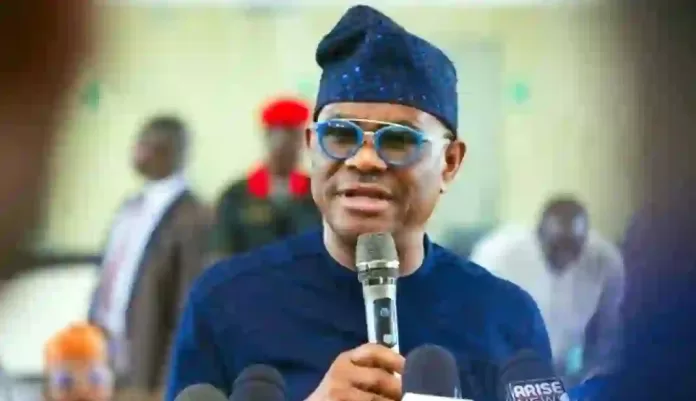
Nyesom Wike, Minister of the Federal Capital Territory, FCT, has stated that the Party will continue to wax stronger, as he and the founding Fathers will not allow the Party to be destroyed by those who joined the PDP fold from other political parties.

The former Rivers State Governor made this remarks during the 104th National Executive Committee, NEC, meeting of the Abdulrahman Mohammed-led faction of the Party held at the Minister’s official residence in Abuja.

Berating the Tanimu Turaki-led faction of the Party for violating court judgements by conducting what he described as an “illegal convention”, Wike insisted that the party must respect judicial processes if it hopes to regain public confidence.

He further accused the faction of disregarding two substantive judgements of the Federal High Court, which he said had ruled on the matter, yet they proceeded to hold their own convention and later approached a State High Court to seek recognition.

“You went to a State High Court to sue the Independent Electoral Commission (INEC), asking that the convention must take place.

“You got an ex parte order to override judgements of the Federal High Court. How do you disobey two final judgements and still claim leadership?” he asked.

Wike added that that the same group returned to another court, seeking validation after failing to comply with lawful rulings.

“You had the convention without obeying the court, and now you are back asking a Federal High Court to recognise you. If INEC already recognised you, what exactly are you going to court for?” he asked.

He warned that such actions could jeopardise the future of the party, stressing that leaders must not allow selfish interests to destroy the political platform that has existed since 1998.

“We must not allow our party to die. Leadership requires commitment and honesty, not propaganda.

“If we don’t respect our own laws, how do we earn respect from Nigerians?” Wike asked.

He called on the party faithful to support lawful leadership and unite to rebuild the PDP in line with democratic principles and judicial integrity. He finally added: “Nobody can expel me from the PDP.”

Recall that Wike, along with some other Party members, were expelled at the Ibadan, Oyo State, National Convention held on November 18 by the Kabiru Turaki-led PDP, and their certificates of expulsion signed and forwarded to them by courier service.

Insecurity: ADC Slams Tinubu, Says If He Can Act In Benin Republic Overnight, Why Not In Nigeria

0
Bolaji Abdullahi and Bola Tinubu

By Akinwale Kasali

President Bola Ahmed Tinubu has come under strong criticism from opposition Party, the African Democratic Congress, ADC, following his swift intervention in the attempted Coup in Benin Republic.

The ADC took a swipe at the Federal Government saying that the speed with which action the President took action highlights how slowly the government responds to the insecurity tormenting communities across Nigeria.

ADC Spokesperson, Bolaji Abdullahi, said the development raises important questions about the government’s priorities, its respect for constitutional processes, and its commitment to safeguarding Nigerian lives.

The Party said it acknowledges the fact that Nigeria’s prompt response in Benin Republic was commendable, but argued that the contrast with Nigeria’s domestic security failures is becoming too glaring to ignore.

The ADC in a statement signed by Abdullahi said:

“The African Democratic Congress (ADC) welcomes Nigeria’s swift intervention in the Benin Republic following the announcement of a coup attempt. We commend the Federal Government for acting promptly to defend constitutional order in our neighbourhood.

“Why were we not as swift in responding to the crisis in Guinea-Bissau, even when a former Nigerian President was trapped there? What determines when Nigeria acts firmly and when it delays?” the party asked.

It further stressed that any such intervention must still follow constitutional procedures, noting that military or security deployment outside Nigeria requires the approval of the National Assembly, as clearly outlined in the Constitution.

According to the ADC, such inconsistencies only fuel speculation that Nigeria’s rapid move in Benin may have been influenced by interests outside the country, a perception it says undermines Nigeria’s credibility as a regional leader.

But beyond foreign policy, the party said the Benin action draws attention to something far more troubling; the government’s inability to act with equal urgency against bandits, terrorists, and violent criminals who continue to terrorise Nigerians.

“If Nigeria could respond decisively to threats across our borders, why has our government demonstrated such outrageous incompetence in dealing with domestic insecurity?” the ADC queried.

“A government that can act swiftly abroad must also act decisively at home. The defence of democracy does not begin in neighbouring countries; it begins in the protection of Nigerian lives,” Abdullahi added.

Reaffirming its opposition to any unconstitutional change of government in the region, the ADC said the most effective way to prevent military intervention is for elected leaders to govern responsibly, improve citizens’ welfare, and allow opposition voices to flourish.

“The best possible safeguard against military adventurism is for elected governments to make democracy meaningful to the people by improving their lives and allowing opposition to thrive,” the party stated.

Nigeria’s High-Stakes Intervention in Benin – Democracy, Security, and the Geopolitics of West Africa

0
Adebamiwa Olugbenga Michael

By Olugbenga Adebamiwa

Nigeria’s swift military intervention in the Benin Republic following Sunday’s failed coup attempt has reignited a complex debate at the intersection of national security, constitutional legality, regional diplomacy, and democratic stability in West Africa.

As the region battles a surge of coups, violent extremism, and weakening civilian institutions, Abuja’s decisive though constitutionally contested response underscores both the opportunities and dilemmas facing Africa’s most populous democracy.

West Africa has experienced nine coups or attempted coups since 2020, from Mali and Burkina Faso to Niger and now Benin.

These uprisings are fuelled by a mix of jihadist insurgency, public disillusionment with civilian governments, and geopolitical realignment involving France, Russia, and increasingly China. In Benin’s case, the attack led by Colonel Pascal Tigri was contained within hours, but the episode reflects the wider instability sweeping Francophone states where over 45% of citizens express declining trust in electoral democracy, according to Afrobarometer.

Nigeria’s rapid deployment, acting on two formal requests from Cotonou, reflects Abuja’s growing concern that the coup wave could spill over into its borders.

Nigeria’s armed forces face immense pressure. Fighting insurgents, bandits, and separatist groups across at least six active security theatres, the military has neutralized thousands of terrorists over the past decade, though official figures vary and independent verification remains difficult in conflict zones. Unlike Benin’s coupists, terrorists inside Nigeria operate from dispersed forest camps, mixing with civilian populations and employing guerrilla tactics specifically designed to deter conventional airstrikes. This structural difference explains why the precision strikes witnessed in Benin cannot simply be replicated in Niger, Chad, or Nigeria’s internal battlegrounds.

The challenge is compounded by the sensitive allegiances of communities along the borders, where cross-border ethnic ties sometimes complicate enforcement efforts and fuel political suspicion.

Under Section 5(4)(b) of Nigeria’s 1999 Constitution, the President must obtain Senate approval before deploying troops on combat duty outside national borders, except in immediate defence of Nigeria. Critics argue that President Bola Tinubu acted unlawfully by ordering an air and ground response without prior legislative consent. Supporters counter that the urgency of the coup attempt justified prompt action and that Benin’s formal request for help aligns with ECOWAS protocols on collective security. The controversy highlights an uncomfortable truth, constitutional safeguards often collide with real-time security demands, particularly when regional stability and Nigeria’s own national interests are at stake.

Tinubu’s supporters frame his move as statesmanship, opponents call it geopolitics disguised as democratic defense.

Beyond the military dimension lies a deeper political calculation. Nigeria’s action reassures partners like France and ECOWAS that Abuja remains the region’s democratic anchor, especially after Niger, Mali, and Burkina Faso transitioned toward military rule and Russian influence. President Tinubu, with decades-long credentials as a pro-democracy activist, seeks to position Nigeria as West Africa’s “Democratic Defender-in-Chief.” Yet sceptics argue that global optics play a role, suggesting the intervention serves multiple goals, reinforcing Nigeria’s regional dominance, securing international backers, and sending a message to domestic actors who might underestimate the military’s reach. As one analyst put it, “This is as much about democracy as it is about geopolitical chess.”

The failed coup in Benin is a reminder that democracy without economic justice cannot endure. In Francophone West Africa, nearly 40% of the population lives in poverty, youth unemployment exceeds 30%, and weak public services fuel resentment against civilian administrations. Until governments provide jobs, education, security, and credible elections, military overreach will continue to tempt dissatisfied populations.

Nigeria’s intervention may have preserved Benin’s constitutional order for now, but long-term stability depends on broader governance reforms across the region. West Africa must choose between a future defined by recurring coups or one anchored in accountable leadership, shared prosperity, and institutions that work for all.

Ultimately, democracy survives not by force alone, but by delivering dignity, opportunity, and justice to the people it claims to serve.


Adebamiwa Olugbenga Michael is a Lagos-based political analyst who explores ethnic economics and urban policy through open-source data.

He is also the publisher of The Insight Lens Project.