


Home Blog Page 2861

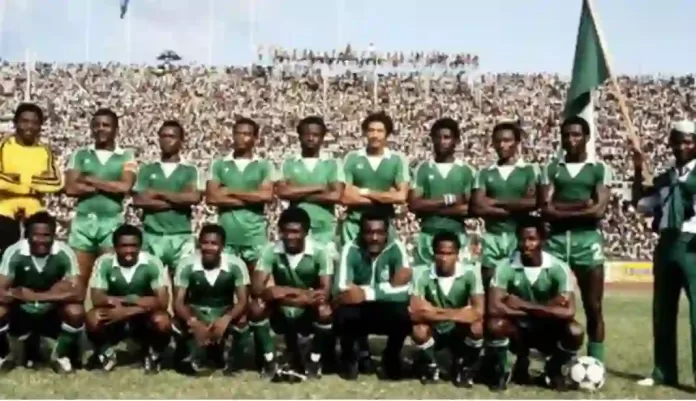
1980 Green Eagles Squad: 38 Years After AFCON Success

0
1980 green eagles

The ‘Chief Justice’ of Nigerian football, distinguished legal luminary and Member of the Order of the Niger (MON), Chief Adokie Amiesimaka was the one who called me (Segun Odegbami) up and reminded me it was 38 years to the day on March 22 that a group of young Nigerian footballers won the African Cup of Nations for their country for the first time and created history.

He told me he was celebrating the team in his own way, and was calling up all those he could reach to extend his handshake and a token gift in appreciation and demonstration of how well the Lord has blessed him.

He was graciously extending his ‘token’ support to my school in Wasimi. Within an hour of his call he kept his promise and gave the school what I can only publicly reveal with his consent.

It was a sobering moment indeed. It unleashed memories that raced through my mind.

It is by the Grace of God that we are alive in this wilderness of daily, known and unknown dangers that lurk in every corner of our country and our lives.

Adokie came up with an idea for us to establish a Foundation to cater to the needs and challenges of the less privileged amongst us and amongst the generations of the footballers after. The foundation will provide ‘fishing’ skills rather than fish itself for those in need. Of course, I am game.

So, do not be surprised if in the next few weeks, or months, we launch out on such a project to make a difference applying the gifts and opportunities that God has blessed us with to bless others.

Permit me to recall the members of that 1980 team in my own humble celebration.

(1.)  Best Ogedegbe. Late and resting with the Lord. Brave, and almost ‘arrogant’ in the uncommon level of his confidence in goal. He was almost as good a field player as he was a goalkeeper.

(2.)  Emmanuel Okala. ‘Man Mountain’. Tall, agile, and imposing. His best training was ensuring that the Eagles’ best strikers never scored him in training. He is alive but, like all of us, facing the consequences of the stresses and strains we put on our bodies as players.

(3.) David Adiele. Alive. Now lives in Houston, Texas. Enigmatic. Streetwise. Still doing his ‘thing’, hustling in the US and doing very well.

(4.) Johnny Orlando. Alive. Shuttling between Ghana, where he came from, and the USA where he settled in after the Nation’s Cup. No one can explain how he got into the Nigerian national team and played as well as he did.

(5.)  Sylvanus Okpala – Alive.  ‘Quick Silver’. One of the younger players in the team – strong headed, versatile, all-round player, very hard, very confident on the ball, and a great shot. He rose through the ranks from the junior national team where he was captain. One of the early Nigerian professional players to Europe. Played in Portugal.

(6.)  Okey Isima – Passed on.  Another early export to the professional ranks in Portugal. He was that good. Don’t quite understand how and why he was converted from his attacking midfield role to a left full back even though he was right footed.

(7.)  Mudashiru Babatunde Lawal – too young to have passed on even before the dust of 1980 had settled. He was so good he was the first African player to go to the African Cup of Nations five times; Nigeria’s first official football Ambassador; First Nigerian athlete to be awarded two national honours; One of the best all-round midfield players to don the national colours of Nigeria.

(8.)  Alloysius Atuegbu – Passed on. ‘Block Buster.’ Endless running and tireless worker in the centre of the midfield, with the additional gifts of a great shot and short passing skills.

(9.)  Henry Nwosu – Alive and surviving in the turbulent and uncertain world of Nigerian coaching. The youngest in the team at the time, with such prodigious skills he could have played for any team in the world. ‘The youngest Millionaire’. Played professional football briefly in Africa during the twilight years of his career. Midfield general in the true sense.

(10.) Ifeanyi Onyedika – Alive. One of the younger players. A great centre-forward with silky skills and sharp reflexes in the crowded box of opposing goals. A quick thinker.  I still do not understand why he did not last for a lot longer in the national team.

(11.) Adokie Amiesimaka – Alive. ‘Chief Justice.’ The fleet-footed master of the dribble. Right footed player that mastered playing from the left wing, a system that is now sweeping global football. Graceful and elegant on the ball. Added intellectual depth to his football, always thinking, always creating as he dances and meanders through defenses with such consummate ease. Great crosser of the ball.

(12.) Tunde Bamidele – Passed on. A cool and calculative player in the heart of Nigeria’s defense. His effectiveness was made less apparent because he shared the same space with the great ‘Chairman’ Chukwu. He was the hard-tackling destroyer and hatchet man whilst Chukwu cleared the mess of his tackles.

(13.) Kadiri Ikhana – Alive. A very versatile, effective hardworking player. Not one ounce of flamboyance in his game. Did the dirty work of keeping dangerous players quiet.  ‘Kawawa’, very wise, with a sharp mind. He became one of the most respected and most successful coaches in domestic football in Nigeria.

(14.) Godwin Odiye – Alive. Living a quiet life in the US with an unfortunate ‘scar’ on a great footballing career that was truncated with his move to the US at a young age. Hard, stylish, very fast and dependable defender. He is doing well developing young football talents… for America.

(15.) Shefiu Mohammed – Alive. He is struggling to survive in the hard and harsh environment of Taraba State in Nigeria, away from the glare of stardom and celebrity. Great running and tackling defensive midfield player. A pest to opposing attackers. Not finding life after football easy at all.

(16) Martin Eyo – Passed on. An academic and football player. At any other time but when he appeared on the football scene he would have been better known. Against the array of regular first team attackers in the national team, he became a fringe player. But he was effective whenever he was called upon to add some pep. Fast, strong, good with both feet and had a unique dribbling style.

(17) Frank Nwachi – Alive – Did not play any match during the Championship. One of the players with a degree in the national team. Left for the US shortly after the Nations Cup, and has shuttled between the two countries ever since.

(18.) Charles Bassey – Alive and doing well in Calabar where he was discovered in the great Rovers team of the late 1970s and to where he returned and has remained ever since. Very good player with one of the best shots at goal in the team, but remained on the fringes because of the sea of other exceptional talent.

(19) Moses Effiong – Alive and kicking in Calabar. Third Goalkeeper in the team. Very quiet on and off the field. He was such a gentleman the football fraternity hardly ever remembers him. He stood little chance with Best and Okala in the same team with him, but a great goalkeeper nevertheless.

(20) Felix Owolabi – Alive. ‘Owoblow’. What does one say about this great player who plays like a one-man army? It does not matter where he played on the field, he covered more ground than most others, attacking, defending, marking, shooting, and was felt everywhere on the field. He was like a tornado, unstoppable.

(21) Christian Chukwu –  Alive. ‘Chairman’. The great Chairman was true legend. Majestic and dominating in the defense. A true libero and leader on the field. His actions spoke more than words. Very calculative, immaculate passing skills over long distances, a great shot from incredible distances and a man who led by physical example. He was a born captain, respected and loved by all.  He coached and managed different national teams at different times. Slowed down now by arthritis – the ailment of retired footballers.

(22) Segun Odegbami –‘Mathematical’. He was just one of the boys in a great squad that made history. He played his part.

Where is the Petrol?

0

By Oji Odu

From Ikorodu Road in Lagos to Kudurat Abiola Way, and to most parts of the Lagos metropolis, the long fuel queues of vehicles and jerry cans have resurfaced, including the thriving black market. The is same in Abuja the nation’s capital and other parts of the country.     Many of the filling stations operated by major marketers are not selling while outlets owned by independent marketers are shut.  Those that are selling sell above the official pump price of between N200 to N300 per litre. Do we blame them? What went wrong?

Most Nigerians had thought that the problem which almost grounded the nation during the yuletide was a forgone issue following the explanations by government and alleged agreement between them and the marketers. But, no, it seems to be far from over as the blame game between government and the petroleum marketers has continued, with the masses bearing the heavy brunt.

Reacting to the situation, Executive Secretary of the Depot and Petroleum Products Marketing Association, DAPPMA, Femi Adewole, said if the Nigerian National Petroleum Corporation(NNPC) can raise supply, they will be able to get to inland areas and focus on major cities.

In a chat with the Magazine, a major marketer at one of the besieged filling stations at Kudirat Abiola Way, Lagos, and who craves anonymity said: “ It’s a pity that the NNPC will not want Nigerians to know the truth of the matter. How do they want us to load the product at over N145 per litre and expect us to sell at the so called official N145 per litre pump price? It is not possible. It can only be possible when the pump price is increased.”

But  the NNPC has not only denied the allegation that it is not supplying enough fuel to the marketers, it has also  debunked the rumour and assured Nigerians that it has no plans to increase prices both at the pump and ex-depot level.

Meanwhile,  the Petroleum Equalisation Fund (PEF), an agency of the federal government, claimed that it pays out a minimum of N26 billion annually as reimbursement to petroleum product marketers as palliative for transportation.

A source at the Fund who craved anonymity because he was not authorised to speak on the matter revealed  that the agency pays out a minimum of N500 million weekly to some petroleum products marketers across the country which translate to N26 billion annually.

Although the figures according to the source may vary from time to time, the least amount paid to marketers per is week is N500 million. The source further disclosed that the agency pay over 15,000 marketers across the country weekly.

“When we make payment we deal with more than 15,000 marketers. If we are making payment, you will see that in less than 2 minutes we pay about 15,000 people across every nook and crannies of Nigeria. We pay out over N500 million every week.

“You know in Nigeria people don’t believe that you can pay N50 million without receiving anything, but in this case, you don’t even know who you are paying you are driven by the data,” the source said.

However, PEF’s spokesperson, Dr. Goody Nnaji, refused to confirm the figure to our correspondent, stressing that the agency does not disclose how much it pays to marketers due to the inherent danger in doing so.

According to him, the agency, in sometime past used to publish the payment to marketers but stopped doing so as some marketers said the action exposes them to becoming targets of armed robbers and kidnappers.

In his reaction to the situation, an angry commercial taxi driver at the besieged NNPC filling station, Moshood Adedeji, told the Magazine that he had been on the queue for over four hours without hope that he will get fuel, unless he resorts to the black marketers who sell at between N230 and N250 per litre.

“ In fact, everyday, everything gets worse, and I believe those in government, who do not care about our sufferings are even more confused,” he lamented.

But on his take on the situation, Johnson Okon, a Civil Servant, said that until issue of refineries are resolved, the problem will continue to reoccur. “Enough of the ‘snake and rat game. Nigerians are already overburdened. What we need is adequate supply of petrol that we have in this country,” he said.

Owerri: Nero Fiddles While Rome Burns

0

By Comfort Obi

Students of history would, of course, remember  Nero, the frivolous Emperor of the Roman Empire who famously fiddled while Rome burnt. In the South-East where I come from, nothing could be nearer the truth than Nero’s story. Most of our leaders play while the region burns. They engage in frivolities and big-manism while the region is systematically being destroyed.

You will excuse me to use the tragedy that is the Ekeukwu market in Owerri as a typical example.  For two years, almost, the case of the famous Ekeukwu Owere, situated along Douglas road and adjoining streets was a ding-dong affair. To be or not to be? To relocate or not to relocate? It has been so between the Governor Rochas Okorocha-led Imo state government and the natives of Owerri (Owere Nshi Ise), the capital of Imo state.

A few months into the Okorocha administration, he came up with the idea that the market represents everything that is bad, and so, must be relocated. He described it as an embarrassment, especially in a state capital, which, in fairness to the governor, he has tried to give a modern look infrastructure-wise. I see new roads even though the inner roads in the state capital are unbelievably ugly and impassable. I see beautiful, modern buildings. I see well, how do I describe them? Okay, let me use the local parlance — decorations. Beautiful as they are, it would have been preferable to use the hundreds of millions of Naira, spent on such decorations for good roads. Of what use are beautiful buildings and decorations when there are no good roads aside from a couple of major streets. Everywhere, almost, is cut-off from the state capital because of the terrible state of the roads. The people are frustrated over the situation. It is not even different within the state capital. Many of the roads are a nightmare.

But I digress.

I was talking about the tragedy that has now become the Ekeukwu Owerri market. So, the governor said the market was an eye-sore sitting majestically on an otherwise growing modern city. He talked about the environmental hazard. The refuse it accumulates, which stench reaches high-heavens, the governor said, can no longer be tolerated. Worse, the governor and security agencies insisted that it had become a den for criminals. Many youths, they allege, do nothing but wait for market men and women – morning, afternoon, evening, to collect “tolls” from them, or forcefully make away with their wares. More worrisome, however, they allege: Ekeukwu has become the melting point for armed robbers, rapists, pick-pockets, hard drug users etc. According to them: “There is a shopping centre known to everybody as cocaine complex yet, everybody keeps quiet.”

The government said for sanity to reign, the embarrassment that has become Ekeukwu Owere has to go. It said it needed to demolish the market to finally upgrade the capital city to its status as a capital city.

But Owere people cried foul, alleging that the mere thought of relocating the market is an abomination, a sacrilege. The governor, they allege, is only expressing in another way, his alleged deep seated hatred for Owere people. They cite as an example, his alleged treatment of former high profile appointees from the zone in his government who he humiliated out of office using either fabricated stories, flimsy excuses, or both. To punish the Owere man more, they say, he now wants to humiliate their forefathers from whom they inherited the market. They also doubt the relocation of the market would be in public interest. An elder told this writer: “The governor’s interest in the market is suspect. He has an obscene, selfish acquisition tendency. I suspect whatever he puts up there will not be for the state government. It may be his personal acquisition. We have seen and endured things in this Owere Nshi Ise from this governor. Ekeukwu Owere is the limit. This is not about giving the state capital a modern look. It is about one man’s business.”

Ekeukwu Owere is an ancestral market, inherited from the people’s forefathers. It has, for decades, been the people’s identity. Their icon. So they ask: What are we going to tell our ancestors? What will  Owere Nshi Ise be without Ekeukwu? Relocating it is like stripping us of our identity. Perhaps.

Yet, not a few people are of the view that Owere Nshi Ise  had since, because of local politics, stripped itself of its identify and that perhaps, the ancestors may be angry. Such people ask: Where were Owere people when the government split the once proud single autonomous community into five – with a couple of autonomous communities not bigger than a hamlet? From having, usually, one respected and revered king, the people now have five of them whose, no disrespect intended, names people do not even know? What can be worse than that?  Meaning: The people can hardly speak with one voice.

However, government’s action on the market seem to have woken them up from sleep. So they ask now: Whatever happened to us? What did we do? Where are we? A bit late, one is tempted to say. Yet…

For the traders, chasing them out of the market is as bad as a death sentence. Where will they go to? The traders have invested their lives in the market. Their goods are worth billions of Naira. What will happen to them? But the government countered that it had built more than 10,000 shops/stalls where they would be relocated to – Ohi, Naze, Relief market. To Owere people, that is not the point. The point is, they insist: This is their ancestral market bequeathed unto them by their ancestors. Taking it out of Owere nshi ise is a deliberate provocation and insult – not only to the living, but to the dead.

Penultimate week, however, something gave. The government “ran out of patience” and issued a-72-hour ultimatum to the traders to vacate the market and take a long walk. Many traders thought things would, as usual, be sorted out. And so did Owere Nchi Ise people. Afterall, there is a court order against the goverment. This time, however, it was different.

On the eve of the demolition exercise, Owere youths and women assembled to defend their inheritance.  But they were out-smarted by security agents who told them to go to bed as only shanties along the road would be demolished. They left at about 2.00am, satisfied. At about 4.00am, the demolition squad and its weapons moved in. On ground were a combination of the military, police and other para-military agencies. But there was also a strange group in black uniform – allegedly recruited from another senatorial zone by the state government. They were armed with guns and matchets. And so, guns boomed from them and allegedly from Owere youths who felt betrayed. Eye witnesses say neither the military nor the police shot at anybody or anything. Only the police tear-gas was handy. But the strange “uniformed people” sowed havoc, blood and tears. In the confusion, an innocent boy – Somtoochukwu Ibeanusi — was killed by an obvious stray bullet while he was out, with his sister, to help his parents evacuate their wares from their shop. It remains to be ascertained why parents would send their children out at that dangerous period. Anyway, the young boy died in a most cruel manner, leaving his devastated parents and siblings with unanswered questions.

So, what is the truth about the Owerri tragedy?

Let me start by saying that the government, considering the Imo state land use laws has the right to take charge of any parcel of land and revoke its Certificate of Occupancy. Every piece of land belongs to the government. Meaning that the Imo state government reserves the right to take over the land on which Ekeukwu is situated. But this must be done according to the laws of the land, following due process. And it must be done with human face. There must be compassion. Agreement. And compensation.

In the case of Ekeukwu Owere, the government showed no compassion. It acted as if it was at war with the people, and as if there will be no tomorrow. The market may have degenerated, to a little extent, an abode for some criminals. But that removes nothing from its iconic status. Most markets in Lagos have the same reputation. In any case, what is the job of security agencies? It is to flush out criminals, not to give them a free reign. And, what makes anybody think that the alleged criminals will not congregate again at the new locations — unfortunately, outside Owere nshi ise? This relocation outside it has firmly denied them of their pride.

But more important, the people insist there is an injunction against the relocation of the market. So, why did the government not wait until its vacation?  Worse is: the government, wittingly or unwittingly, allowed the exercise to degenerate to a low level — bloodshed. It breaks the heart looking at the body of the young Somtochukwu as it sprawled on the ground, spewing blood, and his sister, blood soaked, weeping over his body. More heartbreaking, however, is that both the state government and law enforcement agents feigned ignorance of the boy’s tragic and avoidable death. As I write this, neither the state government nor the police has visited his family to offer condolences. This is not acceptable. They say he was not killed by their agents. True?

In case the state government does not know, it has blood on its hands. But for the demolition exercise, Somtochukwu would still have been alive. Indeed, the government even, excuse this cliché, adds insult to injury by insisting that those who stood against the relocation and demolition exercise were neither Owere people nor the traders; that Owere people and the traders were happy with the exercise. True? This is propaganda taken to a ridiculous level.

The question the government should answer is: Who brought  the armed, strange youths, allegedly from another senatorial zone to come and “fight” in Owerri? Was that necessary? In doing that, the government, or whoever brought them, has deliberately created enemity between the two zones. More curious, however: Where were the police, the military and other security agencies when the “strange fellows” showed their faces in Owerri to back the demolition exercise and face Owerri youths? The relocation of the market may be necessary, at some point in time, but I don’t know why the state government thinks it is a priority now. For many Imo people, it is not. The state is faced with so many problems that this tragic exercise would have been ignored. There is the problem of salaries owed. There is the problem of pensioners dying over non-payment of their entitlements. There is the problem of bad roads. There is the problem of youth unemployment. There is the problem of hunger. There is the problem of insecurity — armed robbery, kidnapping, rape, etc. How come the demolition and relocation of Ekeukwu  Owere  became a priority? Indeed, there are many uncompleted projects in the state. Why start a new one – be it a shopping mall or a school project as is being speculated?

Definitely, none of these problems is exclusive to Imo state or the South east. It is general in character. But it is worse in the South-east, a zone with no road, no federal presence. Just nothing but plenty of hunger and suffering. Yet, our leaders in the South-east would pre-occupy themselves with frivolities. But back to the Owere problem.

In case the governor does not know, or have not heard, the fear is that after demolition, the Ekeukwu Owere land may be up for grabs. Personally, I don’t believe it, but he needs to disabuse the minds of the people. A couple of days after the demolition exercise, the government held a meeting with the leaders of the  Ekeukwu Owere market where it tried to explain its  position, and make offers of free shops (for three months). This seems like, excuse this cliché again, medicine after death. Why was the meeting not held before the exercise?

The state government has a lot of work to do in the state. A first step is to forget the propaganda and make deliberate efforts to win back the trust of the people. This, it can start, by coming down from its high horse, and visit the bereaved Somtoochukwu family and all those injured during the exercise. It should pay compensation to his family and off-set the funeral expenses as well as pick the hospital bills of the injured. It should also invite the leaders of Owerri zone to a meeting – a zone which feels that the incumbent governor has no use for its people.  As for me, my prayers for Imo is: Peace, brothers and sisters, peace.