Barely three days to the February 16, Presidential election, officials of the Independent National Electoral Commission, INEC, are still counting their loses. At the last count about 4, 695 Card Readers, and thousands of Permanent Voters Cards, including power generators have been destroyed by mysterious fire outbreaks. The worry: the fire disasters occurred in supposedly strong holds of the People’s Democratic Party, PDP, thus, fueling speculations of sabotage. The fire incidents had occurred in Abia, Plateau, and Anambra states in quick succession.
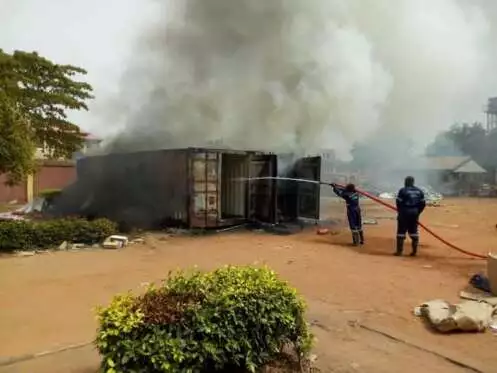
Take for instance, the Sunday, February 10, 2019, incident at the Commission’s Secretariat, Awka, Anambra state. Only the intervention of the state Fire Service, on the invitation of the Commission, saved the fire from spreading to other offices. Notably, Anambra state is the home state of Peter Obi, the Vice Presidential Candidate of the PDP.
The initial assessment of the damage to facilities confirm that 4,695, Card Readers were destroyed. But an eyewitness account insist that other election materials were also destroyed in the process. INEC officials in the state admit that the fire incident is a ”setback to its” preparations for the conduct of the elections but refused to give details of the cause of the inferno and the extent of damage to facilities. The question is: Who dunnit? The impression is that it is a deliberate ploy to suggest a postponement of elections in some states and Local Government Areas.
INEC Container-Built Office: Razed At Awka, Anambra State
Festus Okoye, an INEC National Commissioner, and Chairman, Information, Voter Education Committee, however, assures that” there is no cause to worry”, insisting that the Presidential and National Assembly elections in the state would hold as scheduled on February 16 , 2019. OKoye disclosed that the electoral umpire has taken immediate measures to ameliorate the situation by mopping up some of the spare Card Readers from other states to deploy to the state.
He confirmed that the report of the incident has been sent to the state Police Command and the Fire Service, which have commenced their investigations.
Meanwhile Nwachukwu Orji, the Resident Electoral Commissioner in the state, has denied reports making the rounds that the fire incident was caused by electrical faults, an indication that there might be sabotage. Orji may have been convinced that the Container, where the equipment and other materials were kept in the Commission Secretariat at Awka, may have been set on fire as the inferno started at about 2.30 pm when members of staff were still in the office.
According to an official of the Commission who spoke to The Source in the state, ”we have been using the facility since 2011 to keep our election materials and never experienced any problem”. The official wondered why the problem should occur in this 2019 general elections.
Recall that there had been other fire incidents on INEC facilities in some local government offices before the Anambra state INEC incident. Given a break- down of the incidents, Okoye cited the Qua’aan Pan local government inferno on Saturday, January 9, 2019, and that of the Isiala Ngwa South Local government in Abia state on February 2, 2019.
According to him, about 2,979, PVCs, and other election materials were destroyed in the fire incident while in the Qua’an Pan office in Plateau state alone, 5, 987, uncollected PVCs , 380 voting cubicles , 755 ballot boxes , 14 generators, election forms and official stamps were destroyed.
The recurring fire incidents may have informed the reason why Mahmood Yakubu, the INEC Chairman, has notified Mohammed Abubakar Adamu, the acting Inspector General of Police, IGP, that additional security measures need to be provided to the Commission offices nation-wide to protect election materials and other critical structures .
The INEC boss has every reason to cry out to the acting IGP, for help. This is because the Nigerian Air-Force, has been contracted to start the airlifting of the Commission’s electoral materials to designated states across the country for the conduct of the elections.
President Muhammadu Buhari’s administration would have gone down in history as the first government to arrest a Chief Justice of Nigeria in case the police eventually picked Walter Onnoghen, suspended CJN.
Following the bench warrant issued against the ex-CJN on Wednesday by Code of Conduct Tribunal chairman, Danladi Umar, security agencies in the country including police and Directorate of State Services, DSS, the magazine has learned have been on red alert to apprehend and arrest Onnoghen.
The CCT a short while ago directed ordered the Inspector General of Police, IGP to arrest the ex-CJN after he failed to appear before the tribunal.
At the trial on Wednesday, counsel to Onnoghen, Adegboyega Awomolo, a senior advocate of Nigeria failed to stop the CCT chairman from making the order.
Umar consequently ordered the Inspector General of Police and the Director General of the DSS to arrest Onnoghen and produce him in court on Friday, February 15 for arraignment.
Onnoghen is facing trial for not fully declaring his properties as a public officer, a breach of the Code of Conduct law.
Chairman of the Tribunal, Danladi Umar, on Wednesday, issued the bench warrant against Onnoghen following his absence in court for arraignment.
The Tribunal had at its last sitting on February 4, ordered that Onnoghen must make himself available in court today February 13, for arraignment over the allegation.
When the matter came up today, Onnoghen was not in court and his lawyers led by Adegboyega Awomolo, SAN prayed the court to take all pending applications relating to the trial, particularly the issue of the tribunal’s jurisdiction to hear the matter.
President Buhari has faced local and international backlash over the suspension of the CJN and appointing Ibrahim Tanko Muhammed as his replacement on January 24.
But the president has maintained that it was the right thing to do, after the CJN refused to step down from office.
Justice Onnoghen is accused of owning swathe of properties locally and abroad, including foreign accounts in breach of his oath as a public officer.
But the embattled CJN said it was an oversight on his part not to disclose all his belongings to the Bureau.
He’s currently being investigated by the National Judicial Council, NJC.
Former President Goodluck Jonathan will always be remembered by posterity for making the 2015 general election violent free, even when under pressure not to do so. With 2019 election just days away, calls and pleas have re-echoed for violence free polls.
Will there be violence free elections when the gladiators have continued to tear each other with hate speeches, unguided provocative languages and words? Will it be violence free when such words are echoed by both religious and traditional rulers?
Will it be free polls when there are heightened fears of impartiality of security personnel, there are no implementable laws to punish electoral offenders? And will there be no disruptions when eligible voters are disenfranchised by no fault of theirs, but the electoral umpire, Independent National Electoral Commission (INEC)?
Following several recorded electoral violence both intra and inter party, the National Security Adviser (NSA), retired Major General Mohammed Monguno, during his meeting with members of the Nigeria Governors Forum (NGF) made a very shocking revelation on how some politicians are scheming to arm political thugs during the general elections. He said that intelligence reports had indicated plans by some individuals and groups to instigate violence during and after the upcoming elections.
Lamenting to the Magazine, Charles Ojinma, a political analyst, he regretted that it is the youth, the working population of the country that are either maimed or sent to their early graves, “ by this old brigade politicians who have been at the leadership of this nation in one capacity or another, some of them since their 20s and 30s.”
Speaking on the anxiety and fears of violence in the 2019 election at a news conference on international religious freedom, Samuel Brownback, United States Ambassador at- large for International Religious Freedom recently challenged religious leaders in Nigeria to preach non violence to their members in the 2019 election, saying the whole world is watching the way Nigeria’s general election would be organised.
“My advice to religious leaders is to suggest to everybody for there to be a calm election, a peaceful election, and no violence in the election. And I would ask all the religious leaders in Nigeria to put that message out: that people get out and vote, but that it be calm and peaceful and no violence.
“That this is a right that everybody in Nigeria has to vote. It should be exercised, but it shouldn’t be something that people then are threatened with violence or deadly force in various places, and the religious leaders have a role to play and a strong role to play asking for people to do this election peacefully.
“The world is watching. Nigeria is an important, incredibly important country, and it’s important throughout the world. It’s certainly a key country in Africa. “And what you do on having a peaceful election cycle is an important thing for the progress in Nigeria.
“And the religious leaders should be just adamant about that this must be peaceful. We do these things peacefully and we showcase that to the world,” he said.
Brownback explained that he came to Nigeria for several days recently and went to the middle belt and the southern part of the country. “I tracked the situation very closely. The United States Government is strongly concerned that there be free and fair elections, and that they be safe elections – that the factions vote, but not attack each other. “And that the government itself that’s in power now do everything they can to protect the people, to make sure that they’re safe,” he said.
Earlier call s were made by Stuart Symington, United States Ambassador to Nigeria. He said the future of the country depends on the forthcoming 2019 general elections, as he urged the institutions of government to promote credible and peaceful polls. Symington made this known after meeting with the Rivers state governor, Nyesom Wike, at the Government House, Port Harcourt.
With three mysterious infernos at INEC offices in two weeks in Abia and Plateau states, and with thousands of Permanent Voters Cards (PVCs) lost which are yet to be replaced, and INEC yet to make solid arrangements not to disenfranchise these voters, is this not enough to cause violence at this period? Are others that are going to be disenfranchised because INEC could not print their PVCs, or was unable to do their transfers to their new polling centers not likely to cause electoral disruption?
The Magazine’s findings reveal that just as there is increase in the number of voters, many may stay at home to avoid any violence by political thugs, while others say they will do so because of distrust of the electoral umpire, INEC.
Meanwhile, the tension raised by the anxiety of violence in the 2019 elections led to the signing of the
non violence pact by the Presidential political gladiators in the election today, February 15, 2019, for anyone that loses the not to resort to violence.
President Muhammadu Buhari is not happy that his party, All Progressives Congress, APC will not present candidates for governorship elections in Rivers and Zamfara states.
APC has been bared by the courts from presenting candidates for parliamentary elections in the two states due to factional issues.
“I’m not happy that our party would not” present candidates for election in Rivers state, Buhari said in Port Harcourt on Wednesday barely four days to presidential election on Saturday, February 16.
Whatever happens in the two states will impact the result of the election in which the two frontline candidates, Atiku Abubakar of the Peoples’ Democratic Party, PDP and Buhari stand head to head.
From all indications the PDP candidate appears to have gained ground in some states, once regarded as Buhari’s base.
Atiku’s popularity has soared in Zamfara, Kano, Katsina and other Northern states in recent times.
This must have become a source of worry for the Adams Oshiomhole led APC leadership, some analysts say, adding that the situation is more worrisome considering feed-backs from other states where APC recently held its campaigns.
In Ogun state for instance, the party is polarized between the Governor Ibikunle Amosun faction and another led by Vice President Yemi Osinbajo.
The governor is supporting the candidate of APM for governor while the party has thrown its weight behind Dapo Abiodun, the party’s candidate for the March 2 governorship election.
The fact that President Buhari was pelted with stones by those alleged to be Governor Amosun’s supporters, underscore the deep seated acrimony that exist in Ogun APC, keen political watchers told the magazine.
In Imo state, Governor Rochas Okorocha is still not happy that his son in-law, Uche Nwosu was denied APC governorship ticket, though the governor is APC senatorial candidate, he may work against president Buhari re-election to prove a point, some say.
“No doubt that what’s happening in these APC states will have grave effect on Buhari’s re-election bid,” Yemi Amusan, an analyst based in Lagos told the magazine on Tuesday.
His assertion came on the heels of a US Polling firm, Williams and Associates prediction which gave victory to Atiku.
Also, Teneo Intelligence, a New York-based analysis firm, had last September predicted that Atiku could beat the president.
Recall that William and Associates was hired in 2015 by ex-President Jonathan to determine his chances in the election.
The firm had then predicted that Buhari will win the election.
The firm said in its latest polls that Atiku will coast to victory by 45 percent vote margin, while Buhari will get below 33 per cent.
It said its prediction was based on its interaction with a cross section of Nigerians on who they will vote for during the election.
Meanwhile, a global research and political risk solutions firm, Eurasia Group, predicted victory for President Buhari in the forthcoming presidential election.
The firm said Buhari will defeat his closest rival in the election, Atiku, by 60 percent.
But the fate of the two presidential candidates will largely be determined by their local support s, analysts said.
The two candidates have polarized various groups in the country countdown to the presidential election on Saturday.
For instance, Afenifere, the pan Yoruba group has been polarized between the two presidential hopefuls.
The same with Ohaneze Ndigbo, the Igbo pan cultural and political group.
The candidacy of Buhari and Atiku has also largely divided the Arewa Consultative Forum, ACF, the Northern political body.
The way things stands today, votes from the northern part of the country will be divided by the APC and PDP candidates where the two candidates hail from.
Atiku is from Adamawa while Buhari hails from Katsina.
The same is likely to happen in the six south west states where the two candidates are popular, even though APC governors are controlling these states.
But Atiku has a good affiliation with some south west leaders since his days as Vice President between 1999 and 2007 under the administration of President Olusegun Obasanjo.
Besides, his wife, Titi hails from Ilesha, Osun state and has been meeting women groups and other political leaders from the region in the last few weeks on the need to support her husband for the presidency.
This might work in Atiku’s favor, according to analysts.
What is likely to weaken Atiku’s bid for the presidency, is the perceived recalcitrance of some PDP governors in the south east to fully throw their weight behind him.
In the south south where PDP governors are in control, APC has also made an inroad after the defection of former Senate Minority Leader and ex-governor of Akwa Ibom state, Godswill Akpabio.
PDP controls four out of the five states in the south east but, there has not been much support from these governors for Atiku.
Most of these governors have stayed back from the PDP presidential campaigns, fueling suggestions that they are not happy with him taking a shot at the presidency.
The acrimony among PDP leaders in the south east started after Atiku picked Peter Obi, a former governor of Anambra state as running mate.
But staunch PDP leaders from the region told the magazine that fences have been mended and that they are now fully behind Atiku.
This position is however contrary to Eurosia’s position, which stated in its report that Atiku’s chance is still being threatened by the divisions among party stalwarts from the region.
“The lack of enthusiasm on the part of some PDP governors is a problem for Atiku because these officials control significant discretionary funds at the state level (known as “security votes”) that are easier to access without triggering graft concerns.
They can also leverage strong relationships with security, judicial, and election officers in their respective states. Governors are thus critical to mobilizing voter turnout on Election Day,” the firm said.
Few minutes ago, the two presidential candidates signed a peace accord in Abuja, the nation’s capital to abide by the result of the election.
“One of you will be elected our president” on Saturday said one of the facilitators of the peace accord on Wednesday. Indeed.
Comptroller Mohammed Uba Garba , the controller in charge of Seme Command of the Nigeria Customs Service, NCS took over the command last October thinking that his major task is to collect revenue for the federal government, so he can make the Comptroller General of Customs, Hameed Ali happy.
At least that’s what he thought.
But few months after, he understands better that his job also includes catching arm robbers.
Recently, he warned smugglers and saboteurs of the nation’s economy, who operate along the border between Nigeria and Republic of Benin to relocate, that the command under him will not tolerate their activities.
His list of worries now includes dare-devil, heavily armed thieves who are ready to kill their victims at will along the corridor.
On January 30, the ever alert officers of the command received a tip off that some robbers were operating along the international highway along Lagos/ Abidjan.
The usual thing was to alert the police who will in turn arrest the robbers. But the smart officers quickly reckoned that time was of offence, the heavily armed robbers would have escaped.
So they quickly launched out with the precision of the Russian made F16 fighter jet. By the time the surgical operation ended few hours later, the dare-devil robbers who for months terrorized passengers and traveler were all apprehended and handed over to IGP anti-robbery squad for further investigations.
The suspects are Ibrahim Fasasi, Alex Bright, Godwin Sunday and Abiodun Sodik.
While handing over the robbers to the police, Comptroller Uba said the command has stepped up fight against cross border crime.
The task of policing the Seme corridor has not been an easy task.
But the controller and his men seem to be happy that they are getting results for their selfless work.
What does not really matter is whether their boss in Abuja is impressed by what they are doing or not, the most important thing, keen watchers of customs said, is that the officers are rising up to their duties.
Figures don’t lie. Recently Comptroller Uba oversaw the successful facilitation of a joint border between Nigeria and Republic of Benin.
President Muhammadu Buhari flew in from Abuja last month to commission the Seme/Krake joint border post, which has now made the movement of goods and persons seamless and acrimony between the two Customs to disappear.
Business activities can only thrive in a peaceful atmosphere. Before now perennial clashed occurred between the NCS and their Benin counterpart.
The matter had at a point got to a head that Comptroller Uba’s immediate predecessor, called on the federal government to intervene in the matter.
But the situation is no longer so following series of consultations facilitated by Uba and his team to promote trade within the ECOWAS sub region.
Uba Garba: Regional cooperation is key.
Comptroller Uba said of such meetings “The joint meetings become important to strengthen ECOWAS common trade policy for regional integration and economic development within the sub region.”
If Nigeria is to attain the regional economic hub status, it must not limit herself to ECOWAS alone, analysts say.
That may have informed the participation of Nigeria in the recently organized knowledge sharing workshop for West and Central African regions on One Stop Border Post, OSBP by USaid and other international partners in Accra, Ghana.
On the high level meeting the controller said, Nigeria must interact with neighbors and partners to” promote regional integration, trade facilitation and economic development for the regions.”
But what’s the importance of such collaborations if it does not translate to the badly needed revenue for the federal government, some have rightly ask.
The NCS recently declared that it collected over N1trillion into the federation account. It was the first time such feat has been attained.
Therefore, CG Ali will not take the revenue issue lightly.
The Seme command had generated a total of N9.2billion into the Nigerian commonwealth last in 2018, representing over 76 per cent of the revenue target given to the command for that year.
The South West Youth Forum, SWYF, has thrown it’s weight behind the All Progressives Congress, APC, presidential candidate, President Muhammadu Buhari, to be reelected as the president of the nation at the February 16th presidential polls.
The group said it is impressed with the achievements of the Buhari administration so far, optimistic that he would do more if reelected to remain in office beyond 2019.
In a communique issued by the group on the upcoming election, the group frowns at the endorsement of the Peoples Democratic Party candidate, Alhaji Atiku Abubakar, by the Afenifere’s Group, anchored by Pa Ayo Fasanmi, stressing that it Condemns in totality the endorsement.
“We condemn in totality the purported endorsement of the PDP presidential candidate, Atiku Abubakar by the Afenifere’s group, we only acknowledge that Asiwaju Bola Ahmed Tinubu remains the leading voice of Yoruba and his patriotism and forthright leadership remain unparallel in our present political history”.
The group stressed that the Buhari led administration to a large extent fulfilled his promises by completing the Ibadan-Lagos-Abeokuta rail line which past administrations have failed to accomplish for years, basically shows that the Southwest has been impacted positively in terms of infrastructural development.
The group however urged the youths not to be used to perpetrate electoral malpractices and electoral violence by selfish politicians.
“We however call for a free, fair, peaceful and credible election, the Independent National Electoral Commission, INEC, should upp the ante in making this election historic as one of the best and credible elections held in the history of Nigeria.
” We also urge well meaning Nigerians to ignore those anti-democratic forces, who are bent on fanning the ember of hate, war and violence”.
The dwindling fortunes of the electioneering campaigns of President Buhari in recent times has become a source of worry to the All Progressives Congress-led central government. An emergency meeting of the security chiefs was said to have been called by the presidency- a meeting the opposition Peoples democratic Party, PDP insisted is a closed door meeting to perfect the rigging plan of the APC.
Recent campaign outings has become worrisome to the political gladiators, particularly since the president seem to lack coordination in his utterances and actions. His constant loss of memory where it matters most, and his inability to recognize the candidates he is to hand over the party flags to has become a source of worry to his handlers. Indications were that the Party Chairman, Adams Oshiomhole, may have decided that the duty of handing over the flag and the raising of candidates’ hands are not to be left for the president to handle. “The tendency was for him to raise the hand of any one privileged to stand near him”, an APC Chieftain lamented. “ And he hardly remembers the name of the state he was in”.
He once handed the flag to the governorship candidate in Delta State and called him the Presidential candidate. He had to be corrected twice.
All these may have resulted in the dwindling crowds at his rallies, even in places where he is believed to hold sway.
The rallies have gradually evolved from cold reception to outright antagonism. In Sokoto and Benue states, his foot prints were washed away when he left; in Lagos, he was booed, with electorates following his convoy shouting “ole, Ole”, a local parlance for “Thief, thief”. But the worst was witnessed in Ondo state where security agents had to shield him and spirit him out of the venue of the rally. The Party Chairman, Adams Oshiomhole, was not so lucky as he was allegedly stoned.
During the rally, all principal officers were singing discordant tunes.
The President had earlier appealed for votes in a special broadcast-a surprising move, since the president appears to have talked to Nigerians more in the last three weeks than in the entire four years of his tenure.
Bookmakers are readjusting their permutations on the 2019 elections on the new dynamics, particularly as the opposition party candidate, Atiku Abubakar, appears to have gained surprising momentum.
In the midst of this, the International Community has become the butt of attacks from the presidency who accuse them of meddling in the internal affairs of the country. Only recently, the United Nations insisted that the Federal Government’s sack of the Chief Justice of Nigeria, Walter Onnoghen, violates International Human rights. This came at a time that the National Judicial Commission, NJC, is about to reach a verdict on the Onnoghen case. The conference of political parties, CUPP, haD alleged that the presidency has been pressurizing the NJC to sack Onnoghen and make Ibrahim Tanko the substantive CJN. It is not clear whether the UN announcement influenced the NJC, but it appears that there was a tactical postponement by raising more issues and giving Onnoghen more time to respond. They asked him to respond to new Economic and Financial Crimes Commission, EFCC allegations within two days. The council will reconvene on 13th February 2019.
It also gives them a breather from the Government.
Meanwhile, the Onnoghen case, which led to critical international reactions, has resulted in the United states taking a position that the presidency is uncomfortable with. The APC Campaign Council, for example, accused the American envoy of bias , claiming that his comment is a direct attack on the Nigerian Government. According to them, the continued warning by America to Nigeria about a “Flawed Election” is capable of dampening the process, thereby undermining public confidence. According to them, President Buhari will win the 2019 presidential elections free and fair.
“The days of unquestioned condescension to western powers are long gone and we are not prepared at this time in Nigeria to recede to that era. Nigeria will define Nigerian democracy”, Festus Keyamo, spokesperson for the council, said.
Monday, February 11, 2019, the last of the three days grace to those who have not collected their Permanent Voters Cards (PVCs) still with the Independent National Electoral Commission (INEC) to do so, many eligible voters have like in the last two days thronged Commission’s offices throughout the nation to do so. Yet, six days to the Presidential poll many are still unable to get them.
Have they been disenfranchised? Will the electoral body still do something quickly to allow them exercise their constitutional right to vote? Have their efforts at being obedient and patriotic citizens been in vain?
Speaking on the issue, part of the statement issued by INEC read: “The Commission wishes to reassure Nigerians that we will continue to take every necessary step to ensure that no registered voter is disenfranchised on account of non-collection of PVCs.
“Similarly, the Commission is taking urgent steps to address complaints of unavailability of the PVCs of some registered voters before the end the deadline for the collection.
“We wish to reiterate that after the deadline of Monday 11th February 2019, all uncollected PVCs will be recalled and deposited with the CBN for safe-keeping until after the general elections when the collection of cards and the continuous registration of voters will resume.”
What about those whose PVCs fell in the category of those not printed? What about those whose cards were burnt in the mysterious fire that recently gutted some INEC offices in Abia and Plateau states?
“ We have already become ‘Aaron’s’. We have already become losers. From the way things are going, and from the questionable efficiency and effectiveness of INEC, coupled with the collusion and corruption of its officers, I don’t see an INEC that will do the miraculous to make sure that we the unfortunate Nigerians are not disenfranchised.
“ One thing I know, if we do not get our PVCs today, the truth will not be far from the fact that they have either sold our cards to the gladiators or purposely decided to help their candidate by not printing them,” Abu James, an angry qualified voter who claimed he registered in 2017, and has been over six times to INEC office from November 2018 to collect his PVC without success said.
A frustrated Surulere-Lagos resident, John Onwudiwe with registration number PU: 24/20/12/017 described this issue as a calculated attempt by INEC to bar many Nigerians from voting in the 2019 elections.
“Since January, I have been here up to five times. INEC kept telling me they have not brought the PVCs, asking me to come back. With the deadline, the reality is that I and my wife, like millions of Nigerians, will not vote since they have said they will take away the uncollected cards until after the elections”.
The Magazine learnt that the Aare Ona Kakanfo of Yorubaland, Iba Gani Abiodun Ige Adams, while receiving his PVC, 24 hours after issuing a statement and warning INEC not to disenfranchise him and his family last Thursday, had urged the Commission to do all with them not to disenfranchise eligible Nigerians.
Delivering the PVC to Adams at his Omole Phase II residence, in Ikeja, Lagos, Mrs. Grace Asemoloye, INEC officer expressed regret at the delay. What becomes the fate of those who are no Aare Ona Kakanfo’s?
On the fate of the eligible voters whose 2,979 in Isiala-Ngwa South, Abia state whose PVCs were destroyed when fire gutted the INEC office, and the 5, 987 PVCs in Plateau state, the commission said it would be determined after investigation reports. It is now six days to the election, and there is neither investigation report nor decision on their plight. Is there hope for them not to be disenfranchised?
Speaking on this, INEC said: “In view of these developments, the Commission has taken the following steps: Notified the Inspector General of Police of this new trend and requested that additional security measures be provided to enhance security around INEC Offices and other critical structures of the Commission.
“Directed the Resident Electoral Commissioner for Plateau State to open a register for all those in the affected Local Government Area who approach the Commission to collect their PVCs within the specified period. The Commission will print the PVCs and make them available for collection in good time before the elections.
According to INEC, the total number of registered voters in the country stand at 84,004,084,
which translates to just 42 percent of Nigeria’s population that currently stands at 198 million.
The number is 15.17 million more than the 68, 833, 476 Nigerians who voted in the 2015 general election.
The South-south has 12,841,279 registered voters, representing 15.29 percent of the total number of registered voters.
The North-central has 13,366,070 voters, representing 15.91 percent; South-east has 10,057,130 registered voters, representing 11.91 percent, and South-west 16,292,212, representing 19.39 percent of the total number of voters.
The North-west has 20,158,100 voters, representing 24 percent while the North-east has 11,289, 293 representing 13.44 percent of the total registered voters.
Wife of the president, Aisha Buhari, has been conspicuously absent with her family at the ongoing political rallies by the All Progressives Congress, APC, thereby raising eyebrows as to the reason for her absence.
It will be recalled that Mrs Buhari has been vocal in the criticism of the government she is part of, alleging that the Presidency has been hijacked by two people. The Media has dubbed the two unidentified people as members of the Cabal.
Since that remark, Aisha has been scarce in public appearance. The last recalled public appearance was when she visited cross River state, where the Wife of the governor and the wife of former governor Godswil Akpabio fought over the order of protocol to receive her.
Since then, most engagements expected to be led by her have usually been done by a representative. She hardly appears in person.
But this Magazine has been informed that she has been in was in Germany for treatment of an undisclosed illness. “She was receiving treatment in the same hospital that her son was treated. She has been hospitalized for some time, but currently, she is no longer there. Her where about is currently unknown”,this magazine was informed by a source who should be in the know.
Be that as it may, her absence appears to be in favor of the powers that be, since there is hardly any apprehension anymore that her usual candid talk that rattles the presidency will be heard.
Even her daughter, Zara, who is known to be active on twitter at the early stage of president Buhari’s tenure, has relapsed into political silence.
Only recently, there were rumors that Yusuf Buhari, her son, has joined Senate President Bukola Saraki in the PDP campaign train, but it was later discovered to be fake news. The picture was that of Yusuf’s look alike.
It will be recalled that Buhari’s last visit to Gemany was when he made the popular “other room” gaffe in the presence of German Chancellor Angela Merkel. The leader of the opposition party in Germany had gone on National television to demand that Buhari leave their country. He returned the next day.
Such diplomatic faux pas has been in ascendance in recent times, with the latest being the body bag comment by the governor of Kaduna state, Nasir el-Rufai. This has elicited national and international outrage, with the main opposition party, PDP, threatening to pull out of the peace treaty both parties signed in the wake of the 2019 elections.
Things were made worse by the presidency endorsing the governor’s position.
However, former president of the United states has decided to wade into the matter by coming to address the two principal gladiators on Friday, 15th February, a day before the presidential elections.His coming was on the invitation of the Kofi Annang foundation, which has been worried about the trend the electioneering campign in Nigeria is taking. According to Allan Dross, president of the foundation, Clinton’s presence will demonstrate the importance of the elections to not only Nigeria but Africa as a whole.
Let me begin with an apology. Please, excuse the title of this write-up. Penultimate week, I used a title almost similar to this. It was entitled: Ambode: Nigeria’s Most Powerless Governor.
Now this.
But don’t be envious of Lagosians. They don’t proudly call their state “Eko for show” for nothing. It is their luck that God blessed them with men of two extremes. The most powerless governor. And the most powerful politician. Forget President Muhammadu Buhari, Vice President Yemi Osinbajo or even former President Olusegun Obasanjo. Sure, they flex their muscles. Sure, they are powerful. Buhari, in case you forgot, is the President of the most populous black country in the world, with all its God-given resources, manpower, vibrant and innovative youths. Osinbajo is the country’s very energetic, cerebral Vice President, and Chief Executive Officer of Trader Moni. Then, Obasanjo is everybody’s foul-mouthed Baba, the grand headmaster who tries to whip us all into line – for good or bad. Yet, when it comes to politics, a former Governor of Lagos State, Asiwaju Ahmed Bola Tinubu, takes the cake. He is, easily, Nigeria’s most powerful politician. And everybody, especially in his party, the All Progressives Congress, APC, bow and/or grovel before him.
Asiwaju’s powers transcend Lagos. But charity, it is said, begins at home. So, I start with his almost suffocating influence in Lagos with a couple of recent incidents.
From December 2018, to just last week, Lagosians were on edge over the state’s budget. Ambode, in his powerlessness, was not able to present the budget. He tried but was not allowed to. The State House of Assembly, led by its Speaker, the only Speaker of a House of Assembly in Nigeria who can threaten his governor at will, and/or ignore him, Mudashiru Obasa, threw all kinds of obstacles along the way. When a date was agreed upon, Ambode was stood up. Then, Obasa and company raised the ante. They waved an impeachment threat at Ambode. Many groups hit the roof. Carrying placards, they protested the constant humiliation of the governor, even after he had been humiliated out of a second term in office. Enough is enough, they chanted, and swore that any plans for Ambode’s impeachment will be resisted. Perhaps, buoyed by the huge support, Ambode found the courage which had deserted him since many months ago. He ignored the summons by the House of Assembly. The tension was so bad, it was suffocating.
Then, steps in the Asiwaju, very smoothly. Like an old headmaster, he summoned both parties, along with members of the Governors’ Advisory Council, touted as the highest decision making organ of the APC in the state. Not left out is Babajide Sanwo-Olu, the man for whom Ambode was ditched. Present, too, was his running mate, Dr. Femi Hamzat, the man whose name not a few Nigerians were hearing for the first time, but who, all the same, alleged that former President, Goodluck Jonathan, offered him five milliion dollars to support him, Jonathan, during the 2015 presidential election. Clean guy, no jokes intended, he said he rejected the offer. Problem: When Jonathan, in a swift reaction, called him a liar, and asked what electoral value he had at the time, deafening silence was, and still is, Hamzat’s answer to Jonathan. But I digress.
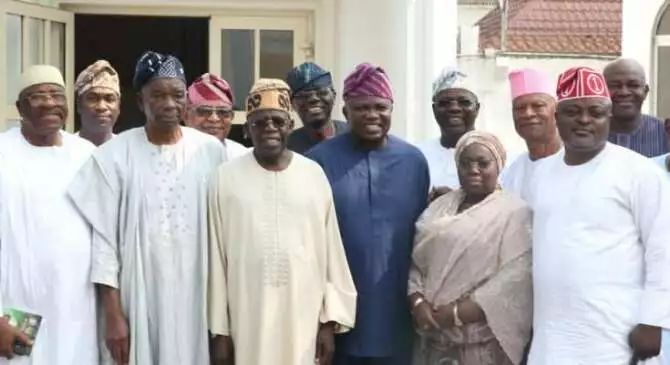
So, Tinubu called them together on Sunday, February 3, 2019. When they came out, everybody was happy. All were smiling. They even took a group photograph, and Ambode, looking like an abandoned orphan, stood by the Asiwaju. Tinubu has spoken. All is well. And like a messiah, he assured Ambode and Lagosians: “No more impeachment.” Lagosians clapped, and hailed Tinubu’s intervention. A couple of days later, Ambode presented the budget before the House. See? The Tinubu effect.
The questions many asked, however, were: Who was behind the budget delay and hints of an impeachment? They point accusing fingers at the godfather. Their reasoning: Without his support, where would the Lagos State House of Assembly get the courage to even dream of Ambode’s impeachment? They concluded that, perhaps, the godfather needed to teach Ambode more lessons, in case denying him a second term ticket was not enough lesson. Perhaps, Ambode is either strong-headed, or does not learn fast.
A group photograph taken after Tinubu’s intervention.
There were, for example, allegations that Ambode was neither releasing money to the House, nor for the Governorship campaign. They allege he refused to release some hundreds of millions of Naira for campaigns. What’s wrong with the guy? So, the impeachment threat. Anyway, now, money will flow.
Yet, there are people who insist that Tinubu stepped in because he knew many Lagosians had become irritated over the Ambode issue, and were prepared to call anybody’s bluff, including Tinubu’s. He was denied a second term, they argued, because the godfather was angry, not that he under-performed. The spontaneous protests, it is alleged, were enough warning. There were fears in Tinubu’s circle, it is alleged, that Ambode, having been pushed into the gutter, no longer feared a fall, and could spoil a lot of things during this fluid period. What if his supporters, and they are many, decide to back another candidate?, they asked.
Every godfather knows when to pull the breaks. Not a few people say it has been Tinubu’s main stay. As smart as they come, he knows when to fight, and when to retreat. In the Ambode impeachment case, he knew he had to pull the breaks; that there could be a back-lash; that the consequences might have been too much; that it could spiral out of control.
Yet, nobody can take anything away from Tinubu’s powers. He is a master strategist. In the Governors’ class of 1999, he remains the most relevant. The most powerful. When one thinks he has fallen, he rises with more powers. When he takes a beating, he retreats, cries in the rain, re-strategises, and comes on stronger than ever. He is, without doubt, Nigeria’s most influential politician, a title a number of people hate to acknowledge. But, it’s true.
In Lagos, he changes political office holders the way women change their underwears. Ever since he left office as a governor, almost every political office holder in Lagos owes his/her position to Tinubu. He decides who gets what; who goes where, including local Councilors. The civil service is not allegedly spared. While his pretty, brilliant, effective wife, Remi, is heading to the Senate for the third consecutive time, a couple of others, no less brilliant or effective, have since been given the push. But they keep quiet, and still remain loyal. They seem to have no choice.
Just before you think his powers and influence are localised, they transcend Lagos state. They extend to other South-west states. He controls a faction of the Yoruba cultural group, Afenifere. A good number of Yoruba traditional rulers hold him in awe, and reverence. They are likely to do his biddings than those of anybody else. He has installed a couple of governors across the South-west, the latest being Osun state’s. A couple of governors in the South -west who dared him, are not finding governance easy in their states. They watch their backs, politically, every inch of the way.
Nationally, he is also on the big stage, and arguably, the most powerful man in the APC, forget whatever anybody tells you. Ask President Buhari, and even former Presidents Jonathan and Obasanjo, both of whom were not in the same party with him. Here are some proofs.
Proof one: During Obasanjo’s second tenure, the old man out-witted all the governors in the South-west, but Tinubu. He swept them out of office. Tinubu was the only man standing. All his former colleagues in the South west, and a couple of other politicians who had fallen out with him grovel before him, almost, to be relevant in politics. When they stay away from him, they ultimately go back. When they bad-mouth him, they go back to beg. He forgives them. Ask his former deputy when he was governor, Femi Pedro. Ask former Minister of State, Musiliu Obanikoro.
Proof two: When Tinubu, from behind, backed Jonathan in 2011, Jonathan swept the South-west, except Osun state where he, and then Governor Rauf Aregbesola, known as Tinubu’s man-friday, wanted to prove a point. In 2015, Tinubu pulled the rug from under Jonathan’s feet. He rallied the Yoruba against him and gave the votes to Buhari. When he gives an order, it is obeyed.
Proof three: For three consecutive times, Buhari fought to be the president of Nigeria. For those number of times, he failed badly, forget the tales about being rigged out. Then, steps in Tinubu, fully behind him in 2015. Completely repackaged, and backed with cash like he never thought possible before, Buhari ingnited a tsunami and, became Nigeria’s President.
Proof four: When Buhari eventually became the President, he tried to sideline Tinubu. Tales had it that it was on the advice of a few people around the President. Hurt, Tinubu crawled back into his shell. Some people mocked him. We told you so, they said. We told you this man will use you and dump you. Even his wife, Remi, in a whiff of anger, during an interview, lashed out that her husband was treated like thrash after helping the APC to win big. But Asiwaju said not a word. He re-strategised. And soon, Buhari came calling. He made Tinubu the Chairman of APC’s Reconciliation Committee, nationwide. Even though that was a mission unaccomplished, it was still a recognition of Tinubu’s powers and influence. Tinubu fingered former APC National Chairman, John Odigie Oyegun, as the guy behind the failure of the assignment. And Oyegun paid dearly for that. Tinubu made sure Oyegun lost his coveted office. He then installed the foul-mouthed Adams Oshiomhole in Oyegun’s place. Since then, Oyegun has been rendered irrelevant, almost, in the APC. He hardly talks. Oshiomhole has been acting the good boy. He needs to. During the party’s primaries, he showed the Asiwaju how grateful and subservient he is to him. After former Governor of Cross River State, Clement Ebri, cancelled the primaries that threw up Sanwo-Olu, describing it as a no-event, Ebri was forced to swallow his vomit within 24 hours. As Nigerians watched, with mouths agape, Ebri announced Sanwo-Olu winner. There is no prize for guessing who pulled the strings. Oshiomhole made not a whimper. In nearby Ogun state, Governor Ibikunle Amosun, as close as he is to the President, was unable to pull that stuff with Oshiomhole. When it concerns Tinubu, Oshiomhole walks as if he is walking on egg shells.
Proof five: A few weeks ago, Tinubu pulled the big one. In constituting the Presidential Campaign Team, Buhari named him his Co-Chairman. Meaning: The two of them would drive the campaign train. The President is supposed to be the chief driver. Afterall, it is his campaign. But no. On the inauguration day, Buhari withdrew, and told a shocked nation that the Asiwaju would lead his campaign. That he, Buhari, would be too busy with governance to campaign. The President’s position was greeted with jeers. Not a few people laughed. He does not have the strength or capacity to stand the rigours of a campaign, they mocked.
Perhaps, realising the damage, his mangers quickly announced that the President would lead his campaign in all the 36 states of the federation and Abuja. He has so far managed to, the number of embarrassing gaffes and situations notwithstanding. Yet, nobody will forget that President Buhari once ceded his job to Tinubu.
This other day in an interview he granted to the Vanguard, Sokoto state Governor, Aminu Tambuwal, re-confirmed Tinubu’s powers. The problems the Executive and Legislative arms of government are having are traceable to Tinubu, he sensationally revealed. In the run-up to the 2015 elections, Tambuwal disclosed, Tinubu had endorsed Bukola Saraki for the position of Senate President. But he turned against him when Saraki opposed Tinubu as Buhari’s running mate. A Muslim-Muslim ticket will be dangerous for the party, Bukola and some others reasoned. To get back at Saraki, Tinubu picked Lawan, the now Senate Leader. Even when he, Tambuwal, pleaded that Saraki become the Deputy Senate President under Lawan, Tinubu refused. All of them, including Tambuwal, and Governor Abdulazeez Yari of Zamfara state, who stood against Tinubu’s Vice Presidency, became his political enemies. It was also same way Femi Gbajabiamila, House Leader, lost the Speakership allegedly, on Tinubu’s advice. He refused to have Dogara as his running mate. According to Tambuwal, that was how Lawan and Gbajabiamila lost the coveted offices.
Tinubu has fought battles. He has lost a couple of them, and won most, beginning with a certificate scandal in 1999 when he was first elected governor. But the 2019 general elections will be his biggest battle. If he succeeds in installing Sanwo-Olu as Lagos governor, that will be another feather to his many caps. He would have installed three governors in quick succession If Tinubu pulls another overwhelming victory for Buhari in the South west, thus handing over the Presidency to him, Tinubu would have become unarguably, Nigeria’s ultimate political godfather. Problem may be how it would play out later.
In Lagos, he might still remain the most powerful politician since Sanwo-Olu will do everything to avoid the Ambode treatment. But nationally? That may pose a problem. Nothing stops Buhari from freezing him out again after victory. Afterall he is not going for a third term. New alliances will start as soon as Buhari is sworn in. And, it may pose a problem for the Asiwaju. Here is why?
In the APC, especially in the South west, he has as many admirers and loyalists as those who cannot stand him. A couple of them have eyes on 2023, the year Tinubu plans to be the Chief Executive Officer of Nigeria – with a Christian running mate from the North West. If Buhari loses, however, I cannot begin to imagine what Tinubu’s fate will be, because it may have a spiral effect on Lagos politics. So, if that happens, will he lose all? Perhaps. But don’t bet on it. The man is a master strategist. Hard to ignore.