For weeks now, there have been widespread unrest in the country. Rogue Fulani Herdsmen’s heinous activities, Occupy Lekki Toll Gate Protest, the Yoruba/Hausa crisis in Shasha, Oyo State and other national issues.
But the National Leader of the ruling All Progressives Congress, APC, and former Lagos State Governor, Asiwaju Bola Ahmed Tinubu, who happens to be a strong force in the nation’s nascent democracy have been mute.
In this regard, Political Activist, Timi Frank, has called on Tinubu to speak up in defence of the Yoruba race now under fierce attacks by herdsmen, bandits and kidnappers.
Frank, the former Deputy National Publicity Secretary of the APC, berated President Muhammadu Buhari and Tinubu over their silence following the recent crisis in Oyo State as well as across the Southwest and other regions of Nigeria.
In a statement in Abuja, Monday, February 15th 2021, Frank decried the spate of insecurity in the country, especially in the South West, saying that Buhari and Tinubu should be held responsible for the crises.
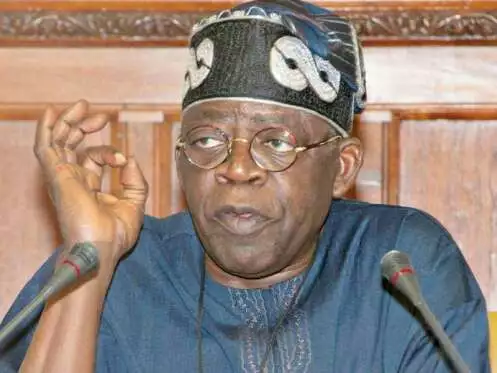
Bola Tinubu
He urged the APC leader to break his silence and speak up against the attacks in his region, saying his continued silence does not portray him as a leader who has the interest of his people at heart.
He said: “The crisis in the South-West should be solely blamed on Tinubu who foisted Buhari on Nigerians and especially on the Southwest.
“How can Tinubu continue to keep mute over the attacks in Oyo state and other Southwest states?
“Tinubu is a leader of the Yorubas in Southwest. Asiwaju cannot be silent over matters involving threats to life, peace and security of his people.
“His continued silence has become too loud, especially owing to the fact that he was the major influence and the reason the Yorubas voted massively for Buhari in 2015.
“Tinubu’s silence shows he is only protecting his business interests in the South-West as well as protecting his political ambition.
“He does not want to shatter his relationship with Buhari which in turn, by his calculation, would attract the President’s nod for him to have a shot at the presidency come 2023.
“But as a leader of the region, Tinubu should speak against the attacks against his people and not be driven by his selfish 2023 presidential ambition.”
The Bayelsa-born activist added: “Nigeria is more divided under Buhari than it has ever been before. Buhari’s government has polarised the country across religious and ethnic lines.
“This government is so clueless and incompetent that it recognises and shows a soft hand on terrorist groups like Boko Haram, killer herdsmen and bandits, but sadly mete out cruelty on innocent and patriotic Nigerians.
“Look at the number of security personnel it sent to wickedly dehumanise and arrest peaceful #EndsSARS protesters at the Lekki Tollgate in Lagos.
“Yet, the Buhari government can’t send a similar proportion of law enforcement agencies after killer herdsmen.
“Instead, the President is emboldening the terrorist groups with his direct and indirect support, even against the South-West region and the likes of Tinubu have kept silent while their people suffer.”
Frank, however, urged all Nigerians and especially the leaders in the South-West to “unite and fight this common enemy.”
He urged other regions to also join in the fight, warning that if the trend is allowed to fester, that sooner or later, the crisis of insecurity may grow out of proportion in every region of the country.
A Senior Advocate of Nigeria, SAN, Mike Ozekhome, has criticised the arrest, of Protesters of the #OccupyLekkiTollGate at the Lekki Toll Gate, Lagos State. They included comedian, Debo Adebayo, popularly known as Mr Macaroni. About 40 of them, they were arraigned before a Mobile Court, and charged with, among other things, a breach of the peace and public disorder. They were granted bail same day, Saturday.
Of the arrest, Ozekhome said that it is disheartening that the Lagos State Governor, Babajide Sanwo-Olu, the Inspector General of Police, Mohammed Adamu and the Federal Government will arrest Protesters staging a peaceful protest.
He stressed that even during the military dispensation, people were allowed to protest peacefully.
According to him, “It is patently illegal and totally unconstitutional to to detain Debo Macaroni . At least the Nigerian constitution has not been abrogated by this dictatorial government of impunity. Sections 40 and 41 of the constitution give Debo and others the right to peaceful assembly and association and the right to freedom of movement.
“Even under military dictatorship, as one of the founding fathers of the Civil Liberties Organization, CLO, (the first indigenous human rights organisation in Nigeria founded on October 15, 1987), I was allowed to demonstrate and protest on the streets by successive military juntas.
“Debo and the other protesters have done no wrong to protest. It has not been shown that it was violent . Is the Federal government truly saying Nigerians should no longer protest? Then, the Federal Government should dissolve the people and select or elect another one of its choice.”
Oyo state government is to arrange a meeting with leaders of Yoruba and Hausa at Shasha community, in continuation of fostering peaceful coexistence among the ethnic.
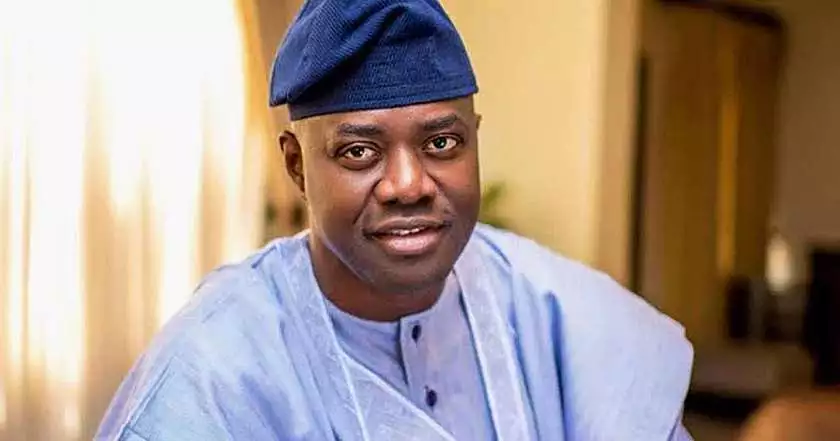
The decision was reached at the end of a meeting in Ibadan between Governors Rotimi Akeredolu of Ondo state and Seyi Makinde.
The two Governors, after the meeting, also visited the troubled shasa community, where they appealed for calm and peaceful coexistence between the Hausa community and their Yoruba hosts.
A statement by the Chief Press Secretary to Oyo state Governor, Mr Taiwo Adisa, said Governor Makinde, spoke at Shasa market and the Palace of the Baale Shasa, urging the residents of the community and Oyo State, particularly the Yoruba and Hausa to stop taking laws into their hands.
The Governor promised to give palliatives to those whose wares were affected during the crisis, adding that the two factions have to eshew violence and allow peace to reign.
“Please, I want you to listen to me clearly. You cannot resort to self-help to solve the issue on ground. All of you who are here are doing business with one another in one way or the other.
“The last time I came here, about six weeks ago, some shops belonging to Hausa and Yoruba people got burnt.
“So, you have been living together peacefully and all I am pleading to you is, no matter what is making anyone angry, we will solve it with patience.
“I was reluctant to declare curfew here because I feel the economic wellbeing of everyone here is important, and because this is where you get what you use to feed yourselves.
“I will engage with your leaders. One thing is, if you allow those who don’t have anything to lose here to blow this matter out of proportion, no one will be able to say where the crisis will end. By the grace of God, I pray we don’t lose any more lives.
“We must not lose any life needlessly anymore. What the government will do to ensure that those whose houses, shops were burnt, we will rebuilt immediately.
“But please, I beg of you, let us stop fighting with ourselves. I can assure you that we will deal with the situation.
“We must continue to maintain the peace here. Those who are hoodlums here will be dealt with but those who are law-abiding will be compensated for what they have lost.”
Similarly, Governor Akeredolu of Ondo State, said that he was in Oyo State on behalf of the South West Governors.
He said that every aggrieved party must stop fighting and allow peace to reign.
“Concerning the issue on ground, we have come to beg you. We have been living together for a very long time and this is not the time to start fighting ourselves. So, let us consider that. There are some things that could be making us angry but don’t let us look at that because things cannot be like this forever.
“I have come here on behalf of my colleagues in Ekiti, Lagos, Osun and Ogun. All of them have sent messages. Ogun has its own crisis, it is battling with, so does Lagos. But as the chairman, I decided to come around to appeal to us.
“Though we are here in our fatherland, our own sons and daughters are in another person’s fatherland. So, let us think about this and continue to live in peace with one another. We don’t need to fight ourselves.
“We have security agencies that you can call their attention to any issue that could cause crisis. Let us not take law into our hands. I have a brother in Abuja and others living in Hausaland.
“Also, let us cooperate with the governor here. If there are things we have done wrong, forgive us.”
Dr Ngozi Okonjo Iweala, a former Nigeria Minister of Finance will be named as the Director General of the World Trade Organisation, WTO by its governing council, in Geneva, Switzerland, today.
The former minister and coordinating Minister of the Economy under President Goodluck Jonathan had inched towards becoming the first black person to head the trade organization last October, but was rejected by the United State President Donald Trump who preferred the South Korean Korea Trade Minister Yoo Myung-hee, for the top job.
The WTO DG position is based on consensus and majority of the blocs that made up the organization, including EU, UK and China had thrown their weights behind the former World Bank managing director, except the US which exercised its veto to stop Dr Okonjo-Iweala from being announced as the winner.
The development Economist, analysts say was caught up on the wrong side of the Trump administration, who accused her of lack of trade-negotiating experience despite the endorsement of the organization’s selection committee and almost all other member nations.
President Joe Biden’s administration finally gave its blessing, few days ago after the South Korean candidate stepped down, clearing the way for the ex-minister to become the first woman and the first African to lead the WTO in its 25-year history. She will also be the first American citizen to hold the organization’s top job.
Describing Dr Okonjo-Iweala, the President of the European Central Bank, Christine Lagarde said “She is this wonderful, soft, very gentle woman with an authentic approach to problems but, boy, under that soft glove there is a hard hand and a strong will behind it .She is going to rock the place.”
Ngozi Okonjo-Iweala was noted for her effort to root out corruption during her first stint as Nigeria’s finance minister, which made her opponents to give her sobriquets such as of her ‘Okonjo Wahala’ and ‘Okonjo the trouble maker.’
Meanwhile, trade analysts say the enormous support she enjoyed from President Muhammadu Buhari and other African heads of state served as strong impetus to clinch the job.
Until a couple of days ago when the Attorney-General of the Federation, AGF, and Minister for Justice, Abubakar Malami, SAN, mentioned the name, Ibrahim Magu, many people had forgotten him.
This may sound surprising. But that is us in Nigeria. It is our mannerism. Our way of life. Nigerians don’t get bothered, too much, about many things. We don’t dwell on any subject for too long. We worry at that particular time, scream blue murder, but soon forget it. Somebody described it a general amnesia. I disagree. It is just that we are too busy, hustling for survival to bother.
That is why politicians take the people for granted. They do something unbecoming, we scream, but quickly forget. That is why, for example, a Senator Elisha Abboh, (remember him?), the woman- beater at an Abuja adult shop, will look us in the face, and tell us, seriously, of his plans to become the Governor of Adamawa State in 2023.
Nobody should blame this man. He was not punished for his shamelessness. After the ugly incident which went viral on WhatsApp, and other social media outlets, he still sits in the Senate, and prefixes his name with: “Distinguished Senator.”
In other climes, that would have marked the end of Abbo’s political career. In Japan, the Chairman of the Tokyo Olympics, Yoshiro Mori, stepped down because he dared say, during a meeting, that “Women are talkative.”
But here, a Senator Elisha Abbo publicly beats up a woman in her shop, sits tight in the Senate as a Senator, and prefixes his name with “Distinguished”.
It is because of our same attitude that the Governor of Kogi State, Yahaya Bello, would be thinking of becoming Nigeria’s President come 2023. Here is a Governor who has not only shamed us here, but has put a question mark on Nigeria before the International Community, by his continued denial of the existence of COVID-19, and worse, propagating absolute falsehood about the deadliness of its Vaccine.
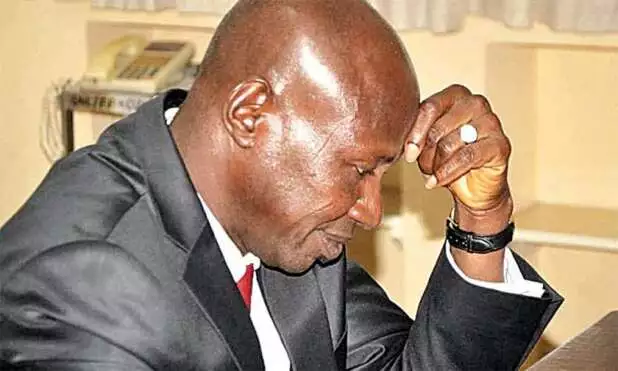
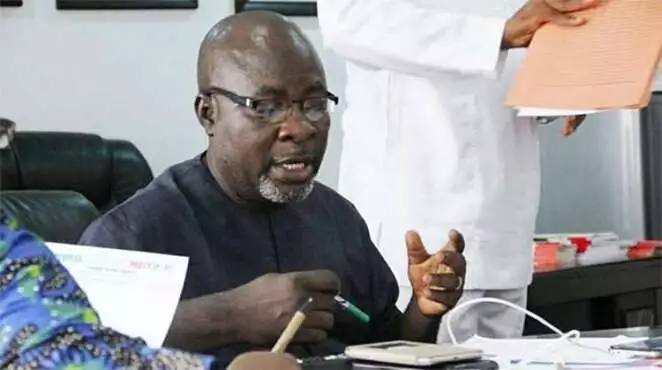
Ibrahim Magu
We can say the same thing of the Governor of Bauchi State, Bala Mohammed. This Governor, a couple of days ago, said the unbelievable. It is very okay, he said, for Fulani Herdsmen to carry AK 47 because of cattle rustling. By saying that, Governor Mohammed has endorsed illegal carrying of arms. He has also endorsed the killings and kidnappings of innocent citizens by rogue herdsmen.
On Sunday, Mohammed tried to clarify what he said, insisting he did not mean it that way, that he only meant to draw attention to the sufferings of the Fulani herdsmen, he left his clarification late. The harm had already been done. In the times we are, and on such a sensitive issue, there is no room for ambiguity from any leader.
Shocked, as most Nigerians were, Ondo State Governor, Rotimi Akeredolu, dismissed his Bauchi colleague as an anarchist, not fit to hold any public office. Not a few people agree with Akeredolu.
In other climes, Governor Mohammed would have resigned from office for that chilling pronouncement.
Here, people are urging him to aspire to the office of the President in 2023.
But I have since digressed. I was talking about
Magu, and how not a few people have forgotten him and who he was.
A Commissioner of Police, Magu was, remember, the Acting Chairman of the Economic Financial Crimes Commission, EFCC. He held that position until July 7, 2020, when, acting on a damning letter to the President against him, by Malami, President MuhammaduBuhari “removed” him from office.
Many people are of the opinion that the manner of his removal was not tidy. His convoy was blocked on his way to a meeting at the Force Headquarters, Abuja, diverted to Aso Rock Villa, and Magu was hauled before a Presidential Investigative Panel. There, his security details were stood down, and his official vehicles, withdrawn.
After the preliminaries at the Panel, headed by a retired President of the Court of Appeal, Hon. Justice Ayo Salami, Magu was, that same day, hauled into detention for 10 days. Within the 10 days, he was suspended from office, and another Acting Chairman, Muhammed Umar, appointed.
For months, the Panel sat. Witnesses upon witnesses were called. There was a lot of drama Allegations of prejudice were, atimes, made against the Panel by Magu’s defence team. They said the Salami-Panel had made its mind up to find Magu guilty, by all means. They said Magu was not being given the opportunity to defend himself. They said the Panel was inviting those Magu”s EFCC was either investigating or prosecuting. At a point, they alleged that the Chairman of the Panel had confided in them that he regretted taken up the job – an allegation Salami strogly denied.
Malami, Magu’s nemesis, after his earlier public pronouncement to appear before the Panel, if invited, reneged when the time came. Magu’s team cried foul.
The Panel stayed focused and on course. After sitting for months, as against the earlier expected 45 days, the Panel finally handed over its report. But that is all there has been to it since then, until this order day when AGF Malami, in explaining the delay in deciding Magu’s fate, said President Muhammadu Buhari was still studying the report.
Listening to Malami, one cheeky fellow asked: Who’s Magu again? While shock registered on the faces of some people, others shook their heads. It was difficult for me to decipher whether both different reactions were out of pity for Magu, or for a country that delays, almost, everything until it is forgotten, or makes no meaning again when it is remembered.
Otherwise, how can anybody ask; Who’s Magu again? Magu ke? – the same Magu who bestrode Nigeria like a colossus. He was the nightmare of everybody, almost. His name instilled fear, even amongst the innocent. He walked where Angels feared to walk. He seemed to have no friends, or so it was thought. Magu didn’t give a damn. He didn’t think he needed friends, anyway. His job was his life, his friend.
His many humiliations did not worry him. And, he broke quite a couple of records in that area. In the history of the EFFC, he was the only one who the Senate refused to confirm. Not once, but twice. And he was there for five years. He was the only one who a sister- Government Agency – the DSS, wrote a damning report against. That, effectively, stopped his confirmation by the Dr Bukola Saraki-led 8th Senate.
At the exit of the 8th Senate, everybody thought he would have an easy walk-through. But Mr President, surprisingly, wouldn’t send his name to the 9th Senate for confirmation. What nobody knew was that a worse fate awaited him. He chucked another minus up his sleeves.
His supervisory Minister, Malami, wrote a damning letter against him to the President, resulting in his present fate. Of all his predecessors, he is the only one, accosted along the road, arrested and hauled before an Investigative Panel; the only one suspended from office, and whose fate hangs in the balance, months after he was removed.
When his predecessors were removed, they knew from day one that they have been removed, even though their manner of removal was, also, untidy.
The removal, from office, of one of Magu’s predecessors, the lovely, hard-working, and unassuming Mrs Farida Waziri, was announced over the Radio and Television, even before she had an inkling of her sack. I remember.
Not quite 10 minutes after Waziri dropped me off at the hotel where I lodged, I heard the announcement of her removal as soon as I switched on the television.
For over an hour, I sat down, dumbfounded, just remembering how happy two of us were, chatting like teenagers, just some minutes ago. Life can be funny and brutish.
So, one just wonders.
Why does the Government, most times, not remove its high profile officials, decently? In Magu’s case, for example, nothing stopped an invitation to him, nicely, to appear before the Salami Panel. The public exhibition of his arrest was unnecessary, unless he had refused an earlier invitation.
When people say serves him right, that he was given a little of his own meficine to others, I counter them by taking refuge in the Holy Bible. Never repay evil with evil, the Holy Book admonishes us. Magu has his good sides. He was not the worst in that office.
Under the pioneer Chairman, Nuhu Ribadu, a serving Police Officer, at the time, of the rank of a DCP, I forget now, EFCC Operatives had the courage to, disrespectfully, wrestle the IGP then, Tafa Balogun, to the ground, in a bid to handcuff him and PUSH him into a vehicle. The man did not resist entering the vehicle, or anything of that nature, so, what was the public drama about? Not a few Police Officers were incensed by that treatment, and never quite forgave Ribadu.
Under Ribadu too, a member of the House of Representatives, Maurice Ibekwe, was left to die in detention. While in prison custody, under prosecution for alleged 419 by the EFCC, he took ill, very ill, with sores all over him. The EFCC opposed all applications for his bail, and rejected all entreaties from a number of people to allow him out for proper medical treatment.
When he died, the EFCC issued a lame apology. It is the enormous powers attached to that office that make occupants seem inhuman.
But back to Magu’s fate. I know Mr President is busy, but the Magu issue has taken quite sometime. The report should be dealt with, and the case rested.
Government has a way of delaying reports. I once sat, for about eight months, on a high profile Committee which looked into the grey areas of reports from a couple of Constitutional Conferences. A former Chief Justice of Nigeria, The Hon Justice Alfa Belgore was the Chairman. Senator Udo Udoma was his Deputy. Ambassador Babagana Kingibe, Professor Anya O.Anya, among others, were members, while the cerebral Ferdinand Agu, was the Secretary.
Patriotism drove us. We painstakingly, did a good job. But, till date, the report has not seen the light of the day. They are dumped somewhere, gathering dust Delay is dangerous, it is usually said. It gives room for wild speculations. And takes the wind off serious issues.
The prayer, here, is that Magu’s case will be different. His fate should not be left to hang in the balance for too long. No matter what it is, the release of the report will keep his mind at rest. Whatever, he will take it as a man. He is pretty sure the plum office is gone forever, unless there is a miracle. Though I hardly see that. Not after midway into the sitting of the Investigating Panel, Garba Shehu, Special Assistant to Mr President on Media and Publicity, gave us an inkling into what to expect. He warned us that the report would shock us.
Aged 58 years, time is no longer on Magu’s side in his career as a Police Officer. He will retire at 60. The sooner he knows his fate the better for him and the Federal Government.
For Magu, he will have the rest of mind to prepare for his retirement. And for the FG, it would take care of some dangerous speculations. One of such speculations, for instance, says that Magu’s “ordeal” has everything to do with the politics of 2023. See?
That is why it is important to deal with it as soon as possible. I believe in this cliché: Justice delayed, is justice denied.
President Muhammadu Buhari has been chastised by the Peoples Democratic Party, PDP, over his silence as violence and unrest take center stage in many parts of the country.
The PDP condemned what it called the President’s indifference and aloofness to crisis rocking the nation.
The opposition Party In a statement signed by its National Publicity Secretary, Kola Ologbondiyan, told President Buhari to perform his obligations as President and ensure security of lives and property in the country.
Ologbodiyan added that the crisis in various parts of the country is as a result of the “insensitive, divisive and parochial approach to governance” by the Buhari-led administration.
It also noted that the country has degenerated into sectional disagreements and violent conflicts, and urged him to work towards ensuring peace and security.
“The Peoples Democratic Party (PDP) expresses deep concerns over the rising sectional disagreements and violent conflicts in various parts of the country, which are being exacerbated by the insensitive, divisive and parochial approach to governance by the Buhari-led All Progressives Congress (APC) administration,’’ Ologbondiyan said.
“The party laments the escalated sectional conflicts in various parts of the country; the bloody ethnic clashes currently raging in Ibadan, Oyo state, in addition to similar clashes recorded in Benue, Taraba, Kogi, Plateau, Kaduna, Kano, as well as other states of the federation.
“The PDP calls on President Muhammadu Buhari to note that the once cohesive and economically thriving nation handed over to him in 2015 is fast collapsing in his hands due to his failure to effectively manage the economy, inability to administer the complex political and sectional nuances of the nation, as well as manifest lack of capacity to confront terrorists, bandits and kidnappers ravaging our country.”
The PDP, however, urged Nigerians to remain calm and vigilant, while calling on Buhari to take steps to unite the nation by ensuring justice for victims of criminal activities.
Kola Ologbondiyan
“The PDP urges President Buhari to wake up from slumber, end the divisive tendencies of the APC administration and, without further delay, take urgent steps to guarantee peaceful co-existence in our country by ensuring strict adherence to extant provisions of the 1999 constitution, especially regarding our federal structure and sensibilities.
“While calling for calm and vigilance, our party charges President Buhari to take steps to unite the nation by ensuring justice in the face of infractions against our federal sensibilities as a people.
“The PDP stressed that the nation is already distressed by unbridled violence, wanton killings and bloodletting by terrorists, bandits and kidnappers, who the Buhari administration has failed to contain, and cannot stand the trauma of sectional conflict at this critical time.’’
The Minister of Youth and Sports, Sunday Dare, has broken silence over allegations leveled against him of being a beneficiary of the constant stream of income from the Lekki Concession Company, LCC.
In a statement by the Minister, he said it was a figment of imagination, that is false and ridiculing.
The statement reads: “The attention of the office of the Minister of Youth and Sports Development, Hon. Sunday Dare has been called to a false news making the rounds on social media that he has been benefiting from constant stream of income from Lekki Concession Company Limited (LCC).
“The story reeks of blackmail, malicious slander and false in every material particular.
“The misleading, disingenuous and false report that offers no facts which are sacred should be disregarded and seen as the handiwork of hatchet men who pose as social media journalists, political jobbers and unscrupulous persons who are acting the script of their pay master(s) in a calculated attempt to tarnish the hard earned reputation and good works of Dare.
“For the records and posterity, it is important to state that the unsubstantiated report is not only capable of but aimed at heating up the polity at this critical time of nation building.
“Let it be categorically stated that Mr. Dare is not a stakeholder (Shareholder, Director or Contractor) in LCC. He collects no proceeds from the the LCC directly or indirectly as the malicious social media posts tried to suggest without an iota of fact”, the statement read.
“He who alleges must proof. The Minister will not hesitate to institute immediate legal action against these purveyors of false/fake and malicious news. This few give the media a bad name.
“We also use this medium to admonish the unsuspecting public to discard the fake news while advising online media practitioners to embrace objective and investigative journalism in order not to cause unnecessary tension”, the statement stressed.
Northern Youth Group under the aegis of Northern Youth Council of Nigeria, NYCN, has expressed concerns on the alleged constant attacks against Northerners, especially the recent attack in Sasha market of Akinyele Local Government Area of Oyo State which led to loss of lives and destruction of property, advising Northerners not to take the risk of travelling to the South West for now.
A statement from its spokesman, Mock Kure, observed that, “The attention of the Northern Youths Council of Nigeria has been drawn to the ongoing Carnage against Northerners, particularly in Sasha Market of Akinyele Local Government, Oyo State, South West Nigeria wherein so many lives were either killed or injured, business premises and vehicles were burnt by Yoruba hoodlums.
“We wish to condemn such an attack in the strongest terms possible and call on security agents to arrest the perpetrators so as to serve as deterrent to would be hoodlums.”
The Arewa youths noted that the hidden agenda to expel Northerners in that Zone started with the call on all herdsmen (Not criminal elements) by the Governor of Ondo State, His Excellency, Rotimi Akeredolu, to leave all State controlled Forest Reserves.
It explained that this led to the sudden emergence of one Sunday Igboho, “a well known motor park tout” as the Enforcer-In-Chief of the hidden, but now open agenda in far away Oyo State.
The youths noted, “The eviction orders violate the provisions of the constitution of the Federal Republic of Nigeria (1999 as amended) which guarantees freedom of movement to all citizens and rights to own movable and unmovable properties in any part of the country.”
The statement noted that in his effort to defend the laws of the country, the Inspector General of Police gave instruction to his subordinates in the region to arrest and bring the said Sunday to Abuja, saying that the arm of the law has proven to be weak and helpless as the said wanted person has been going about dishing out fresh quit notices to law-abiding citizens and enforcing same in many States of the region.
“We believe strongly that the inability of the government at all levels to tame the lawless wings of Sunday Igboho and his co-travellers has led to the emergence of his variants, hence, the renewed attacks on settled business people and many others that can’t speak Yoruba at Sasha Market,” the statement explained.
The Group called on the Federal Government to declare Sunday Igboho’s group a terrorist organization as he is not different from Boko Haram.
They called on the Northern Governors Forum under the leadership of Plateau’s Simon Lalong, to rally his colleagues to begin to evacuate their brothers that are trapped in the Southwest and other troubled spots in Southern Nigeria since the governments in those regions have proven to be helpless or tacitly complicit in the ceaseless attacks ”on our people.”
The statement observed that the Northern Youths continue to maintain maximum restraints despite the unjustifiable and unprovoked attacks on their people pending when government would exhaust all its cards.
It enjoined the National Emergency Management Agency (NEMA) to mobilize resources to the market to ameliorate the sufferings of those who lost their means of livelihood to the carnage.
The Arewa youths urged the federal government to adequately compensate those who lost loved ones and property to the crisis.
The youths, also, enjoined Northerners to desist from travelling to South West Nigeria as signals from the region remain awful, pending when the government would prove that it is now safe to travel to that region.
The statement urged Nigerians with conscience to condemn such attacks and other planned attacks, saying that together, good shall triumph over evil.
As expected, it was a tense fight. The two former training partner and friends, Nigerian fighter, Kamaru Usman and his Brazilian counterpart, Gilbert Burns were full of emotion while embracing in the middle of the Octagon on Saturday night.
Burns had blood and tears running down his face. Some of their cornermen behind them were trying not to cry.
Usman stopped Burns, his former teammate, via TKO at 34 seconds in the third round to defend his UFC welterweight title in the main event of UFC 258 in Las Vegas.
Usman landed a right hand as he was switching stances to floor Burns, then slammed Burns with punches on the ground until referee Herb Dean pulled him off.
“Gilbert is a guy that I’ve known from the start,” Usman said in his postfight interview. “I love him. This one was tough for me to deal with.”
Usman picked up his 13th straight win, surpassing legend Georges St-Pierre for the most consecutive wins in UFC welterweight history. Only Anderson Silva has won more than 13 straight fights in UFC history, winning 16 in a row from 2006 to 2012. Usman is tied with six other fighters with 13 consecutive wins.
Usman and Burns were teammates in South Florida since 2012, first with the Blackzilians and most recently with Sanford MMA. Usman departed for Colorado to train under coach Trevor Wittman last year after the initial fight with Burns was scheduled for July. But Burns tested positive for COVID-19 and withdrew from that bout. Henri Hooft, the longtime head coach for both Usman and Burns, did not corner either man and said he would not even watch the fight.
Usman said he “almost started bawling” when the two fighters embraced in the Octagon after the fight.
“I know what that loss feels like,” he said. “I have a loss on my record. I’m not perfect. I know what that felt like. I knew how bad he wanted this. … Having to be the one to do that to him, it almost broke me in there.”
Kamaru Usman rolled to his 13th straight win, breaking Georges St-Pierre’s record for most consecutive victories in UFC welterweight history.
Jeff Bottari/Zuffa LLC
The bout had major implications outside of the personal story. Coming in, ESPN had Usman ranked No. 5 in the world in its pound-for-pound MMA rankings. In the welterweight division, ESPN has Usman ranked No. 1 and Burns at No. 5.
Burns rocked Usman twice early with huge right hands. But Usman hung in through a tumultuous first round. He then took over in the second, working a beautiful jab and stymieing Burns’ power and explosiveness. Usman’s striking looked better than ever, as he switched stances and landed with power from each one.
In the second round, Usman dropped Burns twice, the second time with a jab. In the third, it was a right hand that resembled a jab that put Burns on his butt before Usman pounced and finished on the ground.
“I am the best on the planet for a reason,” Usman said in his postfight interview. “Y’all, everybody else, you better put some f—ing respect on my name. … I’m here to stay.”
Burns said he made a “mistake” trying to finish Usman in the opening round.
“I know I can end any one of these guys. But in order to become a champion, I have to be disciplined,” Burns said. “I saw he was hurt. I kind of started loading up so much [on my punches]. The key for me was to keep doing what I was doing. Stay light on my feet. … Me, I was overexcited. He stayed disciplined. That’s what happened.”
UFC 258 was held with COVID-19 protocols in place at the UFC Apex, a facility across from the UFC’s Las Vegas corporate campus. It was the promotion’s first domestic pay-per-view card of the year.
Usman (18-1) has been champion since beating Tyron Woodley at UFC 235 in March 2019. He has had three successful title defenses. The Nigeria native, who grew up in Texas, has never lost in the UFC.
“He’s the whole package,” UFC president Dana White said. “The guy’s got the whole thing. It’s just, when are people gonna notice?”
White added: “The kid is the real deal, man. For the people that know, for the people that actually know about fighting, they know this win tonight was a big deal.”
Usman, 33, was coming off a unanimous-decision win over Jorge Masvidal at UFC 251 last July. Afterward, Usman called out Masvidal, who took that fight on six days’ notice. Usman said that “it’s not done” with Masvidal.
“He keeps running his mouth,” Usman said. “If he’s gonna talk, step in here and see me.”
White said Usman has “a lot of options,” but if Usman and Masvidal want to fight — and if the fans are interested — White said the promotion would consider it.
“If you look at all the guys that are lined up that he has to fight next, and he keeps doing what he’s doing, we’re gonna all pop our heads up one day and we’re gonna start talking GOAT,” White said. “It’s not just how you’re fighting and if you’re winning, it’s who you’re fighting, too.”
Masvidal’s co-manager Malki Kawa wrote Saturday night on Twitter that Masvidal wants to coach opposite Usman on the next season of “The Ultimate Fighter.”
Burns (19-4) had won six in a row coming in, the most recent a unanimous-decision win over Woodley last May. The Brazil native is 4-1 since moving up to welterweight from lightweight in 2019.
Burns, 34, is a multiple-time Brazilian jiu-jitsu world champion with power in his hands. He was trying to become the first Brazilian to win the UFC welterweight title.
“I’m the varsity guy,” Usman said. “My fight IQ is different. It’s different when you’re in the gym with me. But when you get in here, it’s a different ballgame. I’m a whole ‘nother savage.
Chairman Nigeria’s Governors’ Forum (NGF), Dr Kayode Fayemi, has said the carnage in Ibadan, Oyo state capital was avoidable.
Dr Fayemi, who is Ekiti state Governor, condemned the violent clash between some Yoruba and Hausa traders in Shasha market, Ibadan, at the weekend.
The violent clash had reportedly led to the death of some residents, destruction of properties and displacement of people in the area.
Already, Oyo state Governor, Mr Seyi Makinde, has imposed a curfew in the affected area, as part of measures to curb the crisis.
Dr Fayemi, in a statement signed by his Chief Press Secretary, Yinka Oyebode, on Saturday, called on the warring traders to sheathe their swords and embrace peace.
He sympathised with the Government and people of Oyo State, especially families that have lost lives and properties during the violent clash.
He also commended Oyo State Governor, Seyi Makinde for taking immediate steps in arresting the carnage, including the declaration of curfew.
Governor Fayemi said regardless of the cause of the disagreement that led to the mayhem, a peaceful resolution of the conflict remains the best option.
He urged the Yoruba and Hausa traders in the area, and in different parts of the country, to see themselves as brothers and partners in progress, adding that disagreements should not always be allowed to degenerate into violence, maiming and killing.
The NGF Chairman warned that the Shasha crisis, if not curtailed, could ignite pockets of crises in different parts of the country, adding that it would be disastrous for the country.
“We do not need any act of violence leading to unnecessary death of citizens.
“Now is the time for the leadership of various ethnic nationalities, trading groups and the security agencies to halt the orgy of violence in Shasha area and work towards ensuring peace in different parts of the country.
“We will enjoy enduring peace and progress through dialogue, mutual respect and understanding for one another. Violence and attendant death and destruction would only spell doom for the country.
“While commending Governor Makinde for his timely intervention in the crisis, we also express our sympathy to families of the victims as well as those who have lost properties and businesses during the crisis.”, Fayemi added.