

The Nigerian Maritime Administration and Safety Agency, NIMASA says more assets are being deployed to tackle the problem of piracy in Nigeria’s waters, particularly in the Gulf of Guinea.
The director General of the agency, Bashir Jamoh disclosed this after taking delivery of a Special Mission Aircraft under the Deep Blue Project designed to secure Nigerian waters up to the Gulf of Guinea.
Jamoh, received the aircraft, in the company of the Minister of State for Petroleum Resources, Chief Timipre Sylva, and NIMASA’s Executive Director, Finance and Administration, Chudi Offodile.
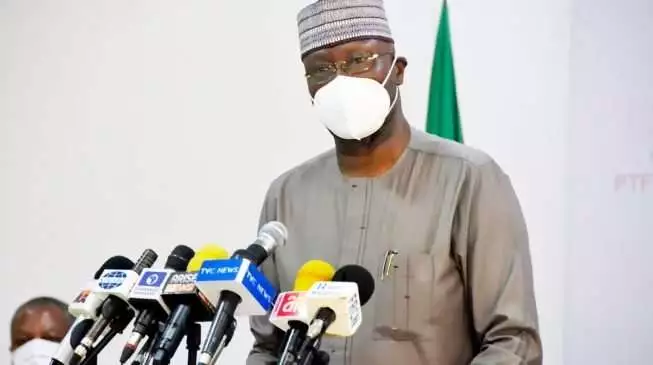
Addressing journalists at the Nigerian Air Force Base, Murtala Muhammed International Airport, Ikeja, during a brief ceremony to mark the arrival of the aircraft, Jamoh said the assets would further improve security in Nigerian waters.
The Director General revealed a drastic reduction in the rate of attacks in the country’s Exclusive Economic Zone (EEZ) with the deployment of the Deep Blue Project assets, saying the goal is to eliminate entirely such incidents.
He said, “There has been a drastic decrease in the rate of security breaches in our waters in recent times. This is a clear indication that we are getting it right with the Deep Blue Project.
“The figures we are getting from the International Maritime Bureau (IMB) are encouraging. We ultimately aim to completely eradicate security hindrances to shipping and business generally in the Nigerian maritime domain.”
Silva, Jamoh Receive Assets To Tackle Piracy
IMB, a specialised division of the International Chamber of Commerce ICC, has in recently reported a consistent year-on-year drop in the number of attacks on ships in Nigerian waters.
The latest IMB quarterly report of piracy and armed robbery against ships recorded only two incidents in Nigerian waters between January and March this year, compared to 11 attacks within the same period last year, the agency said.
“These figures are a proof that we can make our waters safe and secure, and we are determined to do so,” Jamoh said, adding that “today, we are here to receive the final phase of assets under the Deep Blue Project to further boost our capacity to secure our waters up to the Gulf of Guinea.”
According to the apex maritime agency “The Integrated National Security and Waterways Protection Infrastructure, popularly called the Deep Blue Project, is designed with three categories of platforms to tackle maritime security issues on land, sea, and air.
“The land assets comprise the Command, Control, Communication, Computer, and Intelligence Centre (C4i) for intelligence gathering and data collection; 16 armoured vehicles for coastal patrol; and about 600 specially trained troops for interdiction, known as Maritime Security Unit.
“On air, there are two Special Mission Aircraft for surveillance of the EEZ, one of which was received Wednesday, with the second expected to arrive May 18; three Special Mission Helicopters for search and rescue; and four Unmanned Aerial Vehicles. The sea assets consist of two Special Mission Vessels and 17 Fast Interceptor Boats,” NIMASA said.
Jamoh had earlier inspected three Special Mission Helicopters at the Naval Base, Apapa, under the project billed for launch on May 21
President Muhammadu Buhari has pleaded for more time to tackle the myriads of problems facing the country, noting that his government has performed well in the face of seeming challenges since it came to power in 2015.
But, the opposition PDP in response, said the president must buckle up and stop making excuses for his failures. The president made the comment on Thursday, in an obvious response to many Nigerians who believe that his government has failed to tackle the problems facing the country.
Also, the Sultan of Sokoto Alhaji Sa’ad Abubakar III yesterday challenged President Buhari and governors to bring insecurity in the country to an end.
The Sultan, who is the spiritual head of Nigerian Muslims as leader of the Nigeria Supreme Council for Islamic Affairs, NSCIA, said during his Eid prayer that all the political leaders in the country must wake up to their responsibilities.
Buhari, who spoke when the Executive Secretary of the Nigerian Christian Pilgrims Commission, Rev. Yakubu Pam, visited him in Aso Rock, Presidential Villa, Abuja, said the economy, infrastructure and security were in a very bad shape by the time he came to power six years ago. He said those criticising him have failed to consider areas where his government has recorded tremendous achievements.
The President said: “Those criticising the administration should be fair in terms of reflecting on where we were before we came, where we are now and what resources are available to us and what we have done with the limited resources. “We had to struggle paying debts, investing in road repairs and rebuilding, to revamp the rail and try to get power. This is what I hope the elite, when they want to criticise will use to compare notes.”
On the security situation Buhari said “What was the situation when we came? Try and ask people from Borno or from Adamawa for that matter and Yobe. What was the condition before we came and what is the condition now?” He, however, said the government is not unawares of the insecurity in some part of the country, assuring that such will be dealt with.
“Still, there are problems in Borno and Yobe, there are occasional Boko Haram problems, but they know the difference because a lot of them moved out of their states and moved to Kaduna, Kano and here (in Abuja). We were not spared of the attacks at a time. The government is doing its best and I hope that eventually, our best will be good enough.”
Meanwhile, the Peoples’ Democratic Party, PDP has responded to the president’s plea for understanding, saying that Buhari’s efforts in tackling insecurity have obviously not paid off, considering the current situation in the country.
The National Publicity Secretary of the PDP, Kola Ologbondiyan, said this on Thursday, noting that Nigerians are facing the worst situation as a result of government’s failure to tackle problems facing the country.
He said, “We note the appeal by President Muhammadu Buhari for Nigerians to show more understanding for his regime’s lethargic approach to governance. It is obvious his best is so far not enough; Nigerians are hungry and dying.
“We also invite him to also note that Nigerians are getting tired of an endless stream of excuses coming from his regime. He was elected to find solutions to problems not give excuses.
“We urge Mr President to wake up from his lethargy and address problems. Blaming the past has been the favourite sound bite of this regime since 2015. The other day, a minister was blaming the General Murtala Mohammed regime of 1975/’76 for Nigeria’s security problems. We can’t make progress this way.”
The Sultan of Sokoto said: “We are calling on President Muhammadu Buhari, and all the state governors to, as a matter of urgency, bring to an end insecurity across the country.
“As our leaders, you should continue to remain resolute and more committed to your various responsibilities of protecting the society.
“Therefore, you should enhance your commitment toward the restoration of the peaceful nature our country was long known for.”
The federal government has urged all sides in the Israel- Palestine conflict to embrace peace, saying that the authority in Nigeria is concerned that the problem could escalate.
The Buhari’s administration call for peace came on the heels of similar calls by the international community for the warring parties to embrace dialogue in the interest of their people. The United Nations, UN, France, United Kingdom, UK Russia and China have advised Isreali Prime Minister, Benjamin Nentayahu and leaders of the Palestinian Authority to deescalate immediately.
Biden’s 2020 presidential campaign website says he “believes in the worth and value of every Palestinian and every Israeli,” adding that he believes in the ‘Two States’ solution.
President Biden “will work to ensure that Palestinians and Israelis enjoy equal measures of freedom, security, prosperity, and democracy. His policies will be grounded in a commitment to a two-state solution, where Israel and the future viable state of Palestine will live together in peace, security, and mutual recognition.
“Biden opposes any unilateral steps by either side that undermine a two-state solution. He opposes annexation and settlement expansion and will continue to oppose both as President.”
The US will also “take immediate steps to restore economic and humanitarian assistance to the Palestinian people, consistent with U.S. law, including assistance to refugees, work to address the ongoing humanitarian crisis in Gaza, reopen the U.S. consulate in East Jerusalem, and work to reopen the [Palestine Liberation Organization] mission in Washington,” the US Government said.
Responding to an urgent question in the House of Commons, the UK Foreign Office Minister James Cleverley said the situation was “deeply concerning”.
“This cycle of violence must stop and every effort must be made to avoid the loss of life – especially that of children,” he said urging all sides “to refrain from any kind of provocation so that calm is restored as quickly as possible”.
The UK “unequivocally condemns acts of terrorism from Hamas”, he said and he stressed that while Israel has a “legitimate right to self-defence”, it must ensure that all action is “proportionate and in line with international humanitarian law.
“As we enter the final days of the holy month of Ramadan, restoration of peace and security is in everyone’s interest. The UK will continue to support that goal,” Cleverly said.
Adding the Nigerian voice to the call for peace, the Ministry of Foreign Affairs on Thursday said Nigeria was observing the conflict between Israeli and Palestine forces with “great concern.”
The conflict which broke out last week after Israeli forces tried to evict some Palestinians from the Al-Aqsa mosque, has led to clashes and death from both sides. Anger has also boiled over Israeli police’s decision to evict Palestinian families from the Sheikh Jarrah neighbourhood of east Jerusalem.
At least 109 Palestinians, including children and nine Israelis have been killed so far.
The Jerusalem’s Al-Aqsa mosque is sacred to both Muslims and Jews and has been in the middle of clashes between Israel and Palestine for some time. .
Responding to the conflict, the Nigerian Government through a statement signed by the Ministry of Foreign Affairs spokesman, Ferdinand Nwonye said “The Ministry of Foreign Affairs wishes to state that the Federal Government of Nigeria is watching with great concern, the unfolding developments in Israel and the State of Palestine and urges both parties to see reason and de-escalate the hostilities.
“The Nigerian Government further urges the two parties to remain committed to the two-state solution and, in the meantime, guarantee the rights of all citizens to live in peace and dignity.”
On Thursday, Israel deployed additional troops to Gaza’s border as the military conflict with Palestinian Islamists raged on, while inside Israel security forces scrambled to contain deadly riots between Jews and Arabs.
For the resolutions of the Southern Governors, which met early in the week in Asaba, Delta state, to receive needed backing, they will still have to meet their counterparts in the North to iron out grey areas, former Governor of Ondo state, Dr Olusegun Mimiko, has advised.
Dr Mimiko stated that “the next step is for the Southern Governors to meet with their Northern counterparts to iron out what may just be minor areas of difference in substance and timelines.
“There cannot be any reasonable arguments against decentralization of policing to ensure emergence of compact and efficient sub-national forces under State (sub-national government control).
“There surely cannot be any disagreement amongst the Governors on the issue of devolution of resources from the centre. As a matter of fact, the present Revenue Allocation formula has long been statutorily due for review.
“New sources of revenue will surely be needed for state policing, and to address ongoing security challenges in the states.
In a statement on his behalf by his media aide, John Paul Akinduro, Dr Mimiko added that the present system of open grazing by Herdsmen has become obsolete and needed to be reviewed.
“The Governors’ Forum also recently took a position on open grazing in its virtual meeting of February 2021. In a communiqué issued after the meeting, the Forum had noted: “The current system of herding mainly through open grazing is no longer sustainable, in view of growing urbanisation and population of the country.” (www.nggovernorsforum.org).
“That position has now been reiterated at the Asaba meeting, underscoring the need for, and urgency of implementation of remedial measures. Time lines and details of these measures can be worked out amongst the Governors ”
Dr Mimiko expressed the hope that the country may actually be closer to a national consensus on short to medium term solutions to the present challenges than we imagine.
Former President and West Africa Mediator in Mali, Dr. Goodluck Jonathan, has advised the Malian transition government to ensure more inclusiveness with key socio-political actors ahead of general elections scheduled for early next year.
The former Nigerian President who stated this in a communique issued in Bamako at the end of a mid-term assessment of the Interim Administration of President Bar also commended the Government’s commitment to the 18-month transition period and progress so far made in implementing other measures agreed with the Authority of Heads of Government of the Economic Community of West African States (ECOWAS).
Speaking after the three-day visit, Dr. Jonathan said: “In the light of the concerns raised by the stakeholders, the Mission encourages the Government to ensure greater inclusivity of the main socio-political actors in the Steering Committee to reach a consensus on the prioritization of the reforms that should lead to a transparent, credible and universally acceptable electoral process within the timeframe set for the transition. It therefore urges the other stakeholders to work with the Government to achieve this inclusiveness by actively participating in the work of the Steering Committee.
“The mission also noted the need to enhance communication between the government and the stakeholders regarding the implementation of the government’s Action Program.”
Expressing the mission’s satisfaction with the progress recorded by the administration, the former President commended such measures as the dissolution of the military ruling body known as CNSP, adoption of the government action plan, publication of the electoral calendar as well as the establishment of the strategic orientation committee on political and institutional reforms.
The communique further said: “The mission also welcomed the judicial process relating to those who have been arrested over the alleged attempt to destabilize and undermine state security, which led to the acquittal of the alleged perpetrators, the restart of dialogue among the stakeholders within the framework of consultation with the Minister of Territorial Administration and the establishment of the Steering Committee under the Prime Minister.
“The mission welcomed all the efforts made by the Government to create the enabling conditions for a successful transition, in particular the field visit led by the Prime Minister to the zones in the Centre, as well as the meetings initiated by the President of the Transition to foster Peace and Reconciliation, the joint military operations initiated by the Government to progressively secure the entire territory, the planned disarmament and conversion of armed self-defence groups and militias, the gradual return of the State to the parts of the territory where terrorist groups are active, etc. Accordingly, the Mission encourages the Government to continue its efforts to strengthen the necessary security for the conduct of peaceful and credible elections.”
Speaking further, the Mediator also urged the Malian authorities to set priorities given the little time left to carry out the transition supposed to bring civilians back to power in early 2022.
“A crucial aspect which should guide a government which has very little time is the management of what is ideal and what is feasible within the allotted time. ”
While in Bamako, the Mediator and his delegation met with the President of the Transition and Head of State, Bah N’Daw, the President of the National Council of the Transition, Colonel Malick Diaw, the Vice-President of the Transition, Colonel Assimi Goita, and the members of the Constitutional Court. It held a working session with the Prime Minister and Head of Government, H.E. Moctar Ouane, and the Minister of Territorial Administration and Decentralization (MATD). The Mission also held consultations with other stakeholders, including members of the diplomatic corps, representatives of the political parties, religious and traditional leaders, and civil society actors.
His voice on that morning of August 27, 1985, was clear and unmistakable. His message, too – clear and unmistakable. Yet, another Military Coup, yet another change of Government,
Nigerians who had become wary of not only Military Coups, but of the then Head of State, Major General Muhammadu Buhari, and his Deputy, Brigadier-General Tunde Idiagbon listened, not sure of what tomorrow will be.
That voice finally died on Thursday, May 14, 2021, never to be heard again.
The men the voice ousted, Buhari and Idiagbon had unsmiling faces. The day Idiagbon, now late, smiled, it made news. He was in charge of the Regime’s War Against Indiscipline, WAI. It imposed a level of discipline on Nigerians. But at the same time, humiliated and dehumanised them.
It was not out of place to see soldiers, publicly, flogging grown men and women for one misdemeanor or the other, no matter how minor.
Nigerians lived in fear of the regime. Buhari and Idiagbon introduced the obscene public execution of drug barons. Using it, the Regime executed three people, including a student, Mr Barthlomew Owoh who committed the offence before it was signed into law. All pleadings and appeals to spare their lives meant nothing.
For not a few Nigerians, therefore, the ousting of that Regime was a welcome development. Things were tough, very tough, just as they are now. The difference : there were no blood-thirsty Boko Haram, Bandits, Herdsmen, Kidnappers, ethnic militias and more. Most important, Nigeria was not as divided as it is now.
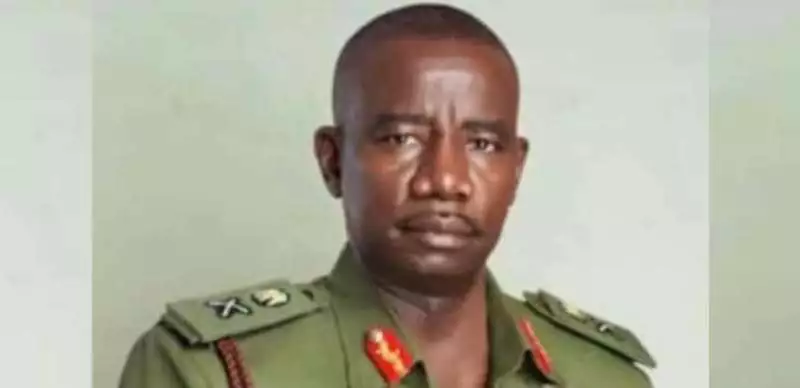
The man who announced the Regime’s ouster was then a Brigadier named Joshua Dogonyaro.There was nothing like Brigadier-General then.
But before his retirement, years later, he had risen to the rank of a Major- General, and occupied a couple of strategic positions.
Dogonyaro, was a former Commander of the Economic Community of West African States Monitoring Group (ECOMOG). He was also, at a point, the Defence Chief.
His death on Thursday, May 14, at the University of Jos Teaching Hospital, Plateau state, at the age of 80 is an irony of sorts many say.
The Head of State then, Major General Muhammadu Buhari, whose ouster he announced in 1985, is now a Civilian President of the Federal Republic of Nigeria.
On hearing the news of Dogonyaro’s death, it was Buhari’s lot to mourn him.
In a statement signed on his behalf by his Senior Special Assistant on Media and Publicity, Garba Shehu, Buhari said that by Dongoyaro’s passing, Nigeria and the Military has lost a patriot.
Of course it is standard protocol, and would have been impolite of President Buhari not to have mourned him. But the irony is not lost on anybody. The man the then Brigadier sacked is, on the Brigadier’s death, still the Commander-in Chief of the Armed Forces, not to mention “The Executive President of the Federal Republic of Nigeria.
To mark the passing of Dogonyaro’s death, following is the full text of his most important speech – the speech that ousted Buhari as the Head of State and Commander- in – Chief on August 27, 1985.
“I, Brigadier Joshua Nimyel Dogonyaro, of the Nigerian Army, hereby make the following declaration on behalf of my colleagues and members of the Nigerian Armed Forces.
“Fellow country men, the intervention of the military at the end of 1983 was welcomed by the nation with unprecedented enthusiasm. Nigerians were unified in accepting the intervention and looked forward hopefully to progressive changes for the better.
“Almost two years later, it has become clear that the fulfillment of expectations is not forthcoming.
Because this generation of Nigerians and indeed future generations have no other country but Nigeria, we could not stay passive and watch a small group of individuals misuse power to the detriment of our national aspirations and interest.
“No nation can ever achieve meaningful strides in its development where there is an absence of cohesion in the hierarchy of government; where it has become clear that positive action by the policy makers is hindered because as a body it lacks a unity of purpose.
“It is evident that the nation would be endangered with the risk of continuous misdirection. We are presently confronted with that danger. In such a situation, if action can be taken to arrest further damage, it should and must be taken. This is precisely what we have done.
“The Nigerian public has been made to believe that the slow pace of action of the Federal Government headed by Major-General Muhammadu Buhari was due to the enormity of the problems left by the last civilian administration.
Although it is true that a lot of problems were left behind by the last civilian government, the real reason, however, for the very slow pace of action is due to lack of unanimity of purpose among the ruling body; subsequently, the business of governance has gradually been subjected to ill-motivated power play considerations.
“The ruling body, the Supreme Military Council, has, therefore, progressively been made redundant by the actions of a select few members charged with the day-to-day implementation of the SMC’s policies and decision.
The concept of collective leadership has been substituted by stubborn and illadvised unilateral actions, thereby destroying the principles upon which the government came to power.
“Any effort made to advise the leadership, met with stubborn resistance and was viewed as a challenge to authority or disloyalty.
Thus, the scene was being set for systematic elimination of what, was termed oppositions. All the energies of the rulership were directed at this imaginary opposition rather than to effective leadership.
“The result of this misdirected effort is now very evident in the country as a whole. The government has started to drift. The economy does not seem to be getting any better as we witness daily increased inflation.
“The nation’s meager resources are once again being wasted on unproductive ventures. Government has distanced itself from the people and the yearnings and aspirations of the people as constantly reflected in the media have been ignored.
“This is because a few people have arrogated to themselves the right to make the decisions for the larger part of the ruling body. All these events have shown that the present composition of our country’s leadership cannot, therefore, justify its continued occupation of that position.
Furthermore, the initial objectives and programmes of action which were meant to have been implemented since the ascension to power of the Buhari Administration in January 1984 have been betrayed and discarded.
“The present state of uncertainty and stagnation cannot be permitted to degenerate into suppression and retrogression.
We feel duty bound to use the resources and means at our disposal to restore hope in the minds of Nigerians and renew aspirations for a better future. We are no prophets of doom for our beloved country, Nigeria.
“We, therefore, count on everyone’s cooperation and assistance.
“I appeal to you, fellow countrymen, particularly my colleagues in arms to refrain from any act that will lead to unnecessary violence and bloodshed among us. Rest assured that our action is in the interest of the nation and the armed forces.
“In order to enable a new order to be introduced, the following bodies are dissolved forthwith pending further announcements: (a) The Supreme Military Council (b) The Federal Executive Council (c) The National Council of States. All seaports and airports are closed, all borders remain closed.
“Finally, a dusk to dawn curfew is hereby imposed in Lagos and all state capitals until further notice. All military commanders will ensure effective maintenance of law and order
“Further announcements will be made in due course. God bless
Ondo State Government has reduced the paramouncy of the Traditional Ruler of Akure, Deji, Oba Aladetoyinbo Aladelusi, restricting his authority to his domain alone.
Before, the Deji of Akure is regarded as a Paramount Ruler with his power spread across all farmsteads founded by indigenes in Akure South and North areas.
But following the creation of Ondo State in 1976, and Ekiti State from Ondo in 1996, a new Local Council, Akure North, was carved out of the former Akure Local Government.
Virtually, all farmsteads hitherto under Akure and jurisdiction of Deji now fall under Akure North.
The Paramount Ruler of Akure has been exercising his power over the farmsteads, some of which have become full fledged towns and villages, including installing their Olus and Baales.
However, in their bid to be self independent from the authority of Akure ruler, some of the lesser Chiefs, known as Olus and Baales have been calling on the State Government to upgrade their status to that of an Oba.
A letter dated 19th April, 2021, has now answered the prayers of the lesser Chiefs as the State Government has directed the Deji of Akure, Oba Aladelusi Adetoyinbo, to hands off from installing Olus and Baales in some villages in Akure North Local Government Area.
The letter signed by Permanent Secretary, Ministry of Local Government and Chieftaincy Affairs, Segun Odunsoya, advised Oba Aladetoyinbo to stay away and maintain status quo over the appointment of minor Chiefs in some of the Communities.
The Communities include Ago Sonibare in Ala/Ajagbusi, Eleyewo, Ago-Ajapada in Ofosu Forest, Ago Tedibomi in Ala/Ajagbusi, Agunla I’m Ayede-Ogbese, Ilado/Elemo and Isinigbo, all in Akure North Local Government Area.
The affected Olus and Baales have, through their lawyer, appealed to the State Government to upgrade their status to full fledged Obas to enable them have control over their subjects.
The letter, signed by Mr Femi Emodamori,
emphasised the need to “upgrade the Olus and Baales in the duly recognized communities in Akure North Local Government Area to the status of Obas, even if they are categorized in the least grade of recognized Chiefs, just as the State Government had successfully done in all the Communities now in Ifedore Local Government Area which were formerly part of the old Akure Local Government.
“By so doing, the Community heads to be recognized as Obas would automatically become the Prescribed Authority for the appointment of minor Chiefs in their respective Communities, in line with paragraphs 10 and 11 of the Ondo State Government White Paper on Morgan Chieftaincy Review Commission of July, 1981.
“Fortunately, the Recognized Chiefs or Obas in Akure North Local Government are fully in support of these suggested measures in the overall interest of peace, and their position in that regard was evident during the public hearings of the Ajama Commission of Enquiry (and) The upgrading of some or any of the Recognized Chiefs or Obas in Akure North Local Government to First Class or category “A” Oba(s).”
You can choose when to have a military government, but often, you can’t decide when, or even if, they would leave.
These days, it seems all right to play with fire.
The blaze started like a solitary spark in Mali in August when the streets, the elite and jihadists banded to remove President Ibrahim Boubacar Keita.
The former President had discarded election results and written a version that tightened his grip on power.
How he thought he could reinvent the Mansa Musa legend in a country riven by violence and poverty only he can tell.
Outside the capital, Bamako, however, it was clear that Keita’s ambition was dead on arrival, awaiting funeral.
And, of course, he didn’t last to tell the story.
President Muhammadu Buhari
To this day, efforts by the 15-member Economic Community of West African States (ECOWAS) to remove the military regime that sacked Keita, or even get a firm handover date commitment, have failed.
You can choose when to have a military government, but often, you can’t decide when, or even if, they would leave.
Before the coup in Mali, West Africa had been coup-free for nearly a decade, with the exception of Guinea Bissau.
Apparently, soldiers in Niger, Mali’s eastern neighbour, had their own plans as well.
On the eve of the swearing-in of President-elect Mohamed Bazoum, they struck, but failed.
A government spokesperson described the attempt as a “cowardly and retrograde” act, but the same ECOWAS which rallied to chase away The Gambia’s Yahya Jammeh four years ago when he wanted to steal an election, barely said a word.
To compound the region’s misery, Chad happened.
The military coup was partly as a result of President Idriss Deby’s misrule and mainly as a result of the destablisation of the Sahel and the Chad Basin by ISWAP elements from Libya.
Like ECOWAS, the African Union (AU), has also been silent. France, weeping more than the bereaved, didn’t mind the hypocrisy of defending Deby’s repressive record and his son’s illegitimate takeover, because clearly, French financial and strategic interests were worth the crocodile tears.
Within nine months a region that had witnessed relative political stability recorded three military coups, two of them successful.
What started as a spark in Mali is slowly growing into a wildfire.
And now, a section of public opinion in Nigeria, a regional powerhouse, is that it might not be a bad idea to light a fire from the neighbourhood to quench the current blaze of domestic problems.
Why is Nigeria playing with fire?How did we become so desperate and so overwhelmed by the bad examples from our neighbours that copying them now appears to be only where salvation lies?
Robert Clarke, a Senior Advocate of Nigeria, swore by his father’s grave, last week, that if things continued the way they were, he could not guarantee that Nigeria would survive another six months.His apocalyptic view may have been exaggerated, but his concern is not.
Kidnapping for ransom has become a deadly game with dozens of school children in and out of dormitories as targets.
A foreign newspaper recently described Nigeria as a bandit country, with little distinction between bandits and negotiators.
Since January, dozens of security men have been killed in violent attacks, while police stations and correctional centres have been set on fire and destroyed with hardly a record of anyone held to account. On top of this, Boko Haram has planted flags in communities less than two hours’ drive from Abuja, the Federal Capital, and is reported to be collecting taxes and even distributing “relief materials” in some communities.
Where Boko Haram is not running amok, ethnic militias have seized the space, issuing ultimatums, imposing curfews and generally behaving like an alternative government.
Kaduna State in the North- west, which has the highest concentration of elite military institutions in the country, has been so badly devastated by the spate of deadly clashes, kidnappings and banditry, that Governor Nasir El-Rufai suggested that schools should relocate close to military bases.
But anyone who has seen the fortification around these bases will know that even the bases are struggling to save themselves.
In the midst of this, President Muhammadu Buhari’s Government appears bereft, divided against itself, weary of issuing condolences, but not ashamed of being condoled with.
The government is lost between hijackers and incompetents. Not a good place to be.That should worry anyone and Clarke is right to fear the worst.
But agreeing, as most members of the elite now do, that Nigeria is in serious trouble, besieged by echoes of what has brought its neighbours to their knees, does not mean the worst would happen. Nor does it suggest that a military coup is desirable or viable.
Not because the military’s knee-jerk promise of loyalty means much, but for two main reasons: one is the enlightened self-interest of the military itself, and two, is that state institutions and civil society have been severely weakened, and ethnic and religious passions dangerously inflamed.
With the proliferation of arms among rogue elements wearing different hats, the military cannot prevail without the country potentially dissolving into fragments.
In pre-1999 Nigeria when soldiers ruled, they held power without being accountable. At first, they didn’t care, hiding behind the vague idea of “national interest and corporate survival” as the main reasons for seizing power.
As time went on and it became clearer that they tolerated criticisms mainly as a small price to pay for the large amounts of money they were stealing, they began to clamp down on civil society and became more hostile and intolerant.
By the end of the Cold War and with increasing internal pressure and demand for change, soldiers had had enough.
But not before Nigeria’s peacetime generals and their acolytes emerged, discreetly below Forbes’ radar, as some of the richest men on the continent.
Democracy has made them even more prosperous, and with less headache that comes from being at the political helm.
Today’s military top brass is speaking in cryptocurrency, fat bank accounts, prime landed assets and foreign stock options Rocking the boat is too high a price.
With chunks of the trillions of Naira set aside for the prosecution of the endless war on insurgency in the last over one decade ending in private military pockets, only mad officers would make a coup. For what?
Also, the country is so broken along ethnic, tribal and religious lines with light arms and ammunition per capita nearly tripling in five years, that militias with secessionist agenda may prove far more difficult to handle than any ambitious officers may reckon.
And that’s not adding Boko Haram and the current wave of banditry to the messy pile.
The hubris of a potential coup is exaggerated.
The chances of Mali or Chad happening in Nigeria are zero.
What should keep the country awake at night is not a threat from the army but the surge of poverty, hopelessness and lawless groups that could supplant both the military and civil society together.
We’re mutually vulnerable.
Former US Ambassador to Nigeria, John Campbell, is right that the Nigerian elite is fed up with Buhari’s government. Those pretending otherwise are mostly hypocrites or folks determined to be misled. Also, calls for Buhari to resign are futile.
Those calling for his resignation know he won’t, and they too, would not resign if they were in his shoes. But it’s foolish to think that a military coup is an option.
The value of the current frustration is that it must not be invested in short-cuts or quick solutions.
Instead, it should make citizens wiser, and perhaps, more painstaking in choosing the next leader in two years’ time.
Ishiekwene is the Publisher of The Interview. He is on sabbatical at the Leadership
While Muslim faithfuls celebrate Eid-el-Fitr residents of Akoko area of Ondo state are living in fears following abduction of two of them within 24 hours.
The incident, according to one of the residents, happened at Ikaram, Northwest area of Akoko where the two victims were abducted by unknown gunmen at two separate spots within the last 24 hours.
The Akala of Ikaram and the Chairman,Akoko Northwest Traditional Council, Oba Andrew Momodu, who confirmed the incidents, explained that the people now live in fear and anxiety due to the invasion of the area by hoodlums.
According to the Monarch, the first incident occurred along Okeagbe- Ikaram road involving one Ade Gbodi,a graduate, who was returning from his farm at Eda Ekiti.
Few kilometres away from his Iyoke Ikaram home, gunmen ambushed him and marched him into the forest .
“It was those coming behind that saw his motorbike where it was abandoned by the road side that came to report his abduction.”
He disclosed that already, his abductors have demanded for one million Naira ransome money.
In his account of the second incident, the Royal Father stated that it happened very close to the spot where some construction workers were kidnapped recently along Ikaram /Akunu road.
The two victims were on a motorcycle when yet to be identified gunmen fired a shot which hit one of them who was left in his pool of blood, while the second one was whisked away.
The abductors are yet to make contact with relations, while the wounded person is receiving treatment at an undisclosed hospital for gun shot wounds.
Oba Momodu disclosed that the case had been reported to okeagbe Divisional Police Headquarters, while the DPO, Mr Ade Akinwande, has swung into action in conjunction with local hunters and vigilante groups, combing the forest to rescue the victims.
He appealed to Government for massive recruitment of police and equip them with modern weapons.
The Traditional Ruler, who is a retired Navy Commodore, lamented the spate of kidnapping in the area, which has sent people away from farms saying famine and scarcity of food are imminent.
In a telephone chat, the regent of Akunu, Princess Tolani Orogun, appealed for deployment of motorized joint patrol of police, army, Civil Defence and vigilante members to reduce the menace of kidnapping and armed robberies in the area.
In a move that took even his closest aides and associates by surprise, Imo State Governor, Senator Hope Uzodinma, on Wednesday, stopped short of sacking all members of his 28- member cabinet in a major Cabinet shake-up.
The members themselves were relaxed, as they thought the Governor had laid to rest the idea of the dissolution of his Cabinet.
They had expected the dissolution a few months ago, but in a minor reshuffle at the time, only two Commissioners were affected – the Commissioners for Finance and Health.
But on Wednesday during the weekly State Executive Council meeting, Uzodinma swept 20 of them away, and retained eight. The eight retained are the Commissioners for Information and Strategy, Works, Women Affairs, Technology, Finance, Health, Sports and Tourism.
Speculations have been rife over why he fired the 20. While some people say it was for political exigencies, others say it was for non-performance. However, it is every Governor’s prerogative to either sack or reshuffle his cabinet.
But a source close to the Governor said given the political situation in the State, and political realignments ahead of 2023, the Governor needed to accommodate other interests in the party. With the dissolution, the source said, the Governor can pick political appointees from different political interests.
Another source said: “I am happy for the Governor because, now, every segment will be on board.
Uzodinma, aside from the strong opposition from the PDP over the way he became the Governor, thanks to the Supreme Court, is also facing opposition from former Governor of the State, Senator Rochas Okorocha, for stripping him of some of his alleged looted State assets, former Senator Ifeanyi Ararume, for not supporting his Senatorial aspiration, and their groups.
It is expected that the Governor will, also, either sack or reshuffle his other Aides – Special Advisers, Senior Special Assistants and Special Assistants.