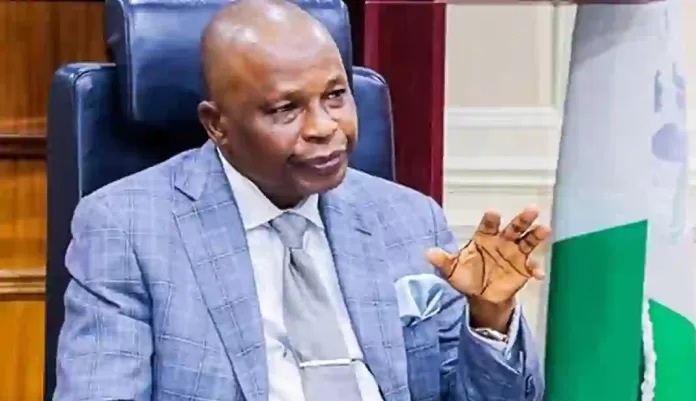
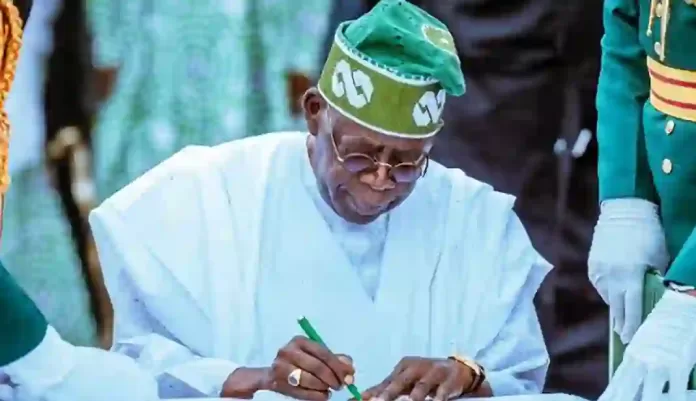
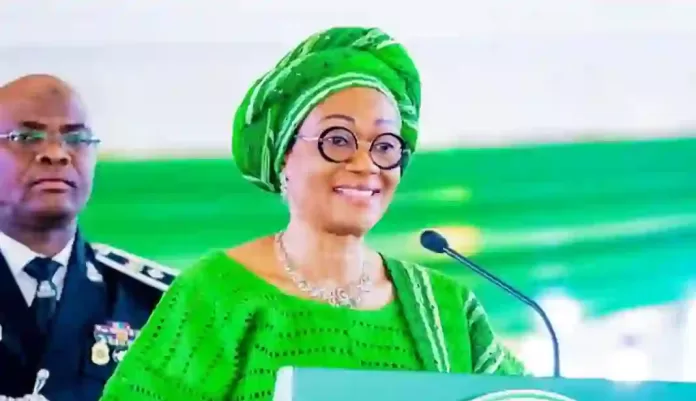
Attorney-General of the Federation and Minister of Justice (AGF), Lateef Fagbemi
By Akinwale Kasali
The Attorney-General of the Federation and Minister of Justice, Lateef Fagbemi, SAN, has warned those he said were fanning embers of hatred and inciting the citizens against the Federal Government.
Fagbemi said that the federal government would not succumb to blackmail by those he described as political desperados.
According to the AGF, “Those fanning the embers of hatred must be stopped,” adding that “those who have lost their sense of patriotism should know that they would not be allowed to set the country on fire.”
He made this statement at the conference of the National Association of Judiciary Correspondents, NAJUC, in Abuja, the nation’s Capital.
He said: “The political desperadoes must learn to act responsibly and within the laws of the land.
“Let me state with respect that relevant government agencies will not be stopped from doing their work if anyone runs foul of the law.
“The government will not succumb to blackmail no matter whose ox is gored. Violence, hate speech or any other criminal tendencies will not be tolerated in any form.
“As citizens of Nigeria, let us show our sense of patriotism and protect the unity of the country”, he said.
This comes in the face of widespread misgivings among opposition political parties, who have all alleged a deliberate witch-hunt of their members by various anti-corruption agencies.
He, however, acknowledged that activities towards the 2027 general elections have commenced in earnest, and stressed that the media have their role to play.
He warned that the media, as a critical stakeholder, must not be used as a tool of division.
“As the main bridge between INEC, political actors, and 90+ million potential voters, the press shapes expectations, trust, and behaviour before ballots are cast and after results are declared.
“It is on this note that I urge the media not to give room to political actors trying to tear the fabric of this nation.
“The media must remember we need to have our country first before we can talk about elections.
“This administration sees the media as partners; that is why we have ensured that they do their job without intimidation or any form of threats.
“My office is a good example of this. I will continue to relate with all of you as my friends of old,” he added.
The AGF said the theme of the conference, “The Role of the Judiciary in Deepening Democracy in Nigeria”, is apt and a pointer to the role the judiciary has played in strengthening the country’s nascent democracy.
“The judiciary is often called the last hope of the common man, and in Nigeria that phrase carries real weight.
“As the third arm of government, it provides the legal backbone that allows democracy to function beyond elections.
“Without an independent and active judiciary, democratic gains can be rolled back quickly.
“At its core, the Nigerian judiciary deepens democracy by interpreting the 1999 Constitution and ensuring that both government and citizens act within its bounds”, Fagbemi stated.
The short answer is yes – but there’s a long answer. There is, in fact, more than one inside story about why President Bola Ahmed Tinubu removed the Minister of Finance and Coordinating Minister of the Economy, Wale Edun.
The online newspaper Premium Times published multiple likely versions in a single story. The biggest issue, according to the newspaper, was the poor release of capital funds.
It reported, however, that there were other reasons, from complaints of delayed payments to contractors to criticisms by lawmakers of “zero implementation” of the 2025 capital budget.
Perhaps the most dramatic, according to the newspaper, was the heated exchange between Edun and the President at a December Federal Executive Council (FEC) meeting, during which aides were obliged to intervene to cool things down. Edun tried to make it up afterwards, but the paper said it was too late. He had crossed the Rubicon.
Was it about health?
LEADERSHIP offered a different backstory. It downplayed conflict and policy failure and focused instead on health concerns about Edun. According to the newspaper, it’s the second time in 22 years that Edun has left a top job due to failing health.
The first time was in February 2004, when, less than a year into Tinubu’s second term as governor of Lagos, Edun resigned his appointment “on health grounds.”
In October last year, two years into his tenure as Finance Minister, he was rushed to London for medical treatment and was out of circulation for a while, only to surface at a London fair, when he couldn’t attend the IMF/World Bank meeting. According to the newspaper, Edun, who turned 70 on April 20, a day before he was fired,was removed becausehe could obviously no longer cope with the pressure to perform.
The Chagoury angle
The online newspaper, TheCable, gave a very dramatic account that, among other things, linked Edun’s removal to sleepwalking over payments to Hitech Construction (Nig) Limited, a company linked to Tinubu’s influential friend, Gilbert Chagoury, handling the Lagos-Calabar Highway construction.
Reuters offered a slightly different version, downplaying personal and political drama and highlighting, instead, economic outcomes and investor pressure for performance.
How the IMF was “implicated”
Outside the media ecosystem, there were quite a few interesting guesses after the announcement of Edun’s removal. One source said, almost authoritatively, that Edun’s comment at the IMF Spring meeting in Washington was the last straw. I was almost tempted to dismiss it as nonsense, but thought it would be rude, so I asked, “How?”
Then, this source, who probably knows just about as much of the goings on in government as I do about Point Nemo, explained that Edun’s statement that Nigeria had no plan to approach the IMF for a loan, “was without clearance from the President.”
With nearly N19 trillion in debt under Tinubu and over $20 billion in borrowing in the pipeline, unless the government is determined to sink the country in a sea of debt, I wasn’t quite sure how Edun’s statement could have led to his removal.
But the source swore it was exactly the reason, adding that if I hear any version other than his, it may well be from the usual suspect, the African Democratic Congress (ADC), planting misinformation.
The inside story, I’m told, however, was that the IMF/World Bank had, during the Spring Meeting, accused the Tinubu government of a lack of transparency in managing public finance. Edun’s reply that Nigeria didn’t need any more IMF loans was at variance with the charge of opacity, setting off alarm bells at the Villa.
Wale Edun
Three years, not bad
If you discount the role of superstition in politics, over the last 20 years, the average tenure of Nigeria’s Finance ministers has been between two and three years.
The longest has been Dr Ngozi Okonjo-Iweala, who served for seven years, and Zainab Ahmed, who served for five. Still, the core cluster has been far shorter, suggesting that Edun’s two and a half years are above average – long enough to start reforms, but often not long enough to consolidate them fully.
His removal is attracting extra attention because 1) the government insists that the economy has stabilised and is on the path of recovery, 2) Edun combines his role in Finance with coordinating the economy, and 3) he is one of the ministers with a reputation of being a part of the President’s kitchen cabinet.
If the economy is not broken, why remove the finance minister, and how could one of the President’s most trusted men be removed in a press statement that describes his removal as a “minor cabinet reshuffle,” bundling him out with another minister, Ahmed Musa Dangiwa, whose name many had barely heard until his sacking was announced?
It’s broken, not shattered
The Presidency is walking back the sack story. In a statement on Wednesday that sounded like the Edun affair was a broken story, but not a shattered one, the Presidency said Edun and Dangiwa resigned; they were not fired. Except if official communication, even at such vital moments, operates on the principle of the right hand not knowing what the left is doing, the tardy handling of Edun’s exit is quite extraordinary.
The Oyedele moment
From the moment Taiwo Oyedele was nominated as junior minister of Finance on March 3, many, quite rightly, suggested that Edun’s days were numbered. But the suspicion then was that he might be interested in running for the governorship of Ogun State and needed to meet the President’s March-end deadline for resignation; a suggestion he later denied.
I’ve heard that Edun always wanted to be governor of the Central Bank, but was refused the position by the President. It’s quite ironic that the CBN governor has now outlasted him in office. So, which backstory is believable? There’s not a single backstory, but among the several enlightened and unenlightened guesses, two are the most probable.
Cabinet frustrations
The first is the broad frustration across the cabinet over capital releases and delayed payments to contractors. Although the Tinubu government had shifted from quarterly capital releases to a performance-based system, in which a significant portion of payments is released only after certificates of completion are issued, Edun operated more like a goalkeeper, trapping payments long after they were due.
When contractor complaints mounted, the President excised revenue generation, distribution and domestic debt management from Edun and transferred them to the junior minister, Doris Uzoka-Anite, who turned out to be a disaster and had to be swapped.
Meanwhile, across the cabinet, grievances about the delayed release of funds rose. For example, Health Minister Muhammad Ali Pate told lawmakers that out of N218 billion appropriated for his ministry in the 2025 budget, only N36 million, less than one percent had been released.
Housing and Urban Development Minister Dangiwa, Works Minister David Umahi, and Power Minister Adebayo Adelabu, whose problem is deeper and more pathetic than money, also complained. I’m told that as far back as October, the President had decided that Edun’s time was up.
Where the buck stops
His health condition, the second probable reason, was the velvet over the iron fist. At 70, and after a long and distinguished career in the financial sector and later in politics, his struggles with failing health and an economy that demands full-speed performance were taking atollon him. His removal had been some time in coming.
We may quibble about the real backstory all day, and the full version may never be known publicly, but one man who comes out looking good from this is the president. He has just sent an unlikely message: if Edun can go, then so can anyone.
Ishiekwene is the Editor-In-Chief of LEADERSHIP and author of the book, Writing for Media and Monetising It.
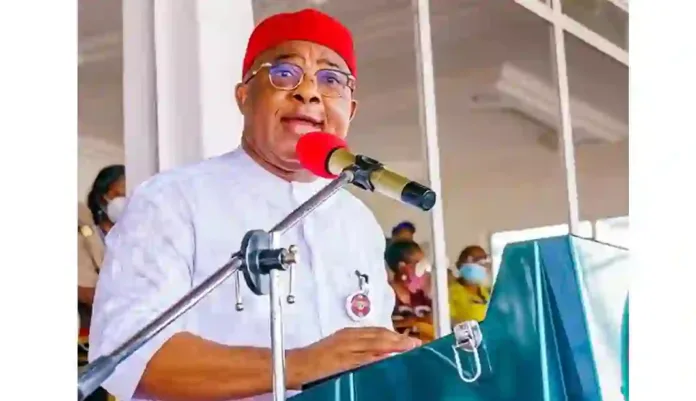
The Governor of Imo State, Senator Hope Uzodimma has urged stakeholders of the All Progressives Congress (APC) in Abia State to be united, close ranks and strengthen the Party, insisting that the Southeast must reposition itself within Nigeria’s political structure under the APC to regain national relevance as 2027 beckons.
Uzodimma spoke at a stakeholders’ meeting on Tuesday night, April 21, 2026 at the Banquet Hall of the Government House, Owerri, where he received APC leaders from Abia State led by the Deputy Speaker of the House of Representatives, Rt. Hon Benjamin Kalu.
He commended Party leaders for the successful Congresses conducted through consensus in Abia State and other parts of South East, and described consensus politics as “evidence of unity, tolerance and perseverance.”
Urging members to consolidate on consensus as the Party Primaries are days away before the general elections, the Governor said Nigeria is at a critical turning point, and warned that the Southeast cannot afford political fragmentation today.
He said the region’s performance in the 2023 presidential election was “a complete political accident which will never repeat itself again.”
Uzodimma stressed that meaningful participation in governance depends on Party alignment, insisting that the APC-led federal government offers the most viable platform for the region.
“If you are not in the Party, you cannot expect to have a say in government,” he warned.
He called on Party members to support President Bola Ahmed Tinubu to win the 2027 presidential election, adding that the Southeast must “invest, and politically, to earn dividends.”
The Governor expressed confidence that APC would record strong electoral performance in the region. “APC will win in the South East and we will win in Nigeria convincingly. So, be united and work together, and I can assure you we will win.”
Reaffirming commitment to Party unity, Uzodimma urged stakeholders to avoid internal rancour and divisions, and instead embrace peaceful consensus-building mechanism, saying, “we must win together.”
He promised to continue to make himself available to the stakeholders in Abia State to ensure the success of the Party.
Deputy Speaker of the House of Representatives, Rt. Hon. Benjamin Kalu, praised the leadership and sense of unity within the All Progressives Congress (APC) in the Southeast as championed by Governor Uzodimma, and urged leaders and members to strengthen collaboration to reposition the region politically.
Kalu commended Governor Uzodimma for his “big brother role” in all ramifications in South East, particularly his foresightedness that resulted in the strategic mobilisation and consensus-building, describing the efforts as visionary.
Like the Governor, he stressed that the Party must avoid division and work collectively for greater influence nationally, noting that “we will no longer sit on the fence.”
Kalu also applauded ongoing leadership coordination aimed at reshaping the Southeast’s political relevance, and thanked Governor Uzodimma immensely for his efforts.
Some stakeholders who made remarks at the meeting affirmed that APC in Abia State has grown in strength and rebranded to achieve overwhelming victory at the polls.
They individually and collectively lauded Governor Uzodimma for providing the kind of leadership that has paid off politically, not just in the Abia State APC and South East, but in Nigeria.
Those who spoke include the former Minister of Labour and Productivity, Rt. Hon Nkeiruka Onyejiocha, Abia State APC Chairman, Hon. Chijioke Chukwu, Dr. Cosmos Ndu, Hon. Emeka Atuma, Dr. Nyere Anyim, Senator Nkechi Nworgu and the South East Zonal youth leader, Barr. Chimamkpa Ogbonna.
President Bola Tinubu has sought the Senate’s approval to secure a fresh $516.33 million external loan.
The request, contained in a letter read on the floor of the upper chamber on Thursday by Senate President, Godswill Akpabio, seeks legislative backing for a syndicated facility expected to be arranged by Deutsche Bank AG.
Tinubu explained that the loan would fund specific phases of a major infrastructure corridor spanning about 1,000 kilometres across several states, linking economic zones in the North-West and South-West.
He noted that the Federal Executive Council had already endorsed the financing structure and urged lawmakers to expedite approval.
According to details of the proposal, the facility will run for nine years, including a grace period of up to three years, with interest benchmarked to the Secured Overnight Financing Rate (SOFR) plus 5.3 per cent annually.
The President explained that the project would enhance connectivity, reduce transportation costs and support trade flows by easing movement between production hubs and major markets.
The latest request comes amid a broader borrowing pattern by the Tinubu administration aimed at plugging fiscal gaps and funding capital projects in the face of revenue constraints.
In July 2025, the Senate approved a sweeping external borrowing plan exceeding $21 billion to support the 2025–2026 budget cycle, covering sectors such as infrastructure, health, education and security.
Earlier in October 2025, the National Assembly also cleared a $2.85 billion foreign borrowing plan, which included Nigeria’s debut sovereign sukuk in international markets as part of efforts to diversify funding sources.
That same period, the administration sought to raise about $2.8 billion through a mix of loans and bond issuances, including $2.3 billion in new borrowings and a $500 million sukuk instrument.
In November 2025, lawmakers approved additional domestic borrowing of about ₦1.15 trillion to bridge a widening budget deficit, further underscoring the government’s reliance on debt financing.
Multilateral support has also featured in the borrowing mix, with the African Development Bank indicating plans to extend a $500 million facility to Nigeria as part of a broader budget support programme tied to ongoing economic reforms.
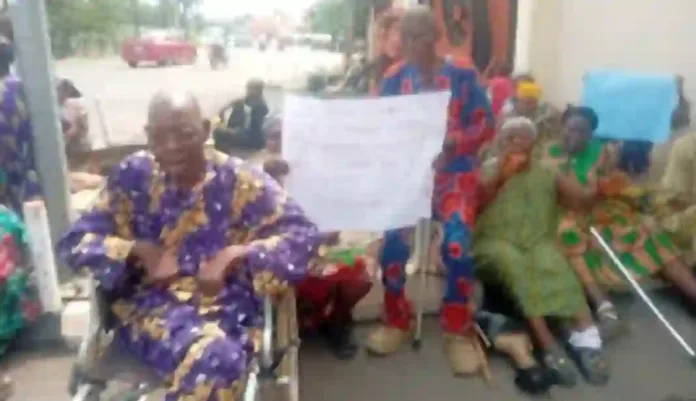
Inmates of Ago-Ireti, a leprosarium settlement in Akure, has appealed to the Ondo state government not to relocate them to an area which has been experiencing banditry for sometime.
The residents on Thursday staged a protest at the Ondo State Governor’s Office, demanding an immediate halt to a controversial relocation directive that has stirred fear and uncertainty within the community.
Area where they are currently settled has witnessed development and falls inside commercial area of the state capital.
The demonstrators carried placards and chanted solidarity songs as they appealed to Governor Lucky Aiyedatiwa to intervene in what they described as an “abrupt and inhumane” decision.
Ago-Ireti—translated as “Settlement of Hope”—was established in 1943 as a leprosarium, long before the creation of Ondo State.
It has since evolved into a symbol of resilience and compassion, providing refuge and dignity for individuals once marginalized due to leprosy.
Over the decades, the community has been supported by faith-based organizations, including the Catholic Diocese of Ondo, the Sisters of St. Louis, and the Anglican Diocese of Akure, alongside several humanitarian groups.
Tensions escalated recently after government officials reportedly arrived unannounced to issue a relocation notice to residents, giving them a one-year ultimatum to vacate the settlement.
The proposed relocation site, believed to be around Ilu-Abo, in Akure North, has raised additional concerns among residents due to reported security challenges in the area.
Speaking during the protest, community representatives alleged that the directive was delivered with intimidation and without prior consultation.
They argued that the government failed to consider the historical significance of Ago-Ireti and the vulnerability of its inhabitants.
“We voted for Governor Ayedatiwa. He should use his office to consider our plight as the proposed relocation will not do us any good.
“How will our helpers such as religious bodies, humanitarian organizations and Non-governmental organizations be able to get in touch with us? This is not just land; this is our home, our history, and our identity,” one protester said.
“We deserve to be heard, not displaced without dialogue.”
Some of them emphasized that Ago-Ireti has benefited from past government interventions, particularly during the administration of former Governor Olusegun Mimiko, when residents received improved welfare support, healthcare services, and infrastructure upgrades.
Non-governmental organizations within and outside the country have also continued to sustain the settlement through humanitarian efforts.
Protesters expressed hope that Governor Aiyedatiwa may not have been fully briefed on the implications of the directive, urging him to suspend the relocation process and initiate meaningful engagement with residents and supporting organizations.
Last minute leadership crisis, rocking the Nigerian Medical Association (NMA), has led to the suspension of the National President, Prof. Bala Audu, by members over alleged constitutional violations and high-handedness.
The dramatic decision was reached at an Emergency Delegates Meeting ,(EDM), held in Abuja, attended by 63 members, including chairmen and secretaries from 23 states and the Federal Capital Territory ,(FCT).
Audu, who also heads the association’s National Officers Committee ,(NOC), was accused of unilaterally disqualifying six candidates from contesting in the forthcoming national elections slated for the NMA Annual General Meeting,(AGM),in Kano from April 27 to May 3.
Although the NOC had justified the disqualification on grounds of incomplete documentation, delegates rejected the move, describing it as unconstitutional and alien to the association’s established norms.
In a sweeping resolution, the EDM unanimously reversed the disqualification, clearing the affected candidates to participate in the elections.
The meeting also constituted a caretaker committee led by former Secretary-General,Dr. Ekpe Phillips, to oversee the affairs of the association pending the elections and to ensure disciplinary measures are initiated against Audu and the NOC if found culpable.
Delegates pointed out that all internal mechanisms to resolve the dispute had failed, prompting the gathering, which was convened after over 100 members, representing the constitutional threshold, endorsed the move.
“The excuse of incomplete documentation is strange to our processes,” a delegate said.
“These candidates were duly nominated and screened. What happened was a clear violation of the NMA constitution.”
Chairman of NMA-FCT, Dr. Emeka Ayogu, backed the suspension, accusing the Audu-led leadership of “impunity and arrogance,” and warning that the association’s unity was at stake.
“We want an NMA that protects members’ welfare and upholds due process. We had no choice but to act decisively,” Ayogu stated, adding that members were prepared for any fallout, including legal action.
Also speaking, former Deputy Secretary-General, Dr. Umezurike Ikechukwu, condemned the leadership’s actions, describing them as disruptive and contrary to the association’s tradition of peaceful transitions.
“This is not how the NMA has operated over the years. There has always been stability and order. What we are seeing now is deeply troubling and must be addressed to prevent further damage,” he said.
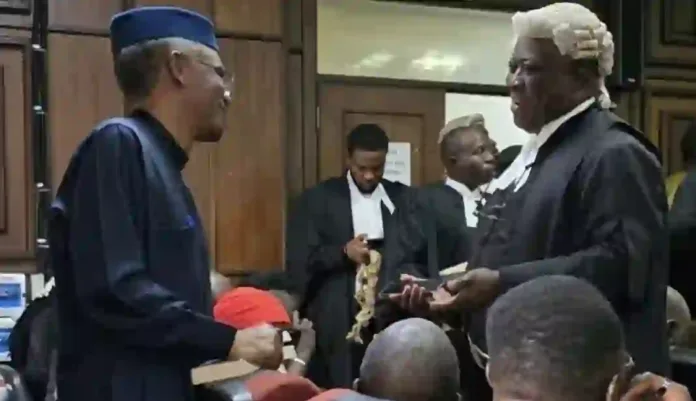
Former Kaduna State Governor, Malam Nasir El-Rufai, was on Thursday, April 23, 2026, arraigned before an Abuja Federal High Court by the Department of State Service, DSS, over security related Offences
The Source reports that El-Rufai who is facing inter-agency investigations and prosecutions over multiple charges bordering on alleged diversion of public funds and security related Offences,was arraigned before Honourable Justice Joyce Abdul-Malik ,on a 5-count charge bordering on alleged wire-tapping of the telephone lines of the National Security Adviser NSA, Malam Nuhu Ribadu.
Specifically, the DSS in an originating summons, accused El-Rufai of intentionally and unlawfully interfering with the Communication of the NSA, which is considered a critical national information infrastructure, as contained in Designation and Protection of Critical National Information Infrastructure Order ,2024 ,and gazetted as Statutory Instrument No 21 of 2024 which he admitted on February 13 , while appearing as a guest on Arise TV Station’s Prime Time Programme in Abuja.
According to the prosecution, the offence which violates Paragraph 7 (b) and (c) of the Designation and Protection of Critical National Information Infrastructure Order ,2024 ,is punishable under Section 5 (1) of the Cybercrimes ( Prohibition , Prevention etc) Amendment Act, 2024.
However, El-Rufai pleaded not guilty to the charges.
His Counsel Oluwole Iyamu SAN, while arguing a bail application, argued that El-Rufai has been in custody of the Independent Corrupt Practices and Other Related Offences Commission ICPC, since February 18, praying the Court to consider his bail application dated April 17.
Earlier, the prosecution Counsel Oluwole Aladedoye had prayed the court to allow for the concealment of the identities of witnesses expected to appear when trial commences.
According to the prosecution, covering the witness identities could be either in the form of shielding of faces ,and or the use of pseudonyms ,for the purpose of preventing possible attacks ,from the defendants followers.
Expectedly, the application was opposed by the prosecution counsel, who argued that shielding the identities of witnesses will negatively affect his client’s constitutional right to know his accusers.
Justice Abdul-Malik after taking arguments from both parties, adjourned proceedings to May,18,19, and 20, 2026.
The Source further reports that the DSS arraignment is coming on the heels of a Kaduna state High Court decision on Tuesday April 21 ,to adjourn El-Rufai’s bail application in alleged corruption trial ,to the first week of June, 2026.
Nigeria’s First Lady, Oluremi Tinubu, has said that Nigeria’s security problem is complex and called for a more balanced international understanding of the situation.
She warned that distorted narratives risk undermining efforts to achieve lasting peace.
She made the appeal on Thursday during a meeting in Abuja with former Archbishop of Canterbury, Justin Welby, where discussions focused on interfaith dialogue and strategies to strengthen national cohesion.
In a statement issued by the Senior Special Assistant on Media, Busola Kukoyi, the First Lady emphasised that Nigeria’s challenges are complex and require deep interpretation.
“The world must get the right perspective of the various challenges in the nation to be able to proffer appropriate solutions,” she said, adding that meaningful conflict resolution depends on listening to all sides.
Mrs Tinubu cautioned against one-sided assessments of Nigeria’s security landscape, arguing that such approaches hinder genuine understanding and effective intervention.
She also underscored the importance of involving security agencies in interfaith engagements, noting that their participation would provide critical insight into ongoing efforts to stabilise the country.
While acknowledging persistent security pressures, the First Lady praised the Armed Forces for their continued sacrifices and urged religious institutions worldwide to promote values that encourage peaceful coexistence.
“The Church needs to preach right so that people can live right,” she said.
Welby, in his remarks, said his visit formed part of broader efforts to advance peace-building initiatives and reinforce Nigeria’s reputation as a nation committed to freedom of worship.
He disclosed that a new round of interfaith dialogue is scheduled to take place in London under the auspices of the Global Forum for Peace, led by Abdallah bin Bayyah.
According to him, the forum will convene 12 Christian and 12 Muslim leaders to engage in structured dialogue aimed at addressing interfaith tensions, both within Nigeria and globally.
“We want to contribute to what Bola Ahmed Tinubu is doing to promote peace. All we are after is enduring peace,” Welby said, noting that his visit also sought to lay the groundwork for meaningful deliberations.
The cleric was accompanied by the British High Commissioner to Nigeria, Richard Montgomery.
The meeting follows President Tinubu’s recent state visit to the United Kingdom, during which the First Lady participated in interfaith engagements, including a church service at Lambeth Palace.
In a separate engagement, the First Lady received Nigeria’s Minister of Communications and Digital Economy, Bosun Tijani, who briefed her on progress under the government’s Girls in Tech initiative.
Speaking to journalists after the meeting, Tijani said Mrs Tinubu is set to host a dinner in Abuja to showcase innovations developed by participants in the programme.
He also revealed that she has agreed to serve as the face of a new campaign aimed at expanding internet access and deepening digital connectivity, particularly in rural and riverine communities.
In a coordinated operation, gunmen kidnapped a woman, Olanike Ogundare from her Lagos home located at No. 1 Olufemi Ogundare Street, Oke Agaye area of Ijedodo in the State.
It was gathered that the Woman was abducted at about 1.00am, Tuesday. The gunmen overpowered the Security Guard on duty at gunpoint before whisking their victim away.
The kidnappers, according to reports, have contacted her family on two occasions, demanding a ransom of ₦60 million for her release.
The incident has been reported to the Nigeria Police Force and the Department of State Services, DSS.
Meanwhile, community leaders and Local Security Stakeholders in the area have also been mobilised, including the Aare Ona Kakanfo, the Yoruba Generalissimo, Iba Gani Adams, alongside his Security Group, Oodua Peoples Congress, OPC.
This development has heightened concerns about safety in residential areas.
The Centre for Democracy and Development (CDD-West Africa), has accused the ruling All Progressives Congress, APC of further triggering corruption because of the prohibitive cost of nomination forms for next years general election in the country, Leadership Newspaper reports.
The ruling party recently released the cost of Nomination Form and Expression of Interest cost for aspirants planning to contest the 2027 election under its platform. The release has been generating reactions from not a few Nigerians, who accused the APC of commercializing democracy in the country.
According to the checks from the APC Presidential aspirants are expected to pay N100 million to obtain the party’s nomination form; Governorship aspirants are to pay N50 million while the cost for Senatorial aspirants is put at N20 million, House of Representatives N10 million, amongst others.
Reacting, the pro-democracy group said the APC has decided to sell its nomination form to the highest bidder, saying this is another way of worsening corruption in the country.
CDD-West Africa director, Dr Gauda Garuba said the price has the potential to increase corruption in the country, saying the priority of political office holders, once they get to office will be how to immediately recoup whatever they have spent on the election, and that they will not work for the masses.
The pro-democracy body said the action will automatically narrow the democratic space against the ‘majoritarian’ principle, adding that many Nigerians will be shut out of the democratic space, at a time when more people shut be encourage to participate in active politics in the country.
“It’s obvious that the ruling party is handing over politics to the highest bidder in Nigeria. Within the context of our tortuous struggle for inclusion where women and youth have been repeatedly discounted, this move by the APC violates the majoritarian principle of democracy,” the group said.
Adding, “More specifically, it makes nonsense of Nigerians’ years of fight for ‘Not too Young to Run’ and the Special Seat Bill to expand the democratic space for women participation in politics. Indeed, it amounts to retrieving with left hand what was offered with a right hand.
“The biggest challenge is its potential to increase corruption in the country as the few who will eventually get elected or appointed into political office will prioritise recouping the money they spent in seeking office over working for the people who voted them into such offices.”
Checks revealed that the APC realized over N29 billion from the sale of nomination and expression of interest forms during the 2023 general elections.