Home Blog Page 2409

Senate Indicts FG, Says ₦9 Billion Meant For NASS Renovation Wasn’t Released

0
Senate Chamber Roof leaking

By Akinwale Kasali

The President Muhammadu Buhari-led Federal Government is being accused by the Senate of being responsible for the deplorable State of the National Assembly Chambers. This follows the embarrassment of Tuesday when the Chambers were flooded due to leakages, following a heavy rainfall.

The Senate on Wednesday said that the National Assembly is yet to receive the ₦37 billion approved for the renovation of the National Assembly Complex.

In a statement by the Chairman, Senate Committee on Media and Public Affairs, Senator Ajibola Basiru, the Senate noted that contrary to the widespread falsehood being peddled both in the mainstream and online media, the legislature was not responsible for the maintenance and renovation of the complex.

The heavy downpour on Tuesday, left several parts of the National Assembly Complex flooded.

Senator Basiru said: “Contrary to the widespread falsehood being peddled both in the mainstream and online media as a fall out of the reported incident of the leaking roof of the National Assembly Complex after a heavy downpour on Tuesday, 21 June 2021, it is pertinent to inform the General Public that the National Assembly and its leadership is not responsible for the maintenance and renovation of the National Assembly Complex and they have not received a sum of ₦37 billion or any amount for the renovation of the Complex.

“While it is true that an initial appropriation of the above-stated sum was made due to the decaying nature of the National Assembly Complex which has not witnessed any major maintenance or overhauling since construction, the said amount was reduced to N9 billion after the outbreak of COVID-19 pandemic.

“Even with this reduction, the sum of ₦9 billion or any amount is yet to be cash-backed or released to the National Assembly. None of this amount is even appropriated for the National Assembly bureaucracy or its leadership.

“It must be reiterated that the National Assembly Complex is a National Monument which falls under the purview of control of the Federal Capital Development Agency. In essence, the FCDA is responsible for its maintenance as well as renovation and not the Leadership of the National Assembly as being falsely bandied about.

“The leakage witnessed at the foyer of the National Assembly yesterday (Tuesday) justifies the apprehension of the leadership of the National Assembly and the FCDA and further underscores the need for an urgent intervention in revamping the dilapidated structures within the complex before it falls into further dilapidation with the attendant huge cost of a possible replacement”.

Lagos Assembly Approves Sanwo-Olu’s Request For ₦85 Billion Bond

0

By Akinwale Kasali

The Rt. Hon. Mudashiru Obasa led Lagos State House of Assembly has approved Governor Babajide Olushola Sanwo-Olu’s request of ₦85 billion Special dispensation for Bond redemption as well as ₦85 billion for bridge loan for a quarter.

This is in pursuant to the approval of Bonds, Loans and other Security Law of Lagos State 2015 and comes at 9.25% per annum to bond financing programme.

During plenary at the House, Chairman, Committee on Finance, Hon. Rotimi Olowo, stated that the terms of reference of the request received from the executive arm appraise the request for a special dispensation; enquire into the debt profile of the State and ascertain the source of the fund for repayment and refinancing.

Olowo stressed further that based on briefing and documents received, the redemption of bonds will allow for extension of maturity of the same with a two years moratorium in 2031 and the special dispensation approval will enable the State earmarks for capital projects.

In a chat with the Media after the Bond approval, Hon. Olowo explained that the request from the governor had two aspects.

The first was for an approval for Bond Bridge Loan which would allow the state to access bond market as soon as possible while the second aspect is a loan from a commercial bank at the interest rate of 9.25.

Olowo explained that as at February this year, the Federal Government went to bond market at coupon rate of 12% , saying that in june it had increased to 13.5%.

He also said comparing the rate with the bond secured by the State Government in 2016 and 2017, the least of all was 16.6%, adding that the highest was around 17.25%.

Olowo explained that the opportunity the market provided was enough for the state to access it now, adding that the state would be able to get the rate cheaper and that the current bond of the state would mature in 2024.

“When you look at our Consolidation Debt Service Account (CDSA) we have about ₦22billion and we are talking N101.2billion in the next 2 or 3years. It will amount to a lot of pressure on our debt obligation, so what we thought that is necessary is that we should quickly access the bond market with the approval of the House so that we can get it at cheaper rate and it will be for 10years with 2years moratorium.

“What it means is that, in the next two years after securing the bond we will not pay any money. We will not pay the interest and the capital, it will be like tax holiday. It will relieve the state the burden of sourcing for money to pay the creditors.

“On the second aspect, if today we don’t access the commercial loan from one of the banks at a single digit of 9.25%, we will still be losing because what we will still access, we will pay the holders of the bond between now and the next one months. That means we have been able to save money worth an average of ₦1.5billion in form of seeking fund to be able to make up to 2023.

“So, if we don’t pay that in the next three years, what it means is that we have gotten a saving of about ₦75billion. It is obvious that there cannot be a better time for the state to go for the bond market which we called ‘ Special Dispensation Bond’ and the second is a loan from a commercial bank at the interest rate of 9.25 which is very cheap. That is the reason why the Assembly speedily supports the executive. We always want to support the executive when it comes to infrastructure,” Olowo said.

Royal Reception For Baby Delivered In Correctional Centre As Ooni’s Wife Doles Out Gifts, Scholarship

0
Naming of Baby Delivered in Prison with Oni waife

By Ayodele Oni

The name christening ceremony of the baby delivered in prison, by female detainee,  Kemisola Ogunniyi, took place on Wednesday.

Kemisola was on Tuesday granted bail of N10 million with a surety by a High Court in Ondo state.

She was among the EndSARS protesters, rounded up last year by police in the state.

The ceremony was graced by Olori Naomi Ogunwusi, wife of the Ooni of Ife, Oba Ogunwusi among others.

The baby is named Okikiola, Samuel, Oluwapamilerin.

Olori Ogunwusi announced scholarship award and presented gifts worth millions of Naira to the baby and her mother.

Read Also:

Detained Teenage Nursing Mother, Kemisola, Admitted To ₦10 Million By Ondo High Court

Northern Group Alleges South East Governors Denouncement Of IPOB Is Hypocritical

0
Coalation of Northern Group

By Akinwale Kasali

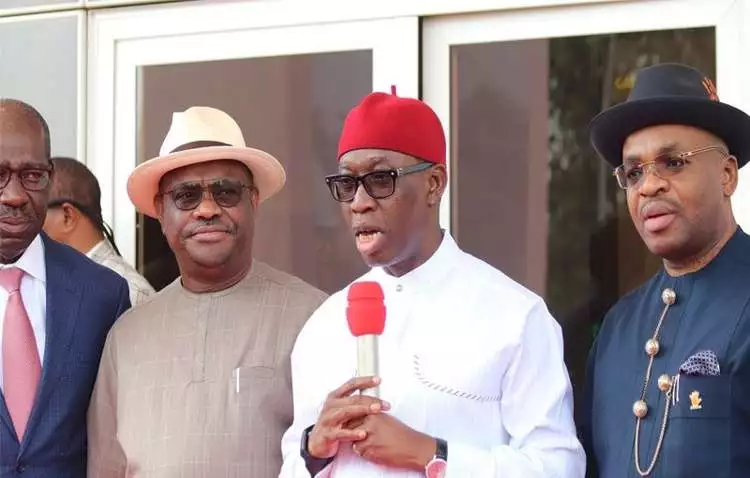
The Dave Umahi-led South Eastern State Governors Forum has come under strong criticisms by the Coalition of Northern Groups, CNG.

The Group alleges that the South East Governors are being hypocritical and economical with the truth in their denouncement of the Indigenous People of Biafra, IPOB.

Governor Umahi of Ebonyi State, who is the Chairman of the South Eastern Governors Forum had recently Condemned the activities of IPOB, promising to meet the leadership and talk to them to denounce their secessionist ambition.

However, CNG spokesperson, Abdul-Azeez Suleiman, said in a statement issued titled, ‘Biafra: South-east Leaders Refutal Insufficient, Unacceptable Substitute for Referendum’, said the refutal by the South-East Governors was unacceptable and insisted that a referendum must be conducted to prepare the stage for the final exit of the Igbo from the rest of Nigeria.

The Group alleged that while on one hand, the South-east leaders were pretending to denounce IPOB, “on another hand, they are working to give legitimacy to the Eastern Security Network, ESN, which they renamed Ebubeagu, which we all know is a militant wing of IPOB.”

He said, “In our earlier submission, we highlighted the conceivable implications of the uttered threats and practical steps being taken by the Igbo under the guise of IPOB. These South-east militant IPOB members unceasingly foment hateful violence against other ethnicities and the Nigerian State, while a handful of South-east leaders began a frantic move to cover their complicity in the atrocities by pretending to denounce the IPOB and its leader, Nnamdi Kanu.

“We note also that while on one hand, these South-east leaders present a pretext of denouncing IPOB, on another hand, they are working to give legitimacy to the Eastern Security Network which they renamed Ebubeagu, which we all know is a militant wing of IPOB.

“The extent of deception also becomes apparent in the way these South-east leaders give the appearance of dissociating themselves from the Biafran violent agitation and at the same time vehemently attempting to support and justify IPOB’s brand of self-determination bid premised on false claims of marginalisation and pursued through violence and violation of other ethnic nationalities and state institutions

“The CNG cannot be blinded by these desperations to cover up what is glaringly an attempt to downplay the atrocities committed, the complicity involved and the trivialisation of what is genuinely a case that must be resolved once and for all.

“The refutal is belated desperation to run away from a raging fire they fanned with their own hands by several years of indoctrinating their youth with the hate of the North in particular, and the whole of Nigeria in general,” the statement said

Osun State First Lady Empowers Women Farmers

0
Kafayat Oyetola - Osun State First Lady

By Ayodele Oni

The First Lady of Osun State and the President of IleriOluwa Development Initiative (IOD-Initiative), Mrs. Kafayat Oyetola, has encouraged women to go into farming to reduce high cost of food items.

She was speaking while unveiling the second phase of her Foundation’s Women in Agriculture empowerment scheme, during which day-chicks, Cocoa, Cashew, Sour Sop plants, and cassava stems were distributed to low-income female farmers in the rural communities of the State.

Mrs. Oyetola, disclosed that the second phase of the program had been delayed by the outbreak of the coronavirus pandemic in late 2019 through 2020.

She noted that the Foundation had been encouraged by the successes recorded from the first phase, whose beneficiaries gave testimonies at Tuesday’s program.

“The Program was designed to assist low-income female farmers periodically with necessary inputs that will enhance their productivity in the farms, increase their yields and ensure food security for their families.

“The first phase of this program was held in January, 2019. I am happy to report here that the beneficiaries in that phase reported back the tremendous positive impact of the IOD-Agricultural scheme intervention.”

She called on every woman to have at least small backyard farms which produce could support their families and help ensure food security.

“The agricultural sector has always been the main pillar for the sustenance of humanity. Here in Nigeria, the current food situation has made this more of a need for us.

“The prices of foodstuffs in our markets demand that we produce more food for our people. The situation has underscored the fact that there is no time better than now to return to the land. We must guarantee food security for our people.

“My fellow female farmers, I thank you for the steadfastness you have continued to put into the farming business despite the challenges.

“Your efforts have continued to contribute to the food chain in this State. Our intervention here today is to serve as the catalyst for select women who are in great need in their farming activities.”

She disclosed that the program had continued to be supported by Access Bank, Sterling Bank, Agrik Matas and some individual donors.

Succession Crisis Hits National Hospital, Abuja

0
National Hospital Abuja

By Ayodele Oni

The National Hospital, Abuja, has been thrown into another succession crisis which has set the Board of the hospital against the Medical Advisory Committee, (MAC).

The Chairperson of the Board of the Hospital, former Speaker, Mrs Patricia Etteh, is reportedly to be at the centre of the current crisis.

This followed the refusal of the Board to honour the established process of appointing the Chairman, Medical Advisory Committee (CMAC)

It was learnt that the tenure of the current CMAC of the hospital, Mrs. Aisha Umar, ended on 5th May, 2021.

In view of the expired tenure of the  CMAC, the Management of the Hospital wrote to the Medical and Dental Consultants’ Association, (MDCAN) of the hospital on 18th May 2021 conveying approval of the Board and Management for the association to conduct an election for a successor to the position of CMAC.

The Directorate of Administration was also directed to supervise the conduct of the election.

Following the letter sent to the Consultant Doctors, the Association was said to have conducted the election on 31st May 2021 among three candidates.

A source within the Board of the Hospital revealed that the election was duly conducted and the name of the winner was sent to the Management and Board.

The source added that the Board was reportedly opposed to the choice of the MDCAN members and expressed the desire to upturn the result of the election.

Following the expression of opposition to the choice of the Association, the Board was said to have introduced an unusual step into the election process by inviting all the candidates that featured in the election for an interview with a  Committee set up by the Board.

The source revealed that one of the candidates, that came third in the election, refused to participate in the interview session held Tuesday, June 22, 2021, insisting that the MDCAN election was free and fair and the result should not be upturned for the progress and peace in the hospital.

It was further gathered that decision of the board has led to agitation among Medical Doctors in the Hospital who have threatened to escalate the case.

CBN Moves To Crash Price Of Rice

0

By James Orji

The Central Bank of Nigeria, CBN has assured Nigerians that the price of rice will crash within few days, following the decision of the Godwin Emefiele-led apex bank’s to release 27, 000 metric tonnes of the commodity into the market.

Rice is a staple food for many Nigerians, but the last two years have witnessed an astronomical increase in the price of the commodity, to as high as 25,000 to 30,000 per bag, particularly following federal government’s closure of land borders in August 2019, which prevented foreign rice from being smuggled into the country.

On their part, local rice producers have seized the opportunity of the shortfall in supply to increase the price beyond the reach of many Nigerians.

The apex bank, however, said it has directed the Rice Farmers Association of Nigeria, RIFAN to distribute 27,000 metric tonnes of rice paddies directly to millers nationwide from Thursday.

The intervention CBN said will eliminate the cost associated with middlemen which impacts the cost of rice.

The direct allocation from RIFAN warehouses across 16 states is sequel to the earlier sale of paddy aggregated as loan repayment under the Anchor Borrowers’ Programme (ABP) to millers from the rice pyramids unveiled in Niger, Kebbi, Gombe and Ekiti States, a source within the CBN said.

According to the acting Director, Corporate Communications Department of the CBN, Osita Nwanisobi, “Kaduna state has been selected as the key location for the paddy allocation exercise which will be done simultaneously in the states that recorded the highest quality of rice harvests during the last farming season.”

The CBN recently unveiled pyramids of rice paddies in Niger, Kebbi, Gombe and Ekiti States, with the Federal Capital Territory, Ebonyi and Cross River slated for the same exercise in the coming weeks in what the Bank says is part of its contribution to ensuring self-sustenance in food production as well as food security in Nigeria.

Before the administration of Muhammadu Buhari took power in 2015, a bag of rice was sold for between N9,000 and N11,000.

Imo: Willie Amadi, Former Federal Commissioner, Dumps PDP, Defects To APC

0
Willie Amadi

By Charles Igbo

The news did not quite come as a surprise to many people. The news, that Willie Amadi, a Lawyer, and the immediate past Federal Commissioner, Public Complaints Commission, has dumped the Peoples Democratic Party, PDP for the ruling All Progressives Congress, APC.

Amadi was an Ombudsman, and represented Imo State on the Commission.

He was appointed to the Commission on the recommendation, and backing of Senator Sam Daddy Anyanwu, PDP, who was the Chairman, Senate Public Complaints Committee, the immediate past Senator who represented Owerri East.

He lost the position when he contested, unsuccessfully, in 2019, for the Governorship of the State. He did not make it in the Primary as he was defeated by the Rt. Hon. Emeka Ihedioha, who went on to be declared the Governor of the State.

Ihedioha lost the seat after seven months in office when the Supreme Court declared Senator Hope Uzodimma as the duly elected Governor of Imo State.

Even though not many were surprised at Amadi’s defection to the APC, it still stung his former party, the PDP.

For months, Amadi, unarguably, one of the most active Commissioners on the Federal Complaints Commission while in office, played straight. Because of the position he held, he shunned partisan politics. In Imo State, for example, to the consternation of some PDP members, he commended the Government of the State, on a number of times for jobs he considered well done, especially, roads. That did not stop him from criticising the Government where he felt it had not done well. On the average, however, Amadi scored the performance of the Governor high, and did not hide it.

This other day when the Governor received in audience, the Owerri Municipal Stakeholders for a  dialogue on the state of Imo State, especially, insecurity, Amadi played a prominent role.

That was a risk in Imo State where  the bitterness and hatred is very deep rooted among political actors of the opposite sides. One becomes an enemy when one does not belong to same party, or disagrees with a particular point of view, or sees white and call it white instead of black.

On Monday, June 21, Amadi courageously took a stand. His stand was to ditch the PDP in order to give Governor Uzodimma  maximum support in his bid to move the State forward.

He went to his ward in the Owerri Municipal, and registered as an APC member.

Making public Amadi’s membership of the APC, the Party Chairman in Owerri Municipal enthused:

“It is my singular intention, and, also, on behalf of the apex leadership of the Owerri Municipal APC, to welcome my elder brother, one of our respected leaders, Chief Barr.Willie Amadi into our great party, the All Progresssives Congress as he just got registered in Aladinma  Ward 2.

“We have no doubt that your wealth of experience and political sagacity will add immense value to our body politic in Owerri Municipal and Imo State as a whole.

“With your entrant, the shared prosperity Government will continue to soar higher and higher.”

On his part, Amadi, a jolly good fellow and a good mixer,  in an open letter announced his new political preference.

In announcing his exit, he said it does not affect his relationship with anybody, especially, his friends in different political parties who he emphasised, remain his friends 100 per cent.

Following is his letter announcing his new political  preference.

My Dear Associates,

CHANGE OF POLITICAL ORIENTATION

“On Monday 21st June 2021, I finally decided to join the All Progressives Congress for personal reasons. I humbly seek your indulgence and understanding. I will always cherish our outstanding  comradeship and  service to the people while it lasted for 21 years.

“I sincerely thank the leadership of the party at all levels for giving me the opportunities and support to serve and grow in the body polity.

“I assure that my personal relationship with all of you remain cordial, despite my new orientation.

“I wish US well and please, accept the assurances of my best regards at all times.

“Affectionately Yours,

“High Chief, Barr. Willie Amadi

UKWA ACHIAKA, Owerri.

OMEUDO, Owerri Autonomous Communities.

AJUZIEOGU LODGE, Owerri

22nd, Tuesday June 2021.”

The PDP in Imo State has not yet reacted, officially, to this development.

Twitter Ban: Nigeria, Twitter Teams Dialogue On Way Forward

0
Twitter Logo

By Adesina Soyooye

On the day the Regional Court, ECOWAS Court, stopped the Federal Government of Nigeria from prosecuting Twitter users, it emerged that President Muhammadu Buhari has set up a Team to dialogue with Twitter in order to reach an agreement on the spat between Nigeria and Twitter.

The Federal Government had fallen out with Twitter over the microblogging company’s guts to pull out a post by Buhari.

Twitter had taken down Buhari’s tweet where he threatened to deal ruthlessly with a section of the country.

The company, after thousands of petitions against the post, took it down, terming it a hate speech. Facebook, also did the same.

In retaliation, the FG banned Twitter from Nigeria, and threatened to prosecute any Nigerian who would circumvent the process and the ban, and use Twitter.

A number of Nigerians,  called the Government’s bluff, including Pastor Enoch Adeboye, the General Overseer of the Redeemed Christian Church of God, and Pastor William Kumuyi of the Deeper life Ministry.

The Federal Government’s action attracted condemnation within and outside the country, including from US, United Kingdom and the European Union. They saw it as an attack on freedom of speech.

Since then, the FG has accused Twitter of being pro-IPOB and and being a promoter of the #EndSARS. It said the Company was interested in the destabilization of Nigeria.

Both the FG and Twitter had always said they were open to a dialogue to resolve the issues.

On Tuesday, the FG named a high powered team to dialogue with Twitter.

A statement signed by Segun Adeyemi, Special Assistant to the President(Media), in the office of the Minister for Information and Culture, titled:

Buhari Approves FG’s Team To Engage With Twitter Over Suspension , reads:

“President Muhammadu Buhari has approved the composition of the Federal

Government’s Team to engage with Twitter over the recent suspension of

the operations of the microblogging and social networking service in

Nigeria.

“The approval was announced in a statement in Abuja on Tuesday by the

Minister of Information and Culture, Alhaji Lai Mohammed, who will

chair the team.

“The Federal Government’s team also comprises the Attorney General of

the Federation and Honourable Minister of Justice, Honourable Minister

of Communications and Digital Economy, Honourable Minister of Foreign

Affairs, Honourable Minister of Works and Housing, Honourable Minister

of State for Labour and Employment as well as other relevant

government agencies.

“Following the indefinite suspension of its operations in Nigeria, for

activities that are capable of undermining Nigeria’s corporate

existence, Twitter wrote to President Buhari seeking to engage with

the Federal Government over the suspension, with a view to charting a

path forward.”

Not a few Nigerians have criticised the number of high profile members that made up the Nigerian team. They say it is an overkill.

OPINION: INEC Polling Units and The Future of Elections

0
Reuben Abati

By Reuben Abati

INEC’s efforts in solving a 25-year electoral riddle is commendable. With the expansion of polling units, voter access and representation will be enhanced. The average voter would not have to travel across kilometres to get to the nearest polling station.

The problem of congestion has also been addressed. Room has also been created for the test-running of the new structure long before the 2023 General elections. These new polling units will first be used beginning with the November 6, 2021 Gubernatorial election in Anambra state, and subsequently in the Area Council elections in the Federal Capital Territory, February 12, 2022, Ekiti state gubernatorial election on June 18, 2022 and the one in Osun state scheduled for July 16, 2022.

Some of the major challenges bedevilling the electoral process in Nigeria, and thus abbreviating the integrity of democracy in the country include over the years: lack of access to polling units, the location of polling units in problematic parts, overcrowding, conflict, violence, the designation of places like shrines, mosques, churches and private residences as polling units which grant the owners of such premises unassigned powers of control over the voting process. There is also the general climate of fear, opaqueness, insecurity and manipulation during every election season.

Last week, the Independent National Electoral Commission (INEC) made notable progress in addressing these challenges when it announced the completion of its delienation of new polling units for the country.

The last time new polling units were defined in Nigeria was 25 years ago by the defunct National Electoral Commission of Nigeria (NECON), as INEC was then known. At the time the country had on the voters’ register, 50 million voters. Over the years, it worked with an estimate of 120, 000 polling units across the country but an eventual census put the exact figure at 119, 973 polling units. As the number of voters nationwide increased, the number of polling units remained static. Section 22 of the Electoral Act says each polling unit is not supposed to have more than 500 registered voters. But as more persons attained the age of franchise (18 in Nigeria), the polling units became congested, with many of them serving up to 2, 000 to 3, 000 voters. As new communities also emerged, especially in urban centres, voters had to travel long distances to get to the next available Polling Unit (PU).

Many did not even bother, because of the stress involved, and so voter turn-out in every election was not a true reflection of the people’s commitment. Analysts often explained this away superficially as voter apathy whereas there were underlying constraints that needed to be addressed.

In 2007, the predecessor of the current INEC Chairman, namely Professor Attahiru Jega tried to update the polling units in the country to reflect the changing voter statistics and demographics. The exercise ran into troubled waters on the grounds of ethnicity and religion. Jega’s INEC was accused of trying to give advantage to the North. He tried again in 2014.

The exercise was, after a pattern, sabotaged by the politics of suspicion and motive-reading. In 2019, Jega’s successor, Professor Mahmoud Yakubu also tried to bring the polling units in line with realities. He also failed. What is common to all those earlier efforts is that the exercises were proposed very close to the elections in 2007, 2015, and 2019, and hence, in a country where there is mutual suspicion and angst, and doubts about the integrity of electoral umpires, the populace was sceptical. So, what has Mahmoud Yakubu done this time that is different?

It has been a week since the new polling units were announced: a total of 56,872 new polling units have been added, bringing the country’s total number of polling units up to 176,846. Despite the fact that the 19 states of the North and the FCT got additional 31,196 polling units, and the 17 Southern states an additional 25, 676 polling units, there has been no usual outcry about ethnicity and imbalance or complaints about any surreptitious attempt to manipulate the figures.

The expected reaction may be delayed, especially as INEC has promised to publish the entire list of polling units in 37 volumes ahead of the commencement of the Continuous Voters’ Registration Exercise on June 28.

What is different however, is that INEC has conducted this exercise far ahead of the 2023 General elections. The new polling units have been created out of voting points and voting point settlements which the electoral body introduced during the 2019 general elections to enhance access and the sovereignty of the voter.

When the process of reviewing what was done in 1996 began, the Joint Senate and House of Representatives Committee on INEC received over 10, 000 requests from 26 states of the Federation for new polling units to be created in their areas. In the end, INEC has arrived at an addition of 56, 872 polling units. It also consulted not just the National Assembly but groups in civil society, including the political parties and development partners.

The inclusiveness of the process must have helped but INEC must now go a step further and publish the entire volumes of the designated polling units. Transparency is crucial. That should provide opportunities for scrutiny, review and amendments where necessary.

INEC’s efforts in solving a 25-year electoral riddle is commendable.

With the expansion of polling units, voter access and representation will be enhanced. The average voter would not have to travel across kilometres to get to the nearest polling station. The problem of congestion has also been addressed. Room has also been created for the test-running of the new structure long before the 2023 General elections.

These new polling units will first be used beginning with the November 6, 2021 Gubernatorial election in Anambra state, and subsequently in the Area Council elections in the Federal Capital Territory, February 12, 2022, Ekiti state gubernatorial election on June 18, 2022 and the one in Osun state scheduled for July 16, 2022.

What many Nigerians would even find more instructive is the announcement by the INEC Chairman that 749 polling units have been removed from inappropriate places: shrines, churches, mosques and private residences. The figure that has been announced is probably modest. The publication of the polling units must provide room for the electorate to help identify more of such strange locations where the integrity of the electoral process has been routinely compromised.

This may sound strange to the international community or even to the uninitiated in the mores of Nigerian politics. But it is true. Can you imagine anyone walking into an open, communal shrine in a village, with the Chief Priest wearing INEC tags, asking the voter to support a particular party? How much freedom of choice can voters exercise under such circumstances? Every election season, pastors and imams also become agents for candidates and political parties as they struggle to support members of their own faith, and clients.

They help to rig elections and cheat in God’s name. Nigerian clerics do not see anything sinful or criminal in this regard. Their moral compass is dictated by the conviction that “heaven indeed only helps those who help themselves.” There is so much doubtful spirituality in Nigerian politics.

Traditional rulers are just as notorious. You can’t run for an electoral office in Nigeria without visiting the traditional rulers in your constituency.

They are regarded as men of influence and authority who can determine electoral outcomes by simply telling their people what to do. Many of them are partisan politicians in traditional garbs. When they tell you that a traditional ruler does not promote any political party, or that he is everyone’s father, believe that and deceive yourself. Even if a particular traditional ruler would not support you and you know, you still must go to his palace to pay homage and receive prayers and the blessing of ancestors. Yes, those ancestors! Nigeria must be one of the very few countries in the world where the dead also have a say in elections: they are served kolanuts, bitter kola and exotic drinks!  During the 2019 elections, we visited a particular traditional ruler, a few days to the election.

When the king invited us to his living room after a reception in the palace premises, the first thing I noticed was a big box beside the king’s throne. It contained voters’ cards! Someone had actually told us that every election season, this particular king controls most of the polling units in his domain, and no one would dare challenge his directives.

On election day, there were reports in other communities as well, of traditional rulers similarly acting as party contractors, and landlords threatening tenants with eviction or increased rent.

It is therefore, precisely for this same reason that I think good as the expansion and enhanced delineation of polling units by INEC may be, certain other critical steps would still have to be taken to safeguard the integrity of Nigerian elections. First on my list is the legal framework for elections. In 2018, the proposed amendment of the Electoral Act 2010 ran into troubled waters because the President refused to give his assent to the Bill, the Electoral Act Amendment Bill 2018, as passed by the National Assembly.

The excuse then was that the process was out of time, given the closeness of the submitted Bill as amended, to the 2019 general elections. The President refused to give his assent on three different occasions.  The 9th National Assembly, upon its inauguration in June 2019, promised to make the Electoral Act Amendment Bill, a major priority to be treated expeditiously. Public hearings on the Bill have been concluded since December 2020, there was even a retreat of lawmakers over it in January 2021 but the federal legislators have been crawling at snail speed over this Bill and others, such as The Petroleum Industry Bill.

They have been playing deaf and dumb.

It is as if there is a deliberate attempt to frustrate demands by the electorate and other stakeholders for a modernisation of the electoral framework in Nigeria in line with observed realities and omissions. The Senate President, Dr Ahmad Lawan even promised that the Electoral Act Amendment Bill 2021 would be ready by May 2021. One major concern is that in 2021, Nigeria should be able to have an electronic voting system, INEC must have a national data base through which results can be collated real-time with the aid of technology in order to ensure the transparency of outcomes. Many stakeholders have also called for a review of the cost of electoral participation, access for persons living with disabilities, and specific provisions to enhance women participation. There is obviously no political will to reform the electoral system. Ahead of the Continuous Voters Registration exercise beginning June 28, INEC has now introduced an online Voter Enrolment Device to enable voters register online. It should be possible for Nigerians to vote online as well.

A hybrid system can be experimented with, whereby disadvantaged voters without access to technology can vote physically at polling units while in the urban centres, technology can be deployed. For this to work, INEC must have enough time to test run the new reforms.  As things stand, the extant Electoral Act 2010 makes no allowance for the use of technology. Without the much-needed electoral reform, INEC’s innovations may be of no serious consequence.

The reviews of the 2019 elections by INEC and the high volume of litigations that followed the elections clearly indicated that the politicians and the political parties are part of the problem, if not the main problem, with elections in Nigeria. In the absence of an Electoral Offences Tribunal and the lack of capacity to pursue electoral offenders, big or small, to bring them to justice, Nigerian politicians have learnt to operate like bandits. They kidnap votes, disrupt the system, cheat, rig, promote violence with the aid of able-bodied thugs, high on dangerous, mind-altering drugs, and they get away with it.

INEC Chairman Mahmoud Yakubu has also been preaching to Nigerian politicians to ensure internal democracy among their ranks, and to avoid a situation whereby excessive litigations place electoral outcomes at the mercy of the courts. Professor Yakubu’s admonitions sound like mere wishful thinking. For the Nigerian politician, the end justifies the means. He is groomed to win elections by any means possible, and those means do not exclude the assassination of opponents, arson, blackmail, and assault.

The key strategy is this: win at all costs and let the opponent go to court. When the matter gets to the courts, another level of mischief is initiated. Nigerian judges are not as neutral as they should be in election matters. From dubious arithmetic to inverted judicial activism, Nigerian courts have gifted elections in surprising manners without ever stating their reasons.

The INEC Chairman may preach as he wishes, but what powers does he have to stop the Nigerian judiciary from jumping into the arena of partisan politics?

Insecurity is another thing to worry about. In the last two years alone, 42 INEC facilities have been attacked in 14 different locations across the country. It got so bad INEC had to appeal to the Federal Government to declare a state of emergency over INEC units nationwide. The leadership of the electoral body also visited the President to present a detailed report.

They were told that the government would ensure that those attacking INEC facilities will soon have “the shock of their lives.” Nobody knows what that means. What is known is that the biggest threat to future elections is the general insecurity in the country.

INEC has increased the number of polling units. It does not have enough staff to man every polling unit. Every election season, it recruits ad hoc staff, which means from November 6, 2021 in Anambra, INEC would recruit more ad hoc staff. But who will allow his or her daughter or relation to work for INEC when there are threats that no election will be allowed in the South East? With kidnappers and separatists running riot?

It is the same in the South West where promoters of the Oduduwa Nation have warned politicians to stay away from the 2023 elections. Will the Nigerian government provide security and protect the integrity of future elections? Otherwise, INEC will be grossly handicapped.

Matters have not been helped by the President’s contemptuous and divisive rhetoric on the key issues agitating the minds of the people.

President Buhari says nobody will be allowed to restructure Nigeria under his watch because there is nothing to restructure. “No country will allow that”, he says. He is also opposed to the idea of a completely new Constitution. He has declared that his government will speak to those who want to dismember Nigeria in “the language they will understand”.

President Buhari at the twilight moment of his tenure should be more concerned about his legacy. The least he can do, is to leave behind a Nigeria that does not tip over the edge of the precipice, after him.


Abati, PhD, Columnist, TV personality, is a commentator on National issues.