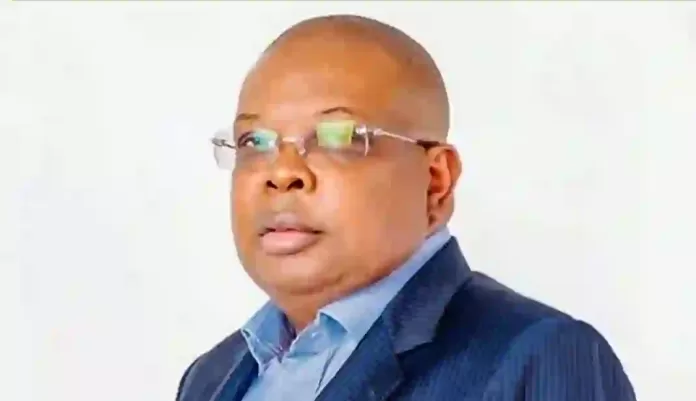



The Minister of the Federal Capital Territory, FCT, Nyesom Wike, has rejected claims that the opposition African Democratic Congress, ADC, has been denied the use of the Eagle Square for its April 14, 2026, National Convention.
This is as he explained that the Moshood Abiola National Stadium Velodrome which played host to the Wike-backed Abdulraham Mohammed-led Peoples Democratic party PDP Convention penultimate week, is under the control of the Federal Ministry of Sports, and not the FCT Administration.
The Source reports that the planned venue of the ADC Convention had been marred in controversy, with initial speculations suggesting that the Management of the Abuja Nicon Hilton Hotel was allegedly forced to cancel at the last minute , earlier bookings by the party.
However ,the management of the Hotel responded swiftly , with an emphatic denial of any such bookings by the party.
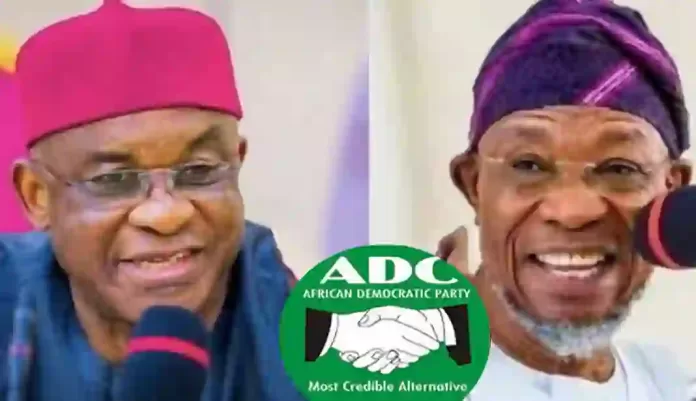
Similarly, there were also reports alleging that the opposition party, which is currently locked in a battle of wits with the Independent National Electoral Commission, INEC, over the status of the Senator David Mark-led National Executive Committee NEC, has been denied the use of the Eagle Square and the Velodrome for its National Convention by authorities.
But responding to the allegation on Monday during an inspection tour of some ongoing projects, Wike insisted that there were no formal applications for the use of the Eagle Square by the ADC, or any other political party.
According to him, intending users of the national facility normally apply through the Abuja Investments Company Limited which is the supervising authority, with the appropriate payment equally made through the outfit.
He maintained that as at the last check, no such application was filed by the opposition Coalition.
“Who denied them the use of the Eagle Square? I am not aware of any such development, and I don’t even know which party you are referring to.
” If it is the African Democratic Congress, ADC, such claims are part of their usual ways of attempting to gain public sympathy”, the FCT stated.
He emphasized that the use of the national facility is subject to adherence to due process, including a formal application through the Abuja Investments Company Limited.
“As we speak, no formal application has been submitted to the Abuja Investments Company Limited.
“When the All Progressive Congress, APC, used the venue, and the PDP used the Stadium Velodrome, they complied with the process. We do not deny anyone access if the rules are followed”, he submitted.
Not a few people, however, have the feeling that the ADC is being deliberately frustrated.
Coming few days after a Brigadier General in the Nigerian Army was killed by terrorists, reports say another attack by Boko Haram insurgents of a military outpost in Monguno, Borno State, has left at least 22 soldiers of the Nigerian Army including a Colonel killed.
According to sources familiar with the incident, the overnight assault is said to have occurred as the military was preparing to launch a renewed offensive against the terrorists, who have recently intensified attacks on security forces in the region.
The affected officer, Colonel I.A. Muhammad, along with his troops, was attached to the 242 Battalion in Borno, an area that has remained a major hotspot in the long-running insurgency that has lasted over 17 years.
A spokesperson for the Nigerian Army did not immediately respond to requests for comments.
Meanwhile, a video purportedly showing the attack circulated on social media shortly after the incident.
Colonel Muhammad is reported to be among at least six senior officers killed by Boko Haram fighters within the past two weeks.
President Bola Ahmed Tinubu has pledged to intensify military action against insurgents, as the conflict, ongoing since 2009, continues to challenge successive administrations.
“There is a need to reassess the security architecture”
A seemingly tired and helpless Governor of Borno State, Professor Babagana Zulum, has disclosed that Security Agencies had prior knowledge of the attack at the Army Brigade Command Benisheikh.
According to the Governor, Security Agencies knew three days in advance that the attack was coming.
Recall that terrorists of ISWAP and Boko Haram bent launched a devastating offensive on the 15 Task Force Brigade Benisheikh, which resulted in the killing of the Brigade Commander, Brigadier-General Oseni Braimah and a number of other troops.
Based on the Governor’s shocking disclosure, the questions then are: What happened? Why were the troops not prepared for the attack? Why was the Brigade not fortified? Why were more troops not moved into the area to avoid the embarrassing overrunning of a Brigade Command and the killing of a Brigadier-General and a number of his troops?
Zulum’s disclosure came when he paid a sympathy visit to the community after the assault that, also, took the lives of several civilians.
The Governor who described the incident as shocking, called for an urgent overhaul of security strategies.
He said: “This is one of the most surprising attacks I’ve witnessed in recent times.
“Credible intelligence had been available for about three days. There is a need to reassess our security architecture.”
The Local Government Chairman also confirmed that intelligence reports were received, and blamed the incident on “a major lapse.”
Few hours to the commencement of its national convention, the African Democratic Congress (ADC), is yet to secure a venue for the event.
Virtually all places visited, including government and privately owned event centres, seem to be reluctant to release the property to the Party.
The ADC fixed Tuesday, April 14 for the event, which is expected to attract delegates from the 36 states and the Federal Capital Territory, FCT.
The disclosure was made by a party chieftain, Kola Ologbondiyan, who on Monday, in a post on his X account, detailed what the party described as a series of setbacks and repeated refusals by both government-controlled and private venues.
The situation has raised fresh concerns over alleged attempts to frustrate the party’s activities.
According to Ologbondiyan, the party had formally applied to use the Eagles Square and submitted a letter to the office of the Minister of the Federal Capital Territory, Nyesom Wike.
Although the request was acknowledged, he said no approval has been granted.
“As the bromide has shown, a letter was presented to the Office of the Federal Capital Territory (FCT) Minister for a permit to use the Eagles Square. The letter was acknowledged but no response,” he stated.
He further revealed that efforts to secure the Velodrome at the Moshood Abiola National Stadium also failed, despite multiple visits to officials of the Federal Ministry of Sports.
“The ADC team paid several visits to the Ministry of Sports officials at the MKO Stadium. At the end, ADC was refused the use of the Velodrome,” the statement added.
In what the party described as a worsening situation, Ologbondiyan alleged that privately-owned event centres in Abuja are declining requests from the party due to fear of intimidation or reprisals.
“To make matters worse, privately owned event centres in Abuja are turning down the ADC requests for fear of harassment in various forms from the government,” he said.
Despite the logistical challenges, the party insisted that its national convention would proceed as planned in Abuja on Tuesday, April 14, 2026, in line with its earlier notice to the Independent National Electoral Commission (INEC).
“All ADC members, teeming party supporters and indeed all Nigerians are assured that, as contained in the Notice issued to INEC (Independent National Electoral Commission), the ADC National Convention will hold in Abuja as scheduled on Tuesday, April 14th, 2026,” Ologbondiyan declared.
The latest development adds to earlier claims by the ADC that the administration of President Bola Tinubu was attempting to stifle opposition activities.
The Party’s spokesperson, Bolaji Abdullahi, had previously told SaharaReporters that the party’s request for Eagles Square was ignored, while access to the Velodrome was denied over a purported sporting event.
However, the Presidency, through spokesman Sunday Dare, has denied the allegations, insisting that all political parties have equal rights under the law.
With no confirmed venue and the clock ticking, the ADC’s insistence on proceeding with its convention signals a looming confrontation between the opposition party and authorities.
Following completion of congresses in wards, local governments and states level, the African Democratic Congress (ADC) is set to conduct the national delegates Congress on Tuesday.
To this end, the party has nominated former Vice-President Atiku Abubakar, former presidential candidate Peter Obi, former Kano State governor, Rabiu Kwankwaso, and former Minister of Transportation, Rotimi Amaechi to conduct the convention.
The convention, has a former Cross River State governor, Liyel Imoke as chairman of the 126-member Convention Planning Committee.
A former Sokoto State Governor, Aminu Tambuwal was named as deputy chairman, while a former Kaduna State Governor, Nasir El-Rufai and former Attorney General, Abubakar Malami were also named as members.
The National Chairman of the New Nigeria Peoples Party (NNPP) camp loyal to Kwankwaso, Dr Ajuji Ahmed, will serve as secretary to the committee.
The Independent National Electoral Commission (INEC) has said it would not monitor the Congress following crisis over the leadership of the party.
One of the factions, is being led by Senator David Mark and the other claimant to the Chairmanship, Nafiu Gombe is also championing the cause of others.
The faction being led by Mark, which is holding its national convention on Tuesday has vowed to go ahead with or without the presence of INEC officials.
Meanwhile, the Supreme Court will, on Tuesday, hear an appeal filed by Sen. David Mark, the embattled National Chairman, African Democraric Congress (ADC).
Mark is seeking an order staying the execution of the March 12 judgement of the Court of Appeal.
The apex court, in a hearing notice with appeal number: SC/CV/180/2026 between Sen. Mark vs Hon. Nafiu-Bala Gombe and four others, said the proceeding was scheduled for April 14.
The hearing notice, sent to the parties in the case through the Litigation Department of the Supreme Court on Friday, was sighted by the News Agency of Nigeria (NAN) on Sunday in Abuja.
This is the unbelievable life story of Asuquo Edet. A native of Ikon-Edikor, Udung Uko Local Government Area of Akwa Ibom State, Edet was one of those unfortunate kids life has dealt with in the hands of those that should have protected him the most – his family members.
He lost his biological mother, but still had his loving father who, however, got remarried to a devil of a woman.
At 13 years of age, Edet was branded a witch and cursed and treated differently by his step mother who showered love on her own children. He would have been thrown into the streets to roam and die, but his father who still loved him was an obstacle.
His stepmother hated him and heaped all kinds of allegations against him – a witch, who is responsible for his father’s prolonged illness and the family’s poverty.
Then, his father died, and the teenager was put through hell and thrown into it. As he sat at a corner of his father’s compound mourning his father’s death and the fate life has thrown at him, a group of young men, about 12, led by two of his step brothers, descended on him with machetes, clubs, cables, rods. They put him through a horrifying experience, all the while, asking him why he killed his father.
When they macheted him on the head, and smashed his head, they carried him into the bush, and dumped him there, believing he was dead.
But God and destiny were on his side.
A Danish Aid worker, Anja Rinngerin Loven and her husband, David, who run an organization, ‘Land Of Hope’ rescued him from the bush when they were alerted. They took Asuquo to hospital and took care of all his need. They took care and literally, adopted him as their son.
Out of hospital, they put him back in school where he always passed on top of his class. 13 years later, the “witch” has just graduated from the Akwa Ibom State University. Edet is now a graduate of Genetics and Biotechnology to the shame of his cruel family and the shame of all those who tried to kill him.
His unbelievable story, from an abandoned child to a university graduate was, on Sunday, April 12, 2026, Anja Ringgren Loven, the Danish Aid Worker who, along with her husband, David, rescued him in 2014, shared his story and achievement in a tribute on Facebook.
“They beat him with machetes, cables, rods, and sticks, demanding to know why he had ‘killed’ his father. Then they decided to kill him. A machete was smashed into his head. He collapsed. Believing he was dead, they carried his body and threw him into the bushes,” Loven wrote in the tribute.
Following is the full text of Loven’s post on Asuquo Edet:
“I came to Nigeria for the first time 13 years ago.
“One of the very first children my husband, David, and I rescued was Asuquo.
“He had been accused of being a witch by his step mother.
“At the time Asuquo was a young teenager and the brightest student in his class. Life was good. He had a close and loving bond with his father, worked hard, and was known in the village for his kindness, humility and willingness to help others.
“But when his mother died and his father remarried, everything changed.
“His stepmother never accepted him. She blamed him for the family’s hardships, and when his father fell ill, she accused him of being a witch.
“Not long after, his father passed away.
“Asuquo was heartbroken.
“He was sitting in his father’s house, mourning his loss when a group of about a dozen men, led by two of his stepmother own children, stormed in and attacked him.
“They beat him with machetes, cables, rods and sticks, demanding to know why he had ‘killed’ his father.
“Then, they decided to kill him.
“A matchet was smashed into his head. He collapsed. Believing he was dead, they carried his body and threw him into the bushes.
“But Asuquo did not die.
“He survived.
“David and I found him and rescued him. We reported the case to the Police and rushed him to the hospital.
“And there is one moment I will never forget.
“On that very hot day, as he lay there with a deep machete wound in his head, bleeding heavily, Asuquo was not thinking about himself.
“He was worried about me.
“He kept asking if I had enough water to drink.
“That is who Asuquo is.
“We contacted the Media, and his story was published in several newspapers. We wanted the world to know. We wanted justice for him.
“If you have followed my work, you already know Asuquo. He is one of the first children we rescued.
“And you will also know this:
“Year after year, Asuquo has taken the first place in class throughout secondary school and high school.
“He graduated with one of the highest scores. Even his principal did not want him to go.
“Everywhere he goes, he brings calm, kindness and hope.
“He has always been, and will always be an inspiration to our children and our staff.
“And now…after 13 years in our care…
“Words cannot describe how proud I felt when Asuquo sent me his certificate.
“From being left for dead in the bushes… to becoming a university graduate.
“Let that sink in.
“To anyone who claims that children are witches, shame on you!
“To any pastor who spreads these beliefs, shame on you!
“To anyone who labels children, the elderly, or people with disabilities or mental health challenges as witches, shame on you!
“Congratulations, Asuquo.
“You are an inspiration to the world. The future is yours, and I know you will help lead the way for a new generation.
“Thank you to everyone who supports Land of Hope.
“Everything our children achieve… is because of you too.
Islamic Cleric, Sheikh Ahmed Gumi, has condemned the Nigerian Air Force airstrike that reportedly killed more than 50 civilians at a weekly market in Jilli village along the Borno–Yobe border. Describing it as unfortunate, he demanded for an urgent investigation.
Gumi questioned the accountability of those responsible for the operation, asking who authorised and executed the bombings that hit innocent civilians.
He demanded for the identities of the Pilots who carried out the airstrike, and called for their immediate probe.
In a Facebook Post, Gumi
cited previous incidents, including the Tudun Biri bombing and other reported strikes in Nasarawa and Sokoto, describing them as part of a troubling pattern of attacks affecting non-combatants.
He also argued that terrorism cannot be defeated through actions that endanger civilian lives, insisting that such operations risk undermining public trust.
He called on the Senate to immediately conduct hearings into what he described as repeated “mistakes” involving the bombing of villages, markets, and other Civilian locations.
Gumi: “Who are the Pilots behind these bomb releases on innocent locals?
“Tudun biri, Nasarawa attack on herdsmen trailer, Sokoto attack etc are just the few ones recorded. Terror cannot be fought with another terror.
“There should be an immediate Senate hearings on these so-called ‘mistakes’ on bombing villages, markets and civilians targets.
“We need answers not condolences.”
The airstrike occurred on Saturday evening during peak trading hours at Jilli market, claiming the lives of numerous civilians, with several persons sustaining various degrees of injuries.
It was gathered from eyewitness that multiple fighter jets were involved in the operation.
Presidential Candidate hopeful of the African Democratic Congress (ADC), Mr. Peter Obi, has criticised recent remarks attributed to President Bola Ahmed Tinubu suggesting that Nigerians should take comfort in being “better off than Kenya and other African countries.”
Obi, in a statement, argued that while the comment may have been intended to ease concerns over rising living costs and economic hardship, it risks downplaying the severity of Nigeria’s current socio-economic challenges.
He drew a parallel between such comparative statements and the biblical parable of the Pharisee and the Tax Collector in the Gospel of Luke (18:9–14), which contrasts self-righteous comparison with honest self-assessment. He also referenced a similar caution in the Qur’an (53:32) against self-praise and arrogance.
According to him, downward comparisons among nations often serve as “a refuge rather than a remedy,” warning that leadership communication must be anchored on measurable realities rather than selective narratives.
Obi also recalled a past campaign-era remark attributed to President Tinubu, “Na statistics we go shop?”, arguing that such a disposition undermines the importance of data in governance.
Obi stressed that statistics remain essential tools for national planning and performance evaluation, noting that no country can achieve meaningful development without benchmarking itself against others using credible data.
Citing multiple development indicators, he argued that Kenya currently outperforms Nigeria in several key areas, including security, Human Development Index (HDI), GDP per capita, life expectancy, literacy levels, and electricity access.
He noted that Nigeria continues to face severe security challenges, ranking among the most terror-affected countries globally, while Kenya does not fall within the worst-affected group.
Available figures, he said, place Kenya’s HDI at about 0.630 (ranked 143 of 180 countries), compared to Nigeria’s 0.530 (ranked 164 of 180). Kenya’s GDP per capita is estimated at $2,200–$2,300, compared to Nigeria’s $807–$835.
Obi further cited poverty estimates indicating that about 63 percent of Nigerians live below the poverty line, compared to approximately 43 percent in Kenya. He also noted disparities in life expectancy—about 67 years in Kenya compared to 54 years in Nigeria—and literacy rates, estimated at 81–85 percent in Kenya and 62–65 percent in Nigeria.
Other indicators, according to him, include electricity access, out-of-school children figures, inflation trends, and currency stability, all of which he said favour Kenya over Nigeria in comparative performance.
He highlighted that Kenya has recorded more stable inflation rates of around 4.5 percent or lower in recent years, while Nigeria’s inflation has remained above 15 percent. He also pointed to sharper currency depreciation in Nigeria compared to Kenya over the same period.
Obi added that despite global pressures, Kenya has not experienced the same level of fuel price volatility as Nigeria in recent years.
He argued that these indicators demonstrate the need for more honest assessment of Nigeria’s situation, stressing that comparisons should be grounded in verified data and used as tools for accountability rather than consolation.
He concluded that Nigeria’s challenges require humility, responsibility, and urgent reforms aimed at addressing structural constraints to development.
The Sultan of Sokoto, Mohammad Sa’ad Abubakar III, has dismissed as false, misleading and mischievous, a viral image online depicting the Governor of Benue State Rev. Fr. Hyacinth Alia genuflecting and appearing to be worshipping him.
He described the picture as well as the mischievous message that it sought to pass as AI-generated, and the handiwork of mischief makers out to stoke religious flame through misleading narratives.
The Source reports that the social media space has been inundated in the last couple of days with the image of the Benue State Governor genuflecting at the feet of the Sultan with accompanying commentary suggesting that Alia has continued to remain silent in the face of impudent and genocidal herdsmen attacks and killings of his people owing to his alleged subservience to the Caliphate.
But in a statement from his media team, and signed by Prince Bashir Adefaka ,the Sultan accused those behind the false image and rhetorics of attempting to ignite ethno-religious conflagration and division in the country.
According to the Media Team, the Sultan does not appear in the manner depicted in the circulated image.
The statement emphasized that Islamic religious teachings clearly frown at prostration before any human, noting that it is an act of worship reserved solely for Almighty Allah.
According to the Media Team, the nature of the image in the video makes the entire video not only false, but also fundamentally inconsistent with the Sultan’s faith and principles.
“The Media Team of the Sultan of Sokoto has been alerted to a misleading post circulating across WhatsApp groups and other social media platforms , titled ‘leaked photo of Governor Hyacinth Alia worshipping the Sultan of Sokoto.’
“The content attempts to introduce divisive religious and ethnic narrative into the ongoing security challenges in Benue state.
“We wish to categorically state that the image in question is fake, likely Al-generated, and deliberately crafted to misinform the public.
“It is also a mischievous ,and dangerous attempt to associate the revered leadership of Muslims in Nigeria, particularly the Sultan of Sokoto, with issues unrelated to his office or person.
“The accompanying commentary falsely alleged religious bias and attempts to inflame tensions by linking the Sultan to the crisis in Benue state.
“Such claims are not only baseless ,but constitute a serious threat to national unity and security.
“These actions reflect a pattern of disinformation designed to invite division and undermine peaceful co-existence among Nigerians.
“As custodians of the image and public communications of the Sultan of Sokoto, who also serves as the President-General of the Nigerian Supreme Council for Islamic Affairs ( NSCIA) , Chairman of the National Traditional Rulers Council of Nigeria ,Co-Chairman of the Nigerian Inter-Religious Council ,and Co-President of the World Religions for Peace, New York, we condemn these acts in the strongest terms”, the Sultanate statement reads in part.
The Media Team emphasized that the Sultan has for nearly two decades been unflinchingly committed to the promotion of peace, interfaith harmony ,and national cohesion.”
It, therefore, warned that all orchestrated efforts to tarnish the examplary legacies of the Sultan must be rejected by all well-meaning Nigerians.
The Sultan called on the Federal Government and all relevant security agencies to take decisive actions against the spread of disinformation, as well as setting machineries in motion for the arrest and prosecution of the promoters of the harmful content.
The Crude Oil Refiners Association of Nigeria has faulted claims that imported petroleum products are cheaper than locally refined fuels, arguing that price differences stem from quality disparities and not efficiency, while accusing the World Bank of failing to make a like-for-like comparison.
The association’s Publicity Secretary, Eche Idoko, who spoke in an interview with The PUNCH, said local refineries were disadvantaged by premium crude pricing and unfair benchmarking against blended imported products.
In a now-deleted report, the World Bank Group had stated that Dangote’s petrol price was higher than imported ones, asking the Federal Government to allow fuel importation. Reacting in an interview with our correspondent, Idoko maintained that the World Bank was not fair with his comparison.
According to him, petroleum products imported into Nigeria are blended and are of low quality compared to locally produced ones.
He added that many imported fuels were blended to meet minimum regulatory specifications, making them cheaper but not directly comparable to fully refined local products.
“What is the quality, what is the process of producing some of these imported products? Some of the products that have been imported are blended products that are coming from Kazakhstan and the Far Eastern European countries. They blend just to get the parameters that they need in this country. And then they bring it in.
“In terms of quality, they would not compete with the quality that we produce from our refineries here. And of course, it also dovetails with the fact that blending is cheaper than refining. So, those are factors that would make those prices cheaper,” he stated.
Idoko said any comparison must account for product specifications such as density, flash point and pour point, noting that different fuel grades attract different prices.
“The World Bank has failed to tell us what the density was, what the flash point was, what the pour point was, and all those things about these products. They should also give a comparison because not all products are the same. There are different grades of PMS. There are different grades of diesel. And as different as they are, so also are the prices. So it’s not okay to just say the price of petrol produced in Nigeria is higher than the price of imported petrol. How do you grade the two of them?” he asked.
He insisted that unless identical grades were compared, conclusions about price competitiveness would be misleading. “When you are speaking of two different grades of fuel, then you are not being fair to the local refinery. So I think those are the factors that the World Bank will have to spell out when they are doing their comparison. It has to be apple with apple and not apple with pear or apple with orange,” he said.
The CORAN spokesman also clarified that blending was not illegal but typically produced lower-grade fuels that cost less. “Blending does not mean adulterated fuel. No, not necessarily. As I said, in products, you have grades. So the higher the grade, the higher the price.
“And then when you’re looking at the grade, you’re looking at the level of emissions. So if I’m refining and my emissions are more environmentally friendly, it will definitely be more expensive because it takes a higher level of refining. But if it’s not, then it means it’s a lower grade, so the price will be lower.
“So I’m not saying blending is bad. I think that the misinformation is that, when you blend, it’s like something illegal. No, it’s not illegal. But it doesn’t give you the grade in terms of quality as the one that has gone through the full reforming process. It won’t give what the one who went through a standard catalytic reformer and reforming process will give you. The refined one will be different from what a blended product will give you,” he stated.