Home Blog Page 210

Osun: Gov. Adeleke’s Son, B-Red Alleges Attempt To Assassinate Him

0
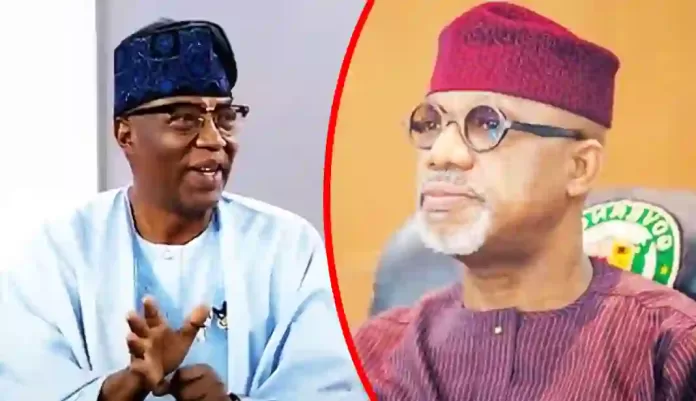
Bayo Adeleke - B-Red and His father Ademola Adeleke
From Left: Bayo Adeleke aka B-Red with his father, Governor Ademola Adeleke.

By Ayodele Oni

Singer Bayo Adeleke aka B-Red and son of Osun State governor Ademola Adeleke, has alleged a plot to assassinate him.

Bayo claimed that he survived an attempt to kill him in Osogbo, the state capital.

The incident reportedly happened around 3:30 pm on Thursday, April 30, along the Oke-Fia area, close to the government house.

According to reports, the singer was trailed and chased by a group of suspected hoodlums while he was out.

Narrating the incidence, Bayo stated that he had stepped out to purchase a few items at Alekuwodo market when things suddenly took a dangerous turn.

He explained that, while in traffic under the Oke-Fia bridge, several motorcycle riders allegedly wearing AMBO-branded caps began to surround his vehicle.

He further stated that things escalated quickly when another vehicle joined the scene.

According to him, a white Toyota Venza approached while the occupants shouted, “It’s him! It is him!”

As he attempted to leave the area, the attackers intensified their pursuit, and a vehicle reportedly tried to block his path and multiple motorcycles joined in the chase.

The pursuit allegedly continued until he reached the gate of the Osun State Government House in Oke-Fia.

He also claimed that one of the individuals involved in the incident was Asiri Eniba, whom he described as a known political thug.

Following the incident, the Osun State government has called for immediate action, urging security agencies to launch a full investigation and arrest those involved immediately.

Supreme Court Ruling: INEC Complied, Restores Names Of Mark, Aregbesola, Others

0
David Mark and Rauf Aregbesola

By Ayodele Oni

Following Thursday’s Supreme Court ruling which affirmed the Senator David Mark-led leadership of the African Democratic Congress (ADC) as authentic leadership, the Independent National Electoral Commission (INEC) has returned the names of Senator David Mark, Rauf Aregbesola,  others back to its website as the national leadership of the party.

The update, observed on Thursday evening, followed a ruling by the Supreme Court of Nigeria, effectively reversing an earlier move by the commission to delist the Mark-led executive amid the party’s protracted leadership dispute.

INEC had in early April removed the faction from its portal, citing an earlier decision of the Court of Appeal which directed parties to maintain the status quo in the crisis.

The dispute has seen competing claims to the party’s leadership, with a rival bloc linked to a former national vice-chairman also asserting control.

In its unanimous judgement delivered by a five-member panel led by Justice Mohammed Lawal Garba, the apex court faulted the appellate court’s directive, describing the order to maintain status quo ante bellum as unnecessary in the circumstances of the case.

The court, however, directed that substantive issues surrounding the leadership tussle be returned to the Federal High Court for determination.

Following the ruling, INEC reinstated the ADC leadership page, now reflecting the full list of national officers under Mark.

The development is being viewed as a significant reprieve for the opposition party, which has been seeking to consolidate its structure ahead of future electoral contests.

Despite the restoration, legal battles within the party persist. A Federal High Court in Abuja had, shortly before the Supreme Court ruling, restrained INEC from recognising state congresses conducted by the Mark-led leadership, citing concerns over the tenure of existing state executives.

The crisis within the ADC has, in recent months, deepened divisions, with party leaders trading accusations over control of its structures.

Some stakeholders have alleged external interference, claiming that the ruling All Progressives Congress is benefiting from the instability—an allegation the APC has consistently denied.

Sacrilege As Suspected Robbers Break Into Catholic Church, Steal Blessed Sacrament

0
Archbishop Lucius Ugorji

By Ayodele Oni 


Robbers have allegedly broken into Saint Mulumba Catholic Parish, Wetheral Road, Owerri, Imo state and stole a monstrance containing the Blessed Sacrament.


The Catholic Archdiocese of Owerri disclosed this on Thursday in a letter addressed to Priests, religious and the laity of the Owerri Archdiocese.


The Archdiocesan Chancellor/Secretary, Rev. Fr. Patrick C. Mbarah, described the incident as a desecration of the chapel and directed members to observe a one-week prayer of reparation.


According to him, yet-to-be-identified persons took advantage of the rain in the early hours of Wednesday, April 29, 2026, to carry out the act.


Mbarah said the perpetrators opened parts of the roof, gained access to the Chapel of Adoration through the ceiling, and made away with the monstrance containing the Blessed Sacrament.


The Catholic Archbishop of Owerri Archdiocese, Most Rev. Lucius Ugorji, has directed members of St. Mulumba Parish to observe a one-week prayer of reparation.


He also ordered that all priests in the archdiocese strictly adhere to established norms and directives regarding the exposition of the Blessed Sacrament and adoration to prevent a recurrence.


Consequently, the Archbishop directed that the Blessed Sacrament must never be left unattended during exposition.


According to the letter, “It is with great sadness that we inform you of the desecration of the Chapel of Adoration of St. Mulumba Parish, Wetheral Road, Owerri. 


“As reported by the Parish Priest, Rev. Fr. Raymond Madu, unknown persons opened parts of the roof, gained access through the ceiling, and made away with the monstrance containing the Blessed Sacrament.


“It is alleged that this incident occurred during rainfall in the early hours of Wednesday, April 29, 2026. 


“Following this act of irreverence, the Archbishop, His Grace, Most Rev. Lucius Iwejuru Ugorji, hereby directs all parishioners of St. Mulumba Parish, Owerri, to observe a one-week prayer of reparation from Friday, May 1 to Friday, May 8, 2026, from 4:00 p.m. to 6:00 p.m. daily.


“All priests in the Owerri Archdiocese are reminded to strictly adhere to the norms and directives regarding exposition of the Blessed Sacrament and adoration to avoid any recurrence.


“We emphasise that exposition is to take place only when a fitting attendance of the faithful is assured (cf. Can. 942). The Blessed Sacrament must never be left unattended during exposition.”

OPINION: Tinubu-Ruto Banter as Food for Thought

0
Azu Ishiekwene
Mr Azu Ishiekwene

By Azu Ishiekwene


Listening to Kenyan President William Ruto diss Nigerians with a smile from faraway Italy, one would think he had taken a page from Amos Tutuola’s The Palm-Wine Drinkard. It was obvious that Ruto assumed Nigerians spoke that variety of unconventional English rendered by Tutuola in his story of magical realism from Yoruba mythology. 

Yes, Tutuola’s English was neither the Oxford lexicon of Ngugi wa Thiong’o, nor, for that matter, the intense mastery of the Nobel-winning Wole Soyinka. It can be argued, however, that like Mark Twain’s The Adventures of Huckleberry Finn, Tutuola didn’t set out to tell a story like Charles Dickens or George Orwell. But he did tell his story – unbounded, in the Nigerian spirit.

Ruto got some respite from the protests about the cost of living and difficult economic policies on the streets of Nairobi and felt comfortable enough to humour the Kenyan community abroad with a jab at Nigerian English. He later tried to walk it back, but the message had landed. 

Who English epp?

While Ruto is browsing Nigerians for translations of English, enterprising Kenyan content creators are online baiting Nigerians for traffic. In fact, if the Kenyan high commissioner in Nigeria is within earshot, he must have overheard countless Nigerians laughing and asking, “Who English epp?”, Nigerian-speak for the vanity of Queen’s English. 

Kenyans may speak the best English (which I doubt), but the economic challenges they face, which Nigerian President Bola Ahmed Tinubu alluded to and drew the clap back, are real. The problems won’t be solved just because Kenyans speak in or mimic the late Queen Elizabeth’s mellifluous tone and accent.

Ruto and Tinubu must brace for the messy, difficult task of fixing their countries’ economies, a task that is not a respecter of fine language. The Kenyan economy, which is largely driven by tourism and agriculture, only approximates to Nigeria’s South-west region. At $2,132, Kenya’s GDP per capita may look better than Nigeria’s $1,378, but Kenyans are more often in riot mode. 

Mother of all protesters

On a state visit to Bayelsa – one of the oil-producing states in the Niger Delta region of Nigeria on April 10, President Tinubu had remarked that despite high fuel prices, which have caused significant economic hardship, Nigerians were still “better off” than citizens in other African countries.

The President was quoted as saying, “Yes, I hear you from various angles of the economy. The fuel price is biting hard, but look around… You are better off. Listen to them in Kenya and other African countries and what they are going through.”

Contextually, the President was not wrong. Perhaps he needed to cite a real, relatable example, and Kenya was handy. 

Since September 2022, Kenya has experienced multiple protests and public outrage regarding the cost of living, tax hikes, and fuel costs. There have been at least six protests between 2022 and 2025, with some accounts citing about 246 police killings connected to public demonstrations. 

Where the shoe pinches

The ongoing war by the US and Israel on Iran has further spiked global oil prices through supply disruptions, significantly raising Kenya’s fuel import costs and further aggravating living expenses. As a net importer of petroleum products, oil prices surged above 25 percent, pressuring pump prices, weakening the shilling, raising transport and production expenses and food prices. 

Inflation rose to 4.4 percent in March 2026 from 4.3 percent exacerbating household strains in an import-reliant economy. 

Nigeria faces a situation practically identical to the one Tinubu’s Kenya analogy sought to downplay. It was the equivalent of an errant father telling his wards that he is not the only parent who defaults on school fees. Nigeria is in a very difficult place, and the suffering threshold of its citizens is often the butt of jokes in many circles.

Tinubu’s hook and Ruto’s refrain are making headlines, obviously because they were heard from the top floor. Downstairs, the rest of Africa loves to spar with Nigeria and Nigerians. For fun, for real and often, for just the heck of it. 

The matter of size

There is a logical basis to it. One out of every six of the estimated 1.58 billion Africans is a Nigerian. That’s about 15.4 percent of the continent’s population, about 63 percent of which is under the age of 25. 

Nigeria’s huge population is about the size of 25 other African countries combined. That’s a demographic variable that comes with inherent advantages and weaknesses. It’s also a variable that makes Nigerians visible on and off the stage.

There’s the regular hee-haw of who has the best jollof rice between Nigeria, Ghana and Senegal. This contest ought to have been resolved when the Guinness World record keepers awarded the chef prize to Nigeria’s Hilda Bassi. Ghanaians, in particular, don’t seem to have heard, seen, or tasted what Nigerians call “party jollof.” They would flood Nigeria on a party pilgrimage if they did.

The Senegalese, the brand owners of jollof, are less vocal about the contest and have, more or less, resigned themselves to watching Nigerians make a greater show of the jollof franchise. Being further to the west coast, and perhaps due to linguistic dissonance, the Senegalese have left the battle for Ghanaians, who are closer neighbours and won’t need “translators” to argue about jollof.

What about the Asian Kenyan variety?

As Kenyans may well know, English, a colonial legacy, is hardly a measure of intelligence or national progress. Otherwise, the British would be the most advanced people on the planet. As former British colonies, both Kenya and Nigeria share English as an official language, but each country has developed distinct spoken varieties with different phonetic structures. 

As Ruto might well know, Asian Kenyans who have been in that country since the 1890s don’t quite have the same English accent as native Luo, Kikuyu or Kalenjin speakers. 

The linguistic or tonal differences reflect the influence of indigenous languages – Nigeria has more than 500 languages, which shape its cadence and intonation. At the same time, Kenya’s peculiarities also give rise to its own accents and adaptations. 

As Nigerian civil rights activist, Shehu Sani, posted on X: “Ruto is mocking the English of the country with a Nobel Prize for literature winner. The nation of Achebe and Chimamanda.” 

Sani might have added that in 2025, a 17-year-old Nigerian student, Nafisa Abdullahi, beat over 20,000 competitors from 69 countries (including Kenyan participants) in English language skills at the TeenEagle finals held in London.

We no carry last!

Nigeria has more English speakers than any other country in Africa. Over time, the language has evolved locally into what is often described as “Nigerian English” – a distinct and widely recognised variety shaped by the country’s history, cultures and everyday usage. Nigerian English continues to influence global English, with Nigerian expressions becoming increasingly common.

Kenyans are very likely aware that apart from marathons, steeple chase and the long distance, Naija no dey carry last – a fact known even as far afield as the Buckingham Palace.

The real trouble is that far more than English, the economy is making both Kenyans and Nigerians miss the humour of these presidential jabs. From a shared colonial past, a youthful population, ethnic diversity and entrepreneurial energy to the love of sports and entertainment, there’s far more that binds both countries than linguistic flair. 

Tinubu and Ruto should face the economy. That is what bothers citizens! 

Na who Queen’s English epp?


Ishiekwene is the Editor-In-Chief of LEADERSHIP and author of the book, Writing for Media and Monetising It.


NASU, SSANU Begin Strike Friday

0
NASU and ASSU

By Ayodele Oni 


The Joint Action Committee of the Non-Academic Staff Union, (NASU) of Educational and Associated Institutions and the Senior Staff Association of Nigerian Universities, (SSANU), have called out their members for strike effective on Friday.


The unions conveyed their decision in a letter dated April 30, 2026, addressed to the Minister of Education, Tunji Alausa.


They cited the Federal Government’s failure to conclude ongoing renegotiations and present a fresh offer on allowances.


The letter, signed by NASU General Secretary, Peters Adeyemi, and SSANU President, Mohammed Ibrahim, said the strike would begin at midnight on May 1, 2026.


“We write to acknowledge receipt of your correspondence and to equally appreciate the Honourable Minister of Education for withdrawing the contentious letter,” the union leaders said, referring to the earlier circular on a 30 per cent increase in the Consolidated Non-Teaching Tools Allowance.


According to the JAC, members had mandated the leadership to act if the government failed to conclude negotiations by April 30.


“In view of this, with the agreement not concluded as at 30th April 2026, and with no new offer, the strike action shall commence by 12am on May 1, 2026.”


The unions pointed out that the industrial action became inevitable following what they described as the government’s inability to avert the crisis through meaningful engagement.


Despite this, the withdrawal did not resolve the core issues in dispute.


“The consensus outcome of the consultation is that our demand vis-à-vis the slow pace of the renegotiation process has not been met.


“While the letter on the withdrawal of the Consolidated Non-Teaching Tools Allowance is acknowledged, no new offer has been made to supersede the 30 per cent allowances contained in the withdrawn letter.


“We hereby inform the federal government… that as a result of the failure to avert the strike by positively acceding to our demands, all members… will commence total and comprehensive strike action by Friday, May 1, 2026,” Adeyemi and Ibrahim added.

ADC: Supreme Court Voids INEC’s Stand On Mark’s  Leadership, Says Lower Court Acted In Bad Faith, Returns Case To It

0
David Mark - ADC Chairman
David Mark


By Ayodele Oni 


The Supreme Court on Thursday ordered all factions in the African Democratic Congress (ADC) leadership tussle to return to the Federal High Court for continuation of proceedings, effectively restarting the legal battle.


The Apex Court also set aside orders made by the Court of Appeal in the ADC leadership dispute, ruling that the appellate court acted improperly by issuing directives after it had dismissed the appeal before it. It accused the Court of acting in bad faith.


The decision was quickly interpreted as restoration of Senator David Mark leadership of the ADC.


The Independent National Electoral Commission (INEC) had maintained that, in line with the directive to preserve the status quo ante bellum, directed by the Court of Appeal, it would refrain from recognising any faction within the party pending the final resolution of the legal dispute.


The Supreme Court’s latest intervention is expected to reopen proceedings at the lower court, setting the stage for a substantive determination of the leadership tussle within the party


In a unanimous judgment delivered by a five-member panel led by Justice Mohammed Lawal Garba, the apex court held: “Giving such an order in an appeal it had already dismissed was unnecessary, unwarranted and improper.”


The ruling favoured David Mark, whose appeal succeeded in part. The court, however dismissed his challenge to an earlier ex parte order of the Federal High Court concerning service of processes in the suit filed by aggrieved ADC members.


The judgement does not however declare David Mark the substantive leader of the ADC. It nullifies the Court of Appeal’s post-dismissal orders and directs the trial court to determine the leadership question on the merits.


INEC had, on April 1, removed the names of David Mark and Rauf Aregbesola as ADC National Chairman and Secretary from its portal, citing the Court of Appeal decision.


INEC explained that  it would maintain the status quo ante bellum and not recognise any faction until the dispute was finally resolved.


With Thursday’s ruling, proceedings will now resume at the lower court for a substantive determination of the party’s leadership.

Tinubu Appoints New Minister Of Power

0
Joseph Tegbe
Joseph Tegbe

President Bola Tinubu has appointed Joseph Tegbe as Minister of Power, subject to confirmation by the Senate. Tegbe, a tax and financial expert, former employee of KPMG had earlier been appointed as the Director General of National Tax Policy Implementation Committee, NTPIC, by the president.

In his current appointment, he will replace Adebayo Adelabu, a former Central Bank of Nigeria,  CBN Governor who resigned from the position earlier in the month, to pursue his governorship ambition in Oyo state.

The appointment, the Presidency said, is subject to confirmation by the Nigerian senate.

According to  a statement signed by the President’s Special Adviser on Information and Strategy, Bayo Onanuga, on Thursday Tinubu said Tegbe’s appointment is necessary enhance stability in the power sector in the country.

Onanuga: “His nomination is expected to strengthen further ongoing efforts to reform the power sector, enhance grid stability, and attract sustainable investment in line with the Renewed Hope Agenda.

“The President expects the Minister-Designate, upon confirmation, to bring his extensive expertise to bear to advance critical reforms and deliver improved outcomes for Nigerians in the power sector.”

Supreme Court Cancels Ibadan PDP Convention

0
Supreme Court Seat

The Supreme Court has dismissed the appeal filed by the Tanimu Turaki-led faction of the Peoples Democratic Party, PDP, seeking to overturn the Court of Appeal judgment which nullified its National Convention held in Ibadan, Oyo state on November 16, 2025.

In a split judgment delivered on Friday, a five member panel of the nation’s apex court, with three justices leading dismissed the appeal for lacking in merit, saying the National Convention was held in contravention of a court order.

In the judgment delivered by Justice Adah, the justices upheld the decision of the two lower courts, the federal High court and the Court of Appeal which had earlier ruled that the Convention was against the law.

The court ruled that the lower courts were correct in applying Sections 221, 222, and 229 of the 1999 Constitution, adding that political parties in the country must act within the law and respect court orders.

More to come………

Cervical Cancer Screening Campaign In Nigeria Gathers Momentum In Imo

0
From left: Minister of State for Health, Prof. Iziaq Adekunle Salako, Governor Hope Uzodimma of Imo State, Imo State First Lady/ Chairperson First Ladies Against Cancer, Barr. Chioma Uzodimma, and Co- Chair of Taskforce on Cervical Cancer Elimination, Dr. Zainab Shinkafi-Bagudu during the flag off of Cervical Cancer Screening Programme' held in Owerri... Wednesday, April 29, 2026.

Imo State Governor, Senator Hope Uzodimma has called for stronger public awareness and increased uptake of free cervical cancer screening and HPV vaccination across the State.

Speaker after speaker were in agreement that the lives of women can be prolonged if they had the opportunity to take advantage of the cervical cancer screening campaign across the country which the First Ladies in Nigeria, under the leadership of Sen Oluremi Tinubu, have initiated.

Speaking at the official flag-off of the ‘Cervical Cancer Screening Programme’

in Owerri, Wednesday, April 29, 2026, Governor Uzodimma urged communities to leverage technology and grassroots networks to spread information, stressing that cervical cancer is now preventable and treatable, and no longer the death sentence it was thought to be.

He encouraged women to take advantage of available free services, dismissing fears about vaccination side effects.

The Governor commended President Bola Tinubu and the First Lady, Oluremi Tinubu for supporting cancer control initiatives, including financial backing, and pledged continued State collaboration to eliminate cervical cancer through sustained awareness and partnership with health stakeholders.

In her address at the event, the wife of the Governor and Chairperson  First Ladies Against Cancer (FLAC), Barr. Chioma Uzodimma said the initiative, under the partnership for Cervical Cancer Elimination in Nigeria, marks “the beginning of a new era of hope and decisive action” against a disease she called “one of the gravest threats to Nigerian women.”

Citing 2023 data of 13,676 new cases nationwide, Mrs. Uzodimma stressed the urgency of action, aligning with the World Health Organisation’s 90-70-90 targets on vaccination, screening, and treatment.

She commended the First Lady of Nigeria for a N1 billion donation to the national task force, noting that Imo’s selection reflects the State government’s commitment to women’s health.

According to her, the programme will expand access to screening, promote early detection, and strengthen treatment systems.

She urged women to take advantage of the initiative, emphasising that “early detection saves lives.”

Mrs. Uzodimma also highlighted the role of First Ladies Against Cancer in reaching underserved communities and pledged continued collaboration to eliminate cervical cancer in Nigeria.

The Minister of State for Health and Social Welfare, Prof. Iziaq Adekunle Salako said the initiative reflects the commitment of President Tinubu to prioritise women’s health.

“No woman should die from a largely preventable cancer,” he stated.

He noted that Nigeria has vaccinated over 15 million girls against HPV and introduced a national screening guideline, backed by the National Strategic Cancer Control Plan (2026–2030).

Salako commended Imo State’s leadership and urged women to take advantage of free screening services. He also called on health workers and community leaders to support awareness efforts.

The programme is part of Nigeria’s broader target to eliminate cervical cancer as a public health threat by 2030.

The Co-Chair of the National Task Force on Cervical Cancer Elimination, Dr. Zainab Shinkafi-Bagudu, in her remarks urged health officials in Imo State to sustain newly launched screening programmes.

Speaking at the flag-off, she warned that past initiatives in other States faded after political transitions, stressing the need for continuity. “We have done our part; it is now left to you to uplift the women of Imo State,” she said.

Dr. Bagudu called for efficient use of resources and stronger institutional support, urging stakeholders to prioritise funding and implementation.

She also challenged Imo to lead Nigeria in eliminating cervical cancer, describing it as a preventable disease that should no longer claim lives.

Chairman of the National Task Force on Cervical Cancer Elimination, Prof. Isaac Adewole who joined virtually hailed the rollout of Nigeria’s national cervical cancer training programme.

He said the initiative, which began with the task force’s inauguration in 2024, positions Nigeria as the first country in Africa to implement a nationwide cervical cancer training scheme.

Prof. Adewole, Nigeria’s Ambassador designate to Canada credited government support and donor funding for accelerating the programme.

He added that the first phase will screen about 60,000 women across six States, with plans to expand to local governments and primary healthcare levels nationwide, ultimately aiming to eliminate cervical cancer in Nigeria.

The Imo State Commissioner for Health, Dr. Chioma Egu said the Programme will strengthen prevention, screening, treatment, and HPV vaccination across the state.

Imo State, Dr. Egu said had already launched the Partnership for the Elimination of Cervical Cancer Programme, aimed at strengthening prevention, screening, treatment, and HPV vaccination.

She praised Governor  Uzodimma’s leadership and the First Lady’s advocacy, while commending the National Task Force for support.

Dr. Egu commended Governor Uzodimma for his “unwavering political will” and praised the First Lady for her advocacy in cancer prevention, while acknowledging the National Task Force on Cervical Cancer Elimination for technical support.

Dr. Egu urged women to embrace screening and HPV vaccination, stressing early detection and collective action to eliminate the disease.

Officials noted that cervical cancer causes about 22 deaths daily in Nigeria despite being preventable. They urged women to access screening services and HPV vaccination, stressing early detection and collective action to eliminate the disease.

The World Health Organization (WHO), UNICEF, Roche Diagnostics, Gates Foundation, Nigerian Cancer Society, among numerous development and technical partners declared their affirmation and commitment to the initiative, pointing out that the launch is a major step toward eliminating the disease.

The development partners praised Federal and State health authorities, including Governor Uzodimma and his wife, Barr. Chioma and urged sustained political commitment, community engagement, and expanded access to save women’s lives.

The event attracted the presence of wives of Jigawa State Governor, Hajia Amina Nemadi, and that of Osun State, Mrs Titilayo Adeleke; traditional and religious leaders, community and women leaders; Federal and State legislators, Frontline health executives, members of the Imo State Expanded Executive Council, as well as the media.

Female Drug Kingpin, Ariket Bags 45-Years Imprisonment Over Cocaine Trafficking

0
Funmilola Arike Ogbuaya

By Akinwale Kasali

After nine years  in custody, Lagos-based socialite and drug kingpin, Funmilola Arike Ogbuaya, popular as Ariket, has been sentenced to 45 years’ imprisonment for the exportation of 1.595 kilograms of cocaine to Saudi Arabia.

Delivering judgment at the Federal High Court in Ikoyi, Lagos, Justice Dehinde Dipeolu found her guilty and sentenced her accordingly.

She was, however, given 15-years sentence on each of the three counts bordering on conspiracy, possession, and illegal exportation of cocaine.

The Court further ordered that the sentences should run concurrently, meaning the convict will serve 15 years effective from 19th May, 2017, the date of her arrest.

The court had earlier found Ariket guilty on all counts but adjourned sentencing following a request by her counsel.

The matter, marked FHC/L/124C/2017, stemmed from the arrest of Ariket’s co-defendant, Odeyemi Omolara, also known as Ariyo Monsurat Olabisi, who was apprehended on 23rd February, 2017, at the Murtala Muhammed International Airport, Lagos.

During interrogation, Omolara reportedly confessed that Ariket supplied her the cocaine for export to Saudi Arabia.

Omolara had earlier pleaded guilty to drug trafficking charges and was subsequently convicted and sentenced to 25 years imprisonment by Justice Hadiza Rabiu Shagari, now a Justice of the Court of Appeal.

While the trial lasted, prosecution witnesses detailed how the operation was carried out.

One of the witnesses, Iyabode Shonibare, the arresting officer, told the court that Omolara raised an alarm upon arrest, shouting that “Arike has k!lled me”.

Another witness confirmed that Omolara consistently maintained that Ariket handed her the bag containing the illicit substance.

A security guard attached to Ariket’s residence, identified as Aliyu, also testified that Omolara visited the house a day before her arrest and spent the night there.

He further revealed that unknown individuals had earlier delivered the same bag later used for the drug exportation, and that Ariket personally transported Omolara to the airport on the day of her arrest.

In her defence, Ariket admitted knowing Omolara but denied any involvement in drug trafficking.

She claimed Omolara had visited her to seek financial assistance and that she only gave her N10,000.

She also confirmed dropping Omolara at the airport en route to her own trip to Ajase in the Republic of Benin, insisting she was unaware of the drugs.

After evaluating the evidence, Justice Dipeolu found her guilty on all three counts.

During allocutus, defence counsel, Yakubu Galadima, urged the court to temper justice with mercy, noting that the convict is a first-time offender, remorseful, and has dependents.

However, the Court sentenced her accordingly.