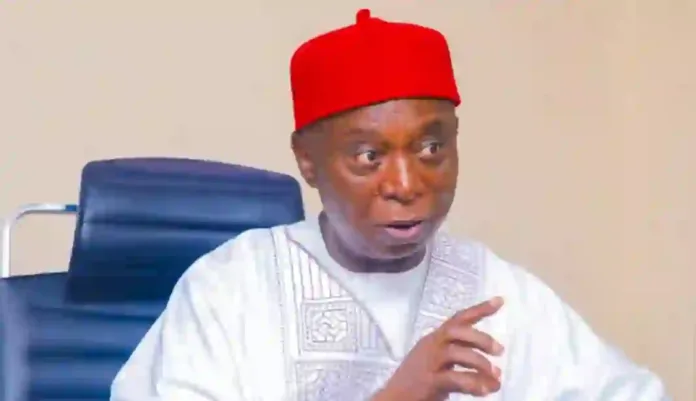
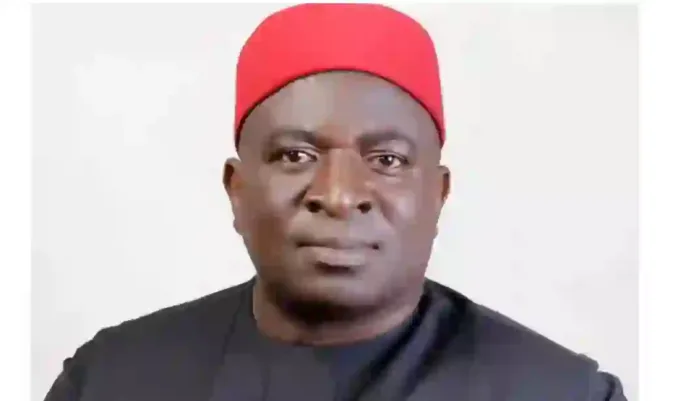
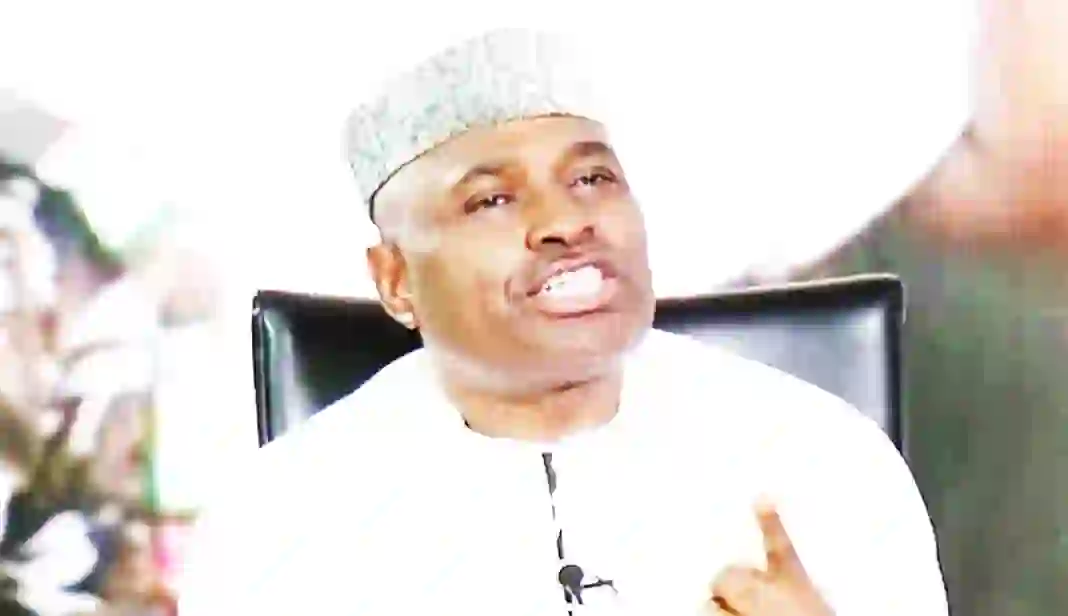
Nigeria’s Senate President, Godswill Akpabio has pleaded with the leadership of the ruling All Progressives Congress, APC to take a second look at the concern raised by some members of the National Assembly who lost in the just concluded primary elections.
According to Akpabio, some APC members in the Senate and House of Representatives who failed to secure their party’s nomination have developed “hypertention” over the issue, urging the party to take to consider those with genuine cases.
The former governor of Akwa Ibom state made the remark on Wednesday during the inauguration of APC National Campaign Council for the forthcoming Ekiti state governorship election.
The magazine reports that no fewer than 50 NASS members have failed APC nomination, and will no likely participate in the 2027 election under the APC banner.
Some lawmakers who lost during the primary elections, and are now at logger head with the party include the current Leader of the House of Representatives, Prof. Julius Ihonvbere , representing Owan Federal Constituency, Senator Representing delta North in the Senate, Ned Nwoko among others.
Akpabio, however, stated that situation could have been different if the losers did their home work thoroughly before going into the primaries, saying it’s not the fault of the APC that they lost.
The APC has yet to release the final list of its candidates for next year’s election, even as some analysts insist that the party will likely tinker with the outcome of the primaries, with a view to slot in their proffered candidates ahead the election.
Akpabio stressed that the party to carry should carry the leadership of the National Assembly along before the final list is released.
The part should “Ensure that they are carrying all the National Assembly members along,“ Akapbio said, blaming state governors as reason why some of his colleagues failed to secure their return ticket to NASS, adding that President Bola Ahmed Tinubu also has the right to influence the selection of lawmakers coming into the Assembly next year.
“ And for the governors, yes, they say the assembly is going to be working with you. You have the absolute right to choose anybody you want.
“Then for the president of Nigeria, Asiwaju Bola Ahmed Tinubu GCFR he also has the right to give him imputs. But when anybody has lost the election on the ground, please don’t expect me, as chairman of the National Assembly, to come and plead with you to put the person. It simply means the person has lost,” he said.
Meanwhile, the Independent National Electoral Commission, INEC has notified political parties in the country that the commission will open, on June 26, the official portal for them to upload the list of their candidates for next year’s election.
You remain my friend, and nothing has changed in that regard.
However, I must confess that I am shocked by the game of deflection you appear to be playing. Kindly share the full message in issue and also point out specifically where I referred to His Excellency Peter Obi as a criminal.
Please also point out where I wrote that His Excellency Peter Obi asked me to pay a bribe of N10 million. I challenge you to reproduce any statement from me in which I made such an allegation. Equally, kindly identify where I referred to him as a criminal. If you cannot do either, then you should acknowledge that you are attributing to me words I never used.
I cannot be drawn into any cut-and-join narrative, particularly as His Excellency is already pursuing legal remedies in court. In Nigeria, even persons standing trial for armed robbery are presumed innocent until proven guilty by a competent court of law. That is a fundamental constitutional principle to which I fully subscribe.
Therefore, even if I had hired and paid you to appear on national television and call Peter Obi a criminal, would your professional training and responsibility as a lawyer permit you to do so without regard to the law and the consequences of such a statement?
Kenneth Okonkwo
I thought you said you had proof from me which justified your position. If that is the case, why are you now threatening to deploy information allegedly obtained while serving as Peter Obi’s spokesman? Public discourse should be based on facts and evidence, not threats or insinuations.
Blackmail is the weapon of the weak and the desperate; men and women of honour rely on facts, evidence, and the strength of their convictions. But perhaps this has become fashionable in our politics. After all, the Asiwaju-led Federal Government has demonstrated remarkable tolerance for political conversions and reinventions, as reflected in the appointment of individuals such as Reno Omokri and Femi Fani-Kayode to prominent public positions. So, I suppose anything is now possible in our political space.
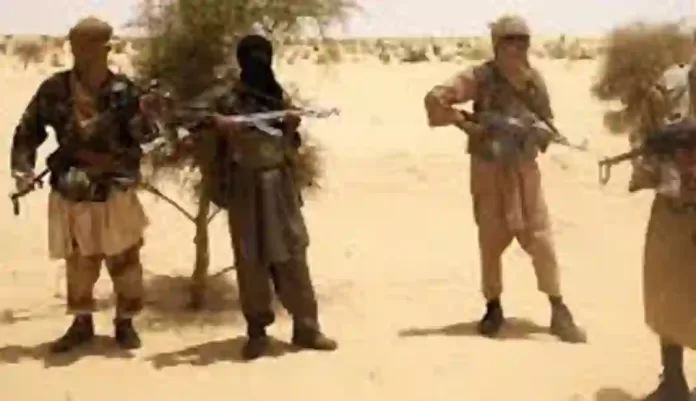
The Southern and Middle Belt Leaders Forum, SMBLF has called on the federal government to set up special court to try suspected terrorists, kidnappers and bandits in the country, saying this will ensure that criminals and non-state actors responsible for the current security problems face speedy trial.
The Forum also also condemned the current administration in the country for prioritizing the 2027 election above the protection of life and property, noting that the situation has plunged the country into chaos, poverty, insecurity and fear.
SMBLF made the admonition in In a statement signed by some of its leaders,including Oba Oladipo Olaitan Leader, Afenifere, Dr. Bitrus Pogu President, Middle Belt Forum, Worldwide and Ambassador Godknows Igali, National Chairman, PANDEF and Senator John Azuta-Mbata, President-General, Ohanaeze Ndigbo.
The call came amid recent upsurge of kidnapping and terrorism across the country, even as security agencies struggle to contain the problem.
Earlier in the week, suspected Boko haram terrorists attacked a military base in Borno state, killing soldiers and razing down the base.
The terrorists were also believed to be behind the abduction of score of children and students in Borno state and oyo states.
The government said it’s on top of the situation but not a few Nigerians have expressed serious concern that the terrorists have yet to be contained despite government repeated assurances.
According to the SMBLF, a swathe of territories in the country are currently under the control of the terrorists, a situation the leaders said have turned many Nigerians into Internally Displaced Persons, IDP in their country, adding that the insecurity situation has also prevented farmers from going to farm, saying this will worsen food shortages and poverty in the country.
“At the moment, large portions of Nigerian territory in the North West, Middle Belt and North East are now effectively under the control or influence of terrorists and bandits.
“Even in parts of the South West, several once-thriving communities have been deserted as frightened residents flee repeated attacks and kidnappings. Millions of Nigerians are now internally displaced persons (IDPs), living in hunger, uncertainty and trauma in camps or with relations in communities across the country,” SBMLF said.
Participants in the planned Kano mass wedding programme has been warned against embarking on any frivolous, and reckless divorce efforts.
Although, considered as their personal choices, the Kano state Shariah police, Hisbah Board, has however, insisted that intending couples in the forthcoming Kano State Government-sponsored mass wedding are to seek its input, and advisory before walking out of their marriages.
The Hisbah warning is coming against the backdrop of growing incidents of marriage break-up among couples in the recent past, a development which has resulted in an astronomical increase in the number of divorced women.
Speaking during an inspection visit to the Kano State Agency for the Control of AIDS, one of the pre-marital screening centres, the Commander-General of Hisbah, Sheikh Aminu Ibrahim Daurawa, maintained that beneficiaries of the mass wedding programme must inform the Board before any divorce.
According to him, the Kano State Government which invested heavily in the marriage programme, as part of its corporate social responsibility, is, in turn, expecting the unions to not only endure, but serve as good reference points.
The Hisbah boss emphasized that the Commission has established enough internal mechanisms for conflict resolution which intending couples must explore before going for the divorce option.
“We don’t encourage any frivolous divorce. Any couples who want divorce for any reasons, must approach Hisbah since this were the marriages it contracted.
“We have a reconciliation Committee in place, which job is to sit down with couples, and try to amicably resolve issues, before the divorce option is considered”, Daurawa maintained.
According to him, the measure is aimed at both protecting marriages, as well as the huge investment being made to actualise the unions by the state Government.
He cautioned against abusing or undermining the good intentions behind Governor Abba Kabiru Yusuf’s decision to ameliorate the difficulties the less privileged pass through in their bid to get married.
“Some people sell their land, motorcycles, and even take loans in their bid to get married.
“But the Governor, in his wisdom and rare display of compassion has decided to sponsor 1,500 couples .
“Under the initiative, the State Government will provide furniture, wedding boxes, clothings, food items etc with each couple receiving cash gift of N200,000 representing money for the payment of dowry ,and business start-up.
“This is an investment of over N 250,000 per couple”, the Hisbah Commander-General noted .
Over ,3000 persons are currently being screened by relevant agencies to ascertain their health status before the mass wedding programme.
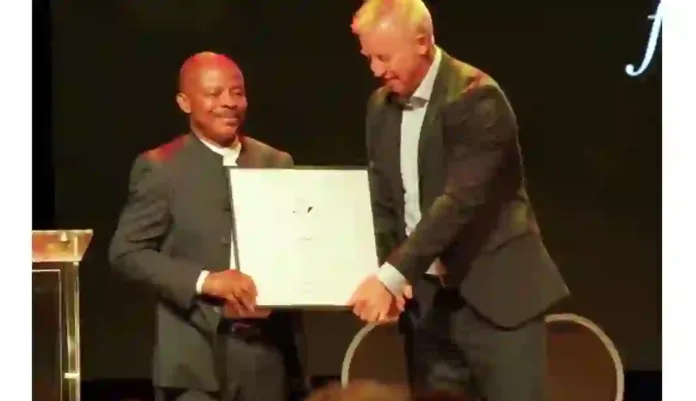
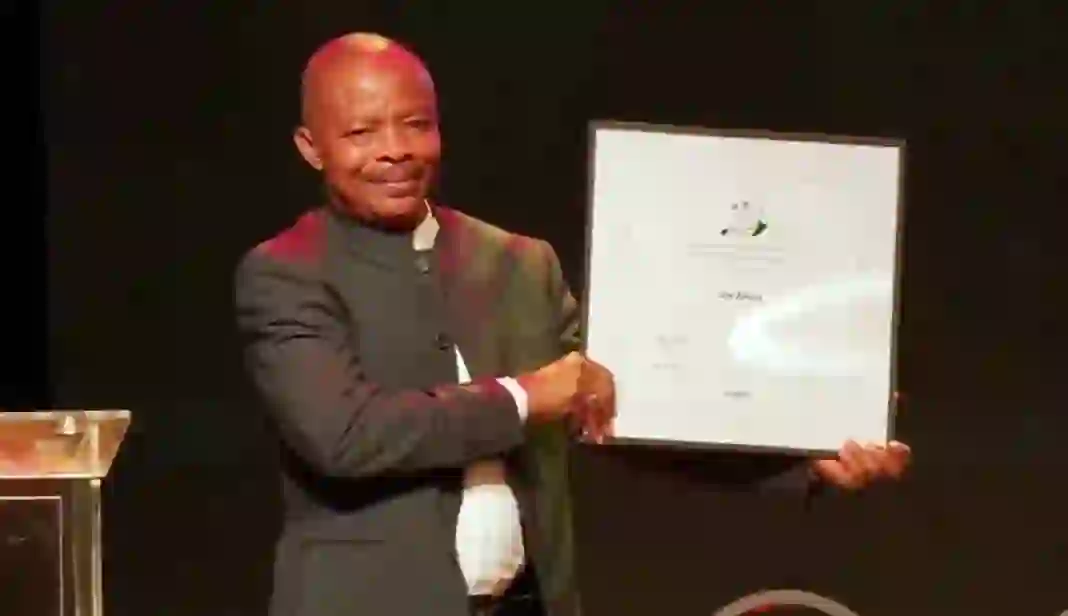
Arthur Svensson International Prize Award Presented to Comrade President Joe Ajaero in Oslo, Norway.
On Wednesday, June 10, 2026, Comrade Joe Ajaero, President, Nigeria Labour Congress, NLC, stood tall in Oslo, Norway, even as he was weighed down by the burdens of Nigerian Workers and the underprivileged, when he was given the prestigious Arthur Svensson International Award which proud 2026 Recipient he is.
Following is the emotional and gripping speech he delivered to the high profile international attendees, all of whom were wrapped in absolute silence by its contents, and brilliant delivery.
“That teacher who was kidnapped and beheaded in Oyo Forest and all the children in terrorists’ captivity with their teachers! We carry their blood, their sweat, their unbroken spirit to Oslo tonight”
Protocols!
Your Excellencies, comrades of the global working class, trustees of the Arthur Svensson Foundation, leaders of the Norwegian labour movement, leaders of Stryk, sisters and brothers especially comrade Alex Yarashuk!
I stand before you today not as a man, but as a symbol, a true symbol of millions of Nigerian workers who wake up every morning not just to the smell of tear gas, the sound of sirens, and the cold silence of a state that preys on its own people but who go to work hungry and come back hungrier more emasculated than before they left for work.
I receive this Arthur Svensson International Award; not as a trophy, not as a ribbon to hang on a lapel. Not at all. I receive it as a weapon, a weapon forged in the memory of a great Norwegian militant, Arthur Svensson, a man who knew that trade union rights are human rights, and that international solidarity is the only shield against the whip of rampaging multinational capital.
Arthur Svensson International Prize Award Presented to Comrade President Joe Ajaero in Oslo, Norway.
Let me sound it clearly and let it echo in every corner of this hall and across the Boardrooms in the world; the ruling class does not give you freedom. You take it; bloody-knuckled, with your lungs full of tear gas and your heart full of rage. At the back of our mind remains the cries and the pains of oppressed Nigerian workers.
I want to thank the Arthur Svensson Foundation from the depths of my scarred lungs. Thank you for your thoughtfulness! Thank you for refusing to look away from the Global South! In a world where capital moves at the speed of light while workers crawl under the weight of debt, you have chosen to spotlight those who fight in the trenches in the forgotten corners of the world. You have reminded us that the international working class is not a metaphor; it is a family. And tonight, that family has wrapped its arms around Nigeria. And, we can feel the warmth! To say I am deeply honoured is to put it lightly.
However, let me be honest with you, comrades, I had no idea that the Trustees of the Arthur Svensson Foundation were taking note of what was happening in Nigeria.
In Nigeria today, to defend a living wage is to become a target of the state. To demand that a worker should not die of hunger in a country swimming in crude oil is to be labelled an enemy of the state. I and my comrades, have been arrested like common criminals. I have been dragged before state agencies for questioning on trumped-up charges; charges of terrorism financing, Cybercrime, criminal conspiracy, Subversion and treasonable felony, of all things! Me, a trade unionist, financing terror? No! The only terror we finance is the terror that grips the heart of every exploiter when workers unite.
Our journey since 2023 has been harrowing; my home in Lagos was visited by unknown fire which razed the building down with all my personal belongings; I was abducted, detained and brutalized by the government for insisting on the implementation of an agreement that protects the rights of workers; I was harassed and arrested while on my way to Britain to attend a TUC UK conference to stop me from telling the world what we were going through in Nigeria; I have been invited for questioning repeatedly and just few weeks back, I was once again an unwilling guest of the nation’s secret Police and I have been placed on constant surveillance both passively and electronically sometimes trailed by unknown vehicles whose motives were clearly not charitable.
Our picket lines have been broken by security forces armed to the teeth. Our offices were raided on the 7th of August, 2024 while a detachment of security personnel was left to occupy our national secretariat forcing an evacuation of the offices by staff members. Our members have been sacked for demanding a minimum wage in the midst of hyperinflation. I have been detained illegally, questioned for hours, threatened in dark rooms; all because we refused to bow, because we refused to tell Nigerian workers that their suffering is normal. They have the jails, the guns, and the instruments of fear. However, we have the power; the power to stop the world, because we move the world. We create wealth! We are workers!
Yet, here I stand and not because I am strong! But because the working class is invincible walking and working together. Every time they silence one voice, ten thousand rise. Every time they tear down a picket line, two more appear. That is the law of labour. That is the dialectic of struggle. Arthur Svensson understood this. He stood against fascism, against capital’s exploitation, against the lie that workers are replaceable. Tonight, we say to the oppressors; you have not silenced us. You have only deepened and sharpened our resolve.
This award is not an end, it is a launchpad. It tells every driver, every teacher, every health worker, every woman selling tomatoes by the roadside under the scorching sun; your suffering is not in vain and can never be mute. Your resistance is not invisible. The world is watching. And more than watching, the world is ready to act in solidarity.
Let me be clear to the multinational corporations sucking the blood of our export processing zones, to the International Monetary Fund and World Bank whose loans are chains, to the Nigerian politicians already scheming for 2027, Nigerian workers are watching. Accolades do not pacify us but, they propel us. This award is not water on the flames; it is fuel for the fire.
We accept this honour on behalf of every Nigerian worker who has been tear-gassed, every union activist who has been victimised, every Nigerian worker who becomes poorer the more he works; every mother who has fought for her child’s future in a factory with no union. That teacher who was kidnapped and beheaded in Oyo Forest and all the children in terrorists’ captivity with their teachers! We carry their blood, their sweat, their unbroken spirit to Oslo tonight.
And we leave here with a promise; We will not rest; the Nigeria Labour Congress will not rest. We will deepen our organising among informal economy workers, platform economy workers, and the unemployed. We will resist every anti-labour law. We will expose every violation of ILO conventions. And we will win; because history is on our side.
As Marx said, the emancipation of the working class must be the act of the workers themselves. So let us go back to our picket lines, our factories, our streets. Let us organise. Let us struggle. Let us win.
Comrades, the struggle continues; and now, it continues with a new weapon; the Arthur Svensson Award in one hand, and the unbreakable solidarity of the global working class in the other.
In struggle, we trust. In solidarity, we conquer. Dare to struggle! Dare to win!
“OUR BLOOD IS NOT WATER: IT IS THE SEED OF A NEW WORLD”
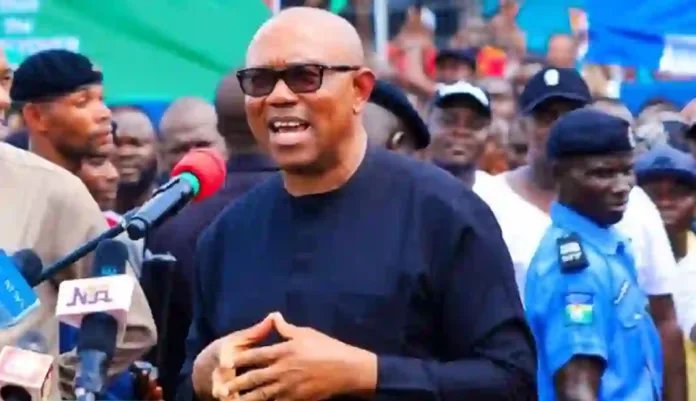
The Presidential Candidate of the Nigeria Democratic Congress (NDC), Mr Peter Obi, has again decried the deteriorating security situation in the country, describing as sad the fact that Nigerian school-children are being turned into pawns in the emerging deadly ransom economy created by bandits.
Obi commented in reaction to the attack, Wednesday, on a school in Kogi State by bandits during which the Vice Principal and three others, a six-year old boy included, were killed.
Lamenting the situation on his X handle same Wednesday, the former Anambra State Governor said, “It’s heartbreaking to report yet another bandit attack in a school, three weeks after over 40 school children and their teachers are still languishing in the forest.
“The security situation in Kogi State shows a brutal bandit attack at the Government Secondary School, Iluke (Kabba-Bunu LGA). Armed bandits disguised in military uniforms invaded the school during an ongoing WAEC examination, killing the Vice Principal, Mr Gani Anifowose, two others and attempting a mass abduction of students.
Reports on the ground indicate that some local security forces and vigilantes actively pushed back and frustrated their abduction attempts.
“Making educational institutions a soft target is a direct assault on the nation’s future. It creates a psychological barrier to school enrollment that worsens Nigeria’s out-of-school children crisis, disproportionately forcing young girls out of formal education permanently due to fear.
“There is nothing more heartbreaking for a nation than an inability to protect its children.
My heartfelt condolences go to the family of the Vice Principal who lost his life while gallantly defending children entrusted to his care. May God grant his soul eternal repose.”
The ambition of Ikenga Ugochinyere, the Honourable Member representing Ideato Federal Constituency of Imo state to become the Minority Leader of the House of Representatives has finally collapsed.
The collapse was not because of the weight of any rival contest, but to an affirmation of the House rule which effectively shut our first -timers from holding Principal Offices.
The Source reports that a document in circulation, Wednesday, June 3, 2026, had indicated that 61 out of the 81 opposition members of the green chamber of the National Assembly nominated and endorsed Ugochinyere as their choice for the vacant position of the Minority Leader.
His endorsement resulted from the vacuum created by the resignation of the erstwhile Minority Leader, Hon Kingsley Chinda, shortly after the announcement of his defection to the ruling All Progressive Congress, APC.
However, while raising a matter of privilege during plenary on Thursday, June 4, 2026, House Deputy spokesperson Hon Philip Agbese , representing Ado/Okpokwu/Ogbadibo Federal Constituency of Benue state denied appending his signature to the document purporting to have endorsed the Ugochinyere for the Minority Leadership position.
According to him, his signature was forged and applied for a purpose not originally meant for, insisting that he only became aware of the endorsement document when it surfaced online and filled the social media space.
Expectedly, the development triggered heavy uproar and sharp disagreement with Lawmakers loyal to the Ugochinyere project insisting that Hon Agbese, just like others, willingly signed up to the endorsement document.
Operating under the aegis of the ” G-60 members,the Minority Caucus, while calling on the leadership of the House to respect the expressed wishes of the overwhelming majority by avoiding the initiation of a fresh selection process for the vacant position of the Minority Leader, also, called for an official verification of the signatures contained in the endorsement document.
The Caucus emphasized that a transparent verification exercise will no doubt conclusively establish the authenticity or otherwise of the earlier nomination process that threw up Ugochinyere.
But at plenary on Wednesday June,10, the House considered and passed a resolution to the effect that only Lawmakers with the requisite “cognate legislative experience will be eligible to vie for, and occupy Principal Offices of the House.
The resolution followed the adoption of a motion sponsored by the Lawmaker representing Ikorodu Federal Constituency of Lagos State, Hon Babanimi Benson which sought to clarify Order 7, Rule 15 of the Standing Orders of the Legislative Body.
According to the order, only members of the House with cognate legislative experience as members (ranking members) shall be eligible for appointment as Principal Officers.
Presenting the motion entitled: “Need for a precise definition of Order Seven , Rule 15 of the Standing Orders of the House of Representatives”, Hon Benson argued that parliamentary tradition, globally, acknowledges and favours experienced Lawmakers for leadership positions.
Referencing the 10th Senate’s interpretation of “cognate legislative experience”, Hon Benson submitted that the law clearly refers to “Senators and House members who have completed, at least, one full term at the National Assembly.
The motion which was seconded by Hon Peter Uzokwe representing Nnewi North/ Nnewi South/ Ekwusigo Federal Constituency of Anambra State was, thereafter, adopted by the House, a development that effectively put paid to Ugochinyere’s ambition, being a first timer to the House.
The Chief Judge of the Federal High Court, Justice John Terhemba Tsoho has announced that Judges of the Court are expected to proceed on their 2026 yearly vacation from July 27.
The Chief Judge, who disclosed this on Wednesday in Abuja said that the vacation is pursuant to the provisions of Order 46, Rule 4 (d) of the Federal High Court (Civil Procedure) Rules 2019.
According to him, the vacation will commence from Monday, the 27th day of July 2026 and terminate on Friday, the 11th day of September, 2026 .
A statement by the Director of Information of the Court, Dr Catherine Oby Christopher on behalf of the Chief Judge, explained that the vacation is for the judges to have their rest and to prepare for the tasks and activities of the new legal year ahead.
The statement however hinted that during the vacation period, the Court will provide judicial services in urgent matters through designated Vacation Courts.
According to the statement, the Abuja, Lagos, Port Harcourt, and Enugu Judicial Divisions will be operational to entertain cases requiring immediate judicial attention.
It urged members of the public and legal practitioners to file and prosecute urgent matters only at the designated Vacation Courts closest to them.
The designated Vacation Judges are
Justices Joyce Abdulmalik and Obiora Egwuatu for Abuja Division.
Others are Justices Akintayo Aluko and Justice Ogazi F. Nkemakonam for Lagos Division, Justices P. M. Ayua and A. T. Mohammed for Port Harcourt Division, while the newly created Enugu Division has Justices F. O. G. Ogunbanjo and M. T. Segun-Bello as vacation Judges.
No fewer than three persons including the Vice Principal of Government Secondary School, Iluke Bunu, Mr Gani Anifowose, have reportedly been killed following the invasion and attack launched by suspected banditry elements.
Although the Police insist there is no conclusive evidence, some students, as well as several residents of the community were also said to have been abducted during the dawn attack on Wednesday June 10, 2026.
Eyewitness accounts informed that the terrorists had primarily targeted students currently sitting for the ongoing West African Senior School Certificate Examination, SSCE, with the UBE centre at which students from about three communities are said to be participating in the exercise the major focus.
“The major target of the attack was UBE Iluke Bunu where students from three communities were sitting for the SSCE examinations at the time of the invasion.
“The Vice Principal of Government Secondary School, Aharha-Bunu, Gani Anifowose, was killed alongside two others. Three students and several residents were abducted by the attackers”, a local witness volunteered
But the Kogi State Police Command, a statement from its spokesperson Saliu Oyiza, noted that preliminary findings indicated that there is, at the moment, no conclusive evidence of any mass abduction of students or residents.
However, the police said three persons , including the Vice Principal of UBE Secondary/primary School, Iluke Bunu, were killed by the suspected terrorists.
Other victims according to the police were 70-year old Sunday Jacob Alhassam, and 6-year old Sunday Ayele.
“At about 10,00 am, the Command received distress information that a large number of heavily armed bandits operatiing on about forty (40) motorcycles, had invaded Government Secondary School, Iluke Bunu, with the suspected intention of abducting students ,and other residents of the community.
“Upon receipt of the report, the Divisional police Officer, Kabba A’ Division, immediately activated a coordinated security response by mobilising personnel from the Division, alongside operatives of the Police Mobile Force and the Command’s Tactical Teams.
“Other security personnel already deployed in the area, including military personnel, and local vigilante groups, were equally alerted, and joined in the operation
“The combined security operatives engaged the hoodlums in a fierce gun duel, forcing the criminals to flee into the surrounding bushes”, Oyiza stated .
According to the Police, one of the terrorists was neutralized during the gun duel, and one of the security operatives who sustained gunshot injuries presently receiving medical attention.
The Police Spokesperson further informed that investigations are ongoing with a view to conclusively ascertain the actual circumstances surrounding the incident, as well as apprehend the perpetrators.
The recent revelations surrounding the finances and operations of the South East Development Commission (SEDC) have generated understandable concern across the South-East and indeed among Nigerians who sincerely desire the rapid development of the region.
The establishment of the SEDC was widely welcomed as a significant intervention by the administration of President Bola Ahmed Tinubu. For many years, stakeholders across the South-East had advocated for a dedicated development framework capable of addressing critical challenges in infrastructure, agriculture, education, healthcare, technology, job creation, and economic revitalization. The commission was therefore conceived as a vehicle for regional transformation, not merely another government agency.
It is against this backdrop that allegations of questionable expenditures, inadequate financial disclosures, and apparent inconsistencies in financial reporting have become deeply troubling. Every naira allocated to the commission represents an opportunity to build roads, support farmers, equip schools, expand ICT infrastructure, empower entrepreneurs, create jobs for young people, and stimulate economic growth. When billions of naira cannot be properly accounted for, it is not merely a financial issue; it is a development tragedy with direct consequences for millions of people.
The South-East cannot afford to lose another opportunity. The region possesses some of Nigeria’s most talented entrepreneurs, professionals, academics, and innovators. An intervention agency established to accelerate development must never be allowed to degenerate into a special-purpose vehicle for waste, mismanagement, or personal enrichment. Such an outcome would not only undermine public confidence but also weaken future advocacy for greater developmental support for the region.
The management and governing board of the commission must therefore accept full responsibility for providing transparent and verifiable explanations regarding every expenditure under their watch. Public institutions are custodians of public trust. Where questions arise, accountability is not optional; it is mandatory. The appropriate response is not defensiveness but openness, transparency, and cooperation with all legitimate oversight mechanisms.
Equally important is the role being played by the Senate Committee responsible for oversight. The public intervention by Senator Orji Uzor Kalu and members of the committee has brought important issues into the national conversation. Their insistence on clarity, accountability, and proper financial reporting reflects the essence of legislative oversight in a democratic society.
However, Nigerians and Ndigbo are watching carefully.
Citizens want to see a thorough, objective, and professional investigation that follows the facts wherever they may lead. They want to be assured that the current scrutiny is motivated solely by the public interest and not by any hidden agenda or competing interests. The credibility of the oversight process will ultimately be measured not by public outbursts but by concrete outcomes, transparent findings, and corrective actions.
So far, the committee has demonstrated a willingness to expose apparent irregularities and demand answers. That is commendable. But the task remains unfinished. The people expect the committee to pursue the matter to its logical conclusion, establish the truth, recommend appropriate sanctions where necessary, and strengthen safeguards against future abuse. If they do so, they will earn the respect and applause of Nigerians who believe that public service should be guided by integrity and accountability.
The South-East deserves development, not excuses. It deserves projects, not paperwork. It deserves measurable progress, not unexplained expenditures. Most importantly, it deserves leaders and institutions that recognize that every public fund entrusted to them belongs to the people and must be used exclusively for the people’s benefit.
This moment presents an opportunity for reform. Let there be a comprehensive audit. Let every questionable expenditure be explained. Let those responsible for any wrongdoing be held accountable. Let transparency replace suspicion and confidence replace doubt.
The future of the South-East is too important to be sacrificed on the altar of mismanagement. The people deserve better, and history will judge all those entrusted with this responsibility by whether they chose service over self-interest.
Elder Amah, a frequent commentator on current and national issues writes from Umuahia, Abia State