

Home Blog Page 1364

APC, PDP At Loggerheads Over Governor Adeleke’s N100bn Infrastructure Plan

0
Ademola Adeleke sworn in as Governor of Osun State

By Akinwale Kasali

The Osun State All Progressives Congress, APC and the Peoples Democratic Party, PDP are trading words over the unveiled plans of Governor Ademola Adeleke to spend a whopping N100 billion on infrastructural amenities across the state in the next 12 months.

The Governor had listed projects he plans to embark on to include five flyovers, 45-kilometer roads across the 30 local government areas, and rehabilitation of health centres and schools, in his one-year infrastructure plan for Osun.

Discrediting the plans of the PDP Governor, Osun APC Chairman, Tajudeen Lawal, described Adeleke’s plan as a “scam skilfully designed to enrich some economic buccaneers close to the government.”

Lawal said since Adeleke had declared that he would not borrow to finance the projects, the citizens deserve to know the source of the funding and the modality for its settlement.

The statement read in part: “Adeleke should tell the world the economic importance of the proposed construction of a flyover at Owode Ede if not only to serve his personal ego as a native of Ede.

“Is there any justification for the construction of five flyovers at this time in the history of the state when the state government under Governor Adeleke is yet to come up with its planned succour for the people of the state when some other state governments have been dolling out the second or third tranche of their government’s support for the governed?

“What sense is therein, for a government which is yet to make a pronouncement on the acceptable minimum wage for its workers as initiated by the federal government, to toy with the plans to build five flyovers in the state at a time?

“All concerned stakeholders in the Osun project should raise up their voice with a view to condemning the seemingly gang-raping of the economy of the state by some disgruntled elements who are parading themselves as political leaders in the state.”

Reacting to the submission of the APC, Osun PDP chairman, Sunday Bisi, described APC’s position on Adeleke’s infrastructural plan as an ill-intentioned one to a development agenda adjudged to be commendable, long overdue, sustainable for Osun’s economic revival.

Bisi noted that the Governor disclosed at the event that he created a project account into which savings from leakages, refunds, and infra-related interventions were being lodged.

The PDP Chairman’s statement further read: “Reading through the APC statement, we see a party that is in bewilderment and severe pain at the ingenuity, innovation, and financial engineering of the Adeleke governorship.

“The PDP government inherited a state with over 95 infrastructural deficits as of November 2022. Our internal state infra audit when PDP took over revealed that the infrastructural decay cut across all sectors education, health, roads, and water among others. We then developed an initial emergency plan that led to the complete renovation of 31 schools, 45 kilometers of roads, 332 functioning boreholes, the commencement of rehabilitation of water works, rewarding intervention in the health sector, and major actions on such roads as Osogbo-Ikirun and the Osogbo ring road among others.

“We call on the APC to read the full speech of Mr. Governor in which he spelt out the strategies, the projects, the funding plans, and sources of such funding. The APC should get educated that not all Governors are interested in diverting public funds as was the practice when the opposition holds sway.”

Obaseki Says Incoming Administration In Edo Will Not Inherit Uncompleted Projects

0

By Ayodele Oni

Edo State Governor, Godwin Obaseki, has assured that his administration will not leave any uncompleted project for the incoming administration.

The governor spoke when he inspected the ongoing renovation of the Stella Obasanjo Hospital, the Edo School of Health Technology, and the Palm House, all in Benin City, the State capital.

The governor, who was in the company of members of the State Executive Council (EXCO), assured speedy completion of the projects and all other ongoing projects in the State.

Speaking to journalists after the inspection tour, Obaseki said, “The whole idea is that as part of our finishing well agenda, we want to make sure that every project we started as a government is completed. So, we wanted to see the status of these projects under construction.”

At Stella Obasanjo Hospital, the governor expressed satisfaction with the level of work done, adding that the facility would be ready for use in no distant time.

According to him, “You saw that we have finished with the Out-patient Department and work is in full gear to complete the in-patient ward and the emergency section.

“The whole idea is that, having brought down the Central Hospital, we now have a network of Primary Health Centres (PHCs) and the Edo Specialist Hospital. You now have this comprehensive health hub that would compete with international hospitals with up to 12 specializations.”

He explained that his government took a deliberate step to revamp the School of Health Technology having met it in a state of disrepair.

“You know I visited here several months ago and you could hardly believe the state of the school. For any government that wants to render services to the people, the foundation of any health care system is the primary health care system.

“That is the school that trains and equips manpower to support and service the health care system.

“We have six specializations, and at any point in time, we would be able to cater for over a thousand students or five hundred for each stream.

“I am pleased with the progress of work done so far. As I promised, before the middle of next year, these projects would have been delivered.”

Obaseki also inspected the Palm House Benin, which is the last project among the series of projects that have been completed at the Secretariat Complex along Benin- Sapele Road, noting that the upgrade was a total overhaul from its former state of disrepair.

War On Terror: Turkish-Made Attack Helicopters Arrive In ‘Few Weeks’-Minister

0

Mohammed Bdaru, the Minister of Defence has disclosed that efforts are ongoing to ramp up the war against terrorism and banditry with the delivery of two Turkish-made attack helicopters in a few days.

According to the minister, the helicopters are part of the six fighter air platforms ordered from the President Edogan-led country.

The development comes two months after a NAF helicopter on a mission crashed in Niger state killing some top military officers.

The remaining four helicopters are expected to be delivered before the second quarter of 2024, the minister said in  a statement.

The minister and the Chief of Air Staff, Air Marshal Hassan Abubakar are currently in Ankara, the country’s capital to facilitate a speedy delivery of the T-129 ATAK NAF, according to a statement released on Sunday by NAF Director, Public Relations and Information, Commodore Edward Gabkwet

The statement stressed that the federal government procured six units of T-129 ATAK helicopters from the Turkish Aerospace Industry.

The minister further stated that efforts are ongoing to collaborate with some Turkiye defence industries which he described as among the best in the world, to strengthen ties with the two countries.

The delegation also met with Turkiye Minister of Defence retired Lt.-Gen Yasar Guler, in other to foster bilateral and defence cooperation, the statement said.

The statement said, “These companies are among highly-rated global defence companies renowned for the production of quality defence and military equipment.

“While at these companies, the minister of defence called for improved synergy between the companies and Nigeria through the transfer of defence technology to Nigeria.’’

Meanwhile, Defence analysts insist that the federal government is in a hurry to acquire more air-fighting platforms due to the loss of some fighter jets and helicopters in the war against Boko haram and bandits in Northern Nigeria.

Two months ago, a Nigerian Air Force MI-171 Helicopter on a casualty evacuation mission crashed near Chukuba Village in Niger State killing some top military personnel.

FCT: We Agreed With Minister On Salary Cut; We Love Him-Workers

1
Nyesom Wike

Federal Capital Territory, FCT, workers under the aegis of the Joint Unions Action Committee, JUAC, says it has no problems with Nyesom Wike, the nation’s capital Minister over the cut in salary.

The union’s president, Mutilukuro Oluwakorede in his reaction to reports on social media that the workers are groaning due to the cut in their salaries by the minister, said the report is untrue.

Oluwakorede said the workers “love our ministers” adding that the decision to cut the workers’ allowance was an agreement between them and the minister after considering the financial situation of the FCT.

He urged Nigerians to disregard the report as a rumour from peddlers of falsehood.

According to him, “The public should disregard the information in circulation. it is not emanating from us. We have an internal issue; we had a meeting and agreed on the best way to manage the issue.

“We have nothing to do with what is trending online currently.

“We love our minister. We don’t have any issue against him as at this moment that I am talking to you, and I wish to be quoted anywhere.”

The union agreed to a salary cut, he stated.

“We realised that the little fund remaining may affect peculiar allowance, and we say we don’t mind stepping it down by one month, while the FCT Administration does the needful against the remaining months.

“So that by November, we return to normalcy. So, I don’t know why journalists are just cashing out on this.

“But I wish to say unequivocally, that we don’t have any problem with our distinguished honourable minister or the minister of state or even the permanent secretary of FCTA.

“We are in good relationship and this decision that we have taken, is for the best interest of staff generally,” the president said.

The union had on Friday issued a circular intimating their members on salary shortfall for October.

Rivers: Group Cautions Against Move To Cause Disaffection Between Gov Fubara, Wike

1

By Ayodele Oni

Feelers from Rivers State indicate that things are falling apart between Governor Siminalayi Fubara and his predecessor, Nyesome Wike, now Minister for the Federal Capital Territory (FCT).

Reasons for this, and to what extent, still remain sketchy but a group known as Rivers in Diaspora, a collective of concerned indigenes of Rivers State residing abroad, has raised alarm over what it described as “the sinister plan by some unscrupulous elements to cause disaffection between the incumbent Governor and his mentor.”

According to the group, it has received information from sources about how the concerned individuals, both within and outside the government of Rivers State, are conspiring to create political turmoil within the state.

In a statement, the group alleged that the sinister agenda is to sow discord between  Governor Fubara, and his mentor, Barrister Wike.

It reads:”We want to emphasize that this intelligence comes from credible sources. Their ultimate aim appears to be the initiation of impeachment proceedings against the Governor.

“Additionally, we have learnt that these conspirators are actively attempting to sway members of the State House of Assembly to support their nefarious objectives.

“Let it be known unequivocally that any endeavour to divert Governor Fubara from his unwavering commitment to good governance in Rivers State will encounter formidable legal opposition.

“We are also prepared to mobilize peaceful protests of unprecedented magnitude, setting a new standard for opposition resistance in Nigeria.

“We have previously advocated for the Niger Delta Agitators, as we recognize their legitimate demands for what rightfully belongs to them.

“If these subversive actions persist, we may have no choice but to engage our fellow Niger Delta brothers and sisters to put an end to the injustices being perpetrated in our state.

“To our dear Governor, we urge you to press forward with your remarkable efforts in the service of Rivers State. Rest assured that Rivers people, both at home and abroad, will not idly standby, while nefarious forces seek to undermine our progress.

“We extend our gratitude to everyone who has supported the cause of justice and equity in Rivers State.”

Ohinoyi Ado Ibrahim, Joins Ancestors, President Tinubu Condoles Ebiras

0

By Ayodele Oni

First class and high ranking monarch at Ebiraland in Kogi state has joined his ancestors.

The demise of Ohinoyi, Ado Ibrahim, whose death was announced on Sunday, has thrown the entire Ebiraland into mourning.

The Ebira community is enveloped in sorrow with the passing of Dr. Ado Ibrahim, the esteemed Ohinoyi, who left behind a legacy of wisdom and leadership deeply ingrained in Ebira culture.

Dr. Ado Ibrahim, born on February 7, 1929, was the fourth traditional ruler and the current Ohinoyi of Ebiraland, a traditional state with headquarter in Okene, Middle Belt, Nigeria.

He was the son of the second Attah now “Ohinoyi” of Ebiraland, Ibrahim Onoruoyiza, from the Omadivi clan, who reigned from 1917 to 1954.

In 1997, after the passing of Ohinoyi Sanni Omolori of the Oziada clan, AbdulRahman Ado Ibrahim, a Lagos-based entrepreneur and the son of the second paramount ruler of Ebiraland, ascended the Okene throne as the second Ohinoyi or the fourth independent traditional ruler of Ebiraland on June 2, 1997.

Throughout his reign, Ibrahim was known for his significant contributions, including the construction of the magnificent Azad Palace, named after one of his sons, which is regarded as one of the most beautiful palaces in West Africa.

He had on occasions had bruises with the state government over handling of some issues. He once refused to attend a reception for the visiting former President Mohammadu Buhari because he was not properly invited.

President Bola Tinubu in a condolence message, described the Monarch’s death as painful.

In a message by the presidential spokesman, Ajuri Ngelale, the President described the late monarch as peace-loving, affable, and cerebral.

“The Ohinoyi of Ebiraland was in a class of his own. He was highly respected and admired for his deep insights, wisdom, and sophistication. He had a masterful way of handling issues. He was very knowledgeable and wise.

“May Almighty Allah grant His Majesty Aljannah Firdaus,” the President prayed.

President Tinubu asked the good people of Kogi State to take solace in the legacy of peace and fellowship left behind by the late monarch.

Imo vs NLC: Ajaero Prepares For Show Down

0
Hope Uzodimma and Joe Ajaero

President of the Nigerian Labour Congress, NLC, Joe Ajaero has promised to lead its members on showdown with the Imo State government on November 1, due to alleged unfriendly workers policies by the government.

Among others complaints against the Governor Hope Uzodinma-led state government, the labour leader said the rights of workers in the state are being seriously violated.

Ajaero who briefed journalists in Abuja on Sunday, lamented the grouses with the state government to include; outstanding salary arrears of about 20 months, unjust declaration of workers as ghost workers, declaration of pensioners as ghost workers and unsettled gratuity arrears, among others.

He accused the state government of refusing to implement the January 9, 2021, agreement reached with the NLC, adding that many workers have died due to the neglect of their welfare.

He said approximately 10,000 pensioners have been wrongly labelled as ghost pensioners resulting in over 22 months of unpaid pensions while about 11,000 workers have been branded by the Imo State Government as ghost workers.

He also accused the state government of non-compliance with the national minimum wage and the refusal of Governor Uzodinma to use social dialogue in resolving labour-related matters.

Meanwhile, the NLC said no court order would stop the union from proceeding with the protest next Wednesday.

Instructively, this is not the first time the NLC and state government will be engaged in a spat. In May this year, the union shut down the state in a protest after Governor Uzodinwa allegedly failed to see the NLC president after spending five days in the state.

Nigeria’s Judicial System Has Been Wrecked

1

By Datijo Muhammad, JSC

Full text of the speech delivered BY Hon. Justice Musa Dattijo Muhammad, JSC, CFR, at the Valedictory Session held in his honour at the Supreme Court of Nigeria, Abuja, on Friday, the 27th day of October, 2023

My lord, the Honourable Chief Justice of Nigeria Olukayode Ariwoola GCON permit me to adopt and rely on the protocols you earlier established at this event.

With your leave having been sought and obtained, let me outrightly make one confession to this distinguished audience.

Initially it was not my desire that a Valedictory be held to mark my exit from the nation’s Judiciary. I had wanted to leave quietly on attaining 70 years from which age our Constitution prescribes a Judicial Officer shall cease to be one.

Why, then, the subsequent reconsideration and the fact of today’s event? This is indeed a pertinent and legitimate question to ask.

It was my view that Valedictory Sessions only provide honorees the platforms to tell their stories and, informed by experience in the course of service, make suggestions as to how to improve the institutions they had served.

I was, however, unable to appreciate the extent to which previous suggestions had been exploited to effect the desired reforms.

Members of my family and close friends prevailed upon me to reconsider my position. They insisted that it is defeatist to allow failure in utilizing suggestions proffered on previous occasions to deter subsequent contributions. The quest for institutional improvement, particularly in the Judiciary, they insisted, must, rather, be intensified to avoid hastening the demise of our society. A society, they significantly reasoned, rots too easily when institutional defects are ignored. I capitulated, and thus the unfolding event today.

I am also here to say goodbye, particularly to the attendees of today’s event, the public, and indeed the country at large for giving me the privilege and honour of serving the Judiciary for 47 years. The Valedictory, again, is a thanksgiving exercise for the good health one enjoyed in the course of service. Glory be to the Almighty Allah the Lord of the universe.

Because I would eventually write a book to tell my story, including the experience gathered while serving in the Judiciary, it is incumbent to be very brief in my address this morning.

Appreciable efforts have been made by earlier speakers in telling you who I am. May it please you to hear it from the horse’s mouth!

I was born and bred in Limawa, a ward in Minna, now the capital of Niger State, then, in 1953, a relatively small and quiet provincial headquarters. I was named after my paternal grandfather, like his deceased siblings, who would also die if they went back home to Kumurya.

Hafsatu remarried subsequently and had a daughter, Gogo Saidatu, Kumurya’s uterine sister. Not quite long, she lost her second husband. Incessant pressure from Musa’s uncles back in Kumurya made her to relocate to Paiko and hence to Minna. Musa, then a young man, joined the labour force engaged in the construction of the rail line passing through the town to Baro, a nearby village, as well as southward to Lagos.

With the successful completion of the construction of the rail line, Musa Kumurya settled in Minna into the grain trade. He married Hadiza, a young Hausa lady from Tawa in the Niger Republic. They were qblessed with three children. My father, Muhammad Najume, the second male child, was the youngest. Usman and Aishatu were his seniors.

My maternal grandparents were of the Fulani stock that accompanied the Dan Fodio Jihadists to Nupe land.

Muhammadu Maigari was my maternal grandfather. Rukayya, Inna Lalemi, his wife, gave birth to two children: Abdullahi and Aishatu Baiwa, my mother. Dr.Mahmud Tabo Minna, of blessed memory, was their sibling from a different mother. Fatima, Halima, and Abdullahi, are my much younger aunties and uncle from my grandfather’s fourth wife. My mother and these three are still alive.

Muhammadu Maigari was learned in the Shari’a and served as a Judge of that Court for many years before he retired. Mallam, what we called him, was a very stern and incorruptible Judge. I was his first grandchild whom he adored, trained, cherished and jealously protected.

Inna Lalemi worked as the head cook, the uwar tuwo, in the Local Authority Primary School I attended in Minna. She was a very hardworking, resourceful, patient, affectionate, and extremely kind lady.I shall return to these themes Insha Allah, in my book.

I graduated from Ahmadu Bello University in June 1976 with an LLB (Hons) and two weeks, thereafter, was employed as a Registrar on grade level 8 step Il in the Niger State High Court. I became the Chief Registrar of the Court in 1986. I was appointed a Judge of the Court the next year along with Honourable Justices Fati Lami Abubakar, Dalhatu Adamu, and Sadeeq Abubakar Abuja. My lord Fati Lami Abubakar has remained a true sister in every sense of the word including supporting my marriage to Rabi, the junior sister she brought up. We lost their lordships Dalhatu Adamu and Sadeeq Abubakar Abuja, the former while serving at the Court of Appeal where, at one time, he rose to become the Acting President of the Court. My lord Sadeeq Abubakar Abuja died not quite long after I had been elevated, along with twenty-four others, to the Court of Appeal in 1998. We were tagged the “Rushians” by our seniors in the Court.

Out of the lot, by Allah’s grace, nine, including my humble self, made it to the Supreme Court. I was elevated to the Supreme Court in July 2012.

Through the years, I rose to become the second most senior Justice of the country’s apex Court and Deputy Chairperson of the National Judicial Council.

Considering the number of years I have spent in Judicial Service and the position I have attained by the grace of the Almighty, I feel obligated to continue the struggle for reforms for a better Judiciary and would be leaning on the earlier submissions of those who had exited before me.

Now, how has the Judiciary fared in the course of my journey? The journey was calm and fulfilling until about halfway through my Supreme Court years when the punctuating turbulent cracks made it awry and askew.

The powers of the Chief Justice of Nigeria and the Depleting Number of Justices at the Supreme Court.

As presently structured, the CJN is Chairman of the National Judicial Council NJC which oversees both the appointment and discipline of Judges, he is equally Chair of the Federal Judicial Service Commission (FJSC), the National Judicial Institute (NJI) the Legal Practitioners Privileges Committee (LPPC) that appoints Senior Advocates of Nigeria. In my considered opinion the oversight functions of these bodies should not rest on an individual alone. A person with absolute powers, it is said, corrupts easily and absolutely.

As Chair of NJC, FJSC, NJI, and LPPC, appointments as Council, Board, and Committee members are at his pleasure. He neither confers with fellow Justices qnor seeks their counsel or input on any matter related to these bodies. He has both the final and the only say.

The CJN has the power to appoint 80 percent of members of the council and 60 percent of members of FJSC. The same applies to NJI and LPPC. Such enormous powers are effortlessly abused. This needs to change. Continued denial of the existence of this threatening anomaly weakens effective Judicial oversight in the country.

By the provision of Paragraph 20 of Part One of the Third Schedule to the 1999 Constitution of the Federal Republic of Nigeria, as amended, the NJC shall comprise the following members: the Chief Justice of Nigeria, who shall be the Chairman; the next most senior Justice of the Supreme Court who shall be the Deputy Chairman.

Regrettably, the next most senior Justice of the Supreme Court like Deputy Governors of State, shorn of any official function except at the pleasure of the Governor, is neither consulted on anything, nor does he have any official function. His job as No. 2 is purely as the CJN pleases. It is incumbent that the system provides for more inclusion and consultation among the stakeholders.

The conversation about the diminishing number of Justices at the Supreme Court has become a refrain. As I bow out today, the number is further reduced to 10 against the Constitutional requirement of 21 Justices. That this avoidable depletion has affected and will further affect the Court and litigants is stating the obvious.

We are in an election season where the Election Tribunals and Appellate Courts are inundated with all manner of petitions and appeals. The Supreme Court is the final Court in the Presidential, Governorship, and National Assembly election appeals. Yet, there are only 10 justices left to determine these matters.

Constitutionally, each of these appeals requires a panel of seven justices to sit on them. When a panel of seven Justices is constituted to sit on a particular appeal, only three justices are left out. Even when regular appeals are being heard in the Supreme Court, a panel of five justices is required to sit.

We must not forget that the Court, being the highest in the land, receives all manner of appeals from the Court below. Presently, there is neither limit nor distinction to the manner of appeals that come to the apex court.

Again, beside election matters which are seasonal, the Supreme Court’s docket is overflowing with civil and criminal appeals, some of which took many years to arrive. Most of these are still pending. Several have not even been assigned hearing dates. The court also exercises original jurisdiction.

As the Justices who hear these matters are grossly overstretched, unable to meet the demands of their onerous assignment, the litigants who approach the court seeking justice are left in limbo; waiting endlessly for justice to be served. These, as I have said before, are avoidable.

When I exit today, the North Central zone that I represent ceases to have any representation until such a time new appointments are made. My lord Hon. Justice Ejembi Eko JSC who also represented the zone retired on the 23rd of May, 2022. It has been a year and five months now. There has not been any replacement.

With the passing of my lord, Hon. Justice Chima Centus Nweze, JSC, on 29th July 2023, the South East no longer has any presence at the Supreme Court. My lord, Hon. Justice Sylvester Nwali Ngwuta JSC died on 7th March 2021. There has not been any appointment in his stead for the South East.

To ensure justice and transparency in Presidential appeals from the lower court, all geo-political zones are required to participate in the hearing. It is, therefore, dangerous for democracy and equity for two entire regions to be left out in the decisions that will affect the generality of Nigerians. This is not what our laws envisage. Although it can be posited that no one expected the sudden passing of Hon. Justice Nweze JSC, yet, it has been two years and seven months since previous Justice from the South East died and no appointment was made. Ditto for the replacement of Justice Eko JSC of North central who exited nearly two years ago. Hon. Justice Sidi Bage JSC, now his Royal Highness the Emir of Lafia, from the North Central, had earlier voluntarily retired. He equally is yet to be replaced. Also, it was clear ab initio that I would be leaving the court this day on attaining the statutory age of 70. It is then not in doubt that there has been sufficient time for suitable replacements to have been appointed. This is yet to occur.

When on the 6th of November 2020 the Supreme Court, for the first time in its history, got a full complement of 21 justices with the swearing-in of eight Justices, little did anyone know that we were only a few steps to unimaginable retrogression. As it stands, only four geo-political regions – the South-west, South-South, North-West, and North-East are represented in the Supreme Court. While the South-South and North-East have two serving justices, the North-West and South-West are fully represented with three each. Appropriate steps could have been taken to fill outstanding vacancies in the apex court. Why have these steps not been timeously taken?

It is evident that the decision not to fill the vacancies in the court is deliberate. It is all about the absolute powers vested in the office of the Chief Justice of Nigeria and the responsible exercise of the same.

Funding and Independence of the Judiciary

Allusions have been made innumerable times about poor funding and how the judiciary has been emasculated by inadequate funding. My lord, the late Hon. Justice Mustapha Akanbi, CFR, a former President of the Court of Appeal in a publication titled “The Main Obstacles of Justice According to Law” said: “[A] good judgment flows from a mind that is not bogged by the thought of-where do I get my next meal? Or where do I get the money to pay my son’s school fees? Poor conditions of service, disturb the mind. It is an obstacle to clear and positive thinking…”(Underlining supplied for emphasis).

Beyond the issue of the salaries of Justices remaining static with no graduation for over 15 years now, it is instructive to enquire what the judiciary also does with its allocations. Who is responsible for the expenditure?

An unrelenting searchlight needs to be beamed to unravel how the sums are expended.

In 2015 when President Muhammadu Buhari became the president, the budgetary allocation to the judiciary was N70 billion. In the 2018 Appropriation Bill submitted to the National Assembly, the President allocated N100 billion to the judiciary.

The legislature increased it to N110 billion; N10 billion above the N100 billion appropriated for the 2017 fiscal year. At the end of President Buhari’s tenure in May 2023, the judiciary’s allocation had increased to N130 billion. That is an increase from N70 to N130 billion in 8 years. The present government has allocated an additional sum of N35 billion to the judiciary for the current financial year making the amount of money accessible by the judiciary to N165 billion. More than 85 percent of the amount appropriated by the 9th Assembly has so far been released to the judiciary. It is envisaged that the additional N35 billion will equally be released by the present government.

Notwithstanding the phenomenal increases in the sums appropriated and released to the judiciary, Justices’ and officers’ welfare and the quality of service the judiciary renders have continued to decline.

It may interest one to know that the Chief Registrar of the Supreme Court earns more than the Justices. While she earns N1.2m per month, Justices atake home N751,000 in a month. The CJN on his part takes home N400,000 plus. The salary of a Justice, curiously, drops rather than increases when he gets the added responsibility of being a CJN.

That the unjust and embarrassing salary difference between the justices and the Chief Registrar still abides remains intriguing to say the least. Valedictory session after valedictory session lapses and challenges that should be nipped are restated to no avail. Why the silence and seeming contentment?

The process of the appointment of Judges and quality of judgments of courts

A couple of years ago, appointment to the bench was strictly on merit. Sound knowledge of the law, integrity, honour, and hard work distinguished those who were elevated.

Lobbying was unheard of. I never lobbied, not at any stage of my career, to secure any appointment or elevation. As much as possible the most qualified men and women were appointed. That can no longer be said about appointments to the bench.

The Judiciary must be uniquely above board. Appointments should not be polluted by political, selfish, and sectional interests. The place of merit, it must be urged, cannot be over-emphasized.

Public perceptions of the Judiciary have over the years become witheringly scornful and monstrously critical. It has been in the public space that Court Officials and Judges are easily bribed by litigants to obviate delays and or obtain favourable judgments. His lordship Adefope-Okojie JCA,at the point of exiting, had enthused, inter-alia, thus:- “Pleas are expressed every day by the generality of the public begging the judiciary to be just to be truthful; and to save the country from collapse. My question is whether the judiciary needs to be begged or cajoled? What is it that qualifies any person to bear that exalted name ‘Honourable Justice? Is it not for him to administer justice without fear or favour?….. Unfortunately, it has been severely vilified, with the Apex Court so denigrated and called by a social commentator as a voter gaggle of useless, purchasable judicial bandits.

How did the judiciary get to this level? Why is the whole country on edge for fear of what the public regards as unpredictable judicial pronouncements? There must be a rethink and a hard reset. If the people we have sworn to defend have lost confidence, there is a problem that must be addressed.”(Underlining supplied for emphasis).

Recently, fresh allegations have been made that children and other relatives of serving and retired judges and justices are being appointed into judicial offices at the expense of more qualified candidates lacking in such privilege and backing.

It is asserted that the process of appointment to judicial positions is deliberately conducted to give undue advantage to the “children, spouses, and mistresses” of serving and retired judges and managers of judicial offices.

At the Court of Appeal, it is also asserted, that presiding Justices are now being appointed out of turn. And there is the further issue of the unpredictable nature of recent decisions of the courts as well.

A number of respected senior members of the bar inter alia, citing Ahmed Lawan, the former President of the Senate and the Imo Governorship appeals, claim that decisions of even the apex court have become unpredictable. It is difficult to understand how and where, by these decisions, the judicial pendulum swings. It was not so before, they contend.

In some quarters the view is strongly held that filth and intrigues characterize the institution these days! Judges are said to be comfortable in companies they never would have kept in the past. It is being insinuated that some judicial officers even campaign for the politicians. It cannot be more damnifying!

President Muhammadu Buhari in 2016 ordered the forceful entry into the houses and the arrest of justices some of whom were serving at the apex court. Not done, in 2019 the government accosted, arrested, and arraigned the incumbent Chief Justice before the Code of Conduct Tribunal for alleged underhand conduct. With his retirement apparently negotiated, he was eventually left off the hook.

In 2022 a letter signed by all the other justices of the Supreme Court, including the current Chief Justice, the aggrieved protested against the shabby treatment meted to them by the head of court and the Chief Registrar. At the centre of the friction was their welfare and the cavalier attitude of the Chief Registrar thereto. In the event, his lordship Ibrahim Tanko Muhammad disengaged ostensibly on grounds of ill health.

Now, it must be said, that Chief Femi Falana is right that the safeguard in our appointment procedures against judicial appointments for improper motives is increasingly being compromised.

Certainly, by Rule 8.3 of the Judicial Code of Conduct, “any judge who takes advantage of his judicial office for personal gain or for gain by his or her relative or relation abuses the power vested in him!!!

My lords, distinguished invitees, ladies and gentlemen, it is obvious that the judiciary I am exiting from is far from the one l voluntarily joined and desired to serve and be identified with. The institution has become something else.

What to do?

Allow me at this point in time to recall that the 1999 Constitution as amended allows each and every one of us the freedom of choosing his religion, the company he keeps, and what to say. I am sure we all know where these rights abate and where the rights the very same Constitution grants others take off.

I am a Muslim for whose conduct the Holy Quran in Chapter 4 (Nisa) Verse 135 provides:- “O you who believe! Stand out firmly for justice, as witnesses to Allah, even though it be against yourselves or your parents or your kin, be he rich or poor, Allah is a Better Protector to both (than you). So follow not the lusts (of your hearts) lest you may avoid justice, and if you distort your evidence or refuse to give it, verily Allah is ever well Acquainted with what you do.”

Chapter 9 (Tauba) verse 71 further requires that believers, both men and women, enjoin what is just and forbid what is evil.

In the A-Z of Qoutes I got stuck to this:-

“This is how a society goes down the drain really quickly first overlook evil, then it permits evil, then it legalizes evil, then it promotes evil, then it celebrates it, and then persecutes those that still call it evil.”

Lastly, Adam Grant’s words, in moments like this, are also instructively apposite:-

“When you follow a concept, consider what would lead you to withdraw your support. If the answer is nothing, your integrity is in jeopardy. Your highest loyalty belongs to principles, not concepts. No concept deserves unconditional love. Commitment is earned through character.”

My contribution towards reforming the judiciary is founded on the foregoing precepts.

Intrinsic in what I have said today are indices to dampen, nay eradicate, the lapses in the judiciary. The duty to revive the institution remains a collective one. We must persist. It suffices to have, for the purpose of this event, a respite at this point though.

My gratitude goes first to my creator for the opportunity, health, and strength of serving through the years.

Among those who contributed to the success of my career are, firstly, my maternal grandfather, Muhammad Maigari, Kokon Dere, my late father, Muhammad Najume, and my mother in that order. I lost the two men, not far in between, in 1982 and 1983 respectively. May Allah forgive their lapses and admit them to paradise. I cannot thank them enough.

Next are members of my immediate family comprising my three wives and ten surviving children, nine of whom, by Allah’s grace, are all graduates. Tani, as she is called, the Uwargarke, heads the house. Then come, Rabi, Kanwata, my sister, and Hadiza, Yar’auta, the last of them.

Our ten children are Abdullahi, an accountant, Aliyu an Estate Manager, Aishatu a Solicitor, Asmau, an Economist, Rukayya, an Information Technologist, Mubarak, a Business Administrator, Farida, an Architect, Fatima, another Solicitor, and Faruk, another Business Administrator. The last of them, Musa Dattijo Muhammad Jnr, now 51/2 years old, like his older siblings, Insha Allah, will be the tenth graduate.

May the Almighty Allah spare our lives to witness the event. We lost Nafisa, in 1996. She was the first of the children. But for her death, they would have been eleven!

I appreciate each and every one of them for their ceaseless love, care, and undying understanding.

I am indebted to the entire members of staff in my chambers: Leramo Emmanuel Gbadebo, Ornan K. Yawo, Alfred Benjamin, Ben Ina Ali, Umaru Abubakar Dikko, and Barr. Ahmed Auwal. I appreciate you all.

My lord the Honourable  Chief Justice and all my learned brothers I must register my indebtedness for the much each and every one of you taught me during my call of duty. May the Almighty Allah continue to guide, protect, and bless us all.

In the course of my over ten years stint at the apex court, we lost three of us: Hon. Justice Nwali Sylvester Ngwuta JSC, Hon. Justice Samuel Chukwudumebi Oseji JSC, and Hon. Justice Chima Centus Nweze JSC in that order. May their souls continue to rest in perfect peace.

Lastly, I am indeed overwhelmed by the number of persons who turned out to witness today’s event. I am short of words. May the Almighty Allah reward you all and guarantee your safe return to your respective destinations. I am done. Thank you for your time and patience.

Alhamdulillah!Alhamdulillah!!Alhamdulillah!!!

MUSA DATTIJO MUHAMMAD
JUSTICE, SUPREME COURT (RTD).

What APC Must Do To Retain Ondo State – Don, Says Money No Longer Determinant

0

By Ayodele Oni

As preparations for the 2024 Governorship Election in Ondo State get underway, a former Vice-chancellor, Oduduwa University, Ile-Ife, Prof Williams Olu-Aderounmu has advised the ruling All Progressives Congress (APC) to put its house in order as defeat beacons on the party.

The Don warned that APC might be on the verge of losing the position to the opposition party if they pick a wrong candidate as the party flagbearer.

Olu-Aderounmu who had once had a shot at the Governorship seat of the State, gave the warning in Akure weekend, while delivering a public lecture with the theme, ‘Ondo State and the dynamics of party politics’ organized by the Progressive stakeholders of APC.

He pointed out that the party needed to put in place definite-orientation Programmes to correct the value system that has been battered in recent times in the State.

Currently APC in the state is divided due to the absence of ailing Governor Oluwarotimi Akeredolu and this has also culminated in Impeachment move against the deputy governor Lucky Aiyedatiwa.

Going by the zoning arrangement, the next governor of the state is expected to come from the southern senatorial district, the home base of the deputy governor.

With the Independent National Electoral Commission (INEC) releasing time table for the election, aspirants have began to emerge from political parties.

Olu-Aderounmu said “Unless good materials are identified, selected and identified, whether they have money or not, APC will lose elections at all levels in the future.

“APC must as a matter of policy in picking Candidates for future elections look for people with integrity, community or local acceptability, education, good past records, popularity of candidates with the NLC, Teachers, Civil servants, Students and Market women. Relying only on naira or dollar would no longer in the long run, be acceptable to voters.

“It is no longer news that the National economy is in shambles in spite of the country being blessed with one of the largest daily output of crude petroleum in the world. I am even told now that the Country had collected revenues for crude oil not yet supplied.

“It is that bad. To Compound the problems, our National infrastructure of transportation energy communication, water and power is in ruins, Our health and educational facilities have decayed and even the administration bureaucracy has become non-functional.”

Olu-Aderounmu also accused the executive arm of government in ondo state of not encouraging full separation of powers.

He said, “Lack of true separation of powers is the issue of non-existence of autonomy for both the legislature and the judiciary, which without doubt, required a serious attention of all stakeholders.

“It can also be said that our legislators are not forceful enough in competing aggressively with other legislators in the Country, Ekiti State has performed better undoubtedly. I hope we have not been sending our tenth eleven to represent us at local, state and National levels

One of the organizers, Afe Olowookere said the theme of the lecture was carefully chosen to “provide compendious ground through which issues pertaining to Governance and good governance, Democracy and democratic values, stewardship and accountability, Leadership and leadership responsibilities, shall be critically examined and exhaustively discussed with the aim of effecting a paradigm shift in all of the topical issues.

What Nigeria Will Gain From My Election Into Executive Committee Of Inter-Parliamentary Union  – Akpabio

0

By Ayodele Oni

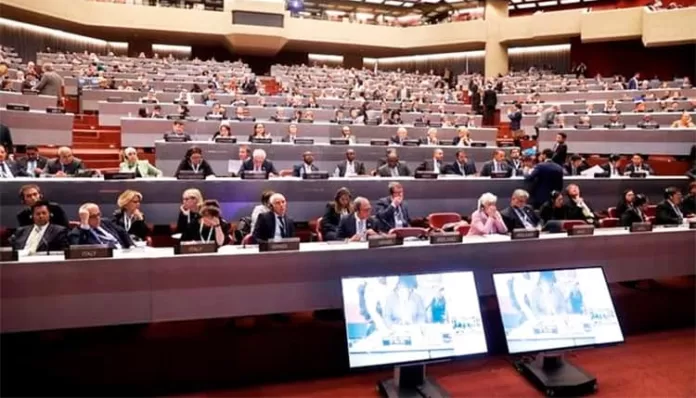
President of the Senate, Godswill Akpabio has highlighted what Nigeria stands to gain from his election into the Executive Committee of the Inter-Parliamentary Union.

This is the first time Nigeria will sit again on the Committee since after 1964.

Speaking to newsmen on arrival from the Summit, which was held in the Angolan capital, Luanda, Akpabio said there is an enormous opportunity for Nigeria as his election would impact positively through the creation of employment and developmental opportunities for young Nigerians, who are seeking to become diplomats.

“A lot of employment opportunities would be created, a lot of offices would be opened; sub-national offices would be opened and a lot of young Nigerians who wish to be diplomats will have the opportunity of working there.

This will also attract foreign direct investments in the area of training and retraining and capacity building, not just for legislature but for people who are in different fields. The benefits are enormous, so we thank God for it.”

Akpabio pointed out that his election was a major political victory for the country as Nigeria had been missing at the decision-making table of the union for the past 59 years.

He said; “On the issues of the IPU, we went there and the delegation realized that Nigeria had not been at the table. Like the deputy speaker of the House of Representatives said, it was a joint delegation of both the Senate and the House of Representatives and he was the first to point out that.

“And when we looked at the decision makers of the IPU, we realized that the highest organ is the Executive Committee and Nigeria was last seen there in 1964.

Akpabio was elected by delegates across the world to emerge an executive committee member of the global parliamentary union for a three-year mandate.