




By Akinwale Kasali

Abuja is a sprawling city of grandeur: Beauty, elegance, pride and power. From the Nnamdi Azikiwe International Airport, the city oozes aroma of strength and candour.
From twilight, the rows of street lights and flashy cars add to the stunning charm.
The urbanization, the good road channels, edifices, the connecting bridges and lurch green that greet every visitor paint the picture of a budding paradise.
From a rural homestead, adorned with large expanse of forestland with crisscrossing tributaries, inhabited by farmers and hunters, Abuja has grown to impose herself as the most beautiful bride in Nigeria. It is not only the home to Foreign Missions, International Agencies, most influential politicians and business icons find their feet in Abuja.
The high-brow hotels with their buzzing hundreds of foreigners, either cutting deals or opening up investment channels.
Abuja is unmistakably the Nigeria seat of political and economic power.
However, contrast to the aforementioned in that same Abuja are poverty-stricken communities, with rickety, desolate roads which one encounters in the city’s outskirts.
What has made their situation worst is the phenomenon of Climate Change.
“I grew up to meet lurch green vegetation. We had a very rich forest resource that served as the source of our health, our wellbeing and our spirituality”, Kadan Goje, 90, a retired teacher who resides in Yaba Community said.
Yaba Community is in Kwali Area Council, the Community belongs to the Ganagana People.
Kadan Goje said some sixty years ago when he was barely 30, Abuja communities had some of the most diversified ecosystem with varieties of plants, animals and trees.
“What I see today is unbelievable. We have lost everything”, he said as he wept intermittently, adding that even to source firewood for cooking has become a problem.
The Abuja Original Inhabitants, (AOIs) were original farmers, hunters and fishermen and fisher-women. Their Men are reputed for agro-energy so also were their Women.
“We had a lot of land to farm until 1976 when the military told us our ancient land now belonged to the Federal Government of Nigeria”, Mark Ladi said.
The 80 Year Old Man from the Pai Community in Kuje Area Council said his parents were some of the richest in what is now Federal Capital Territory, (FCT).
“We had several acres of land. We even had thousands of livestock. When the military came, they took everything by force”, Ladi said pointing to a large stretch of plots said to have been recently annexed by the Nigerian Airforce.
The land has been fenced with the bold inscription, ‘Do Not Trespass.’
Ladi said the land belong to his family and that at no time did the Government had any discussion with any member of the family.
Speaking on human activities in Abuja Original Inhabitants’s villages, Ladi said his people are at the end of the stick. He listed such hazardous human activities to include destruction of trees, disrespect for traditional water sources and routes, dumping of industrial waste, pouching of animals, land excavation for illegal mining.
Abuja indigenous communities are rich in clay, tin, feldspar, gold, iron ore, lead, marble and talc. Activities include but not limited to underground mining, situ mining, placer mining and surface mining.
Underground mining involves tunnels carved to penetrate deep into the soil for mineral extraction.
Across the communities, tales of devastating impact of land seizure and acquisition of ancestral land by big companies for construction is widespread. In many cases, the first thing those who acquired the land did was to either cut down all the trees of burn the entire space.
Traditional rulers from the Gaube Community, a Traditional Settlement in Kuje Area Council who spoke to our correspondents complain about the felling of economic trees by ‘people who visit our communities with Government license to pouch vital trees.’
There are concerns that the natural flow of water and the ancient tributaries have been excavated and turned into estates for politicians and government officials.
Sometimes, the visitors uproot the trees or scorch the land for immediate gains.
One other major problem is bush burning. Many community leaders claim that apart from herdsmen who burn down the elephant grass for their cows to feed on the budding grass that come from the roots of burnt grasses, the herders also engage in indiscriminate bush burning.
With the chirping, croaking and ribbiting of frogs and other amphibians, sounding aloud, as
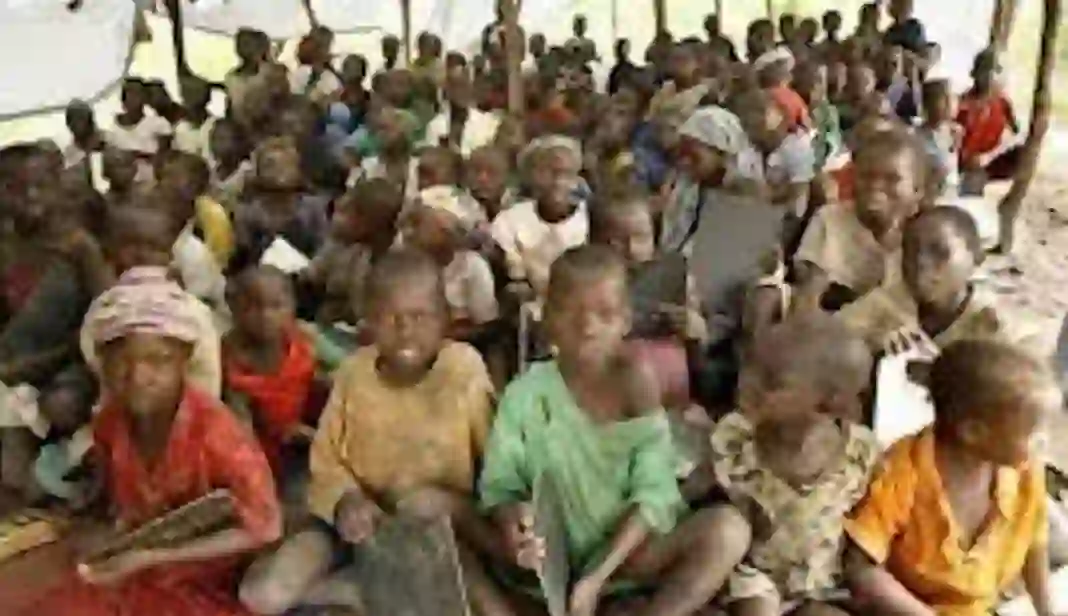
Children bath in an unclean stream in Kwali Community, a significant Gbagyi Town with no hope of a brighter future in sight.
The land that ought to bring forth food has become ‘barren’, and a scourge to farmers, making livelihood extremely difficult, with poverty and impoverishment taking center stage.
“Poverty, hunger and penury are the realities here”, said Pastor Abu Jaji of Gwagwalada in the outskirt of Abuja.
He told members of Network of Journalists on Indigenous Issues, [NEJII) that visited the communitied that climate change has impacted negatively on people living in indigenous communities in Abuja.
Many community leader argue that 50 years down the road, AOIs are yet to regain the lost of their customary land, sustains their farming activities as they continue to face threats of evictions and internal displacement by the government, leaving them to a horrible fate.
One traditional ruler who does not wish to be named said the multiplicity of the impacts of Climate Change is having severe toll on the AOIs, as their farmlands have been completely washed off through gullies that were products of indiscriminate attacks on land resources like mining which continue to lead to poor harvests and loss.
Locals claim their streams remained contaminated, as they do not have access to portable water which exposes them to water borne related diseases and other social deprivations.
They also complain about the destruction of rare animals which ancestors had occupied the Abuja forests for centuries.
“Our rare birds and animals are gone. Nature is being attacked viciously. There are no efforts to replace what we have lost”, another farmer in Jabi told our correspondent.
He said climate injustice means the AOIs losing their heritage and ancestral land to urbanization, with no compensation from the Government, nor intervention in helping the AOIs adapting to the dynamics of the environmental conditions.
There were also reports about flood and droughts that continue to wreck havoc on AOI communities as their major source of livelihoods which is rain fed agriculture and local commerce is adversely affected.
Others say the forceful eviction of the AOIs from their ancestral homes for the urbanization of the FCT had a toll and further threatens their cultural identity, as they became wanderers with their identity blurred.
Lamenting the forcefully eviction by the Government, Usman Bala, a Gwari Man stated, “I am a billionaire given by the land taken away from my Father, sadly, am living in abject poverty and penury”, he stated.
He said the impact of climate change in the AOIs communities has left the people living in pains and agony with no respite in sight.
Climate change adds to the vulnerability and increased poverty prevalent in the area due to the degradation of their farmlands, which has led to food insecurity, with poverty ravishing the communities.
What compounds the problem is the health state of people in AOI communities. Malaria, diarrhea, typhoid are common diseases.
Many are worried that for the AOIs, hope is dim raising the call for the Federal Government to address climate issue bedeviling the AOIs communities.
In addressing the travails of the AOIs, Network of Journalists on Indigenous Issues, [NEJII] think there is need for the Government to implement a climate-smart agriculture innovation, by adopting sustainable livelihoods programs that would foster community-based adaptation strategies.
This however involves planting drought-tolerant crops, expansion of irrigation and enhancement of aquaculture.
There is also need to bring revive indigenous knowledge for environmental management to combat food insecurity and economic hardship affecting the people living in AOI communities.
This means the ecosystem of the communities should be addressed holistically, with reforestation and sustainable land management as priorities.
Discover more from The Source
Subscribe to get the latest posts sent to your email.