


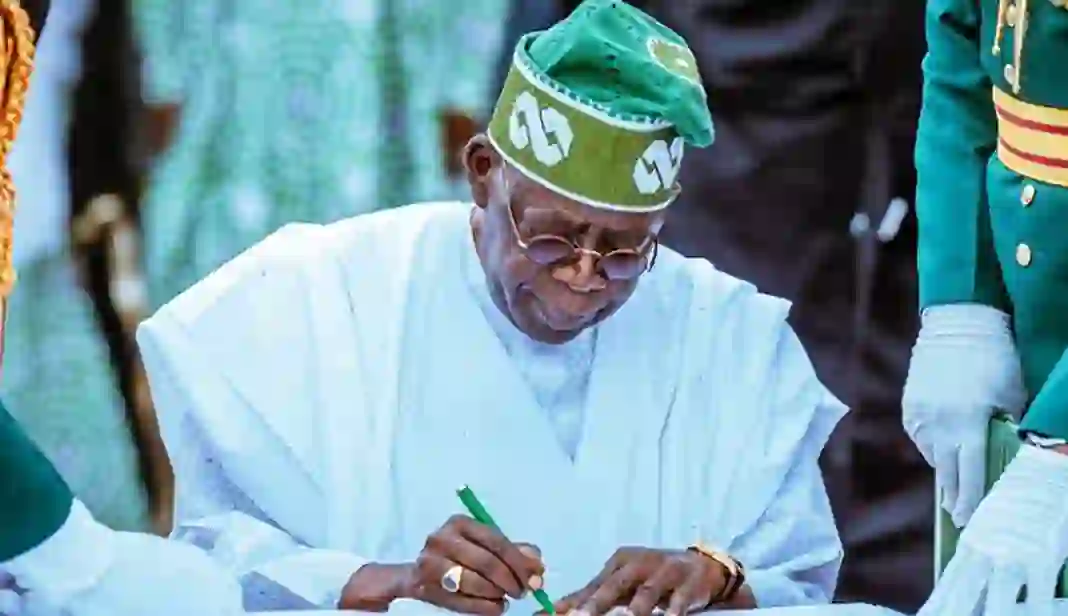

On August 8, 2023 four months after his ascension to the Nigerian Presidency, Bola Ahmed Tinubu promised not to rely heavily on loans to run the affairs of the country.

President Tinubu, spoke while inaugurating the Presidential Committee on Fiscal Policy and Tax Reforms, chaired by Taiwo Oyedele in Aso Rock, Presidential Villa, Abuja, the nation’s capital.
He expressed his resolute commitment to break the vicious cycle of over-reliance on borrowing for public spending, and the resulting burden of debt servicing, which he said strained Nigeria’s meagre resources and hampered development, adding that the government concentrate more on generating tax for its expenses.
“Our aim is to transform the tax system to support sustainable development while achieving a minimum of 18% tax-to-GDP ratio within the next three years.
”Without revenue, government cannot provide adequate social services to the people it is entrusted to serve,” he said.
Four months earlier on May 29, 2023, during his inauguration as the country’s commander-in-chief Tinubu had ended the humungous subsidy on petroleum as one of his government’s strategy to free up resources for the government.
‘Fuel subsidy is gone’ President Tinubu said in his now famous speech on his inauguration, raising hopes among not a few Nigerians that his administration will no longer pay billion of dollars to petroleum marketers, rather, the saved funds from subsidy will now be used run the affairs of the country, thereby reducing the country’s huge debt problems.
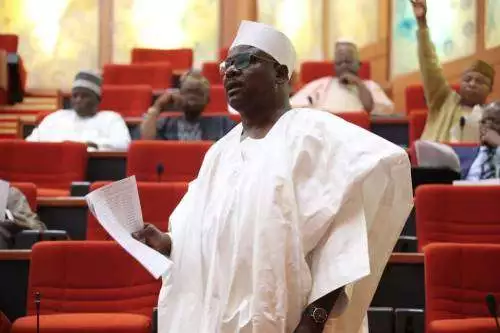
That assertion has proven to be wrong as the country is now fully back to borrowing from creditors such as the World Bank, International Monetary Fund, IMF, among others, according to Senator Ali Ndume, a strong critic of the president, who said the administration has borrowed a whopping $9 billion within two years in office without anything to show for it. The Senator spoke on a television programme.
The $9 billion loans have worsened Nigeria’s total foreign debt which stood at $42 billion as at December 2023, seven months after President Tinubu came to office, but has risen to close to $46 billion by December 2024, according to the Debt Management Office, DMO.
Finance experts informed the magazine that the country’s total foreign debt stocks is currently above $50 billion, and may rise further as the administration expands its appetite for foreign loans.
In spite of the apprehension over the rising debt, the administration has continued to grandstands, saying, for instance, that the debt is still within acceptable thresh-hold, as it has not exceeded the required Debt-to Gross Domestic Product, GDP percentage, which stood at close to 60 percent as at December 2024 . According to the DMO, the Debt to GDP stood at 55 percent by June last year, but has since increased, according to analysts.
According to Ndume, borrowing is not totally wrong as rich countries such as the United States, US, China, Japan borrowed from time to time, but “they borrow for physical, tangible and countable projects that you spread and pay over time. But my worry- in the case of Nigeria (is not even in the borrowing), it’s what you borrow for,” he said, which the administration cannot account for.
The senator, a former Chief Whip of the Senate, who was relieved of that position last following his trenchant outburst against the president style of administration, explained how Tinubu borrowed $9 billion within two years in office.
He said, “You see, in June, 2023, $500million was borrowed for women programme to scale up MPWPS. Can you see that? Can Nigerians see it? Where are the women?
“Then, on June 23rd, the same day, $800million was borrowed to cushion the impact of high petrol prices after fuel subsidy removal. How? Where? Then on September 23rd, 2023 under the same government, $700million was borrowed again for Adolescent Girls Initiative for Learning and Empowerment.
“Then in December, 23rd $750million was borrowed through what they called Renewable Energy Scale-up. On June 24, 2024, $1.5billion was borrowed to support Nigerian Reform for Economic Stabilisation to Enable Transformation. Then on June 24th, $750million was borrowed for Immediate Financial and Technical Support for Efforts to Stabilise the Economy and to Scale-up Support for the Poor and Most Economically.”
Like Senator Ndume, not a few Nigerians are worried that they cannot see the impact of the humungous loans in their lives
Discover more from The Source
Subscribe to get the latest posts sent to your email.